
Phonemic awareness is the ability to notice and work with the individual sounds in spoken words. A child uses it when they blend separate sounds to say map, break fish into its three sounds, or replace the first sound in map to make tap.
The simplest way I know to explain it is to put written letters aside for a moment. Phonemic awareness is about what a child can hear and do with speech. Letters become part of the process when those sounds are connected to reading and spelling.
This distinction helps explain a common puzzle. A child may know several letter sounds and still be unable to read a simple word. Knowing the sounds separately is only one part of the job. The child must also be able to blend them into a recognizable word.
What Is a Phoneme?
A phoneme is the smallest speech sound that can distinguish one word from another. Change the first sound in pat from /p/ to /b/, and the word becomes bat.
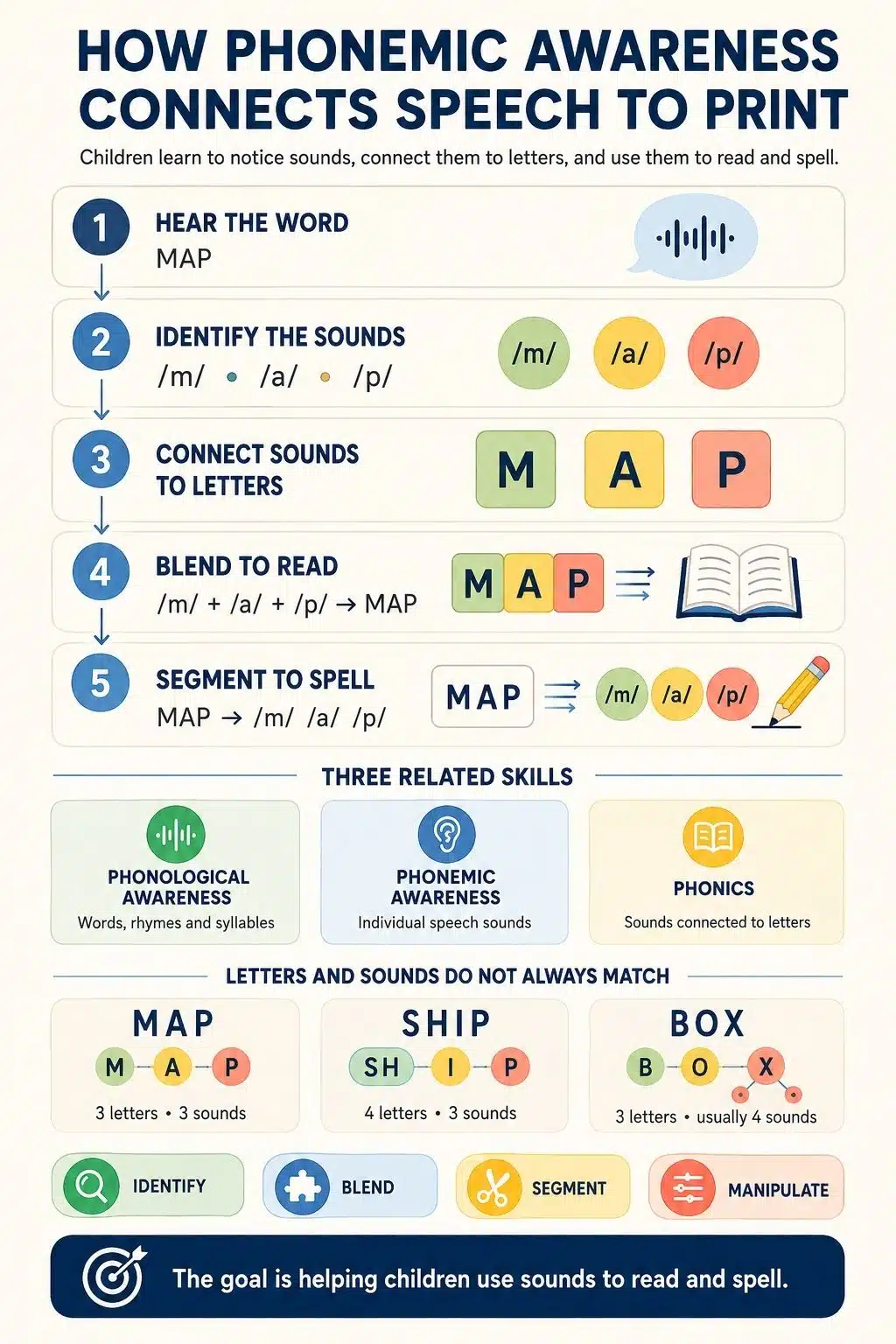
Phonemes do not always match letters one for one:
- Map has three letters and three phonemes.
- Ship has four letters but three phonemes because sh represents one sound.
- Box has three letters but is usually heard as four phonemes because x represents /k/ and /s/.
This is one reason sound work can be difficult for beginning readers. Spoken words do not arrive as a neat series of separate noises. The sounds overlap when we speak, and children must learn to pay conscious attention to them.
Phonemic Awareness Is Not the Same as Phonics
Phonemic awareness, phonological awareness, and phonics are connected, but they describe different abilities.
Phonological awareness: This is the broadest term. It includes noticing and working with words, rhymes, syllables, onsets and rimes, and individual speech sounds. Clapping the syllables in butterfly or recognizing that cat rhymes with hat are phonological-awareness activities.
Phonemic awareness: It is one part of phonological awareness. It deals specifically with individual phonemes. Breaking sun into /s/, the short u sound, and /n/ is a phonemic-awareness task.
Phonics: It connects those speech sounds to written letters and letter combinations. Knowing that sh represents the first sound in ship is phonics knowledge.
The skill itself concerns spoken sounds, but that does not mean instruction should remain oral-only. Once children know some letters, connecting the sounds to print helps them apply phonemic awareness to actual reading and spelling.
Why Phonemic Awareness Matters
Alphabetic writing represents the sounds in spoken language. Children therefore need to recognize those sounds before they can use letter-sound relationships efficiently.
It helps children decode words
Decoding involves looking at a written word, identifying the sounds represented by its letters, and blending those sounds into a recognizable pronunciation.
A child might know the sounds commonly represented by m, a, and p but still struggle to read map. The missing skill may be blending. Until the child can combine the sounds smoothly, letter-sound knowledge remains a collection of separate facts.
It makes spelling more logical
Spelling works in the opposite direction. A child thinks of or hears a word, separates it into phonemes, and selects letters or letter combinations to represent those sounds.
To spell fish, for example, a child needs to notice three phonemes even though the conventional spelling has four letters. Children who cannot hear every phoneme may leave sounds out of their early spellings.
It helps written words become familiar
Beginning readers often sound out words slowly. With accurate practice, many of those words eventually become instantly recognizable.
This is not simply visual memorization. Children use their knowledge of phonemes and spelling patterns to connect a word’s written form with its pronunciation and meaning. Those connections help the word settle into long-term memory.
It can reveal where support is needed
Difficulty blending and segmenting simple words can be an early sign that a child may struggle with decoding or spelling. That information is useful because phonemic awareness can be taught directly.
Still, one poor result in a sound game does not tell the whole story. The child may not understand the task or know the vocabulary being used. Language background, dialect, hearing, speech development, and previous instruction can also affect performance.
Phonemic awareness is a meaningful indicator, not a verdict.
The Main Phonemic-Awareness Skills
The most useful skills are fairly easy to recognize once we see them in action.
- Identification: Recognizing a particular sound in a word. A child might notice that sun and sock begin with the same phoneme.
- Isolation: Naming one sound and its position. For example, the final sound in map is /p/.
- Blending: Combining separate sounds to form a word. The sounds /f/, short i, and /sh/ blend to make fish.
- Segmentation: Breaking a word into its complete sequence of phonemes. Stop has four phonemes.
- Manipulation: Adding, deleting, or replacing a phoneme. Adding /s/ to top creates stop, while replacing the first sound in map with /t/ creates tap.
Blending and segmentation deserve particular attention because they connect so directly to reading and spelling. Addition, deletion, and substitution can be useful too, but complicated oral manipulation should not become an end in itself. A child does not need to master increasingly difficult sound puzzles simply to prove progress.
How Phonemic Awareness Develops
Children often notice larger parts of spoken language before they can identify individual phonemes. They may enjoy rhyming words, clap syllables, or recognize that two words begin alike.
Instruction has traditionally moved from larger units to smaller ones:
- Words in sentences
- Syllables
- Rhymes
- Onsets and rimes
- Individual phonemes
That progression can make early activities manageable, but I would not treat it as a rigid staircase. A child does not need to master every rhyme or syllable exercise before beginning direct work with phonemes.
Kindergarten instruction commonly includes identifying the beginning, middle, and final sounds in simple words, as well as early blending, segmentation, addition, and substitution. First-grade instruction usually extends these skills to complete one-syllable words and words containing consonant blends.
These are instructional expectations, not diagnostic deadlines. Children arrive at school with different language experiences and levels of preparation. Some acquire the skills quickly, while others need more explicit modeling and guided practice.
Older struggling readers can also benefit from phonemic-awareness instruction when an assessment shows a continuing weakness. The teaching should begin at the level they need, not automatically return them to nursery-style rhyme activities.
How to Teach Phonemic Awareness Clearly
Good instruction does not require elaborate materials. Clear modeling, carefully chosen words, and focused practice matter more.
Start with familiar words
Use words the child already understands. If the child does not recognize the word shown in a picture, the activity may be testing vocabulary rather than sound awareness.
Simple two- and three-phoneme words are usually easier at the beginning. Words containing several consonant blends can wait until the child is secure with basic blending and segmentation.
Show what the task means
Directions such as “Tell me every sound” may not be clear to a beginner. Model the process first.
For segmentation, say the word normally, repeat it slowly, and move one counter for each sound. For blending, say the sounds clearly and then sweep a finger from left to right as they come together.
Make the sounds visible
Sound boxes help children represent something they cannot see. The child moves one counter into a box for each phoneme heard.
The boxes must represent sounds, not letters. Ship therefore needs three boxes rather than four. Once the child knows the relevant letter-sound relationships, counters can be replaced with letter tiles.
Pronounce sounds cleanly
Adding “uh” to consonant sounds can make blending harder. Saying “buh-a-tuh” does not combine naturally into bat.
Continuous sounds such as /m/, /s/, and /f/ are helpful at the beginning because they can be stretched without adding another vowel. Smoothly connecting the sounds is usually easier than separating them with long pauses.
Bring in letters at the right time
Oral activities are useful when introducing phoneme awareness or checking what a child hears. Once the child knows the corresponding letters, connect the sound work to print.
The child can build a word with letter tiles, read it, change one letter, read the new word, and then write it. This gives the activity a clear purpose and strengthens the connection between speech, reading, and spelling.
Follow the child’s progress, not a fixed timer
There is no single practice length that suits every learner. Short and regular sessions are generally more manageable than one long lesson filled with unrelated activities.
More importantly, instruction should respond to the child. If blending is secure but segmentation is difficult, spend more time on segmentation. If simple words are easy, introduce words with consonant blends gradually. Practice should be purposeful rather than repetitive for its own sake.
When a Child May Need More Support
Occasional mistakes are normal, especially when a child is learning a new type of task. I would pay closer attention when difficulty persists despite clear instruction and repeated opportunities to practice.
Possible signs include:
- Being unable to blend two or three spoken sounds into a word
- Struggling to separate a simple word into individual phonemes
- Frequently missing the medial vowel sound
- Leaving sounds out when attempting to spell
- Knowing letter sounds but being unable to use them to read words
- Guessing at words rather than blending through them
- Making little progress after focused instruction
Parents can begin by asking the teacher what has been taught, assessed, and observed over time. A reading specialist or speech-language pathologist may also be helpful when the difficulty involves speech, oral language, sound perception, or persistent early-literacy problems.
Weak phonemic awareness is common among children with dyslexia, but it is not present in every case and does not confirm dyslexia on its own. A proper evaluation considers word reading, spelling, decoding, fluency, oral language, the quality of instruction, and the child’s response to support.
Supporting Multilingual Children and Different Dialects
A multilingual child may already understand how to work with sounds in a home language but need additional help with English phonemes that do not exist or function in the same way in that language.
That difference should not automatically be treated as a disorder. Instruction should use English words the child understands, explain unfamiliar vocabulary, model new sounds clearly, and provide enough practice to hear how similar phonemes differ.
Dialect matters too. English dialects have legitimate, rule-governed sound patterns, and pronunciation can affect how a child segments or spells a word. Teachers and assessors need to distinguish a genuine phonemic-awareness difficulty from a normal difference in language or dialect.
The goal is to help children connect their spoken language with written English without suggesting that the language they use at home is wrong.
The Goal Is Reading, Not Perfect Sound Games
Phonemic awareness is foundational, but children do not learn to read through sound activities alone. They also need phonics, spelling, oral language, vocabulary, background knowledge, fluency, comprehension, writing, and regular experience with meaningful text.
Its real value is practical. Phonemic awareness helps children understand what letters represent, combine sounds while reading, and separate sounds while spelling. When that relationship becomes clear, written words begin to feel less arbitrary and more like a system children can understand and use.
Frequently Asked Questions on Phonemic Awareness
1. Is phonemic awareness the same as phonics?
No. Phonemic awareness involves noticing and manipulating speech sounds. Phonics connects those sounds with written letters and spelling patterns. They are different skills, but effective early reading instruction brings them together.
2. At what age should children develop phonemic awareness?
Early sound awareness often begins during preschool, while direct phoneme-level instruction is especially important in kindergarten and first grade. Development varies, and older children may still need targeted help if they struggle with decoding or spelling.
3. Do rhyming games build phonemic awareness?
Rhyming games build broader phonological awareness because they focus on larger sound patterns. They are useful, but they do not replace practice with identifying, blending, and segmenting individual phonemes.
4. Can parents teach phonemic awareness at home?
Yes. Parents can practice oral blending, sound matching, simple segmentation, and one-sound word changes. Activities should be brief, use familiar words, and connect sounds to known letters when the child is ready.
5 .Does weak phonemic awareness mean a child has dyslexia?
Not necessarily. It can increase the risk of reading difficulty and is common in dyslexia, but it can have other explanations. Dyslexia cannot be identified through a single phonemic-awareness task and requires a broader evaluation of reading and spelling development.