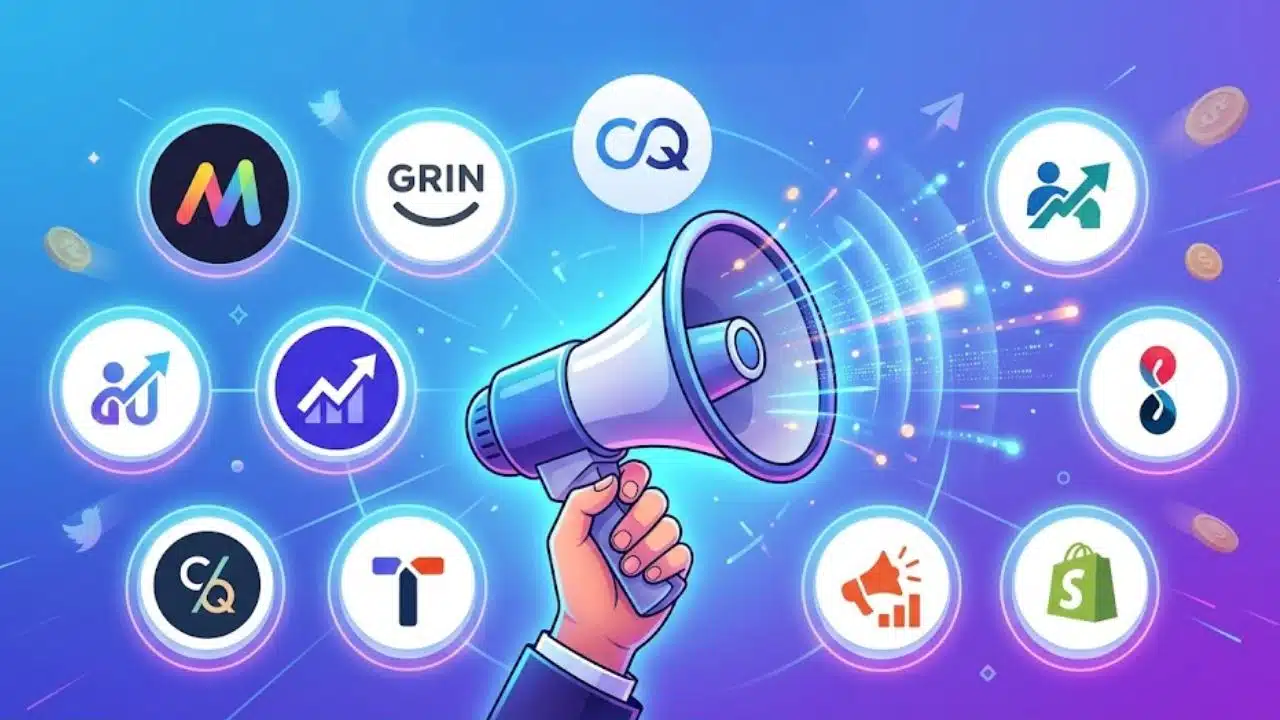
Selecting the Best Influencer Marketing Platforms comes down to solving your specific operational bottleneck, not just buying the largest creator database. Brands rarely need nine versions of the same tool; they need clarity on whether their primary goal is discovery, creator relationship management (CRM), automated product seeding, affiliate tracking, or enterprise global governance.
While a search engine helps recruit talent, it will not handle digital contracts, content approvals, global payouts, or revenue attribution. To help you make an informed decision, this evaluation ranks software based on real-world feature coverage, price transparency, buying friction, platform integrations, and practical ROI measurement.
Best Influencer Marketing Platforms at a Glance
| Platform | Strongest Fit | Pricing Snapshot |
| Modash | Growing e-commerce teams | From $199 monthly with annual billing |
| GRIN | AI-assisted creator operations | Free plan; paid plans from $200 monthly |
| CreatorIQ | Enterprises and large agencies | Custom quote |
| Aspire | Product seeding and ambassador programs | Custom quote |
| Upfluence | Modular e-commerce programs | Custom quote; 12-month minimum |
| impact.com | Creator and affiliate programs | Starter from $30; marketplace from $500 |
| Traackr | Multinational program management | Custom quote |
| HypeAuditor | Creator vetting and market research | Limited free access; full pricing by quote |
| Shopify Collabs | Shopify affiliate programs | Free to install plus payment fees |
What Most Comparison Lists Miss
A bigger database does not guarantee better partnerships. Audience location, recent content, brand history, engagement quality, commercial terms, and genuine interest in the product matter more than the number of profiles returned by a search.
Measurement deserves similar caution. Affiliate links and discount codes can show attributed orders, but they cannot prove that every customer purchased because of the creator. Buyers should also check how a platform handles refunds, content rights, creator taxes, payment currencies, data exports, and access permissions.
1. Modash: Best Overall for Growing E-Commerce Teams
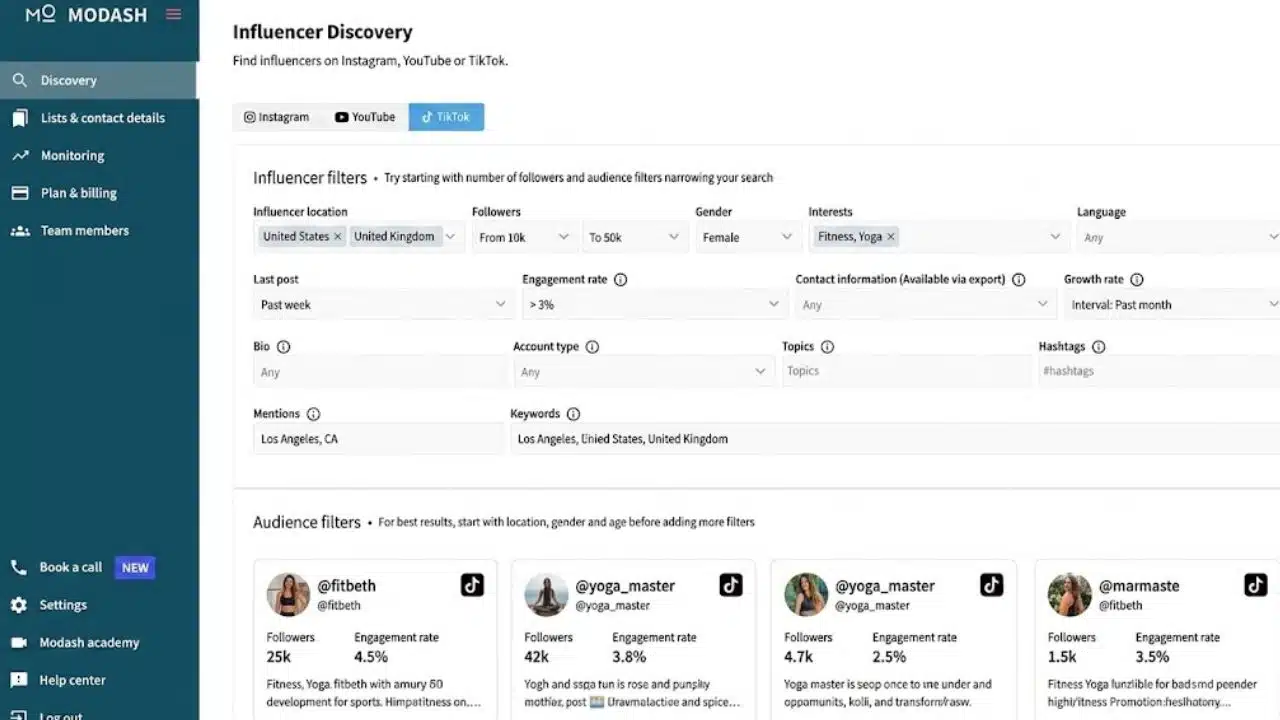
Modash takes the top position because its pricing and usage limits are visible before a sales call. Essentials costs $199 per month with annual billing or $299 on monthly billing. It includes two team members, 300 opened profiles, 150 creator email unlocks, and content tracking for 100 creators.
Discovery covers Instagram, TikTok, and YouTube. The platform also provides audience analysis, relationship management, email integration, automated content collection, and Shopify gifting. Brands focused on Twitch, Pinterest, or X will need broader coverage elsewhere.
Payments and affiliate management require Performance, priced at $499 per month annually or $599 monthly. A 5% fee applies after its combined $10,000 annual fee-free allowance for payments and affiliate activity is exceeded.
2. GRIN: Best for AI-Assisted Creator Program Management
GRIN has moved away from an opaque enterprise-only model. Free includes 200 monthly credits, while Starter, Growth, Scale, and Complete cost $200, $500, $1,000, and $1,500 per month.
Its Gia system uses credits for sourcing, outreach, reports, gifting workflows, and campaign setup. CRM records, affiliate links, discount codes, and sales tracking do not consume credits. GRIN Classic, the hands-on workspace, begins with Growth.
The model is attractive for teams that want routine work automated, but it is less predictable than ordinary per-seat pricing. Included monthly credits expire, and additional usage costs $0.10 per credit within a customer-set spending cap.
3. CreatorIQ: Best for Enterprise Governance and Brand Safety
CreatorIQ belongs on enterprise shortlists, not small-business buying lists. It combines discovery, creator evaluation, campaign execution, payments, measurement, benchmarking, permissions, and global governance.
SafeIQ adds multimodal brand-safety analysis, while integrations connect creator activity with commerce, affiliate, analytics, and social systems. Pricing requires a consultation. That makes sense for organizations coordinating multiple brands or markets, but smaller teams are likely to pay for controls they will rarely use.
4. Aspire: Best for Product Seeding and Ambassador Programs
A consumer brand sending products to hundreds of creators needs more than discovery. Aspire handles recruitment, briefs, agreements, Shopify fulfillment, content approval, affiliate links, promo codes, payments, and reporting.
It can support gifted collaborations, paid posts, affiliates, ambassadors, and reusable creator content without forcing each program into the same workflow. Pricing is not public. During a demo, buyers should ask which marketplace, payment, advertising, automation, onboarding, and managed-service features are included in the quoted package.
5. Upfluence: Best Modular Platform for E-Commerce Integrations
The first issue to consider with Upfluence is commitment: its minimum contract is 12 months. Its Find module covers discovery and outreach. Scale adds campaign management, affiliate tracking, product shipment, marketplace access, sales analytics, and integrations with Shopify, WooCommerce, Magento, BigCommerce, and Amazon. Autopilot adds creator payments, multiple payout currencies, budget controls, and tax-form administration.
Pricing is custom, but Upfluence charges a fixed platform fee rather than taking a percentage of tracked creator sales. It is better suited to established programs than short experiments.
6. impact.com: Best for Combining Influencers and Affiliates
impact.com makes the most sense when creators, affiliates, and referral partners already sit within the same performance-marketing strategy. It can manage recruitment, contracts, links, promo codes, product feeds, conversions, commissions, and payouts.
Do not anchor the decision to its $30 Starter price. Marketplace access begins with Essentials at $500 per month, which also adds custom contract terms and automated workflows. Pro starts at $2,500 per month, and a separate setup fee may apply.
For a business with meaningful affiliate revenue, that shared infrastructure can be valuable. A brand running occasional sponsored posts will probably find it excessive.
7. Traackr: Best for Multinational Program Coordination
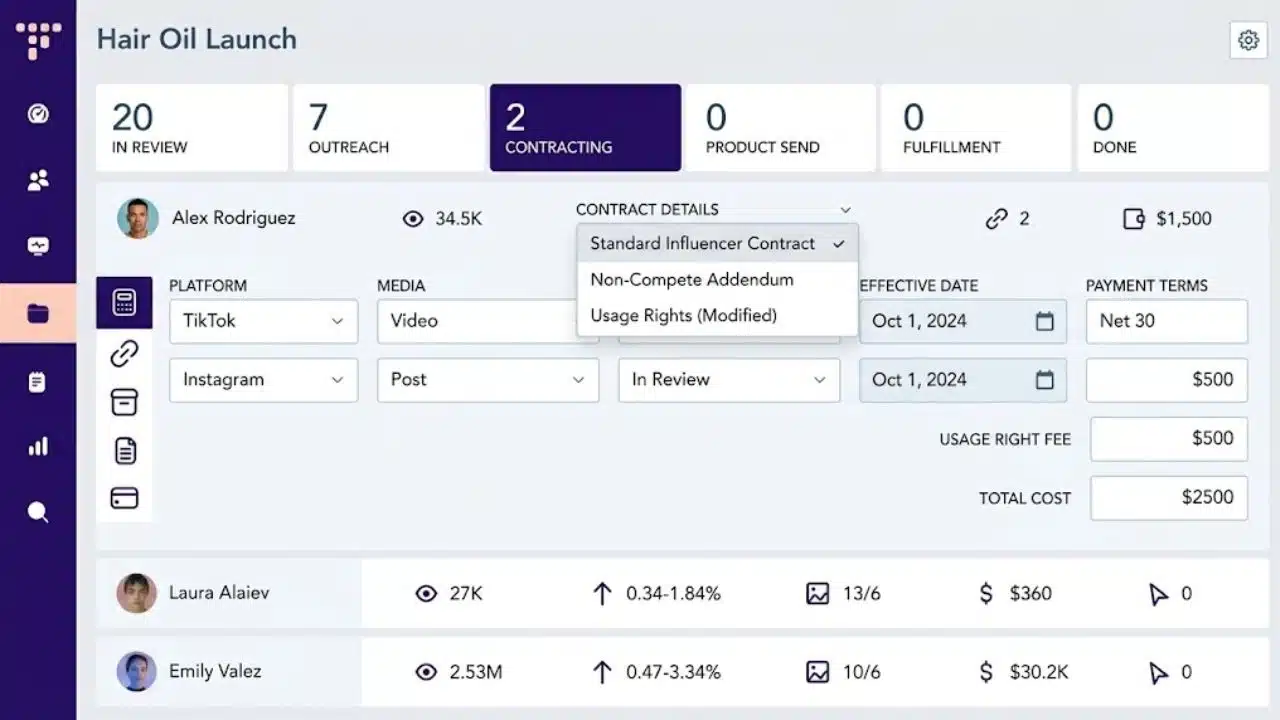
Traackr addresses a narrow but expensive problem: regional teams running creator programs with inconsistent data, permissions, and reporting.
Its discovery coverage spans 71 countries and 26 languages. Centralized data, advanced roles, unified performance indicators, spend tracking, disclosure monitoring, brand-safety controls, and market benchmarks support large international programs. Pricing is available by consultation. Smaller teams should skip it unless cross-market coordination has already become a genuine operational problem.
8. HypeAuditor: Best for Creator Vetting and Competitive Research
HypeAuditor is often treated as an analytics tool, which understates its current scope. It now covers discovery, outreach, relationship management, contracts, campaign tracking, payment tracking, media monitoring, and competitor analysis.
Its strongest reason for inclusion remains creator evaluation. Teams can inspect audience geography, demographics, interests, engagement, authenticity indicators, and past performance before starting a conversation.
Free analysis tools and limited campaign features are available. Full platform pricing requires a demonstration, making early budget comparison harder.
9. Shopify Collabs: Best Low-Cost Starting Point for Shopify Merchants
Shopify Collabs is useful when the immediate plan is simple: invite creators, send products, issue affiliate links or discount codes, and pay commission on tracked sales.
The app is free to install, but automatic commission payments carry a 2.9% processing fee. It is available on Shopify plans other than Starter and Retail.
Recruitment is the larger limitation. Shopify is not accepting new general creator registrations at the time of writing, although merchants can send direct invitations and accept applications to their own programs. Open-access offers are limited to eligible creators in the United States, United Kingdom, and Canada. Collabs is a practical testing tool, but it is not a full global discovery or agency-management platform.
Before You Choose
Ask each shortlisted vendor to demonstrate the same sample campaign. Include the creator volume, social networks, countries, product shipments, approval stages, payment currencies, and reports your team actually uses.
Check these costs separately:
- Platform subscription and setup
- Creator compensation and product shipping
- Payment or affiliate transaction fees
- Paid amplification and content usage rights
- Onboarding, migration, and internal training
A cheaper subscription can become the more expensive choice if the team still needs spreadsheets, separate payment software, or hours of manual reporting.
Final Thoughts
Modash is the most balanced option for many growing e-commerce teams because its scope and pricing are relatively easy to assess. GRIN offers a more automation-led model, while Aspire is stronger for product-heavy programs. CreatorIQ and Traackr serve organizations with enterprise coordination problems.
The best influencer marketing platforms are not the ones with the longest feature lists. Choose the platform that replaces specific manual work, fits the program you can afford to run, and gives your team information it will actually use.
Frequently Asked Questions (FAQs)
Do small brands need an influencer marketing platform?
Not always. A brand working with a small, stable group of creators may manage outreach, agreements, and results with email, spreadsheets, and its existing e-commerce tools. Paid software becomes easier to justify when missed follow-ups, manual reporting, content collection, payments, or product shipments begin consuming significant time.
What should brands measure besides attributed sales?
Useful measures include new-customer revenue, conversion rate, refund rate, cost per acquisition, revenue per creator, content production cost, and the value of content reused in ads or product pages. Awareness campaigns may also need reach, views, audience quality, and engagement, but those figures should not be presented as direct revenue.
Is the platform with the largest creator database usually the best?
No. Database size matters only when the search results cover the right networks, countries, audience characteristics, and creator categories. Outreach tools, current contact information, content tracking, and reliable campaign data often matter more after the initial search.