History is more than just dates and numbers—it is the compelling story of human evolution, triumphs, tragedies, and the cultural footprints we leave behind. Every day on our calendar holds a treasure trove of forgotten memories, and August 31 in history is no exception. This day is packed with events that have reshaped borders, revolutionized industries, and sparked movements that still influence the modern world.
From monumental shifts in the Indian subcontinent to royal tragedies in Europe, technological breakthroughs in the United States, and nations declaring their hard-fought independence, August 31 is a day of profound global significance. In this comprehensive “In-Depth On This Day” report, we will journey through time, exploring everything from the Bangalee sphere to the broader international stage.
Let us dive deep into the fascinating history, notable births, and significant deaths that make August 31 a day to remember.
The Bangalee Sphere
The history of the Indian subcontinent, particularly the Bangalee sphere encompassing present-day Bangladesh and West Bengal, is marked by deep colonial resistance, political metamorphosis, and unparalleled cultural richness. August 31 holds a special place in this timeline, marking both the birth of influential figures and the passing of those who molded the political and literary landscape of the region.
Historical Events
-
1928 – The Publication of the Nehru Report:
As the clamor for self-rule intensified across British India, the Nehru Report was officially published on August 31, 1928. The report, drafted by a committee headed by Motilal Nehru, famously demanded ‘dominion status’ for India within the British Empire. This was a watershed moment in Bengal’s political circles. The region’s vibrant, youthful revolutionary leaders, such as Subhas Chandra Bose, fiercely opposed the idea of dominion status, demanding Purna Swaraj (complete independence) instead. This ideological clash significantly shaped the subsequent decades of the anti-colonial struggle in Bengal.
-
1956 – The States Reorganisation Bill:
On this day, the President of India officially gave his consent to the States Reorganisation Bill. This landmark act fundamentally restructured the internal boundaries of Indian states along linguistic lines. For the Bangalee population in India, this was a critical moment, as it formalized the political borders of West Bengal. It effectively consolidated the cultural and linguistic identity of the Bengali-speaking majority within the newly formed state structure, resolving years of post-partition ambiguity.
-
1967 – Satyajit Ray Wins the Ramon Magsaysay Award:
The global cinematic landscape was forever enriched by the genius of Bengali filmmaker Satyajit Ray. On August 31, 1967, Ray was honored with the prestigious Ramon Magsaysay Award for Journalism, Literature, and Creative Communication Arts. This accolade not only cemented his reputation as one of the greatest auteurs of the 20th century but also brought international prestige to Bengali cinema, elevating it far beyond regional boundaries.
Famous Births and Deaths in the Subcontinent
| Name | Year | Category | Significance & Legacy |
| Jahangir | Born 1569 | Royalty | The fourth Mughal Emperor, born Nur-ud-din Muhammad Salim. Under his reign, the Mughal administration heavily consolidated its power over Subah Bengal, transforming it into the empire’s economic powerhouse. |
| Amrita Pritam | Born 1919 | Literature | While she was a legendary Punjabi poet and novelist, Pritam’s poignant, heart-wrenching writings about the trauma of the 1947 Partition struck a deep, agonizing chord with the shared tragedy of partitioned Bengal. |
| Bashir Al Helal | Died 2021 | Literature | A celebrated Bangladeshi novelist and former Director of the Bangla Academy. He authored significant works like Kalo Ilish and contributed immensely to Bengali literature until his passing at age 85. |
| Pranab Mukherjee | Died 2020 | Politics | Born in Birbhum, West Bengal, he rose to become the 13th President of India. A master strategist, his long political career significantly influenced cross-border diplomatic and economic relations between India and Bangladesh. |
International Observances & Holidays
August 31 is celebrated across the globe as a day of national pride, freedom, and cultural recognition. It serves as a reminder of the continuous struggle for human rights, equality, and national sovereignty.
Major International Days
-
International Day for People of African Descent:
Supported by the United Nations, this vital observance was created to promote and celebrate the extraordinary contributions of the global African diaspora. It also serves as a rallying call to condemn and eliminate all forms of discrimination against people of African descent worldwide.
-
Bhatke Vimukt Diwas (India):
Observed primarily in the Indian state of Maharashtra on August 31, this day honors the nomadic and denotified communities who historically endured severe injustice under colonial rule. It specifically celebrates the repeal of the oppressive and discriminatory Criminal Tribes Act of 1952.
National Independence Days
| Country | Event Celebrated | Year of Event | Importance |
| Malaysia | Hari Merdeka (Independence Day) | 1957 | Celebrates the Federation of Malaya gaining full independence from British colonial rule, establishing a new Southeast Asian powerhouse. |
| Trinidad and Tobago | Independence Day | 1962 | Marks the day the twin-island Caribbean nation officially severed its colonial ties to gain full independence from the United Kingdom. |
| Kyrgyzstan | Independence Day | 1991 | Observes the historic day the nation declared its absolute independence following the collapse of the Soviet Union. |
| Uzbekistan | Independence Day | 1991 | Similarly, Uzbekistan declared its independence from Soviet rule on this day, reshaping the geopolitical map of Central Asia. |
Global History
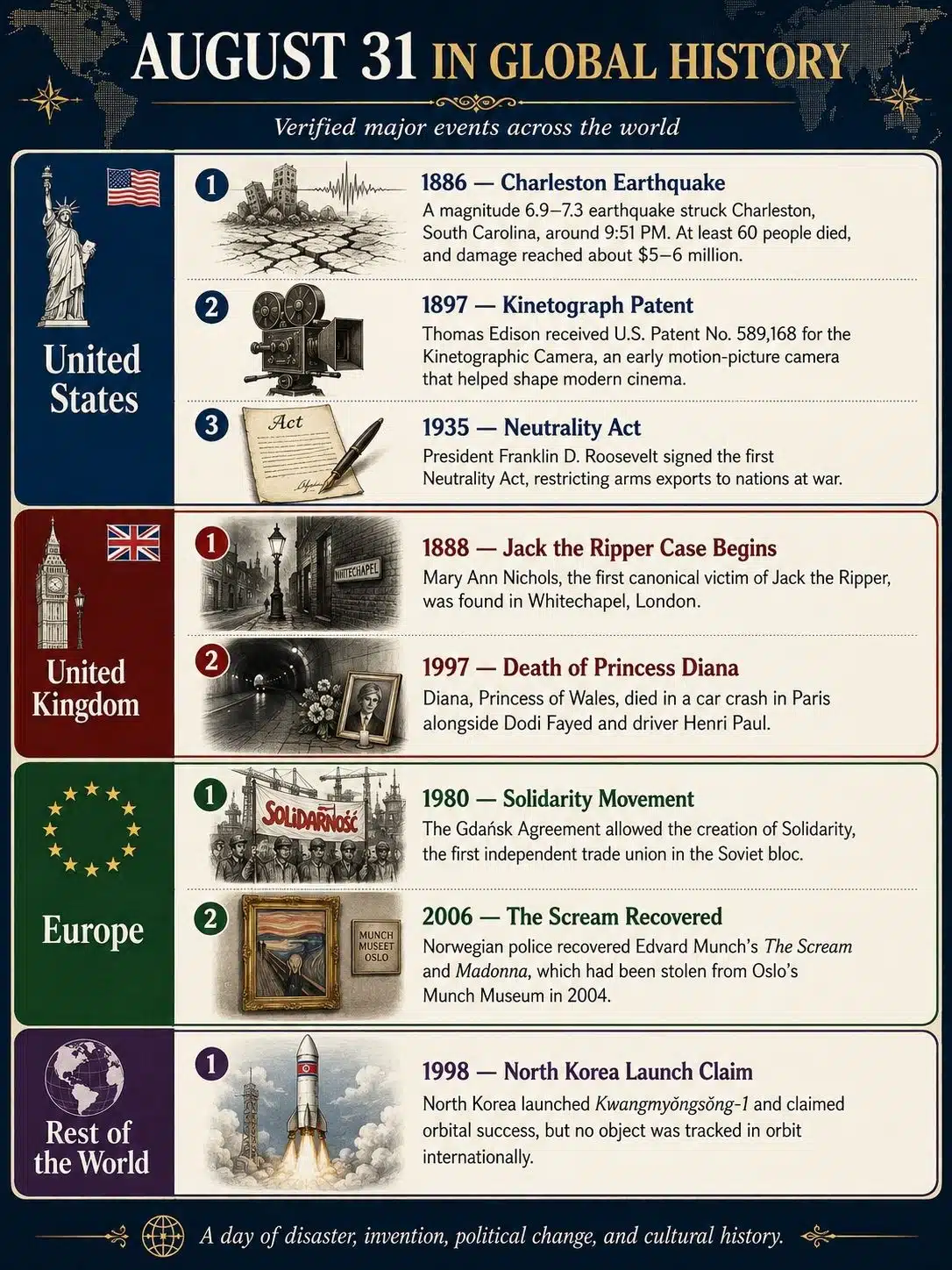
History is rarely isolated. A technological invention in one corner of the globe can revolutionize societies in another. Let us break down the massive global shifts that occurred on August 31 across different regions.
United States
-
1886 – The Devastating Charleston Earthquake:
A massive earthquake, with an estimated magnitude of 6.9 to 7.3, struck Charleston, South Carolina, at nearly 9:50 PM. It killed over 100 people and resulted in $6 million in damages (a colossal sum at the time). It remains one of the most destructive seismic events to ever hit the East Coast of the United States.
-
1897 – The Dawn of Cinema:
Inventor Thomas Edison officially secured a patent for the Kinetograph, an early iteration of the movie camera and projector. Originally designed to be viewed by a single person through a peephole, this invention was a crucial stepping stone in the development of global motion pictures, laying the groundwork for the modern entertainment industry.
-
1935 – The Neutrality Act is Signed:
President Franklin D. Roosevelt signed the Neutrality Act into law, actively banning the export of arms and ammunition to warring nations. The legislation was designed to prevent the United States from being drawn into emerging foreign conflicts as the clouds of World War II began to gather over Europe.
United Kingdom
-
1888 – The First Jack the Ripper Victim is Found:
The gruesome body of Mary Ann Nichols was discovered in the impoverished Whitechapel district of London. She is the first confirmed victim of the notorious, unidentified serial killer who came to be known as “Jack the Ripper”. This grim discovery sparked a century-long true-crime mythology that continues to fascinate historians and sleuths today.
-
1997 – The Tragic Death of Princess Diana:
In an event that brought the world to a standstill, Diana, Princess of Wales, her companion Dodi Fayed, and their driver Henri Paul died in a devastating car crash inside the Pont de l’Alma tunnel in Paris, France. Chased by relentless paparazzi, the tragedy sparked an unprecedented outpouring of global mourning and permanently altered the British monarchy’s relationship with the media and the public.
Europe
-
1980 – The Birth of the Solidarity Movement (Poland):
After sweeping strikes at the Lenin Shipyard, the Polish communist government was forced to sign the Gdańsk Agreement with striking workers led by Lech Wałęsa. This historic agreement legally allowed the formation of the “Solidarity” trade union. It was the first independent labor union in a Soviet-bloc country and dealt a fatal ideological blow to Soviet communist control in Eastern Europe.
-
2006 – The Recovery of The Scream (Norway):
Norwegian police successfully recovered Edvard Munch’s iconic expressionist masterpiece, The Scream, alongside Madonna. Two years prior, armed gunmen had shockingly stolen the irreplaceable artworks from the Munch Museum in Oslo in broad daylight. Fortunately, the paintings were found in remarkably excellent condition.
Rest of the World (Asia, Africa, and Beyond)
-
1998 – North Korea’s First Satellite Launch:
North Korea allegedly launched the Kwangmyŏngsŏng-1, claiming it was their first successful satellite placed into lower Earth orbit. However, global space agencies have never been able to verify any objects in orbit from this launch, and outside of North Korea, it is widely considered to have been a failure.
Notable Births & Deaths (Global)
August 31 is the birthdate of emperors, innovators, and entertainers, as well as the solemn anniversary of the passing of titans in literature and sports.
Famous Births
| Name | Year | Nationality | Profession & Global Impact |
| Caligula | 12 CE | Roman | Roman Emperor whose short reign was characterized by chaotic unpredictability, extravagance, and tyranny before his inevitable assassination. |
| Maria Montessori | 1870 | Italian | A visionary physician and educator who revolutionized early childhood education worldwide. Her “Montessori method” championed child-led, independent, and tactile learning. |
| Richard Gere | 1949 | American | Golden Globe-winning actor celebrated for his charismatic roles in classic films like Pretty Woman, An Officer and a Gentleman, and Chicago. |
| Van Morrison | 1945 | Northern Irish | Legendary Grammy-winning singer-songwriter. He seamlessly blended soul, R&B, and Celtic folk music to create timeless, universally loved hits like “Brown Eyed Girl”. |
| Chris Tucker | 1971 | American | Stand-up comedian and actor whose high-energy performances in the Rush Hour film franchise alongside Jackie Chan made him a global comedy icon. |
Famous Deaths
| Name | Year | Nationality | Legacy & Cause of Death |
| Charles Baudelaire | 1867 | French | A highly influential and controversial French poet whose magnum opus, Les Fleurs du mal, pioneered modernism by breaking strict thematic and structural norms. |
| Rocky Marciano | 1969 | American | Widely regarded as one of the greatest boxers in history, he died tragically in a plane crash. He remains the only heavyweight champion to retire completely undefeated. |
| John Ford | 1973 | American | A trailblazing, four-time Academy Award-winning film director. He practically defined the American Western genre through his innovative location shooting and sweeping landscapes. |
“Did You Know?” Trivia
A dinner table conversation is never complete without a few fascinating, lesser-known historical quirks. Here are three trivia facts related to August 31:
-
The Mystery of Jack the Ripper:
Despite over 130 years of obsessive investigation since the death of Mary Ann Nichols on August 31, 1888, the true identity of Jack the Ripper remains one of the world’s most fiercely debated mysteries. Over the decades, conspiracy theories have pointed the finger at everyone from the renowned Victorian painter Walter Sickert to Queen Victoria’s own grandson, Prince Albert Victor.
-
The Value of a Penny:
It is a mathematical marvel—if you took a single penny and doubled its value every single day for exactly 31 days (the length of August), you would amass over $10.7 million by the end of the month!
-
The Sound Barrier First:
The very first human-made object to break the sound barrier wasn’t a high-tech supersonic jet engine or a massive explosive. It was actually the tip of a simple, cracking whip, which creates a miniature sonic boom when snapped.
Quote of the Day
Sometimes, the wisdom of those born on this day perfectly captures the essence of their life’s mission. Today’s quote comes from the revolutionary educator born on August 31.
“The greatest sign of success for a teacher is to be able to say, ‘The children are now working as if I did not exist.'”
— Maria Montessori, Italian educator and physician (Born August 31, 1870)
Final Thoughts
August 31 serves as a profound historical mirror, reflecting both the fragility and the resilience of humanity. We witness the sorrow of tragic losses—from the shockwave of Princess Diana’s death to the devastation of the Charleston earthquake. Yet, simultaneously, we celebrate immense triumphs: nations like Malaysia and Trinidad and Tobago stepping into the light of independence, and visionaries like Thomas Edison and Maria Montessori laying the groundwork for a modernized, educated future.
Whether we are observing the rich political history of the Bangalee sphere, honoring the heritage of marginalized communities, or remembering the artistic contributions of legendary filmmakers and musicians, August 31 in history proves that every single day is a complex tapestry of world-changing events. By looking back at what happened on this day, we better understand the geopolitical, cultural, and social forces that continue to shape our present reality.