Building a B2B SaaS product requires making several foundational technical decisions, but perhaps none is more impactful, or harder to change later, than your choice of database. For modern products, this isn’t just about finding the “fastest” engine; it’s about balancing unit economics, security isolation, and developer velocity. The central problem is that marketing claims are usually distractions from the real operational complexities of tenancy models, noisy neighbors, and cross-region recovery.
I have cross-checked the entire landscape against official product documentation, cloud-provider guidance, and real-world limits. This analysis confirms that the “universally best” database is a myth. The correct choice depends entirely on whether your application needs global writes, strict logical isolation, serverless dynamics, or extreme write throughput.
This article provides a prioritized, reality-based ranking of the 10 best database options for multi-tenant SaaS workloads.
What Are the Three Multi-Tenant Database Architectures?
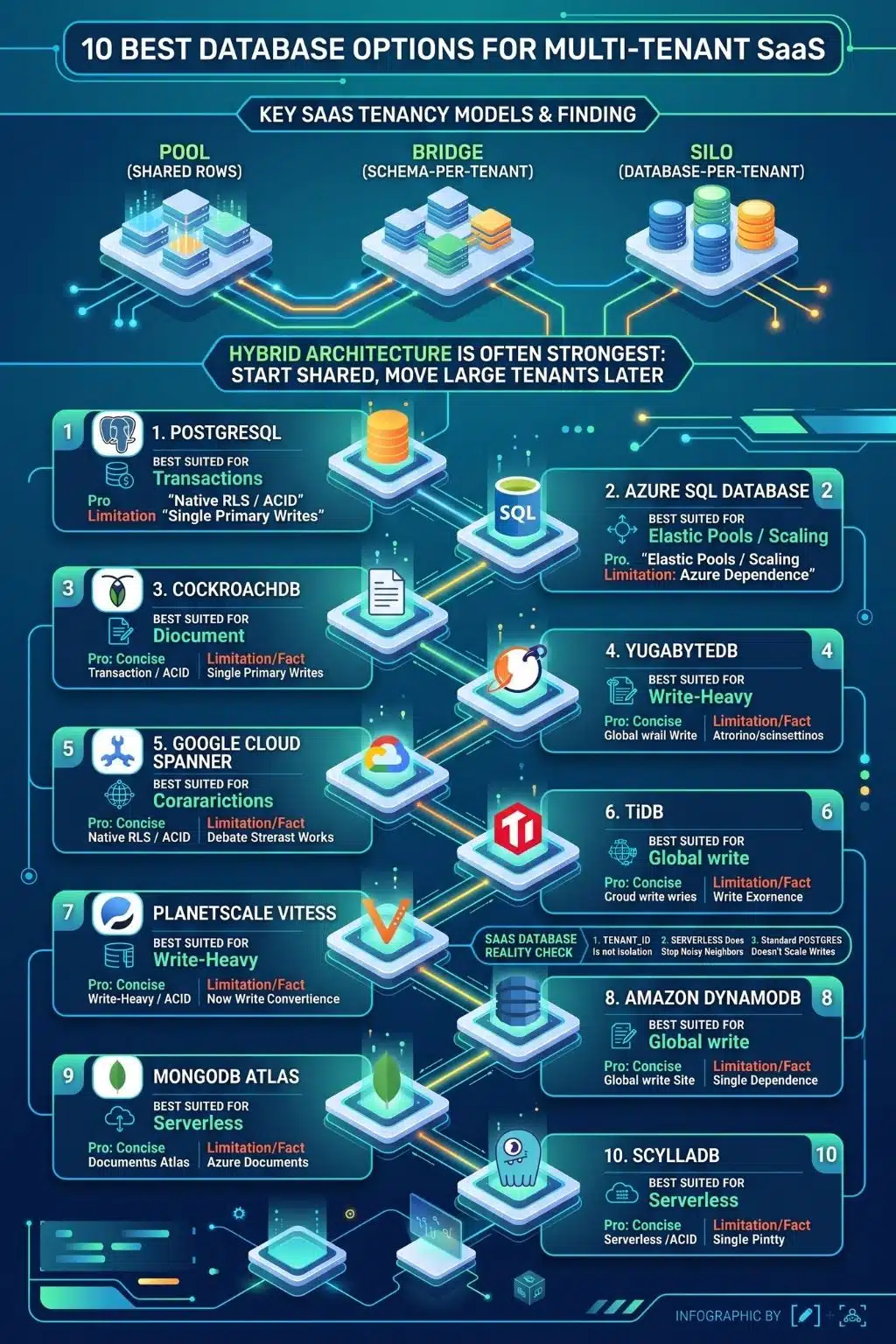
When I audit SaaS data models, I always map them to one of three isolation strategies. You have to know your model before you pick your database:
- The Pool (Shared Rows): All tenants share the same tables, separated only by a tenant_id column. It is highly cost-effective, but it risks noisy-neighbor performance issues and requires flawless security policies.
- The Bridge (Schema-per-Tenant): Tenants share the same database server but get their own isolated schemas.
- The Silo (Database-per-Tenant): Every tenant gets a completely separate database. This offers ultimate security and performance isolation, but it becomes expensive and complex to manage at scale.
The strongest production architecture I see today is hybrid: start small tenants in a Pool, move your enterprise tier to dedicated Silos, and use a central tenant catalog to route traffic.
Here is how the top 10 databases rank for these exact workloads.
1. PostgreSQL
Best for: The vast majority of standard transactional B2B SaaS apps.
PostgreSQL is the gold standard because it handles the Pool, Bridge, and Silo models beautifully. Its superpower is Row-Level Security (RLS). RLS policies automatically filter reads and writes based on the active tenant, preventing accidental data leaks at the database level even if your application code misses a WHERE clause.
- The Pros: Mature ACID transactions, a massive extension ecosystem, and the flexibility to start pooled and shard out later.
- The Catch: Standard Postgres concentrates writes on a single primary node. If you pool tenants, restoring just one tenant’s data from a backup requires messy, custom extraction logic. Also, superusers bypass RLS, so your app must connect through restricted roles.
2. Azure SQL Database
Best for: Strict Database-per-Tenant (Silo) architectures.
If your compliance requirements demand that every client gets their own logical database, Azure SQL is remarkably well-designed for the job. Its standout feature is Elastic Pools, which lets thousands of isolated databases share a purchased pool of compute resources.
- The Pros: Native database-per-tenant tooling, easy point-in-time recovery for individual tenants, and the ability to seamlessly move noisy tenants into dedicated compute tiers.
- The Catch: You are heavily locked into the Microsoft Azure ecosystem. Additionally, running cross-tenant analytics across hundreds of isolated databases requires significant operational overhead.
3. CockroachDB
Best for: Global transactional SaaS products.
When your SaaS serves tenants across multiple continents and you cannot rely on a single regional primary without crushing latency, CockroachDB shines. It provides distributed horizontal scaling with a PostgreSQL-compatible interface.
- The Pros: Multi-region data placement, automatic rebalancing, true horizontal read/write scale, and native support for pooled RLS.
- The Catch: PostgreSQL compatibility is not absolute. Multi-region consensus inherently increases write latency, meaning your application must gracefully handle transaction retries. It also has specific feature limits, like unsupported Change Data Capture (CDC) queries on RLS tables.
4. YugabyteDB
Best for: PostgreSQL-compatible hybrid scale.
YugabyteDB is a distributed SQL database that leverages a PostgreSQL-derived layer. It is an excellent choice if you need distributed ACID transactions combined with row-level geo-partitioning.
- The Pros: It natively supports pooled RLS, database-per-tenant deployments, and colocation (efficiently packing many small tenant databases onto fewer nodes).
- The Catch: It is built specifically for multi-region scale. If you are just running a modest, single-region SaaS, standard managed PostgreSQL will be much simpler to operate.
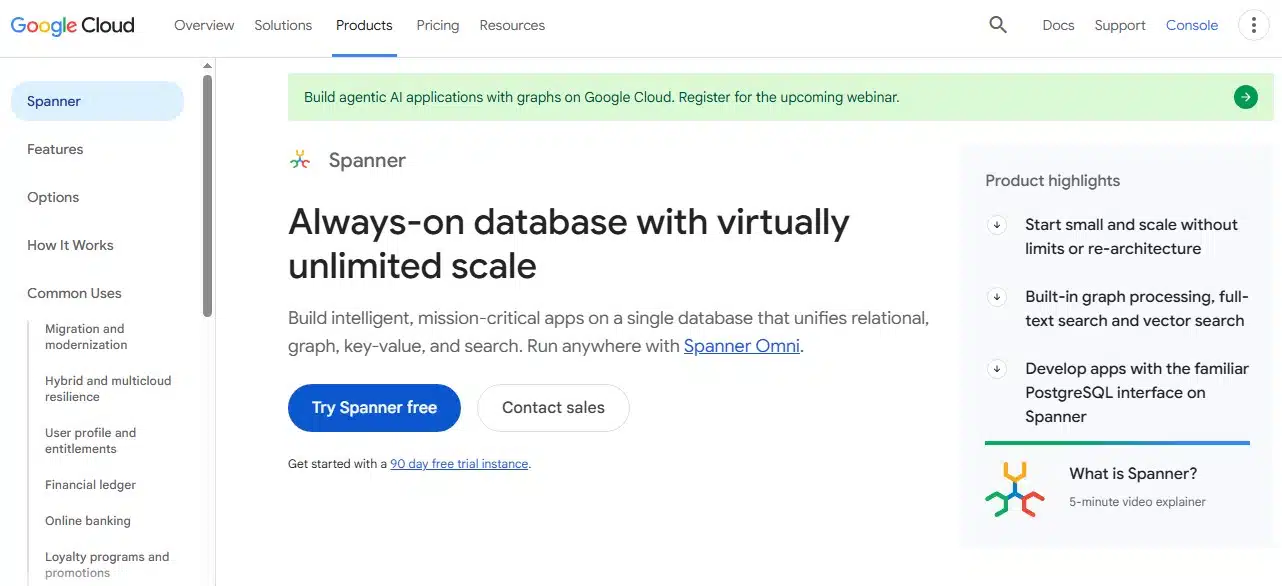
5. Google Cloud Spanner
Best for: Massive global enterprise SaaS platforms.
Spanner is Google’s heavy-duty, globally distributed relational database. It formally supports multi-tenancy across instances, databases, tables, and shared rows.
- The Pros: Practically infinite horizontal scale, unmatched consistency across regions, and incredibly high availability configurations.
- The Catch: In a shared-row setup, Spanner does not natively auto-enforce RLS; your application logic must explicitly add the correct tenant predicates to every query. It is also highly expensive and ties you deeply into Google Cloud’s infrastructure.
6. TiDB
Best for: MySQL-compatible distributed scaling.
TiDB offers horizontally scalable ACID transactions for teams that prefer the MySQL ecosystem. Its greatest multi-tenant asset is its Resource Control feature, which lets you assign Request Unit limits and priorities to specific tenants.
- The Pros: Database-level separation, brilliant tools for operating massive numbers of tables, and native resource guardrails that directly solve the noisy-neighbor problem.
- The Catch: While it has robust role and table privileges, it currently lacks native, PostgreSQL-style Row-Level Security for shared rows.
7. PlanetScale Vitess
Best for: Managed MySQL sharding.
When a MySQL-based SaaS product completely outgrows a single primary database, Vitess is the premier way to shard it. By using a “Vindex,” you can map your tenant_id to specific shards, ensuring a single tenant’s data stays localized.
- The Pros: Automated failovers, built-in connection pooling, zero-downtime schema migrations, and write scaling across multiple primaries.
- The Catch: A Vindex dictates routing; it is not an authorization policy. Your app still has to enforce tenant access limits.
8. Amazon DynamoDB
Best for: Predictable, serverless SaaS workloads.
If you know your exact query access patterns upfront and want to avoid managing servers entirely, DynamoDB is a powerhouse. AWS recommends embedding the tenant identifier directly into every partition key.
- The Pros: True serverless scaling, single-digit millisecond latency, and the ability to use native AWS IAM policies for strict tenant key enforcement.
- The Catch: You lose relational query flexibility—there are no SQL joins here. Restoring a single tenant’s data from a pooled table requires building entirely custom tooling.
9. MongoDB Atlas
Best for: Flexible document data and rapidly changing schemas.
For SaaS platforms dealing with massive catalogs, metadata, or complex user profiles, a document database makes sense.
- The Pros: Highly flexible schemas, natural aggregation of complex objects, and excellent multi-cloud capabilities.
- The Catch: MongoDB clearly warns that tenant separation in shared collections is purely logical. It must be enforced strictly by your application code. Shared collections also struggle with performance balance when tenant sizes vary wildly.
10. ScyllaDB
Best for: Extreme write-heavy telemetry and event workloads.
ScyllaDB is a Cassandra-compatible wide-column database. It earns its spot for specialist workloads: think massive event streams, activity feeds, or IoT tracking across thousands of tenants.
- The Pros: Tunable consistency, multi-datacenter replication, and the ability to allocate different resource shares to specific tenant roles to prevent throttling.
- The Catch: It requires denormalized, query-first modeling. Authorization operates at the keyspace/table level, meaning a shared tenant table relies entirely on application-level filtering.
Which Claims About SaaS Databases Should You Ignore?
When architecting SaaS databases, I see a lot of bad advice floating around. Let’s clear the air:
- “A tenant_id column guarantees isolation”: No, it doesn’t. Without RLS or strict application-layer enforcement, a single forgotten WHERE clause leaks data across companies.
- “Serverless databases eliminate noisy-neighbor problems”: False. Large tenants can still cause hot-key throttling on shared partitions.
- “PostgreSQL scales writes horizontally out of the box”: It scales reads horizontally via replicas. Scaling writes requires active sharding or migrating to a distributed fork.
- “Database partitioning and tenant isolation are the same thing”: Partitioning is for performance and data lifecycle management; isolation is for security and compliance.
Building a Future-Proof Foundation
When you are designing a SaaS product, it’s tempting to over-optimize for performance benchmarks. But I urge you to look closer. The true success of your multi-tenant database isn’t how fast it can write, but how robustly it enforces isolation. Think about noisy neighbors, effortless backups, and seamless migrations.
A sustainable, operationally sound decision today is the best gift you can give your future engineering team, and your customers. My strongest piece of advice? Don’t force yourself into one rigid model; plan for a hybrid future where your data strategy can grow alongside your success.
Frequently Asked Questions (FAQs) on Multi-tenant Database Architecture
Start with a shared pool for the vast majority of SaaS apps. It is significantly cheaper, easier to maintain, and simplifies your schema migrations. You can always carve out dedicated databases later for massive enterprise clients who demand physical isolation.
2. How do I stop one massive tenant from slowing down the whole system?
This is the classic “noisy neighbor” problem. In a shared pool, you need a database that supports resource quotas (like TiDB’s Resource Groups), or you must enforce rate limiting at your API layer. If a tenant is simply too big, migrate them to their own dedicated database instance.
3. Is Row-Level Security (RLS) foolproof?
It is incredibly powerful, but not magic. Database superusers and table owners usually bypass RLS by default. To make it secure, your application must connect to the database using a restricted, non-owner role, and you must strictly enforce the policies on your tables.
4. Can I use NoSQL for a multi-tenant SaaS?
Yes, but only if your access patterns are highly predictable (DynamoDB) or you deal with highly flexible, document-heavy data (MongoDB). If your users need complex reporting, ad-hoc filters, or deep relational joins across their data, stick to SQL.
5. How do I backup and restore just one tenant’s data?
If you use the database-per-tenant model, it is as easy as restoring a standard point-in-time backup. If you use a shared pool, it is painful, you usually have to restore the entire database to an isolated temporary instance, extract that specific tenant’s data, and carefully patch it back into production.