

Running pay-per-click advertising without tight conversion tracking and negative keyword filters quickly drains marketing budgets. Identifying and rectifying common ppc mistakes allows digital marketers to eliminate wasted ad spend, boost Quality Scores, and maximize return on ad spend (ROAS).
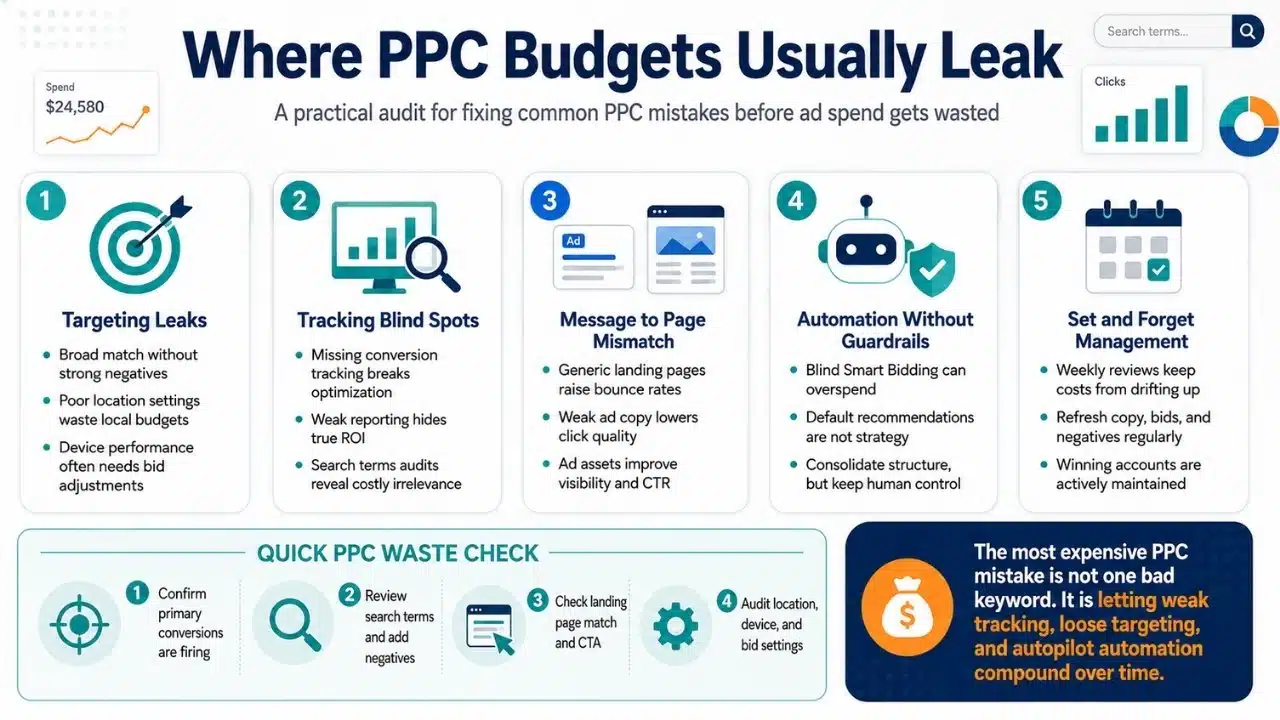
| PPC Mistake | Financial Risk | Impact on Performance | Quick Fix |
| 1. Unfiltered Broad Match | Irrelevant clicks exhaust budget | Drops click-through rate (CTR) and Quality Score | Use exact/phrase match + robust negative list |
| 2. Missing Conversion Tracking | Bidding blindly without ROI data | Inability to optimize top-performing keywords | Implement GTM tags and primary conversion actions |
| 3. Landing Page Mismatch | High bounce rates and paid drop-offs | High Cost-Per-Acquisition (CPA) | Align landing page headline directly with ad copy |
| 4. Neglecting Negative Lists | Paying for competitor/free search terms | Inflated ad spend on low-intent queries | Add account-level negative keyword lists |
| 5. Blind Automation Trust | Algorithm overspending on low-value conversions | Loss of manual bid control | Set max CPC caps and audit automated strategies |
| 6. Set-and-Forget Management | Gradual performance degradation | Stagnant ad copy and creeping click costs | Conduct weekly search term and bid reviews |
| 7. Skipping Ad Assets | Smaller visual footprint on SERP | Lower CTR compared to competitor ads | Enable callouts, sitelinks, and structured snippets |
| 8. Poor Location Targeting | Paying for clicks outside service area | Waste on non-serviceable geographic leads | Change setting to “Presence: People in your location” |
| 9. Ignoring Device Performance | Budget wasted on poorly converting mobile UI | High CPA on specific device types | Apply bid adjustments by device conversion rates |
| 10. Skipping Search Term Audits | Paying for unwanted long-tail variations | Continuous drain from broad search intent | Review search terms report bi-weekly |
| 11. Weak Ad Copy & CTA | Low engagement and wasted impressions | Reduced ad rank and higher CPC | Test dynamic insertion and direct value propositions |
| 12. Over-Segmented SKAGs | Fragmented conversion data for AI algorithms | Slower smart bidding learning phases | Consolidate into thematic intent-based ad groups |
12 Common PPC Mistakes That Burn Ad Spend
1. Relying Exclusively on Unfiltered Broad Match Keywords
Broad match keywords allow search engines to show your ads for searches loosely related to your target phrase. Without strict negative keyword lists, broad match triggers ads for irrelevant, low-intent search terms. Utilizing PPC strategy best practices helps advertisers balance exact and phrase match types while reserving broad match strictly for campaigns with extensive negative safeguards.
2. Skipping or Misconfiguring Conversion Tracking
Running ad campaigns without accurate conversion tracking is equivalent to driving blindfolded. If your ad account does not track form submissions, phone calls, or purchase completions, your optimization decisions are based on guesswork. Ensuring primary conversion actions are properly tagged in Google Tag Manager provides the accurate data required for effective bidding strategies.
3. Sending Paid Traffic to Generic Landing Pages
Directing paid search clicks to your homepage or general services page frustrates users searching for specific solutions. If an ad promises a “50% Discount on Enterprise Accounting Software,” the destination URL must land directly on a page dedicated to that offer. Alignment between ad intent and landing page copy reduces bounce rates and increases conversion rates.
4. Neglecting Account-Level Negative Keyword Lists
Failing to maintain an active negative keyword list allows ad networks to waste your budget on search queries containing terms like “free,” “jobs,” “diy,” or “login.” Building account-level negative lists blocks known non-converting terms across all current and future campaigns, preserving ad budget for high-intent queries.
5. Blindly Trusting Automated Bidding Recommendations
Ad platforms aggressively push Smart Bidding strategies like Maximize Conversions or Target ROAS. However, applying automated bidding without historical conversion data often causes algorithms to bid recklessly on high-cost keywords. Following automated bidding management frameworks ensures bid caps and manual controls remain active until campaigns reach optimal conversion volume.
6. Adopting a “Set It and Forget It” Campaign Management Style
PPC management requires continuous refinement. Keyword performance fluctuates, competitors adjust bids, and search trends shift over time. Allowing campaigns to run for months without updating negative lists, refreshing ad copy, or adjusting bid strategy leads to performance degradation and higher acquisition costs.
7. Omitting Essential Ad Assets (Formerly Extensions)
Ad assets—such as sitelinks, callouts, structured snippets, and image extensions—increase your ad’s screen real estate on the search results page. Skipping assets reduces your visual prominence, lowers expected click-through rates, and negatively impacts your overall Ad Rank.
8. Misconfiguring Geographic and Radius Location Settings
By default, platforms like Google Ads set location targeting to “Presence or Interest.” This means someone located in another country searching for news about your city could trigger your local service ad. Changing location settings strictly to “Presence: People in or regularly in your targeted locations” prevents out-of-market click waste.
9. Ignoring Device-Specific Performance Distinctions
User conversion behavior varies significantly between mobile, desktop, and tablet devices. If your website’s mobile checkout flow suffers from high friction, spending equal budget on mobile traffic will inflate your average cost per lead. Reviewing device performance reports allows you to apply negative bid adjustments to underperforming device categories.
10. Failing to Review Search Terms Reports Regularly
The search terms report reveals the actual queries users typed before clicking your ad. Reviewing this report bi-weekly helps identify unwanted search variations that need to be added to negative keyword lists, while highlighting top-performing queries to add as dedicated target keywords.
11. Writing Generic Ad Copy with Weak Calls to Action
Ad copy that lacks a distinct value proposition or a clear call to action fails to capture user interest. Incorporating conversion rate optimization standards into ad writing—such as highlighting pricing transparency, specific benefits, and urgent CTAs—improves click-through rates and pre-qualifies incoming traffic.
12. Over-Segmenting Campaigns into Rigid Single Keyword Ad Groups (SKAGs)
While Single Keyword Ad Groups were once an industry standard, modern machine learning algorithms require consolidated conversion data to optimize efficiently. Over-segmenting account structures divides conversion volume into tiny fragments, slowing down smart bidding learning phases and increasing management overhead.
The Uncomfortable Truth About AI-Driven PPC Automation
The uncomfortable reality facing modern media buyers is that ad networks are structurally designed to maximize platform revenue, not minimize your customer acquisition cost. Default settings across major PPC platforms consistently steer advertisers toward automated broad matching, automated asset creation, and automated bidding algorithms that obfuscate where your budget actually goes.
As PPC transitions deeper into black-box automation, hands-off campaign management will become increasingly expensive. Ad platforms benefit financially when your campaigns spend their full daily budget on adjacent search intent. The future of competitive PPC relies on human governance: maintaining tight negative keyword boundaries, auditing search queries, feeding high-quality first-party data into conversion APIs, and refusing to hand total control over to default automated recommendations.
Frequently Asked Questions (FAQs) About Common PPC Mistakes
What is the single biggest PPC mistake that wastes money fast?
Running broad match keywords without an active negative keyword list is the fastest way to waste ad spend. Broad match triggers ads for loosely related, non-converting search terms that consume budget without generating qualified leads.
How often should I check my PPC search terms reports?
High-spend accounts should audit search terms weekly to catch non-converting queries and add negative keywords immediately. Lower-budget accounts can perform this review bi-weekly or monthly to maintain targeting accuracy.
Is automated bidding always better than manual bidding?
Automated bidding works best when a campaign has recorded at least 30 conversions over the past 30 days. Applying Smart Bidding to new campaigns without adequate conversion data often leads to unpredictable overspending.
Why are my PPC ads getting clicks but zero conversions?
Zero conversions typically point to a mismatch between ad copy and landing page content, or high friction on the landing page itself. Ensure your landing page directly delivers what your ad promises with a clear call to action.
How do ad assets impact cost-per-click?
Ad assets increase your physical footprint on the SERP and boost expected click-through rate. Higher CTRs improve your overall Quality Score, which directly lowers the minimum bid required to maintain top ad positions.