
You already know how to do the work. You run campaigns, fix landing pages, or pull a site out of a ranking slump. Then one afternoon you look at your salary, look at what the agency bills for your hours, and the math starts to bother you.
That is usually the moment people start reading about how to become a digital marketing consultant. I did the same thing. What I found back then was a pile of articles promising freedom and six figures and almost nothing about the boring parts that decide whether you last.
So this is the honest version. What the job really is, what the money looks like, how to start without burning your savings, and when staying employed is the smarter call.
What You Are Really Selling as a Consultant
A lot of new consultants think they are selling their skills. They are not. They are selling a decision.
Clients do not hire me because I can read Search Console. They hire me because they are spending money and cannot tell what is working. They want someone to look at the mess and say, clearly, do this next. The skill is the reason they trust the answer. The answer is the product.
This changes how you talk about your work. “I do SEO, PPC, email, social, and content” sounds generous. It also sounds like a person who has never turned anything down. ” I help SaaS companies fix organic traffic drops” is a smaller sentence, and it gets far better calls.
I learned this the slow way. My early pitch listed every service I could name. My best year came after I cut that list in half.
The Money Is Better and Worse Than You Expect
Rates depend on who you serve and what you own. Someone doing execution work on a marketplace and someone advising a founder on where to put a budget are doing different jobs, even if both say “consultant.”
Here is roughly where independent rates sat in reports published through 2026. Treat these as planning numbers, not promises.
| How you charge | Common range | Fits best |
|---|---|---|
| Hourly | $50–$200+ | Audits, second opinions, short advisory calls |
| Monthly retainer | $1,500–$15,000 | Ongoing channel work with a clear scope |
| Fixed project | $2,000–$10,000 for most independents | Audits, site migrations, campaign builds |
Two things about that table matter more than the numbers.
First, your quoted rate is not your income. Tax, tools, health cover, unpaid sales calls, sick days, and the weeks a client goes quiet all come out of it. Many freelancers keep somewhere between 60% and 70% of what they bill once overhead is counted. Plan around the lower end.
Second, hourly billing punishes you for getting better. The faster I solve something, the less I earn. Most consultants who are happy after a few years have moved to retainers or fixed fees for that reason. I still quote hourly for one thing only: audits where I have no idea what I will find.
The other side of the money question is stability. A salary pays you in December whether or not anyone signed anything in November. Independent income does not work that way. My first two years looked like a good month, a scary month, a great month, and then a month where a client paid 40 days late and I paid myself last. That pattern is normal. It is also the single biggest reason people go back to a job.
How to Become a Digital Marketing Consultant
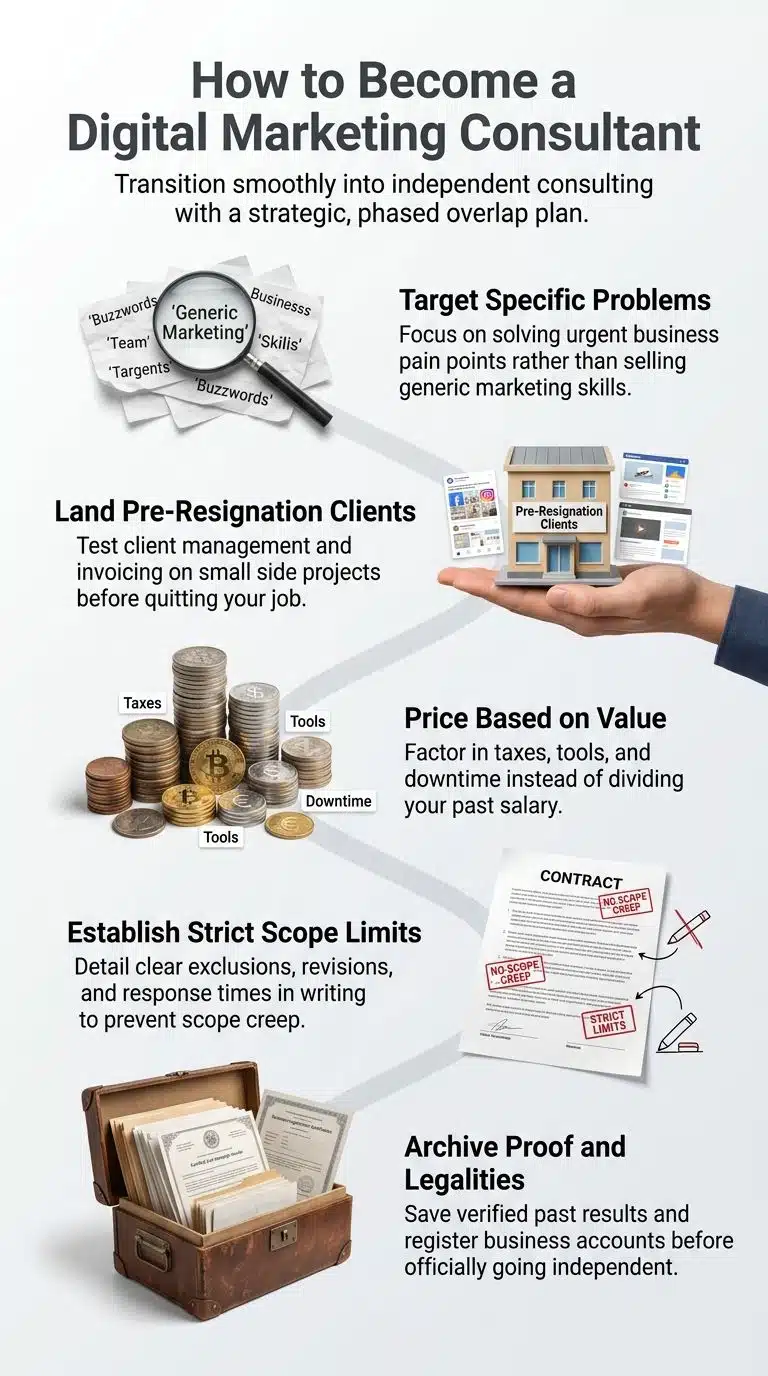
The advice I give friends who ask about how to become a digital marketing consultant is not “quit and figure it out.” It is closer to a slow overlap.
- Pick one problem, not one channel: “SEO consultant” describes a skillset. “I fix product pages that get traffic but no sales” describes a problem someone is already losing sleep over. Pick something you have solved more than once and can explain in one sentence.
- Get the first client before you resign: Check your contract for any conflict or non-compete terms, then take one small paid project outside working hours. Do it properly. The point is not the money. The point is finding out how you handle scope, invoices, and a client who changes their mind on a Friday. Some people love it. Some people discover they hated only the commute, not the job.
- Price the outcome, not your old salary: New consultants often take their monthly pay, divide by working hours, add a little, and call that a rate. It is too low every time. You are now paying for your own tools, downtime, and taxes, and you will not bill 40 hours a week. Twenty billable hours in a week is a full week.
- Write down what is not included: My contracts are short, but the scope section is not. Number of revisions, response time, what a “report” contains, what costs extra. Scope creep is not usually one big request. It is ten small ones, each easy to say yes to, and by month three you are working double for the same fee.
- Sort out the boring paperwork early: Register the business the way your country requires, open a separate bank account, set aside tax from every payment as it arrives, and use a proper invoice with payment terms. Rules differ by country, so confirm yours locally before you register anything. This takes a weekend and saves you a miserable quarter later.
One more thing that is rarely mentioned. Keep a written record of results from your current job before you leave, with your employer’s permission where needed. Traffic charts, revenue changes, before-and-after screenshots. The day you become independent, that access disappears, and proof is what makes a stranger comfortable paying you.
Where the Work Actually Comes From
For my first year I believed clients would come from content. I wrote posts, built a site, and waited. The site did eventually work, but it was slow and it was not what paid the rent.
Almost everything early came from people who already knew my work. Former colleagues who moved to new companies. An agency owner who needed overflow help. A client I had managed at my old job who asked, quietly, whether I took private work. Referrals from a designer and a developer I had shipped projects with.
Cold outreach worked, but at a much lower rate, and only when the email pointed at something specific on their site instead of introducing me.
If your network is thin, build it before you need it. Answer questions publicly. Publish teardowns of real problems rather than definition posts. Talk to freelancers next door to your skill, because designers and developers pass work along constantly. And keep every old client warm with an occasional short message that is not a pitch.
Content still matters. Just do not expect it to feed you in month two.
The Parts Nobody Warned Me About
Selling never stops. Even when fully booked, I keep a small amount of time each week for the pipeline, because contracts end without warning and a good month can turn into an empty one within thirty days.
Being alone is heavier than it sounds. There is no one to check your thinking, no one to catch a bad call before it ships, and no team chat on a bad day. I now pay for a small paid community and speak to two other consultants regularly. It is not a luxury.
Clients also buy differently than employers do. Internally, you are judged on results. Independently, you are judged on results and on how clearly you explain them. I have watched weaker marketers keep clients longer than better ones because their reporting was calm and easy to read.
And you become the collections department. Chasing an overdue invoice from someone you like is one of the least pleasant parts of the job. Ask for a deposit. Charge upfront for small projects. It removes most of this problem.
When Staying Employed Is the Better Choice
Going independent is not automatically an upgrade. I would wait if any of these apply:
- You have less than two or three years of hands-on experience. You need pattern recognition, and you get that from volume.
- You have no savings buffer. Three to six months of living costs are the minimum I would want before leaving a salary.
- You cannot name three people who would refer you next month.
- Your income has to be exactly the same every month for family reasons.
- You want to escape a bad manager. That is a reason to change jobs, not to change your entire business model.
There is also a version people forget: fractional or part-time work. Two days a week for one company, three days for your own clients. Less freedom, far less risk, and a reasonable way to test the water.
Final Thoughts
Was it worth it for me? Yes, but not for the reasons I expected. The money improved after year two. What actually changed my life was choosing the work, dropping clients who treated marketing as decoration, and being paid for judgment instead of hours in a chair.
If you are still deciding how to become a digital marketing consultant, the useful test is not whether you are good at marketing. You probably are. The real test is whether you can sell steadily, price without apologizing, and stay calm through a slow month. Those three things decide it.
Start small and start now. One paid project this quarter, on the side, done properly, will tell you more than another year of reading about it.