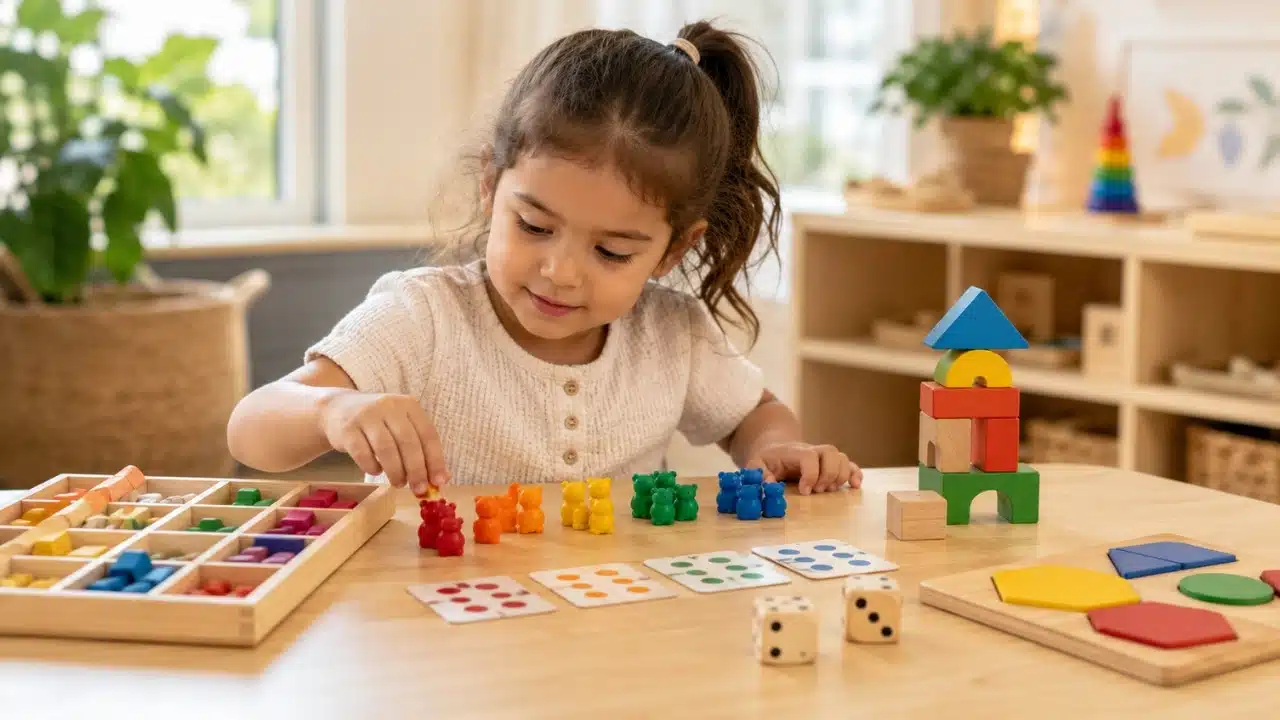
Early mathematical fluency relies on foundational cognitive building blocks rather than simple rote memorization. Observing key signs of strong number sense in young children helps parents and educators nurture spatial awareness, logical reasoning, and long-term academic confidence.
| Skill / Behavior | Practical Example | Why It Matters |
| 1. Instant Quantity Recognition | Seeing 3 apples and knowing the amount without counting | Builds visual math speed through subitizing |
| 2. One-to-One Correspondence | Touching one toy per spoken number while counting | Prevents double-counting and skipping errors |
| 3. Understanding Cardinality | Knowing the final number spoken represents the total | Connects sequential counting to real quantities |
| 4. Comparing Relative Magnitudes | Correctly identifying which bowl holds “more” snacks | Establishes foundational concepts of scale |
| 5. Environmental Number Matching | Spotting digits on house doors, clocks, or price tags | Connects abstract written symbols to daily life |
| 6. Pattern Identification | Continuing an alternating blue-red-blue block tower | Prepares the brain for algebraic reasoning |
| 7. Part-Whole Awareness | Understanding that 4 snacks can split into 2 and 2 | Lays the framework for addition and subtraction |
| 8. Backward Counting Ability | Counting down from 5 to 1 during a game | Strengthens mental number line flexibility |
| 9. Practical Quantity Estimation | Guessing whether a jar holds 5 or 50 buttons | Develops mathematical intuition and reasonableness |
| 10. Sorting and Classifying | Grouping buttons by color, shape, or size | Builds logical categorization structures |
10 Key Signs of Strong Number Sense in Preschoolers
1. Instant Quantity Recognition (Subitizing)
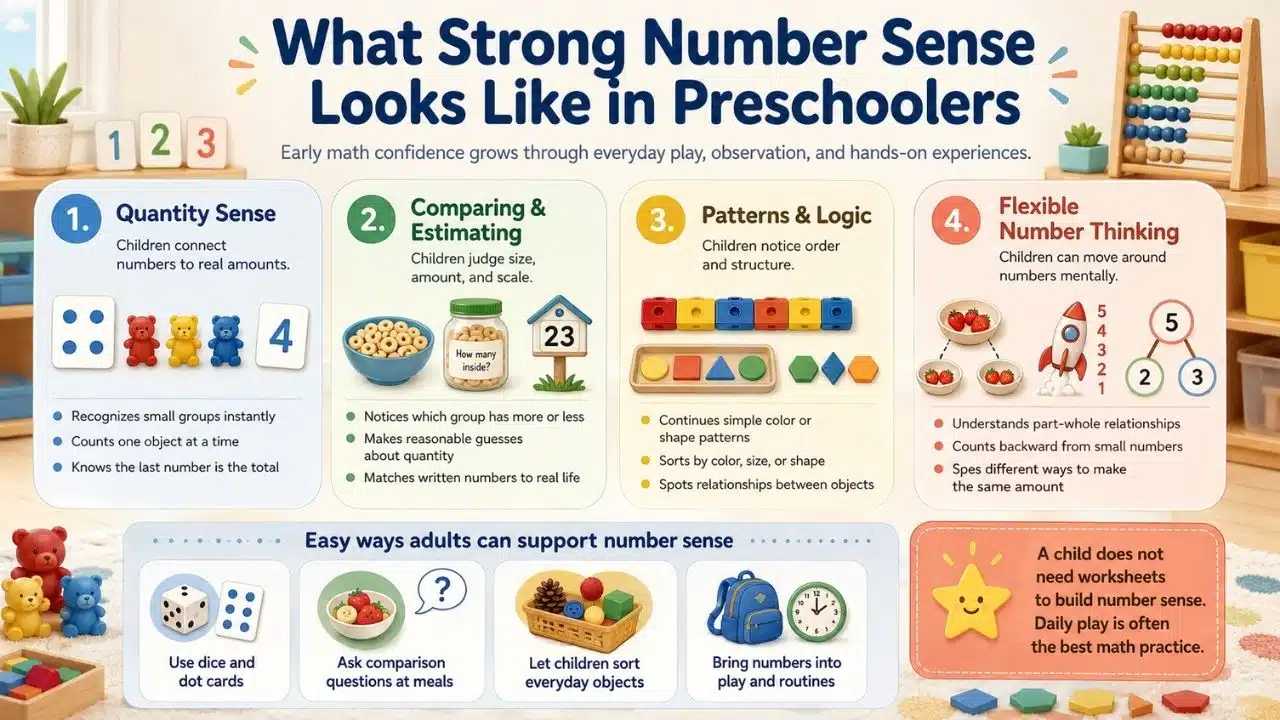
Children with well-developed numerical intuition do not need to count small groups of objects one by one. When looking at a die showing three dots or a plate with two crackers, they immediately identify the quantity visually. Aligning early instruction with early childhood math guidelines shows that this skill, known as subitizing, forms the core foundation for future mental arithmetic.
2. Accurate One-to-One Correspondence
A common milestone in early counting is the ability to pair one spoken number word with exactly one physical object. Rather than rushing through number words while pointing randomly, a child with solid number comprehension touches each object individually while reciting the sequence. Utilizing interactive counting strategies during daily play helps reinforce this physical-to-mental connection.
3. Comprehension of Cardinality
Counting from one to five is a sequential skill, but cardinality requires understanding that the final number recited represents the entire set. When asked “How many blocks are there?”, a child who understands cardinality states the final number directly rather than recounting the entire pile from the beginning.
4. Ability to Compare Quantities (More vs. Less)
Young learners demonstrate practical math intuition when evaluating relative amounts without explicit counting. They can instantly point out which cup has more juice or which pile of crayons is smaller. This visual comparison skill shows an intuitive grasp of volume, size, and numerical magnitude.
5. Recognition of Written Number Symbols in the Environment
Connecting spoken numbers to written digits is a major conceptual leap. Children showing strong mathematical awareness notice and identify written numbers on street signs, microwave timers, elevator buttons, and book pages, demonstrating that abstract symbols carry real-world meaning.
6. Spatial and Object Pattern Recognition
Mathematics is fundamental pattern recognition. Children who build alternating color towers with blocks, arrange toy cars from smallest to largest, or notice repeating shapes on clothing demonstrate the structural thinking necessary for geometry and higher-level arithmetic.
7. Understanding Part-Whole Relationships
Before learning formal addition equations, children with intuitive number grasp recognize that larger quantities are made of smaller combinations. For example, they understand that a group of four apples can be divided into two pairs, or that three toy cars and one truck still equal four vehicles total.
8. Ability to Count Backward from Small Numbers
While counting forward is often learned through song and repetition, counting backward requires flexible mental movement along a number line. A child who easily counts down from 5 to 1 during rocket launch games demonstrates a deeper conceptual grasp of numerical order.
9. Reasonable Quantity Estimation
When shown a jar filled with marbles, a child with emerging number sense will not make wild guesses like “a million” or “one.” Instead, they offer reasonable estimates based on visual proportion, demonstrating that they understand the relative scale of different numbers.
10. Natural Curiosity for Sorting and Classifying
Children naturally display mathematical thinking when organizing their environment. Sorting toy animals by habitat, arranging buttons by size, or categorizing snacks by shape displays the logical organization skills necessary for data interpretation and set theory.
How to Nurture These Signs of Strong Number Sense at Home
Parents can support early mathematical development without relying on formal flashcards or worksheets:
-
Integrate Math into Household Chores: Ask your child to set the table by placing one fork next to each plate, practicing one-to-one correspondence.
-
Play Board Games with Dice: Games that involve rolling dot dice naturally strengthen subitizing and counting skills.
-
Ask Open-Ended Comparison Questions: During snack time, ask questions like “Who has more berries?” or “How many more crackers do you need to match my plate?”
Observe your child during unstructured play today to identify which mathematical behaviors they naturally exhibit. Focus on incorporating simple, play-based counting questions into daily routines to strengthen their numerical confidence without making math feel like formal instruction.
Building Long-Term Mathematical Confidence
Developing strong number sense in early childhood sets the stage for lifelong mathematical success. Rather than drilling abstract calculations or pushing for early memorization, parents and educators achieve the best results by recognizing and encouraging intuitive math behaviors during everyday play. By nurturing skills like subitizing, pattern recognition, and one-to-one correspondence in natural settings, you help young learners build a concrete, stress-free foundation for complex mathematical concepts in the years ahead.
Frequently Asked Questions About Signs of Strong Number Sense
What is the difference between rote counting and number sense?
Rote counting is the ability to recite number names in order from memory, similar to singing the alphabet. Number sense is a deep conceptual understanding of what those numbers actually mean, including quantity, relative size, and relationships between values.
At what age should a child display these signs of strong number sense?
Basic number sense skills begin developing between ages 2 and 5. Subitizing small groups (1 to 3 items) and simple quantity comparisons often appear by age 3, while cardinality and written symbol matching typically mature closer to ages 4 and 5.
How can I help a child who struggles with subitizing?
Use visual dot cards, dominoes, and ten-frame grids during playtime. Regularly pointing out small clusters of objects (such as “Look, two birds!”) helps train the brain to recognize small quantities visually without counting each item individually.