Selecting the best nlp tools for developers requires matching software architecture to computational constraints, domain complexity, and latency targets. Whether building low-latency API microservices or multi-step agentic workflows, understanding the underlying technical design of each NLP engine ensures scalable deployment and optimal model performance.
| Tool / Library | Ecosystem | Selection Rationale (Why Picked) | Underlying Architecture | Primary Production Use Case |
| 1. spaCy | Python / Cython | Maximum execution speed for production APIs | C-level memory pointers & deterministic pipelines | High-throughput entity extraction & POS tagging |
| 2. Hugging Face | Python | Unified access to state-of-the-art transformer models | Abstract PyTorch/TensorFlow wrapper over self-attention | Fine-tuning LLMs (BERT, Llama) & task heads |
| 3. NLTK | Python | Granular control over low-level NLP algorithms | Pure Python modular rule-based & statistical functions | Academic research, teaching, & custom tokenizers |
| 4. Gensim | Python | Memory-efficient vector space & topic modeling | Out-of-core streaming via NumPy/SciPy C-bindings | Document similarity & unsupervised LDA topic modeling |
| 5. Stanza | Python | Highest syntactic & morphological annotation accuracy | Bi-LSTM & transformer-based Universal Dependencies | Multilingual grammatical parsing & legal NLP |
| 6. FastText | C++ / Python | Instant subword classification & OOV handling | Bag-of-character $n$-grams with hierarchical softmax | Real-time spam filtering & multi-label classification |
| 7. Apache OpenNLP | Java / JVM | Direct execution within native enterprise Java stacks | Maximum Entropy (MaxEnt) & Perceptron JVM models | High-concurrency enterprise Java microservices |
| 8. LangChain | Python / TS | Multi-step LLM orchestration & RAG state control | Abstraction layer connecting LLMs, vector DBs, & tools | Retrieval-Augmented Generation & agentic workflows |
| 9. TextBlob | Python | Rapid prototyping with zero setup overhead | High-level API wrapping NLTK & Pattern engines | Quick sentiment scoring & low-code internal scripts |
| 10. AllenNLP | Python | Deep neural network experimentation in PyTorch | Modular research primitives & declarative state tracking | Custom deep learning architectures & QA research |
10 Best NLP Tools for Developers: Technical Breakdown
1. spaCy
Why Selected: spaCy is the industry benchmark for commercial text processing pipelines where execution latency and memory predictability are critical requirements.
Underlying Architecture: Written in Cython from the ground up, spaCy bypasses Python’s Global Interpreter Lock (GIL) and object overhead by managing memory directly with C-level structures. Rather than offering dozens of competing algorithms per task, it uses a single, highly tuned pipeline featuring non-destructive tokenization, convolutional neural networks (CNNs), and transition-based dependency parsers.
Technical Trade-off: Sacrifices algorithm customization and academic experimentation for deterministic execution speed and ease of maintenance.
2. Hugging Face Transformers
Why Selected: It unifies hundreds of disparate neural network implementations into a standardized model framework, democratizing access to modern deep learning.
Underlying Architecture: Built as an abstraction layer over PyTorch and TensorFlow, Hugging Face implements self-attention mechanisms, multi-head transformer blocks, and pre-trained tokenizers (e.g., WordPiece, Byte-Pair Encoding). Developers can instantiate, fine-tune, and export transformer weights across hardware acceleration backends (CUDA, ROCm, Apple Metal) using identical API signatures.
Technical Trade-off: High memory footprint and computational requirements that necessitate GPU infrastructure for real-time inference.
3. Natural Language Toolkit (NLTK)
Why Selected: NLTK offers unmatched pedagogical depth, exposing every step of traditional computational linguistics without black-box abstraction.
Underlying Architecture: Constructed in pure Python, NLTK exposes discrete modules for tokenization (Punkt), stemming (Porter, Snowball), probabilistic parsing, and lexical databases (WordNet). It gives developers granular control over raw string transformations and mathematical language models.
Technical Trade-off: Slower execution speed and high string-object overhead make it unsuitable for high-concurrency production endpoints.
4. Gensim
Why Selected: Gensim solves the “out-of-memory” problem when processing massive text collections, enabling semantic vector modeling on constrained hardware.
Underlying Architecture: Designed around data-streaming iterators, Gensim streams documents directly from disk rather than loading corpus arrays into RAM. It leverages C-optimized CBLAS libraries, NumPy, and SciPy to calculate matrix factorizations, Latent Dirichlet Allocation (LDA), Word2Vec ($skip\text{-}gram$ / $CBOW$), and FastText embeddings at scale.
Technical Trade-off: Narrow functional scope focused primarily on vector space modeling and topic distribution, lacking built-in syntax parsers.
5. Stanza (Stanford NLP Group)
Why Selected: Stanza provides academic-grade linguistic precision for dependency parsing and morphological feature identification across 60+ human languages.
Underlying Architecture: Built by Stanford researchers on top of PyTorch, Stanza converts raw text into international Universal Dependencies representations. It uses neural network components—including character-level language models and Bi-directional LSTMs—to extract grammatical structure with state-of-the-art accuracy.
Technical Trade-off: Higher CPU/GPU processing overhead per document compared to heuristic or Cython-based parsers like spaCy.
6. FastText
Why Selected: FastText addresses the “Out-Of-Vocabulary” (OOV) failure mode of traditional word embeddings, classifying millions of text samples in seconds.
Underlying Architecture: Written in C++, FastText breaks words down into subword character $n$-grams (e.g., “apple” with $n=3$ yields <ap, app, ppl, ple, le>). The final word vector is the sum of these character $n$-gram representations. For multi-class prediction, it replaces standard $softmax$ layers with a Hierarchical Softmax based on Huffman trees, reducing computational complexity from $O(V)$ to $O(\log_2 V)$.
Technical Trade-off: Generates larger embedding model files on disk due to storing millions of subword character sequences.
7. Apache OpenNLP
Why Selected: Eliminates inter-process communication (IPC) latency and memory overhead when deploying NLP features inside native Java enterprise systems.
Underlying Architecture: Running natively on the Java Virtual Machine (JVM), OpenNLP implements Maximum Entropy (MaxEnt) and Perceptron machine learning algorithms. It provides trainable components for sentence detection, tokenization, part-of-speech tagging, chunking, and named entity extraction using standard Java object serialization.
Technical Trade-off: Slower rate of open-source algorithmic innovation compared to the dominant Python deep learning ecosystem.
8. LangChain
Why Selected: LangChain provides the architectural glue required to turn static Large Language Models into stateful, data-aware, and agentic applications.
Underlying Architecture: LangChain structures software around core primitives: PromptTemplates, Model Interfaces, Output Parsers, Vector Store Retrievers, and Stateful Memory. It automates Retrieval-Augmented Generation (RAG) by chunking text, generating embeddings, querying vector indexes, and composing context windows dynamically before passing prompts to LLMs.
Technical Trade-off: Frequent framework updates and high abstraction levels can make debugging complex agentic loops challenging.
9. TextBlob
Why Selected: TextBlob drastically reduces development time for simple text analysis scripts and internal proof-of-concept models.
Underlying Architecture: TextBlob operates as an intuitive wrapper API surrounding NLTK and Pattern. It translates complex function calls into simple object properties (e.g., blob.sentiment, blob.noun_phrases), using rule-based lexicons (such as Pattern’s sentiment dictionary) to compute polarity and subjectivity scores instantly.
Technical Trade-off: Lacks deep customization options and cannot scale to complex, high-precision enterprise applications.
10. AllenNLP
Why Selected: AllenNLP simplifies the research and development lifecycle for designing custom neural network architectures in PyTorch.
Underlying Architecture: Built by the Allen Institute for AI, AllenNLP provides declarative JSON/Jsonnet configuration files that separate model hyperparameters from Python implementation code. It provides modular abstractions for tensor operations, token indexing, evaluation metrics, and model checkpointing specifically tuned for deep learning NLP tasks.
Technical Trade-off: Requires a steep learning curve and solid understanding of PyTorch tensor mechanics.
Architectural Decision Matrix: Matching NLP Engines to Workflows
-
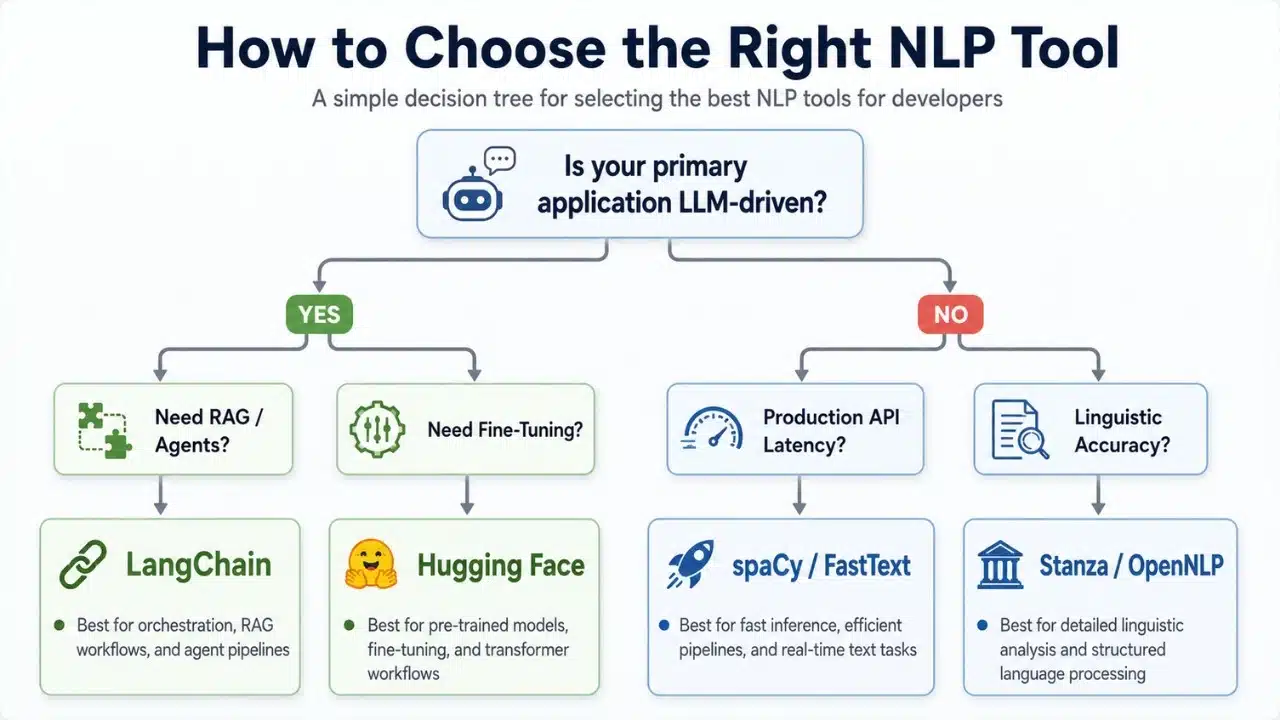
For Real-Time Microservices (Latency < 50ms): Choose spaCy for entity extraction or FastText for text classification. Both run compiled C/C++ code directly, avoiding heavy deep learning execution pipelines.
-
For Generative AI & Context Augmentation: Pair LangChain for context window orchestration with Hugging Face for embedding generation and fine-tuned task heads.
-
For Native Enterprise Java Stacks: Deploy Apache OpenNLP directly within the JVM to prevent cross-language serialization bottlenecks (e.g., Py4J or REST overhead).
Building an Adaptive Natural Language Stack
Modern software engineering rarely relies on a single natural language tool. High-performing AI systems frequently combine multiple specialized frameworks across a single data processing pipeline: leveraging fast, deterministic engines like spaCy or FastText for initial token filtering, named-entity tagging, and multi-class routing, while passing high-value, complex prompts to Hugging Face transformers or LangChain orchestration layers for deep semantic comprehension.
By matching tools to specific computational boundaries—rather than forcing a single library to handle every task—developers can build scalable, low-latency, and cost-effective NLP pipelines tailored to real-world production demands.
Frequently Asked Questions (FAQs)
Why use subword embeddings (FastText) instead of word embeddings (Word2Vec)?
Standard Word2Vec assigns a unique vector to every word in a vocabulary dictionary. If a model encounters a misspelled word or rare term at inference, it returns an “Out-Of-Vocabulary” (OOV) error. FastText breaks words into character $n$-grams, allowing it to calculate meaningful semantic vectors for unseen or misspelled words based on their subword components.
How does spaCy achieve significantly higher speeds than NLTK?
spaCy is written in Cython (C-extensions for Python) and allocates memory directly using C pointers, avoiding Python’s object wrapper overhead and dynamic typing delays. Additionally, spaCy enforces a single, pre-compiled pipeline per language rather than executing dynamic Python script loops.
When should developers choose open-source NLP libraries over Cloud APIs?
Open-source NLP libraries (spaCy, FastText, Hugging Face) provide complete data privacy, offline processing, zero per-request execution costs, and sub-millisecond control over latency. Cloud APIs (e.g., AWS Comprehend, Google Cloud NLP) are better suited for teams lacking machine learning engineering capacity who prefer a managed infrastructure model.