History is not just a series of dates on a calendar; it is a tapestry woven from the triumphs, tragedies, and transformative moments of human existence. Every single day carries the weight of centuries of human endeavor. When we look at August 22, we see a date that has served as the backdrop for royal downfalls, the birth of modern inventions, the sparks of revolutions, and the quiet arrivals of individuals who would go on to shape our cultural landscape.
Whether you are a history buff, a student doing research, or simply someone curious about what makes today special, taking a journey through the historical archives of August 22 offers a fascinating glimpse into the past. In this comprehensive guide, we will explore significant milestones across the globe—from the bustling heart of the Indian subcontinent to the grand stages of Europe and the Americas.
Let’s dive into the defining moments, the famous faces born, and the legends lost on this remarkable day.
The Bangalee Sphere & South Asia
The Indian subcontinent, with its rich, complex, and often tumultuous history, has seen its fair share of pivotal moments on August 22. From colonial milestones to diplomatic maneuvers, this region’s history on this day is both profound and deeply impactful.
Historical Events
-
The Foundation of Madras (1639): On August 22, 1639, the British East India Company purchased a small strip of land on the Coromandel Coast from the local Nayak rulers. This seemingly modest transaction led to the founding of Madras, known today as Chennai. It became a crucial administrative and commercial hub for the British Empire in India, profoundly shaping the region’s colonial history and modern urban landscape.
-
The Mahatma’s Early Activism (1894): Long before he led India to independence, a young Mohandas K. Gandhi was a lawyer in South Africa fighting against racial discrimination. On this day in 1894, Gandhi founded the Natal Indian Congress (NIC). This organization aimed to fight the unfair treatment and protect the rights of Indian traders and laborers in South Africa, marking the genesis of Gandhi’s lifelong commitment to civil rights and non-violent resistance.
-
Diplomatic Tensions and Flood Crises: Fast-forwarding to modern geopolitical events, August 22 has also been a critical date for India-Bangladesh relations. For instance, in August 2024, amidst a severe crisis of unprecedented floods in eastern Bangladesh, Bangladesh’s interim leader Mohammad Yunus held a significant meeting with the Indian High Commissioner to navigate the complex diplomatic fallout, as the Yunus administration blamed India for releasing water.
Global History
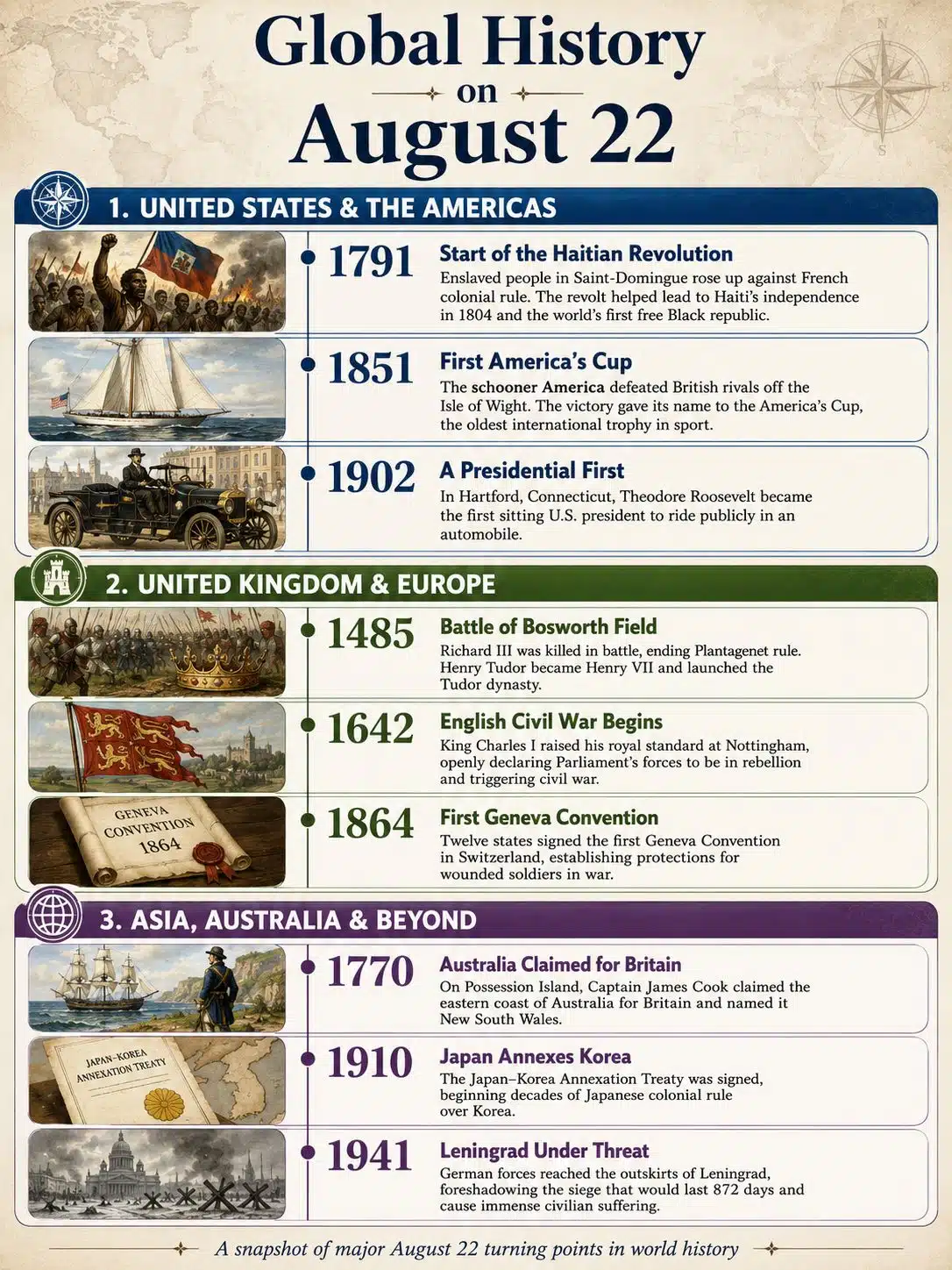
Beyond South Asia, August 22 has been a stage for dramatic shifts in power, revolutionary uprisings, and incredible feats of exploration. Let’s break down these global historical events by region.
United States & The Americas
-
The Start of the Haitian Revolution (1791): One of the most significant and inspiring events in the history of the Americas began on August 22, 1791. Enslaved people in the French colony of Saint-Domingue (modern-day Haiti) rose up against their colonizers. This massive rebellion ultimately led to the founding of Haiti in 1804—the first free black republic in the world and the first independent nation in Latin America.
-
The First America’s Cup (1851): The world of competitive sailing was forever changed when the American schooner America outraced a fleet of British vessels off the coast of England. The trophy won that day became known as the America’s Cup, the oldest and most prestigious international sporting trophy in the world.
-
A Presidential First (1902): Transportation history was made in Hartford, Connecticut, when Theodore Roosevelt became the very first sitting U.S. President to ride in a public automobile, signaling a major shift in American culture and infrastructure.
United Kingdom & Europe
-
The End of the Plantagenets (1485): The bloody Wars of the Roses came to a decisive end at the Battle of Bosworth Field. King Richard III was killed in battle—the last English king to die in combat—and Henry Tudor ascended the throne as Henry VII, birthing the powerful Tudor dynasty.
-
The English Civil War Begins (1642): The tension between the monarchy and Parliament reached a boiling point when King Charles I raised his royal standard at Nottingham. By declaring Parliament and its soldiers traitors, he officially ignited the devastating English Civil War.
-
The First Geneva Convention (1864): In a monumental step forward for international human rights and the rules of war, twelve European nations signed the First Geneva Convention in Switzerland. This treaty established protections for wounded and sick soldiers, fundamentally changing how warfare was conducted globally.
Rest of the World (Asia, Australia & Beyond)
-
Australia Claimed (1770): The famous British explorer Captain James Cook landed on Possession Island and formally claimed the eastern coast of Australia for the British Crown, naming it New South Wales.
-
The Annexation of Korea (1910): Japan formally annexed Korea, beginning a harsh and oppressive period of Japanese colonial rule that would last until the end of World War II in 1945.
-
The Siege of Leningrad Approaches (1941): During the darkest days of World War II, Nazi German troops reached the outskirts of Leningrad (now St. Petersburg, Russia). This marked the grim beginning of the 872-day Siege of Leningrad, one of the longest and most destructive sieges in history, resulting in immense civilian casualties.
Notable Births on August 22
August 22 has seen the birth of brilliant minds across literature, science, the arts, and politics. Here are some of the most influential figures born on this day.
Literary Masters and Creative Visionaries
-
Ray Bradbury (Born 1920): The beloved American author whose works like Fahrenheit 451 and The Martian Chronicles transformed the science fiction genre. Bradbury’s warnings about censorship, technology, and the loss of human connection remain startlingly relevant today.
-
Dorothy Parker (Born 1893): The razor-sharp American poet, writer, and satirist. As a founding member of the legendary Algonquin Round Table, her biting wit and poignant observations on 1920s urban life made her a literary icon.
-
Claude Debussy (Born 1862): The visionary French composer and pianist. Often associated with Impressionist music (though he disliked the term), Debussy’s innovative harmonies and evocative melodies fundamentally changed the course of Western classical music.
-
Henri Cartier-Bresson (Born 1908): The pioneering French photographer who helped establish photojournalism as an art form. He is revered for capturing the “decisive moment”—spontaneous, impeccably timed images that defined modern street photography.
Pioneers in Science and Leadership
-
Deng Xiaoping (Born 1904): The paramount leader of the People’s Republic of China from the late 1970s to the late 1980s. He was the architect of China’s far-reaching economic reforms, transforming the nation into a global economic powerhouse.
-
Denton Cooley (Born 1920): A pioneering American heart surgeon who made medical history by performing the first artificial heart transplant in 1969, pushing the boundaries of cardiovascular medicine.
-
Norman Schwarzkopf Jr. (Born 1934): The highly decorated American general who famously led all coalition forces in the Gulf War in 1991.
Notable Deaths on August 22
Just as this date brought legends into the world, it has also marked the departure of prominent figures who left indelible marks on history.
-
King Richard III (Died 1485): The controversial King of England met his end at the Battle of Bosworth Field. His death brought a close to the Plantagenet dynasty and ushered in the era of the Tudors.
-
Warren Hastings (Died 1818): The first Governor-General of Bengal. While he laid the administrative foundations of the British Empire in India, his aggressive policies led to his impeachment trial in England, highlighting the complex brutality of colonial rule.
-
Robert Gascoyne-Cecil, 3rd Marquess of Salisbury (Died 1903): Serving as Prime Minister of the United Kingdom three times, Lord Salisbury was a towering figure in late Victorian politics, deeply influencing British foreign policy during the height of the Empire.
-
Michael Collins (Died 1922): The brilliant Irish revolutionary leader and tactician was tragically assassinated in an ambush at Béal na Bláth during the bitter Irish Civil War. His death was a devastating blow to the newly emerging Irish Free State.
-
Jomo Kenyatta (Died 1978): The visionary anti-colonial activist and politician who served as the first Prime Minister and then the first President of an independent Kenya, guiding the nation out of British rule.
International Observances & Holidays
While August 22 is heavily anchored in historical events, it is also a day dedicated to modern global observances that reflect our shared human values and ongoing struggles.
-
International Day Commemorating the Victims of Acts of Violence Based on Religion or Belief: Recognized globally, this solemn UN observance serves as a stark reminder of the violence inflicted on individuals because of their faith. It is a day to honor victims, promote tolerance, and advocate for the universal human right to freedom of religion.
-
National Flag Day (Russia): Celebrated in the Russian Federation, this day honors the national tricolor flag, which was officially restored following the collapse of the Soviet Union.
Final Thoughts
The story of August 22 is a spectacular cross-section of the human experience. It is a day that witnessed the birth of creative geniuses like Ray Bradbury and Claude Debussy, and the tragic, violent ends of leaders like King Richard III and Michael Collins. It is a day that changed the map of the world—from the founding of colonial strongholds in India to the passionate fight for freedom in the Haitian Revolution.
By looking back at “On This Day,” we gain a deeper appreciation for the interconnectedness of our global history. The events of August 22 remind us that the actions taken on any single day can ripple outward, shaping nations, sparking artistic movements, and defining the rights we hold dear today.