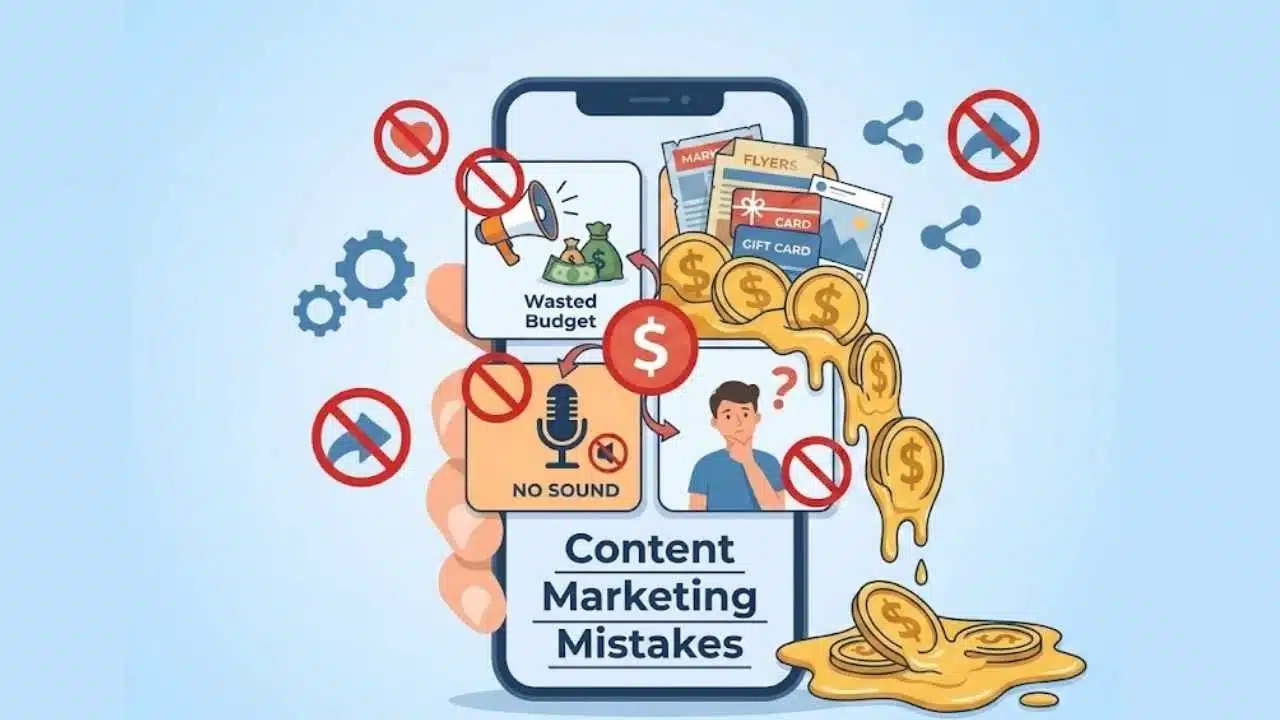
Avoiding costly content marketing mistakes starts with aligning editorial output with clear business intent rather than tracking raw volume alone. Budgets typically drain when teams publish without matching search intent, ignore multi-channel distribution, produce generic unedited AI text, or neglect buyer-journey alignment.
Recent B2B research highlights that resource constraints, poor sales alignment, and failing to prompt user action remain top growth barriers. To maximize return on investment, organizations must shift from vanity metrics like traffic spikes toward revenue-driving indicators—building targeted conversion pathways, updating decaying assets, and optimizing for search engine and generative AI discovery. Eliminating these systemic missteps turns content creation from a ongoing expense into a predictable growth driver.
The Expensive Part Starts Before Production
Writing is only one line in the real content budget. An unnecessary article can consume research time, editing, subject-matter review, design, SEO work, CMS resources, legal approval, distribution, reporting, and management attention.
A more expensive asset can still be economical if sales repeatedly uses it, customers rely on it, or it attracts qualified demand for years. A cheaper article can be expensive if it duplicates three existing pages and creates no useful result.
That changes the question worth asking before commissioning anything.
- Not: How cheaply can we produce this?
- Ask: Why should this asset exist?
1. Publishing Content Without Giving It a Business Job
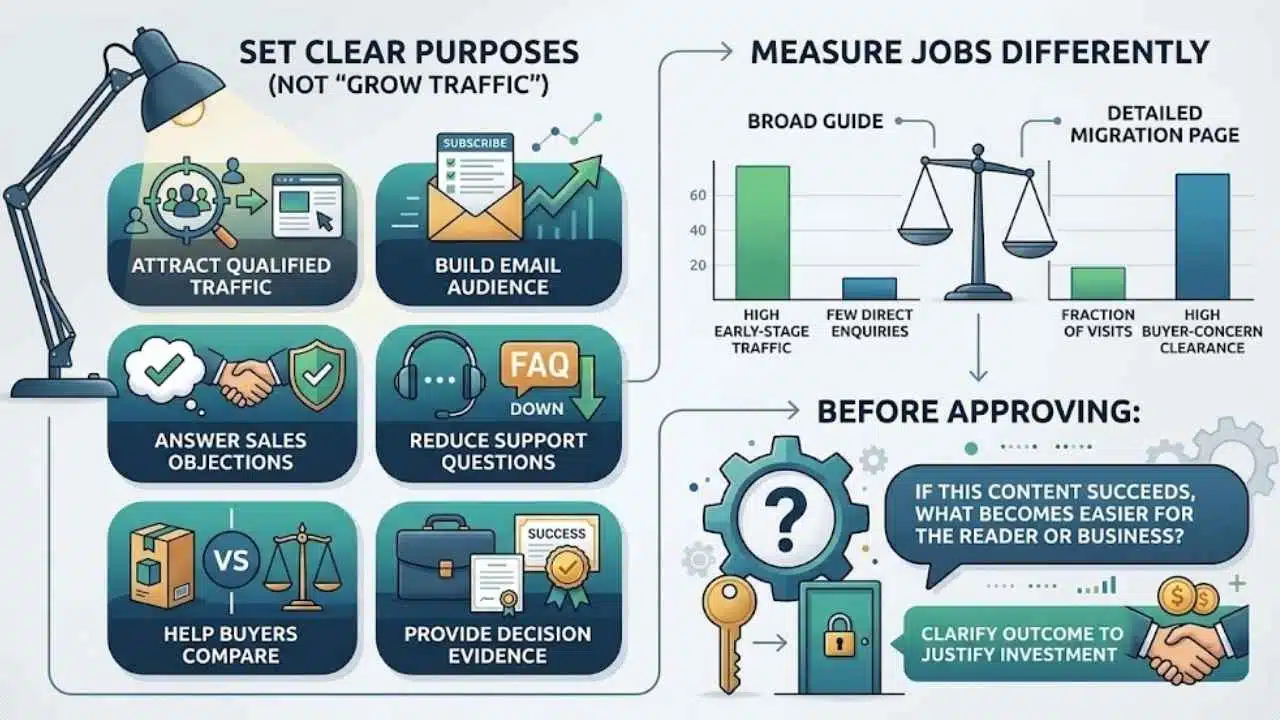
“Grow traffic” is too vague for most commercial content. An asset should have a clearer purpose. It might attract qualified search demand, answer a sales objection, help buyers compare options, build an email audience, explain implementation, reduce repeated support questions, or provide evidence that a customer needs before making a decision.
Those jobs should not be measured the same way. A broad educational guide may bring substantial early-stage traffic and few direct enquiries. A detailed migration page may receive a fraction of the visits but help prospects get past a serious buying concern.
Both can be valuable. The problem begins when the team has no idea which outcome would justify the investment.
Before approving a brief, ask:
If this content succeeds, what becomes easier for the reader or the business? If nobody can answer clearly, the idea probably needs more work.
2. Treating Search Volume as a Content Strategy
Keyword volume shows that people search for something. It does not tell a company whether publishing about that subject is a good use of money.
A large informational keyword may attract people with little connection to what the business sells. A smaller query about migration, compatibility, implementation, pricing, integrations, or a specific operational problem may be much closer to commercial value.
For established sites, Google Search Console can add useful first-party evidence through queries, pages, impressions, clicks, CTR, position, country, and device data. It still does not show every query and should not replace customer research.
Before converting a keyword into an assignment, test three things:
- Audience fit: Is this somebody the business wants to reach?
- Intent: What is the searcher actually trying to do?
- Business fit: Does the organization have expertise, evidence, a product connection, or a useful next step?
Search volume belongs in that decision. It should not make the decision by itself.
3. Confusing the Editorial Calendar With the Strategy
A spreadsheet containing titles, owners, and publishing dates can look impressively organized while hiding the absence of a strategy.
A useful content strategy should answer harder questions:
- Which audiences matter most?
- Which problems deserve investment?
- Where does the business have something credible to contribute?
- Which stages of evaluation are poorly served?
- How will important content reach people?
- What result would make the investment worthwhile?
The calendar comes after those decisions. The difference becomes obvious when business priorities change. If a software company begins targeting enterprise accounts and security reviews start delaying deals, content priorities may need to move toward technical security documentation, implementation guidance, procurement information, and customer proof.
A calendar based on “three articles per week” may simply continue producing three articles per week. Consistency is an operating habit. It is not a strategy.
4. Paying for Commodity Content
This is one of the least defensible uses of a serious content budget. The article may be accurate. It may have good headings, clean grammar, competent SEO, and no obvious problems.
It also may say nothing that ten competing pages have not already said. Google’s people-first guidance asks whether content provides original information, reporting, research, analysis, or meaningful value beyond other results. Its guidance for AI search features also encourages useful, expert-led, non-commodity content that adds something beyond common knowledge.
That does not guarantee rankings, and originality alone is not an SEO strategy. It does set a sensible editorial standard.
Useful differentiation can come from:
- internal data that can responsibly be shared;
- expert input;
- actual product workflows;
- customer questions;
- original examples;
- useful diagrams;
- candid limitations;
- meaningful comparisons;
- primary-source analysis;
- a decision framework competitors have not explained well.
A good warning sign is this: if the article could have been produced without learning anything specific about the company, customer, product, or problem, ask what the budget is paying for.
5. Scaling Production Before Fixing Editorial Governance
Increasing output makes a good production system more productive. It makes a weak one create problems faster. The 2026 CMI research offers a useful example. Among respondents using AI for content creation, 87% reported improved productivity and 80% improved operational efficiency. Only 39% reported improved content performance.
That survey does not prove that AI causes weak performance. It does highlight a distinction marketers often ignore: producing faster and producing something more effective are different achievements.
Before scaling output, somebody needs to own:
- topic approval;
- briefing;
- source verification;
- expert review;
- duplication control;
- editorial standards;
- SEO review;
- publishing QA;
- maintenance.
Without that structure, increased production often creates a larger future bill for rewriting, consolidation, correction, and cleanup. AI has made this problem more visible. It did not invent it.
6. Keeping Sales and Customer Knowledge Out of Planning
SEO tools know what people type into search engines. They do not sit through procurement calls. Sales hears objections. Support knows which instructions repeatedly fail. Customer success sees adoption problems. Implementation teams know where projects stall. Product specialists understand limitations that polished marketing copy sometimes avoids.
That information should influence editorial planning. A B2B software company may not need another broad article about “business automation.” Prospects may repeatedly need answers about migration, permissions, integrations, data residency, onboarding, security review, export options, or contract termination.
Several of those topics may have modest public search volume. They can still be commercially valuable because content has jobs beyond acquiring a first search visit. If the content team rarely speaks with customer-facing teams, fixing that gap may be more valuable than buying another keyword dataset.
7. Overfunding the Top of the Funnel
Educational content is usually easy to approve because it asks little of the company.
“How to improve productivity” is simpler to publish than explaining:
- how long implementation takes;
- what migration involves;
- what the product does not support;
- how two serious alternatives compare;
- what procurement will need;
- what happens when a customer wants to leave.
A library can therefore become enormous at the awareness stage and strangely thin when a buyer starts evaluating. CMI’s 2026 research still identifies buyer-journey alignment as one reported challenge among B2B marketers, although it ranks below problems such as prompting action, resources, and measurement.
The answer is not an artificial rule that every funnel stage deserves the same number of assets. Look at the questions currently slowing buyers down.
8. Publishing First and Planning Distribution Later
Pressing Publish puts an asset on a website. It does not create an audience. Some search-led content can earn discovery over time. Other content needs a deliberate distribution plan from the beginning.
An executive research report may need charts and findings that work on LinkedIn, in presentations, and in email. A technical search guide needs durable depth and search-friendly architecture. Sales enablement may work better as a concise implementation document than a long public article.
Possible distribution routes include search, email, sales outreach, social channels, partnerships, webinars, customer communications, executive distribution, and paid media. Not every asset needs all of them. It does need a plausible route to the people it was created for.
Asking “Where should we share this?” after production often means distribution was treated as promotion rather than part of the content decision.
9. Letting the Library Become a Pile of Isolated URLs
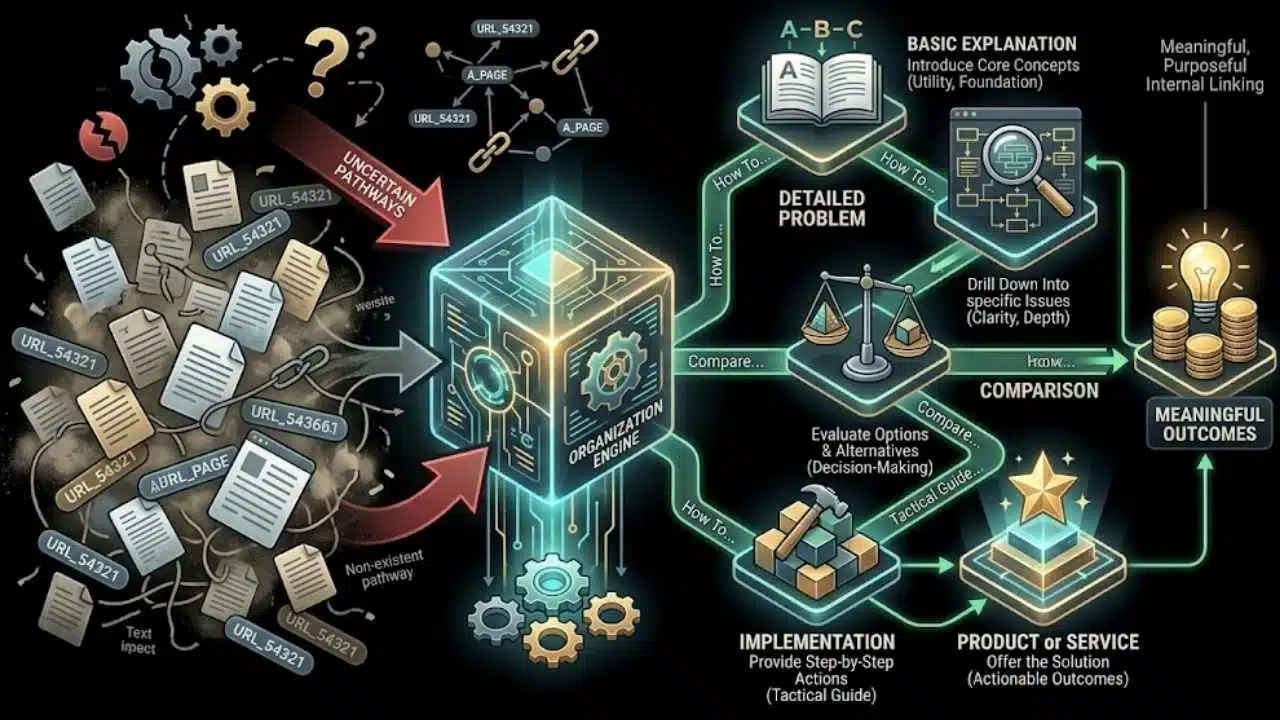
Publishing creates inventory. Without structure, that inventory becomes clutter. Several articles begin answering the same question. Important commercial pages remain poorly linked. Readers finish a useful guide with nowhere sensible to go next.
Google recommends crawlable links so it can discover other pages and descriptive anchor text that helps users and Search understand destinations. That does not mean Google requires a specific pillar and cluster content model or a fixed number of internal links. The stronger reason to organize the library is usefulness.
A reader might naturally move from:
Basic explanation → detailed problem → comparison → implementation → product or service
Build those routes intentionally. Internal linking should reflect relationships between information, not become another quota to satisfy in an SEO checklist.
10. Sending Every Reader to the Same CTA
A person reading an introductory explainer and a prospect comparing vendors are doing different jobs. Sending both directly to Book a Demo makes life easier for marketing operations. It does not necessarily help either reader.
An early-stage visitor may be ready for a related guide, research report, newsletter, webinar, calculator, or checklist. A buyer evaluating solutions may need pricing, specifications, security documentation, implementation details, customer evidence, or direct contact.
This is why weak conversion does not always mean the button needs better copy. Before testing whether “Get Started” beats “Learn More,” check whether the offer matches what the reader is trying to accomplish. Offer fit usually matters more than microscopic CTA optimization.
11. Measuring Content With Traffic Alone
Traffic matters when reach is part of the job. It becomes misleading when it is treated as proof of business value. Depending on the business, a content program may also need to examine qualified traffic, subscriptions, key events, target-account engagement, sales usage, assisted journeys, customer adoption, support impact, or pipeline influence where reliable measurement exists.
Attribution needs similar caution. Google Analytics supports data-driven attribution, which distributes fractional credit across eligible marketing touchpoints using observed path data. It also supports last-click attribution options.
Neither gives a company perfect knowledge of what caused a sale. A long B2B journey can include forwarded links, private messages, calls, meetings, repeated visits, procurement conversations, and offline interactions that analytics does not fully observe.
Use attribution as evidence rather than certainty.
For important content, ask:
- Did the intended audience find it?
- Did it help them do the job it was created for?
- Is sales or customer success using it?
- Does it appear in valuable journeys where measurement is available?
- Is it still worth maintaining?
A large traffic graph is satisfying. It is not automatically ROI.
12. Treating Publication as the End of the Budget
Publishing creates a maintenance obligation. How large that obligation becomes depends on the content. A conceptual explainer may stay accurate for years. Pricing pages, product comparisons, software instructions, statistics, regulations, and technical guidance can age much faster. The common response is another rigid rule: refresh everything every six or twelve months.
That can waste money too.
Prioritize pages with:
- meaningful traffic;
- conversions or sales use;
- valuable backlinks;
- outdated statistics;
- changing product details;
- declining performance;
- overlapping intent;
- technical or regulatory information that can become stale.
Then choose the appropriate action. Some pages need updating. Some should be merged. Some have become obsolete and should be redirected or removed. Others remain accurate and should simply be left alone. Maintenance should respond to value and risk, not the date on a spreadsheet.
Final Thoughts
The most expensive content marketing mistakes occur long before creation begins, typically when keywords are converted into briefs without rigorous scrutiny and publishing volume is mistaken for strategy. Scaling generic output can artificially inflate traffic metrics, but true content ROI depends on upstream decision-making: verifying target audience alignment, ensuring unique brand value, mapping distribution channels, defining conversion goals, and consolidating existing assets before funding new ones.
Industry data confirms that refining overall strategy—rather than simply increasing publishing volume or adopting new technology—is the primary driver of content effectiveness. Sustainable content economics do not stem from producing more material, but from systematically filtering out weak concepts before they drain your marketing budget.