Most SaaS renewal problems begin long before anyone speaks to the vendor. The contract sits in an inbox, no one clearly owns it, and the renewal quote arrives after the cancellation window has already closed.
At that point, negotiating becomes difficult. The vendor knows the company has little time to compare alternatives or move its data elsewhere.
When I look at a SaaS deal, I put the advertised discount aside at first. A low price per user can still produce an expensive agreement if it includes unused seats, unpredictable overages, mandatory support, automatic increases, or a costly exit.
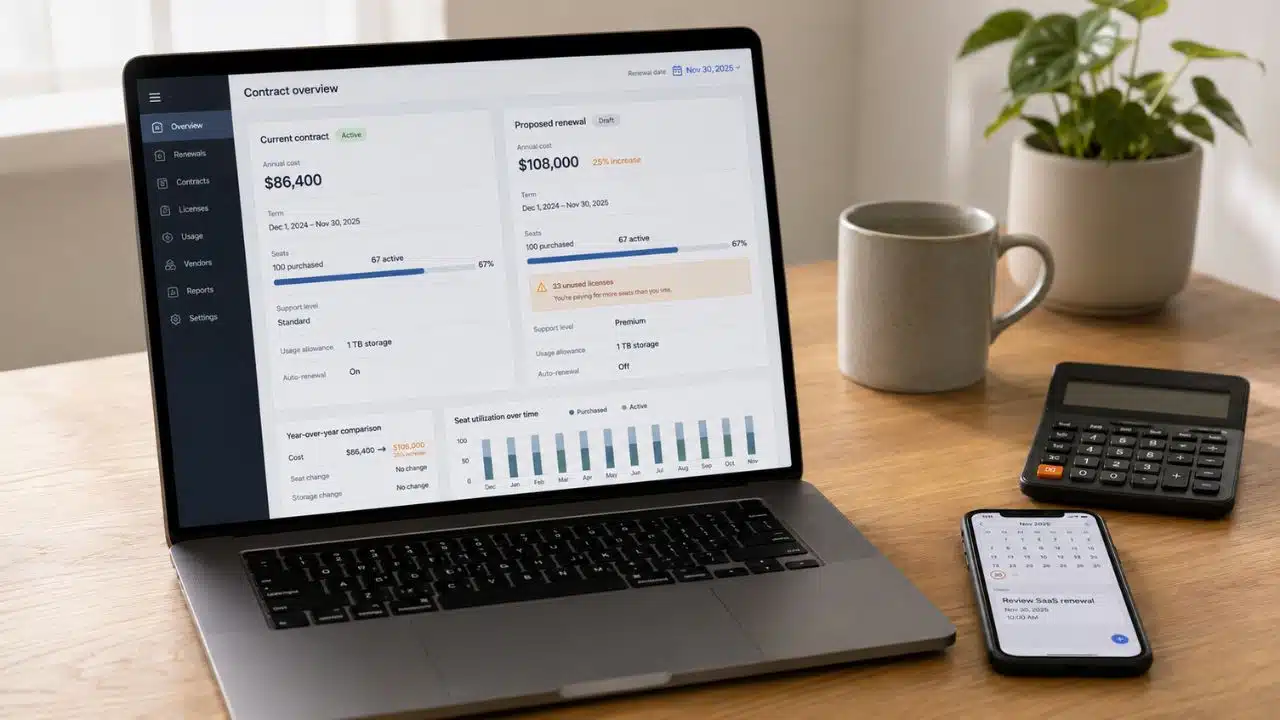
This is not a minor problem. Zylo’s enterprise-focused 2026 SaaS Management Index reported that organizations left an average of 36% of their licenses unused, measured against its recommended utilization levels. The percentage will not apply to every company, but it reflects a common pattern: businesses often negotiate the price before confirming what they actually need.
A good SaaS contract should remain affordable during the term, predictable at renewal, and practical to leave.
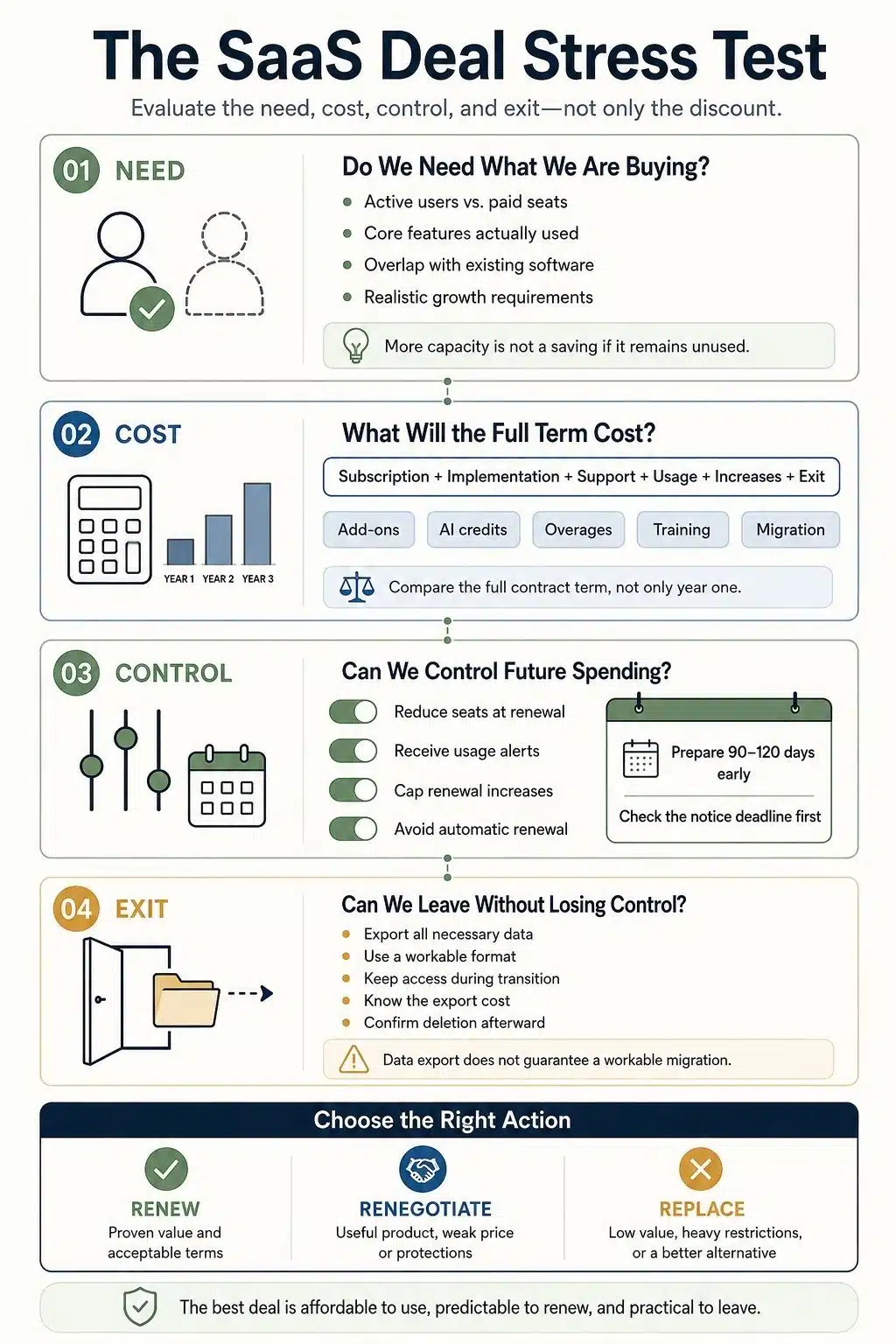
How to Negotiate SaaS Contracts and Renewals
SaaS contract negotiation becomes easier when the buyer has three things: the actual agreement, reliable usage data, and a credible alternative. Without them, the discussion usually comes down to asking the vendor for a discount.
1. Find the Cancellation Deadline Before Discussing Price
The expiration date and the cancellation deadline may be months apart.
A contract that expires on December 31 might require written notice of non-renewal 60 or 90 days earlier. If that deadline passes, the agreement could renew for another full year before the company has decided whether it still wants the product.
Start by collecting the order form, Master Services Agreement, Service Level Agreement, Data Processing Agreement, pricing schedule, support policy, and any online terms incorporated into the deal.
Record:
- The expiration date;
- The automatic-renewal period;
- The non-renewal deadline;
- How notice must be delivered;
- Who must receive it;
- Any scheduled price increase.
The delivery method matters. An email to the account manager may not be valid if the contract requires notice through a customer portal or to a specified legal address.
For a significant renewal, a company may consider sending a protective non-renewal notice before the deadline while discussions continue. The agreement should be checked first so everyone understands whether that notice can later be withdrawn or replaced by a new written renewal.
2. Decide Whether the Software Still Earns Its Place
Before asking what the vendor will charge next year, I ask a more useful question: Would we buy this product again today?
A familiar tool can feel essential because employees have built their routines around it. Familiarity is not proof that the product is still worth its cost.
The internal owner should be able to explain what problem the software solves, who relies on it, and what would stop working without it. It is also worth checking whether another product in the company already covers the same tasks.
High usage does not automatically mean high value. Employees may use an expensive platform every day when a smaller product could support the same workflow. Low usage is not always a reason to cancel either. Seasonal reporting software or a disaster-recovery service may remain important despite infrequent activity.
The decision needs both usage data and business context.
If nobody can explain what the product contributes, negotiating a lower price will not fix the underlying waste.
3. Use Real Usage as Your Starting Point
The vendor knows how many seats the company purchased. The buyer needs to know how many people actively use them.
For seat-based software, compare purchased seats with assigned accounts, monthly active users, and users completing the product’s main action. Look for former employees with active accounts, occasional users holding full licenses, and premium users relying only on basic features.
A login alone is weak evidence. Someone opening a CRM once a month is not using it in the same way as a salesperson managing contacts, updating opportunities, and progressing deals.
Usage-based contracts require a different review. Examine monthly consumption, peak demand, committed units, unused credits, storage charges, API activity, and overages. If possible, compare the vendor’s report with internal records.
This work may reveal that the company can:
- Remove inactive users;
- Move light users to a cheaper license;
- Reassign existing seats;
- Reduce committed consumption;
- Drop an unnecessary add-on;
- Move to a lower product tier.
Avoid buying licenses based on an optimistic hiring forecast. Adding capacity later is usually easier than reducing a commitment after signing.
4. Calculate the Full Cost of the Agreement
The subscription fee is rarely the whole bill.
A proper cost comparison includes implementation, migration, training, support, required add-ons, storage, API usage, AI credits, overages, scheduled increases, and eventual data-export costs.
Calculate those expenses across the full proposed term. A large first-year discount can hide a substantial increase in year two or three.
Bundled offers need the same scrutiny. A vendor may include more users, storage, or features rather than lowering the price. That only creates value when the company expects to use them.
My preference is a smaller, realistic commitment with predictable charges. It is usually safer than a deeply discounted agreement built around more capacity than the business needs.
5. Develop an Alternative the Vendor Will Believe
A threat to switch carries little weight when the vendor knows that switching is impossible.
Research competing products before starting the negotiation. Compare features, integrations, migration effort, security requirements, training needs, and total cost rather than relying only on public prices.
The alternative does not have to be another vendor. A company may be able to move the workflow into software it already owns, reduce the deployment to fewer teams, return to a lower plan, or consolidate two overlapping products.
A credible position is specific:
We are deciding whether to renew 180 licenses, reduce the deployment to 125, or move this workflow into a platform already included in our stack.
That is stronger than threatening to leave without a realistic migration plan. Internal agreement matters just as much. Finance may prioritize price, IT may care about support, and legal may be concerned about data or liability. Settle those priorities before speaking to the vendor.
It helps to separate them into four groups:
- Terms the company requires;
- The preferred outcome;
- Items that can be traded;
- Conditions that would stop the purchase.
One person should lead vendor communication. Casual assurances from other employees can weaken the company’s position before the contract is settled.
6. Negotiate the Pricing Rules, Not Just the Discount
A percentage discount is easy to understand. The pricing rules behind it often matter more.
For a seat-based contract, clarify:
- What counts as a billable user;
- Whether seats can be reassigned;
- When additional seats begin billing;
- Whether true-ups apply retroactively;
- Whether license types can be exchanged;
- What rate applies to future seats;
- Whether quantities can be reduced at renewal.
Reducing the seat count may remove a volume discount and raise the unit price. Compare the total cost before accepting that trade.
For usage-based products, define the unit being measured. “Usage” could mean records, contacts, workflows, tokens, API requests, storage, credits, or completed transactions.
The agreement should state the included allowance, overage rate, alert thresholds, spending limits, credit expiration, and process for disputing a usage calculation.
AI features need a separate check. They may introduce additional credits, premium model charges, different retention rules, or new subprocessors. Review whether customer content can be used for model training and whether that use can be disabled.
Predictable spending may be more valuable than the lowest starting price.
7. Protect the Renewal Price
A good first-year deal loses much of its value if the vendor can raise the price sharply at renewal.
The agreement should state how the renewal price will be calculated, how much it may increase, and how much notice the vendor must provide.
Look beyond a simple percentage cap. The vendor may be able to keep the unit price unchanged while adding a platform fee, removing an included feature, or moving the customer into a new package.
Ask what happens if the contracted product or SKU is discontinued. Without that protection, a price cap may become meaningless after a packaging change.
The automatic-renewal clause also deserves attention. Better options include renewal only through written agreement, a one-year renewal instead of another multi-year term, or a shorter non-renewal notice requirement.
Buyers should start preparing 90 to 120 days ahead. That does not mean they benefit from a contract that forces them to cancel that early.
Auto-renewal laws vary by location and may treat business contracts differently from consumer subscriptions. Do not assume that the law will rescue a missed contractual deadline.
8. Check What Happens When the Service Fails
An uptime percentage means little without a clear measurement method.
As simple annual arithmetic, 99.9% availability allows approximately 8 hours and 46 minutes of downtime. At 99.99%, the allowance falls to about 53 minutes. Actual contractual downtime may differ after scheduled maintenance and other exclusions are applied.
Check how availability is measured, which services are covered, what downtime is excluded, and how quickly the vendor must respond to critical support requests.
Service credits also need context. Some vendors require customers to submit a claim within a short period. Credits may be capped, applied only to future invoices, or made the customer’s only remedy.
That offers limited protection when failures repeatedly disrupt the business. A critical service should have a clear path to termination after serious or repeated failures and, where appropriate, a prorated refund.
9. Make Sure You Can Recover Your Data
The contract should state that the customer retains ownership of its data and gives the vendor only the rights needed to provide the service.
Do not accept a vague promise that data can be exported. Confirm what the export includes and whether the format can be used elsewhere.
A contact list may transfer cleanly through a CSV file. A complex business system may also contain attachments, record relationships, permissions, workflows, configurations, audit logs, and historical activity. Losing those elements can make migration much harder than expected.
Confirm:
- Which data can be exported;
- Available formats;
- Whether attachments and metadata are included;
- How long access remains available after termination;
- Whether the export carries a fee;
- What transition support costs;
- When remaining copies and backups are deleted.
Privacy and security terms should match the sensitivity of the information. Review incident notification, subprocessors, processing locations, access controls, retention, and deletion.
A SOC 2 report or ISO 27001 certification can support due diligence, but neither one replaces clear contractual responsibility.
Liability needs a risk-based review as well. A cap equal to one year of fees may be acceptable for a low-risk tool and inadequate for a system holding sensitive records or supporting a critical operation. High-risk contracts deserve qualified legal review.
When the Vendor Will Not Lower the Price
Some vendors protect their published price more firmly than other terms. If the price will not move, ask for concessions that reduce a real expense or risk.
The most useful options may include:
- Fewer committed licenses;
- Flexible license reassignment;
- Included implementation or migration;
- Additional training;
- Better support;
- More storage or usage capacity;
- Lower overage rates;
- Longer payment terms;
- Renewal price protection;
- Stronger service remedies;
- Free data exports;
- More time to retrieve data after termination.
Extra features are not valuable when nobody needs them. Prioritize concessions the business would otherwise have to pay for.
Read the Final Contract Before Signing
Agreement during a call is not enough. The signed documents must contain the negotiated terms.
Check that the order form shows the correct quantities and prices, discounts apply for the intended period, and renewal language matches the final discussion. Any promised training, support, flexibility, or migration help should appear in writing.
Review linked online policies as well. The agreement should explain which document takes priority if the order form, master agreement, SLA, or online terms conflict.
Once signed, store the contract with its owner, renewal date, notice deadline, and cancellation instructions. Renewal management should begin when the contract is signed, not when the next invoice arrives.
Final Thoughts
A strong SaaS negotiation starts with understanding what the business uses and what it can realistically walk away from. Price matters, but it is only one part of the agreement.
I would rather secure the right number of licenses, predictable renewal costs, meaningful service remedies, and usable data-export rights than accept a larger discount inside a restrictive contract. The best deal is the one the business can afford to use, renew, and eventually leave.
Frequently Asked Questions About SaaS Contract Negotiation
1. How early should I start negotiating a SaaS renewal?
Start the internal review about 90 to 120 days before renewal. Begin earlier when the contract is expensive, the product is difficult to replace, or several teams must complete security and legal reviews. Check the non-renewal deadline before setting the schedule.
2. How much of a SaaS discount should I request?
There is no standard discount that fits every deal. Use actual usage, current market pricing, contract size, alternatives, and commitment length to set a realistic target. A smaller discount with flexible quantities may save more than a larger discount tied to excess licenses.
3. Can a small business negotiate a SaaS contract?
Yes. Smaller buyers may have less influence over a vendor’s standard legal language, but they can still ask for annual-billing discounts, lower setup costs, flexible seats, shorter commitments, better cancellation terms, and protection against renewal increases.
4. Should I accept a multi-year SaaS agreement?
A multi-year agreement is reasonable when the software has already demonstrated value, future demand is predictable, and the vendor provides meaningful price protection or flexibility. Avoid committing based only on a large first-year discount.
5. Which SaaS contract terms matter most?
For most buyers, the key areas are pricing rules, renewal, cancellation, service levels, data ownership, security, liability, termination, and data export. Their importance changes with the product. Downtime may dominate a critical platform, while privacy and portability may matter more for a system holding sensitive or difficult-to-recreate information.