“AI-powered” has become one of the easiest labels to add to software and one of the hardest for buyers to evaluate. It may describe an important capability, a small feature attached to an existing product, or a promise that is still mostly on the roadmap.
I do not think the useful question is whether a product contains “real AI.” Rules-based automation can be the better engineering choice, and a product built on a third-party model can still be valuable. What matters is whether the AI performs an important job, improves the result, and is described honestly.
When the claim is much larger than the contribution, we are looking at AI washing. One warning sign does not prove deception, but a pattern of vague claims, weak evidence, hidden dependencies, and unclear data practices should make a buyer slow down.
How to Spot an AI Product With More Hype Than Substance
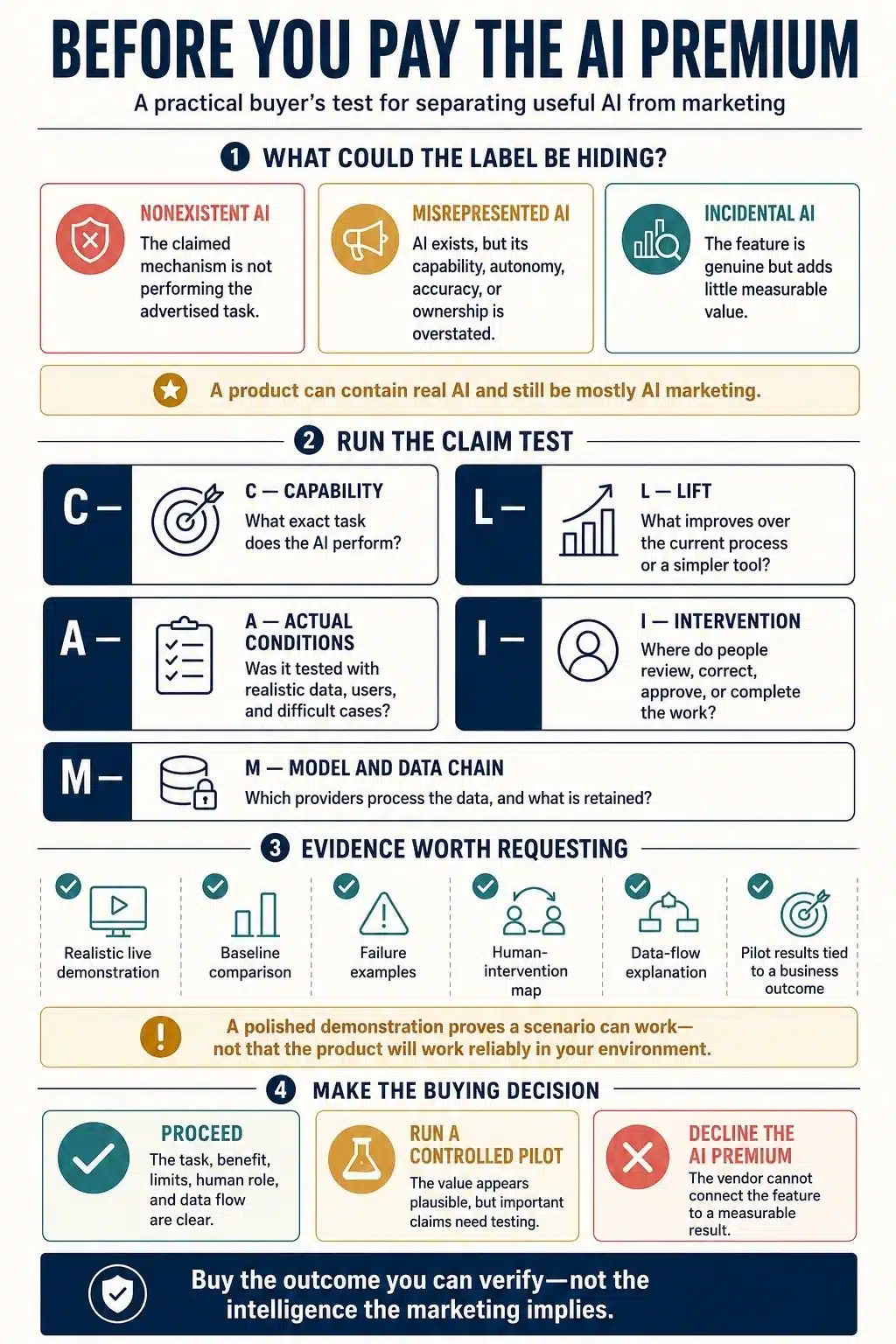
The AI label tells you very little on its own. To judge the product, look at the task the technology performs, the improvement it produces, the conditions under which it was tested, and what happens when it fails. These ten signs help separate a useful product from an oversized marketing story.
1. The Company Cannot Explain What the AI Actually Does
Words such as “intelligent,” “agentic,” “adaptive,” and “AI-native” describe an image, not a function.
A useful explanation identifies the information entering the system, the task performed by the model, the output it produces, and where a person or another process takes over. “The model classifies support tickets and recommends a queue” is testable. “Our intelligent platform transforms customer operations” is not.
The vendor does not need to reveal source code or trade secrets. It should be able to answer one basic question: Which exact step uses AI, and what happens immediately before and after it?
2. The Product Would Barely Change Without the AI
Many established tools now include a summary button, chatbot, or writing assistant. The feature may use genuine AI and save some time, but that does not make AI central to the product.
I become skeptical when a minor feature dominates the homepage and supports a higher price while the core workflow remains almost unchanged. Imagine the feature switched off. Would customers still buy the product for the same reason and get much the same result? If so, the AI is probably an accessory rather than the engine.
That is not automatically bad. It simply means the marketing should reflect the feature’s actual importance.
3. The Claims Describe the Roadmap, Not the Current Product
AI marketing often blurs the boundary between what works now and what may arrive later. A controlled demonstration becomes a product capability. A beta is presented as ready. Planned autonomy is discussed as though every customer already has it.
Check whether the feature is generally available, limited to selected accounts, manually activated, or restricted to an enterprise plan. Ask what “autonomous” means in practice. Does the system complete the task, or does it suggest an action that a person must approve?
An ambitious roadmap is reasonable. Charging buyers for the polished future version shown in a concept video is not.
4. Performance Claims Come Without a Baseline
An accuracy figure means little without context. The same applies to claims such as “10 times faster” or “80% lower cost.” Buyers need to know what was measured, which data was used, what the comparison was, and how failures were counted.
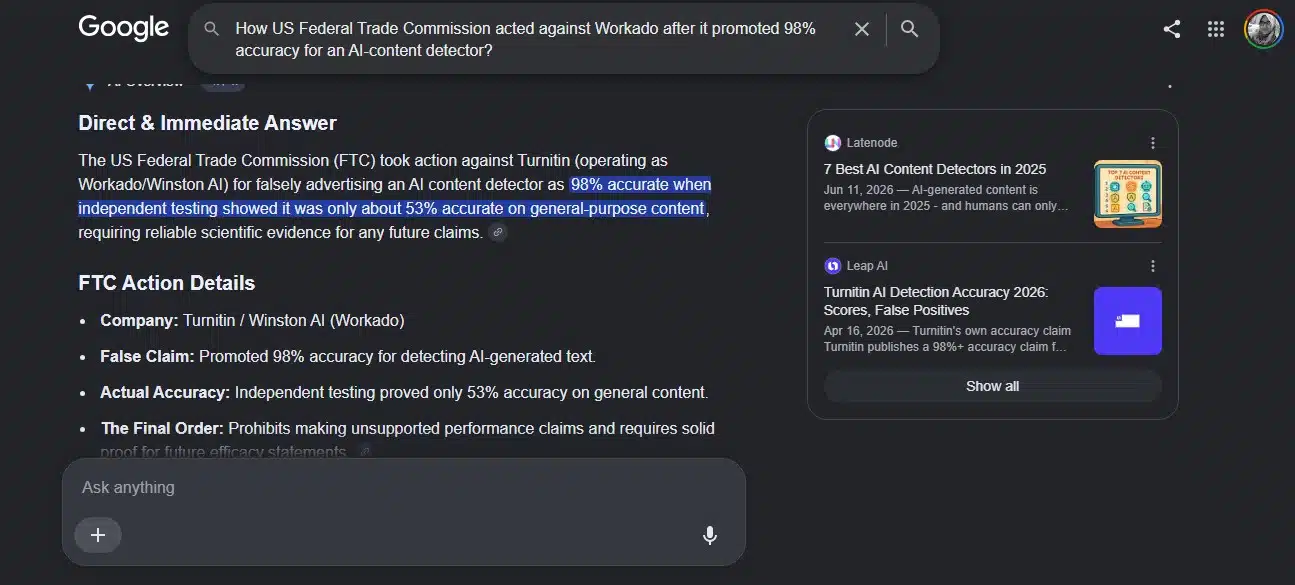
The US Federal Trade Commission acted against Workado after it promoted 98% accuracy for an AI-content detector. According to the FTC, independent testing produced 53% accuracy on general-purpose content. The final order requires reliable evidence for future efficacy claims.
Even an honestly calculated number can mislead when it comes from clean, vendor-selected data. A document extractor tested on neat digital invoices may perform very differently with scans, unusual layouts, handwritten notes, or multiple languages.
Ask the vendor: What does this number measure, what is the baseline, and can we reproduce the result with our data?
5. The Demo Avoids Messy Inputs and Failures
A smooth demonstration proves that the happy path works. It does not show how the product handles daily reality: incomplete fields, noisy recordings, duplicate records, vague instructions, unsupported formats, or users who do not write perfect prompts.
For a serious evaluation, include representative data and difficult cases. Then look beyond the first output. Can a person correct an error, trace what happened, retry the task, or escalate it? Does the system signal uncertainty, or does it present every answer with the same confidence?
The recovery process often matters more than the most impressive demo.
6. Human Work Is Hidden Behind Claims of Autonomy
Human review does not make an AI product fake. In healthcare, finance, hiring, security, and other consequential areas, oversight may be responsible design. The problem is selling autonomy while people quietly complete or correct much of the work.
The SEC’s settled action against Presto Automation addressed misleading statements about its drive-through AI, including the extent to which it eliminated human order-taking. In a separate case involving the shopping app Nate, the SEC alleged that contractors manually processed purchases to a substantial degree despite claims of AI-powered automation. The Nate case remains an allegation rather than a final finding.
Buyers should ask what proportion of tasks finishes without intervention, who handles the rest, and whether that labor is included in the quoted cost and delivery time. Undisclosed human work affects privacy, speed, margins, and the product’s ability to scale.
7. “Proprietary AI” Replaces a Clear Explanation of Value
Using an external model is not a weakness by itself. A company can build substantial value around it through better workflow design, retrieval, permissions, evaluation, integrations, monitoring, or industry knowledge.
The warning sign is a vendor implying deep ownership while being unable to explain what its product adds. Ask what would remain distinctive if the underlying model provider changed. A strong answer may include specialized data used with permission, reliable evaluations, careful controls, or a difficult workflow handled well. If the answer amounts to a prompt and a new interface, the AI premium deserves scrutiny.
8. The Vendor Will Not Discuss Limits
Every AI system has boundaries. It may struggle with certain languages, data formats, industries, user groups, or high-risk decisions. It may need human review when confidence is low.
Credible vendors can describe those limits. NIST guidance similarly emphasizes specific tasks and intended uses, knowledge limits, human oversight, and evaluation under conditions that resemble deployment.
I trust a company more when it can say, “Do not use this feature for that case.” A team that can name no failure mode is probably describing an aspiration rather than an operating product.
Ask: When should we not use this feature, and how does it signal uncertainty?
9. The Data and Model Chain Is Unclear
An AI feature may send prompts, files, recordings, customer records, or employee information beyond the product the buyer originally selected. That data path is part of the purchasing decision.
Before using real information, find out what enters the system, which providers or subprocessors receive it, how long it is retained, and whether it can be used to improve models. Ask how the company handles changes to an underlying provider or model version, since a silent switch can affect output quality without changing the interface.
Compare the sales claims with the privacy notice, security documentation, data-processing terms, and contract. If they tell different stories, request written clarification.
10. The AI Premium Is Not Connected to a Valuable Result
This is the simplest test: does the AI-enabled version produce an improvement worth paying for?
The benefit should connect to work that matters, such as fewer corrections, faster completion, better retrieval, lower operating cost, or improved quality at an acceptable risk level. “Unlimited generations” is a usage allowance, not a business outcome.
Set a baseline before the trial. Choose one or two success measures and include the time spent reviewing, correcting, integrating, and recovering from errors. A system that produces an answer in seconds but requires ten minutes of checking may not save time at all.
If the vendor cannot connect the premium to a measurable result, I would treat the AI label as positioning rather than justification.
Buy the Outcome, Not the AI Label
A product can use genuine AI and still exaggerate its importance, independence, accuracy, or value. That is why proving that a model exists does not settle the buying decision.
The stronger product is the one whose vendor can explain the task, support its claims, show the difficult cases, disclose meaningful dependencies, and demonstrate an improvement in your workflow. When those answers remain vague, the marketing has not earned the premium.
Frequently Asked Questions on AI Washing
1. What is AI washing?
AI washing is the practice of overstating the role, ownership, autonomy, maturity, performance, or value of AI in a product or service. The technology may be absent, misrepresented, or real but too minor to justify the way it is marketed.
2. Is an AI wrapper automatically a bad product?
No. A product built on a third-party model can add real value through workflow integration, domain knowledge, retrieval, evaluation, security controls, or better usability. The concern is weak differentiation combined with misleading claims.
3. How can I test an AI product before buying it?
Run a limited pilot with representative data and difficult cases. Set a baseline first, then record output quality, completion time, corrections, human effort, failures, and recovery. Test data handling and export as well as the visible AI result.
4. Does a vendor have to reveal which AI model it uses?
Not always. A vendor may have legitimate commercial or security reasons not to name every component. It should still explain the feature’s purpose, limitations, important dependencies, data handling, and model-change practices well enough for an informed decision.
5. Can a product use real AI and still be mostly marketing?
Yes. The AI may handle a decorative or low-value task, produce no measurable improvement, or depend on more human work than the sales pitch suggests. Genuine technology does not automatically make the product useful or the premium worthwhile.