If you were to take a cross-section of world history and examine a single day, August 14 would reveal some of the most profound turning points in the human story. This date is a remarkable tapestry of shifting empires, the birth of modern social contracts, the end of the deadliest conflict in human history, and the arrival of cultural icons who would forever change the landscape of sports, cinema, and literature.
From the sweltering, tense midnight hours in the Indian subcontinent in 1947, to the triumphant shouts echoing across Times Square in 1945, August 14 is a day of profound beginnings and dramatic endings. It is a day that witnessed the signing of laws that lifted millions out of poverty, and the quiet spiritual ceremonies that sparked bloody, triumphant revolutions.
As we pull back the curtain on this day, we won’t just list what happened. We are going to explore why it matters, diving deep into the historical context, the cultural ripples in the Bangalee sphere and beyond, and the fascinating lives of the people who were born or drew their last breath on this exact calendar day.
Grab a cup of coffee, settle in, and let’s travel back in time to explore the incredible history of August 14.
At a Glance: Major Historical Events on August 14
To understand the sheer weight of this date, here is a quick reference guide to the global milestones that occurred on August 14.
| Year | Event | Region/Country | Impact / Significance |
| 1040 | King Duncan I is killed in battle | Scotland | Sparked a shift in Scottish royalty; later immortalized by Shakespeare’s Macbeth. |
| 1791 | The Bois Caïman Ceremony | Saint-Domingue (Haiti) | The spiritual catalyst for the Haitian Revolution, leading to the first free Black republic. |
| 1880 | Cologne Cathedral completed | Germany | Construction finally ended after 632 years, symbolizing German unity and Gothic architecture. |
| 1917 | China declares war on Central Powers | China | Attempted to secure a voice in post-WWI negotiations by aiding the Allies. |
| 1935 | Social Security Act signed into law | United States | FDR established a federal safety net, fundamentally changing the American social contract. |
| 1941 | The Atlantic Charter is issued | UK & USA | Churchill and FDR laid the foundational blueprint for the post-WWII world and the UN. |
| 1945 | V-J Day (Victory over Japan) | Global | Japan surrenders, effectively ending World War II after years of unprecedented devastation. |
| 1947 | Pakistan Independence | Indian Subcontinent | The British Partition takes effect, creating Pakistan and displacing millions. |
| 1980 | Gdańsk Shipyard Strike begins | Poland | Lech Wałęsa leads a strike that births the Solidarity movement, cracking Soviet dominance. |
| 2003 | Northeast Blackout | USA / Canada | A massive power grid failure leaves 50 million people without electricity. |
Global History: Empires, Revolutions, and Resolutions
1. The Partition of the Subcontinent and the Birth of Pakistan (1947)
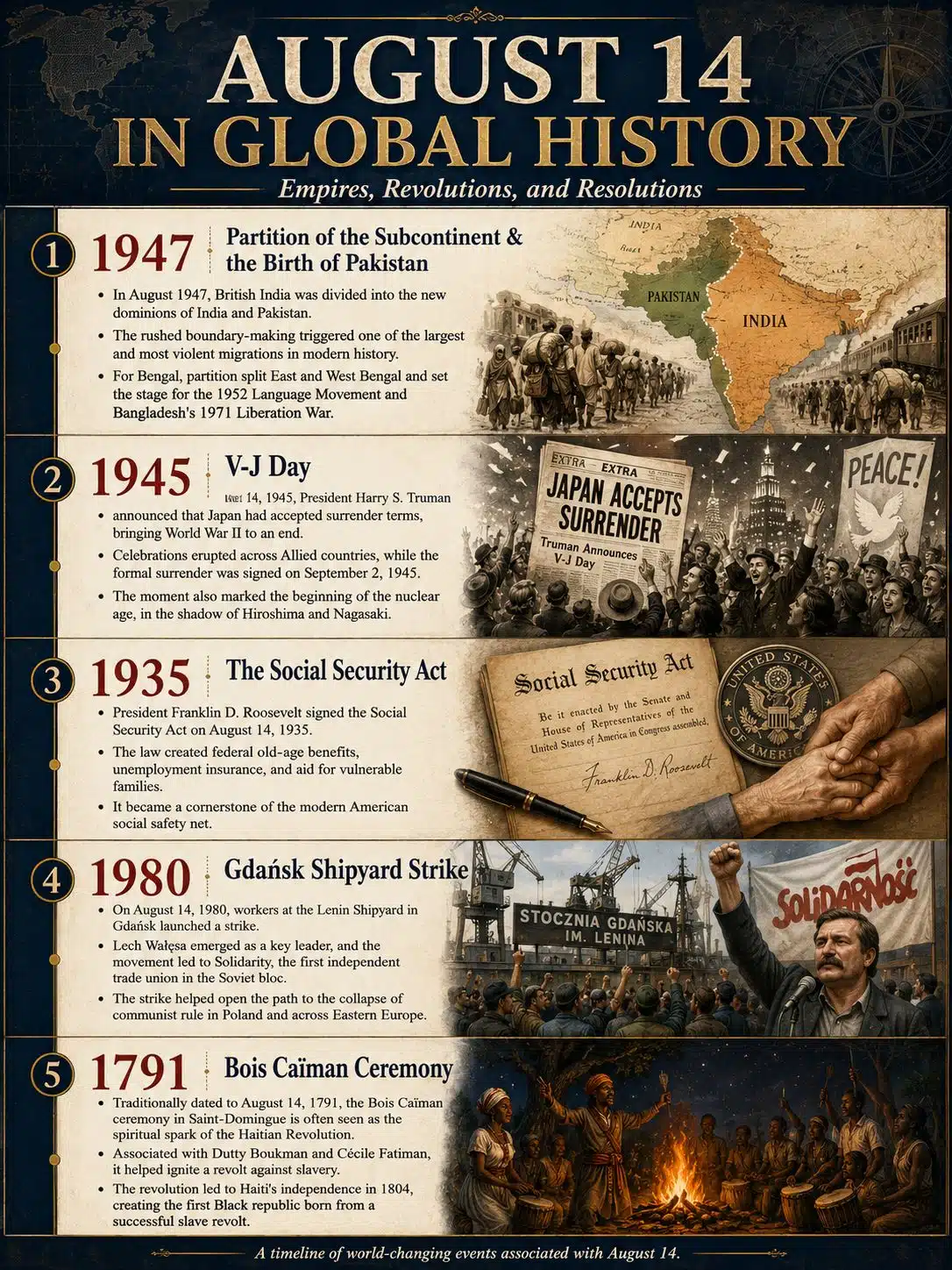
Perhaps no event on this day carries as much lingering geopolitical weight as the midnight hour of August 14, 1947. After centuries of colonial rule, the British Empire finally relinquished control of the Indian subcontinent. However, the exit was hasty and deeply flawed. The Mountbatten Plan, executed by the Radcliffe Boundary Commission, brutally carved the territory along religious lines, creating the independent dominions of India and Pakistan.
Pakistan officially celebrates its independence on August 14. But this birth came with an unimaginable human cost. Millions of Muslims, Hindus, and Sikhs found themselves on the “wrong” side of the newly drawn borders. The ensuing migration was one of the largest and most violent in human history, with casualty estimates ranging from 200,000 to over two million.
The Bangalee Sphere Impact:
For the people of Bengal, this day split their ancient, culturally rich homeland in two: West Bengal (joining India) and East Bengal (joining Pakistan, later becoming East Pakistan). The geographical absurdity of a nation split by 1,000 miles of Indian territory, combined with West Pakistan’s immediate political and economic marginalization of the Bengali people, sowed the seeds of rebellion. The cultural suppression that began in the wake of August 14, 1947, directly led to the 1952 Language Movement (Bhasha Andolon) and ultimately, the bloody 1971 Liberation War that birthed the independent nation of Bangladesh.
2. The End of the Deadliest War in History: V-J Day (1945)
On August 14, 1945 (in the US time zone), President Harry S. Truman addressed a weary, battered world to announce that the Empire of Japan had accepted the terms of the Potsdam Declaration and surrendered unconditionally. World War II, a conflict that had claimed an estimated 70 to 85 million lives, was finally over.
The announcement triggered an eruption of joy across the Allied nations. In New York’s Times Square, millions flooded the streets in impromptu celebrations, immortalized by Alfred Eisenstaedt’s famous photograph of a sailor kissing a nurse. However, the victory was deeply complex, coming just days after the devastating atomic bombings of Hiroshima and Nagasaki, which ushered humanity into the terrifying reality of the nuclear age.
3. The Blueprint of the Modern Safety Net: The Social Security Act (1935)
In the throes of the Great Depression, with unemployment soaring and the elderly facing abject poverty, President Franklin D. Roosevelt signed the Social Security Act. It was a monumental piece of New Deal legislation drafted largely by Secretary of Labor Frances Perkins—the first woman to hold a US cabinet position.
Before this day, the United States had no federal system to care for its vulnerable citizens. The act created a system of old-age pensions, unemployment insurance, and aid to families with dependent children. It fundamentally shifted the philosophical relationship between the American government and its citizens, declaring that a civilized society has a moral obligation to protect its people from the “hazards and vicissitudes of life.”
4. Cracks in the Iron Curtain: The Gdańsk Shipyard Strike (1980)
In the communist bloc of Eastern Europe, dissent was typically met with swift and brutal suppression. But on August 14, 1980, an electrician named Lech Wałęsa climbed over the fence of the Lenin Shipyard in Gdańsk, Poland, to join and lead thousands of striking workers. They were protesting rising food prices and the dismissal of a fellow worker, Anna Walentynowicz.
This localized strike rapidly escalated into a national movement, leading to the creation of Solidarność (Solidarity)—the first independent labor union recognized in a Warsaw Pact country. The movement gained ten million members and became an unstoppable force for anti-communist resistance. The bravery displayed on this day in 1980 initiated a domino effect that culminated in the fall of the Berlin Wall and the collapse of the Soviet Union a decade later.
5. The Spiritual Roots of Revolution: The Bois Caïman Ceremony (1791)
On the night of August 14, 1791, in the densely wooded area of Bois Caïman in the French colony of Saint-Domingue, enslaved Africans gathered in secret. Led by a Vodou priest named Dutty Boukman and a priestess named Cécile Fatiman, the group conducted a deeply spiritual and highly political ceremony.
They swore an oath to break the chains of their enslavement. Within days of this ceremony, the plantations were in flames, and the Haitian Revolution had begun. It remains the most successful slave rebellion in human history, ultimately defeating the armies of France, Britain, and Spain, and resulting in the creation of the Republic of Haiti in 1804.
Famous Birthdays on August 14
The 14th of August has been the entry point into the world for an extraordinary array of individuals who would go on to shape science, literature, sports, and entertainment.
At a Glance: Notable Births
| Name | Year | Nationality | Profession & Legacy |
| Doc Holliday | 1851 | American | Wild West icon, gambler, and gunfighter (O.K. Corral). |
| John Galsworthy | 1867 | English | Novelist and playwright; won the 1932 Nobel Prize in Literature. |
| Ernest Everett Just | 1883 | American | Pioneering biologist who revolutionized our understanding of cell division. |
| David Crosby | 1941 | American | Legendary folk-rock musician (The Byrds; Crosby, Stills & Nash). |
| Steve Martin | 1945 | American | Iconic comedian, actor, author, and banjo virtuoso. |
| Magic Johnson | 1959 | American | NBA Hall of Famer, entrepreneur, and prominent HIV/AIDS activist. |
| Halle Berry | 1966 | American | History-making actress; first Black woman to win the Best Actress Oscar. |
| Mila Kunis | 1983 | Ukrainian-American | Acclaimed actress known for That ’70s Show and Black Swan. |
Deep Dive into the Lives Born Today
Earvin “Magic” Johnson (b. 1959): Born in Lansing, Michigan, Magic Johnson revolutionized the game of basketball. Standing at 6’9″, he possessed the size of a forward but the court vision and passing ability of a point guard. He led the “Showtime” Los Angeles Lakers to five NBA championships in the 1980s. Beyond sports, his public announcement in 1991 that he had contracted HIV changed the global conversation around the virus, helping to dismantle stigmas and raising millions for research. Today, he is a highly successful billionaire entrepreneur.
Halle Berry (b. 1966): Born in Cleveland, Ohio, Halle Berry broke one of Hollywood’s most enduring color barriers. After a successful career in modeling and critically acclaimed roles in films like Introducing Dorothy Dandridge, she starred in Monster’s Ball (2001). Her performance earned her the Academy Award for Best Actress, making her the first—and as of the time of this writing, still the only—woman of color to win that specific category. Her tearful acceptance speech remains a historic moment for representation in cinema.
Ernest Everett Just (b. 1883): An unsung hero of the scientific world, E.E. Just was born in Charleston, South Carolina. Despite facing immense racial prejudice that severely limited his opportunities in American academia, Just became a pioneering marine biologist and zoologist. He made foundational discoveries regarding the fundamental role of the cell surface in the development of organisms and fertilization. Finding greater acceptance in Europe, he conducted groundbreaking research in Italy, Germany, and France, cementing his legacy as one of the most brilliant scientific minds of the 20th century.
Steve Martin (b. 1945): Born in Waco, Texas, Steve Martin completely dismantled and rebuilt stand-up comedy in the 1970s with his absurdist, prop-heavy, anti-comedy routines. After walking away from stand-up at the height of his fame, he became one of the most beloved comedic actors of his generation (The Jerk, Planes, Trains & Automobiles), a brilliant playwright, an accomplished author, and a Grammy-winning bluegrass musician.
Famous Deaths on August 14
Just as this day has welcomed greatness, it has also bid farewell to historical giants, tycoons, and cultural pioneers.
At a Glance: Notable Deaths
| Name | Year | Nationality | Legacy / Cause of Death |
| King Duncan I | 1040 | Scottish | King of Scots, killed in battle against Macbeth’s forces. |
| Pope Pius II | 1464 | Italian | Humanist Pope who tried to unite Europe against the Ottoman Empire. |
| William Randolph Hearst | 1951 | American | Publishing tycoon who created the largest newspaper chain; inspiration for Citizen Kane. |
| Herman Hupfeld | 1951 | American | Songwriter best known for composing “As Time Goes By” (featured in Casablanca). |
| Enzo Ferrari | 1988 | Italian | Legendary auto racing driver and founder of the Ferrari automobile marque. |
| Czesław Miłosz | 2004 | Polish | Poet, prose writer, and translator; won the 1980 Nobel Prize in Literature. |
| Shohei Imamura | 2006 | Japanese | Renowned film director; one of only a few to win the Palme d’Or at Cannes twice. |
Remembering the Departed
Enzo Ferrari (1898 – 1988): “Il Commendatore” passed away on this day in Maranello, Italy, at the age of 90. Enzo Ferrari was a man consumed by a singular passion: racing. He founded the Scuderia Ferrari Grand Prix motor racing team, and only began building road-legal cars to fund his racing endeavors. Despite his reluctance to be a commercial automaker, the Ferrari brand became the global symbol of automotive passion, luxury, and blistering speed. His death marked the end of an era for motorsport.
William Randolph Hearst (1863 – 1951): Passing away at the age of 88, Hearst was one of the most powerful and controversial figures in American media history. He built the nation’s largest newspaper chain and profoundly influenced American journalism, championing “yellow journalism”—a style of sensationalized, exaggerated reporting that helped push the United States into the Spanish-American War. His massive wealth, political ambitions, and secluded life at Hearst Castle served as the direct inspiration for Orson Welles’ cinematic masterpiece, Citizen Kane.
King Duncan I of Scotland (1001 – 1040): While Shakespeare portrayed Duncan as an elderly, benevolent king murdered in his sleep by a treacherous host, history paints a different picture. The real Duncan was a young, aggressively ambitious monarch whose reign was marked by disastrous military campaigns. He was killed in a skirmish on August 14, 1040, by the forces of his cousin, Macbeth, who then took the throne and ruled relatively peacefully for 17 years.
International Observances, Holidays & Festivals
Beyond historical anniversaries, August 14 is marked by annual celebrations and observances around the globe.
-
Pakistan Independence Day (Youm-e-Azadi): Across Pakistan and its global diaspora, August 14 is a day of fervent patriotism. The day is celebrated with the hoisting of the green and white national flag, changing of the guard at national monuments, military parades, and spectacular fireworks. Streets are illuminated, and citizens dress in national colors to commemorate their sovereignty.
-
Pramuka Day (Indonesia): Indonesia boasts the largest Scouting movement in the world. August 14 marks Hari Pramuka (National Scout Day), celebrating the establishment of the Gerakan Pramuka (Scout Movement) in 1961 by President Sukarno. It is a day of massive outdoor camps, community service, and youth leadership activities.
-
Falklands Day: In the Falkland Islands, this day celebrates the first recorded sighting of the islands in 1592 by the English explorer John Davis.
Did You Know? 3 Fascinating Trivia Facts About August 14
Looking for some interesting conversation starters? Here are a few lesser-known events that occurred on this day:
-
The First Indy 500 Track Event Wasn’t for Cars: The legendary Indianapolis Motor Speedway, known worldwide as the “Brickyard,” hosted its very first motorized racing event on August 14, 1909. However, the vehicles zooming around the track weren’t automobiles—they were motorcycles. The race was organized by the Federation of American Motorcyclists.
-
Americans Could Finally Own Gold Again: During the depths of the Great Depression in 1933, President FDR effectively made it illegal for private citizens to hoard or own gold bullion, forcing them to sell it to the Federal Reserve to stabilize the economy. Over 40 years later, on August 14, 1974, President Gerald Ford signed legislation restoring the right of U.S. citizens to privately own, buy, and sell gold.
-
The Largest Blackout in North American History: On August 14, 2003, a seemingly minor software bug in an Ohio power company’s control room triggered a cascading failure across the electrical grid. Within hours, 50 million people across the Northeastern United States and Ontario, Canada, were plunged into total darkness. New Yorkers famously slept on sidewalks and walked across bridges as public transit halted entirely.
Quote of the Day
“A day without sunshine is like, you know, night.”
— Steve Martin (Born August 14, 1945)
This perfectly dry, absurdist humor encapsulates the genius of Steve Martin, whose birthday we celebrate today. It is a reminder that amidst the heavy, world-altering events of history, there is always room for a laugh.
Final Thoughts
From the shifting of continental empires and the tragedy of violent borders to the triumph of cinematic history and the roar of a Ferrari engine, August 14 is a microcosm of the human experience. It is a day that forces us to look at how the geopolitical decisions of the past—like the stroke of a pen drawing a map in 1947, or the signing of a social contract in 1935—continue to govern our daily lives in the present.
History is rarely created in a vacuum. The events, births, and even the deaths that have occurred on this day weave a continuous thread from the past to our modern world. Whether we are turning on a light switch and taking the power grid for granted, collecting a retirement pension, or watching a trailblazing film, the echoes of August 14 are all around us.