History is not merely a collection of dates and faded records; it is the living memory of our civilization. Every day of the calendar holds centuries of triumph, tragedy, and transformation. As an expert historian, cultural anthropologist, and archivist, I invite you to travel back in time to explore the fascinating tapestry of August 13.
From the shifting political landscapes of colonial India to the erection of the Berlin Wall, from the birth of cinematic masters to the tragic loss of pioneering visionaries, August 13 is a date brimming with human achievement and sorrow. In this comprehensive “On This Day” report, we will journey across continents. We will honor the rich heritage of the Bangalee sphere, traverse the historical milestones of the global stage, and reflect on the observances that unite us today.
Let us dive deep into the annals of history and uncover the events that shaped the world as we know it.
The Bangalee Sphere
The Indian subcontinent, with its profound history of colonial resistance, cultural renaissances, and complex geopolitical shifts, has witnessed highly significant events on August 13.
Historical Events
-
1784: Pitt’s India Act is Passed: On this day, the British Parliament passed the East India Company Act, historically known as Pitt’s India Act (named after British Prime Minister William Pitt the Younger). The Regulating Act of 1773 had proven disastrously ineffective at controlling the corruption and mismanagement within the East India Company. Pitt’s India Act established a Board of Control in London, effectively placing the Company’s political and administrative operations in India under the direct supervision of the British government. This fundamentally altered the nature of British imperialism in the subcontinent, turning a corporate monopoly into an arm of the British state.
-
1947: The Eve of the Great Divide: By August 13, 1947, the subcontinent was a powder keg. Just two days before India’s independence and one day before Pakistan’s formation, tensions were at their absolute peak. Mahatma Gandhi, famously refusing to participate in the independence celebrations in Delhi, moved into “Hydari Mansion” in a riot-ravaged area of Calcutta (now Kolkata). His goal was to undertake a fast to quell the intense communal violence tearing Bengal apart.
-
1994: Kolkata Metro Expansion: An important infrastructural milestone in Bengal’s modern history occurred when the Kolkata Metro, India’s oldest rapid transit system, successfully extended its Dum Dum-Belgachia branch by 1.62 kilometers to reach Shyambazar. This significantly eased transit through one of the city’s most congested northern corridors.
Famous Births
| Name | Year | Profession & Legacy |
| Romesh Chunder Dutt | 1848 | An eminent Bengali civil servant, economic historian, and writer. He famously translated the Ramayana and Mahabharata into English and wrote deeply on the economic exploitation of India under British rule. |
| Dr. Phulrenu Guha | 1911 | A dedicated Bengali politician and social activist who worked tirelessly for women’s empowerment and child welfare in post-independence India. |
| Sridevi | 1963 | Widely regarded as the “First Female Superstar” of Indian cinema. Though born in Tamil Nadu, her monumental impact on Bollywood and the cultural fabric of the entire subcontinent is unparalleled. |
Famous Deaths
-
1936: Bhikaiji Cama (Madame Cama): A stalwart of the Indian independence struggle, Madame Cama passed away on this day. She is immortalized in history for unfurling one of the earliest versions of the Indian national flag at the International Socialist Conference in Stuttgart, Germany, in 1907. Her defiant advocacy for Indian self-rule on foreign soil laid the groundwork for future nationalist movements.
-
2000: Nazia Hassan: Known as the “Queen of South Asian Pop,” this Pakistani singer, songwriter, and lawyer died tragically at the age of 35. Her debut album, Disco Deewane (1981), broke records across the subcontinent, deeply influencing the pop music culture of both Pakistan and India, as well as the Bengali music sphere.
-
2011: Tareque Masud & Mishuk Munier: A devastating day for the cultural landscape of Bangladesh. Acclaimed independent film director Tareque Masud (whose film The Clay Bird won the FIPRESCI Prize at Cannes) and prominent journalist and cinematographer Mishuk Munier were killed in a tragic road accident in Manikganj, Bangladesh. Their sudden deaths left an irreplaceable void in the Bengali cinematic and intellectual worlds.
Cultural & Regional Observances
-
West Bengal Partition Horrors Remembrance Day (August 13-14): In recent years, the government of West Bengal, mirroring national observances, dedicates these days to remembering the horrific trauma, mass displacement, and loss of life that occurred during the 1947 Partition of Bengal. Exhibitions and candlelight vigils are held to honor the resilience of those who were forced to rebuild their lives from scratch.
International Observances & Holidays
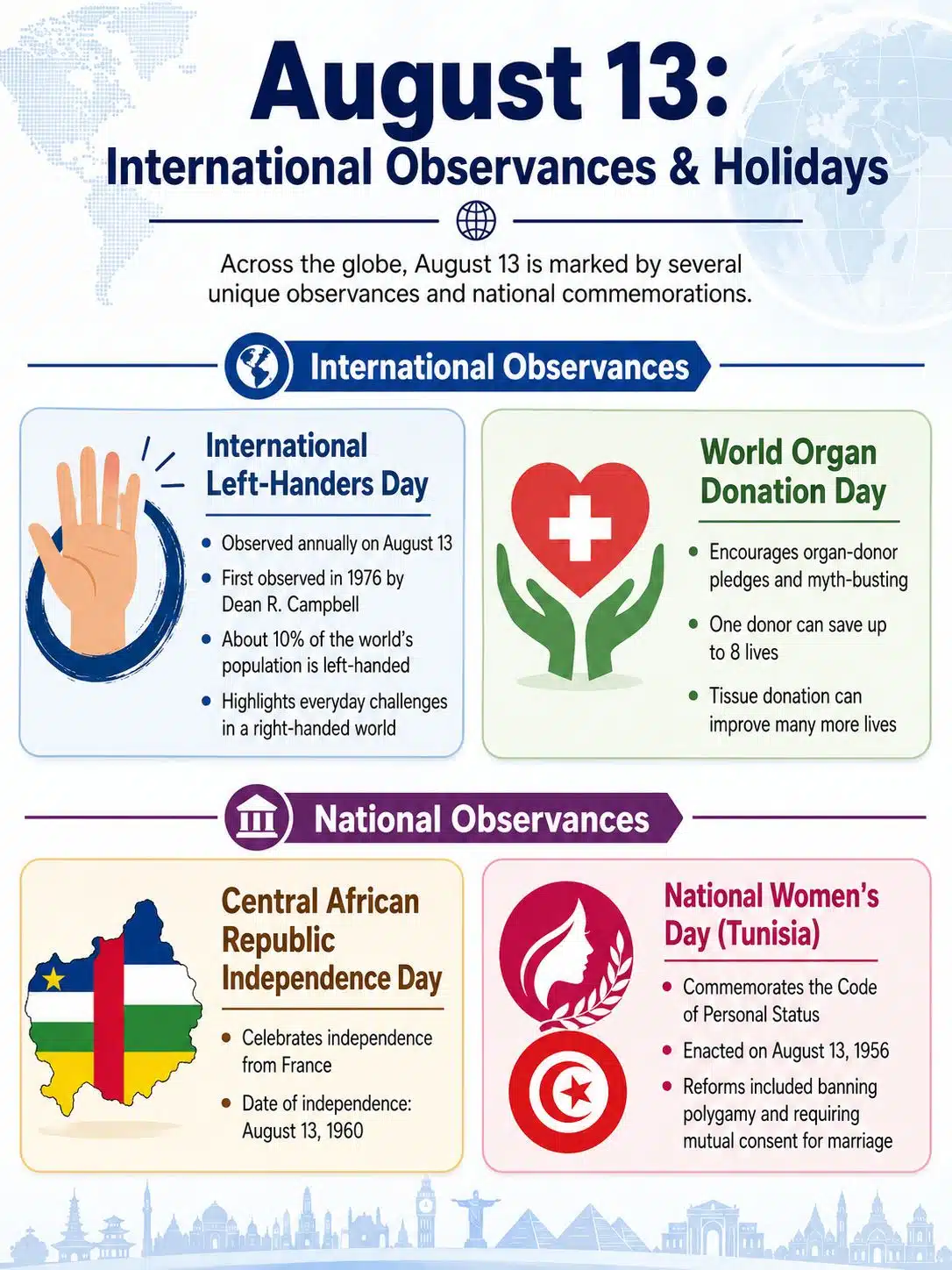
Across the globe, August 13 is marked by several unique observances, ranging from the quirky to the highly essential.
Major International Days
-
International Lefthanders Day: First observed in 1976 by Dean R. Campbell, this day celebrates the uniqueness of left-handed individuals. Roughly 10% of the global population is left-handed, and for centuries, they faced immense stigma (often associated with witchcraft or bad luck in medieval Europe). Today, the observance raises awareness about the everyday challenges lefties face in a world designed predominantly for right-handed people—from scissors and spiral notebooks to heavy machinery.
-
World Organ Donation Day: This vital global observance aims to dispel myths and fears surrounding organ donation. It encourages people to pledge their organs after death, highlighting that a single donor can save up to eight lives and improve the quality of life for dozens more.
National Days
-
Central African Republic Independence Day: On August 13, 1960, the Central African Republic officially declared its independence from France, joining a wave of African nations reclaiming their sovereignty during the mid-20th century.
-
Women’s Day (Tunisia): This day commemorates the enactment of the Tunisian Code of Personal Status on August 13, 1956. The code instituted groundbreaking reforms for women’s rights in the Arab world, including the abolition of polygamy, the requirement of mutual consent for marriage, and sweeping legal protections.
Global History
History is a global mosaic. Let us categorize the monumental events that unfolded on this day across various regions of the world.
United States
-
1918 (Civil Rights & Military): In a historic leap for gender equality within the military, Opha May Johnson became the first woman to enlist in the United States Marine Corps. Her enrollment opened the doors for thousands of women to serve their country in official capacities.
-
1942 (Science & WWII): The United States officially launched the Manhattan Project. Commanded by U.S. Army General Leslie R. Groves, this massive, top-secret research and development undertaking ultimately produced the first nuclear weapons, forever altering the geopolitical landscape and the nature of modern warfare.
-
1969 (Space Exploration): Following their historic return from the Moon and a grueling 21-day quarantine, Apollo 11 astronauts Neil Armstrong, Buzz Aldrin, and Michael Collins were honored with a spectacular ticker-tape parade in New York City. Later that evening, they were awarded the Presidential Medal of Freedom.
-
1889 (Technology): Inventor William Gray was granted a patent for the coin-operated telephone, a communication staple that would dominate public spaces globally for over a century until the advent of the mobile phone.
United Kingdom
-
1704 (Warfare): The Battle of Blenheim took place during the War of the Spanish Succession. English and Imperial forces, led by the Duke of Marlborough, won a decisive victory over French and Bavarian troops. This battle shattered the myth of French invincibility and altered the balance of power in Europe.
-
1913 (Industrial Innovation): Harry Brearley successfully cast the first production of stainless steel in Sheffield, England. By adding chromium to molten iron, he created an alloy that resisted rusting—an invention that revolutionized countless industries, from cutlery and medical instruments to architecture.
-
1964 (Legal History): Peter Allen and Gwynne Evans were hanged for the murder of a laundry driver. They became the very last people to be executed in the United Kingdom before the complete abolition of the death penalty.
Europe
-
1521 (The Americas & Spain): After a brutal and protracted siege, Spanish conquistador Hernán Cortés captured Cuauhtémoc, the last Tlatoani (ruler) of the Aztec Empire. The great capital of Tenochtitlan fell, marking the definitive end of the Aztec Empire and the beginning of centuries of Spanish colonial rule in the Americas.
-
1792 (French Revolution): The radicalization of the French Revolution reached a boiling point when King Louis XVI was formally arrested by the National Tribunal and officially declared an enemy of the people, paving the way for his eventual execution.
-
1961 (The Cold War): In one of the most chilling moments of the Cold War, the East German government sealed the border between East and West Berlin just past midnight. Known as “Barbed Wire Sunday,” this marked the beginning of the construction of the Berlin Wall, which would physically and ideologically divide the city for the next 28 years.
South America & Rest of the World
-
1868 (Natural Disaster): The devastating Arica earthquake (magnitude 8.5–9.0) struck southern Peru (now part of Chile). The massive tremor and the subsequent basin-wide tsunami resulted in over 25,000 deaths and caused destruction as far away as Hawaii and New Zealand.
-
1898 (Space): German astronomer Carl Gustav Witt, working at the Urania Observatory in Berlin, discovered 433 Eros. It was the very first near-Earth asteroid ever discovered, shifting humanity’s understanding of our immediate cosmic neighborhood.
Notable Births & Deaths (Global)
August 13 has seen the birth of individuals who fundamentally changed culture and science, as well as the passing of figures whose legacies endure.
Famous Births: Legends of Their Time
| Name | Year | Nationality | Why They Are Famous |
| Annie Oakley | 1860 | American | A legendary sharpshooter and star of Buffalo Bill’s Wild West show. She proved that women could excel in male-dominated, rugged fields. |
| John Logie Baird | 1888 | Scottish | A visionary engineer who invented the world’s first working television system, changing global communication and entertainment forever. |
| Alfred Hitchcock | 1899 | English | The undisputed “Master of Suspense.” He directed cinematic masterpieces like Psycho, Rear Window, and Vertigo, pioneering psychological thriller techniques. |
| Frederick Sanger | 1918 | English | A biochemist of unparalleled brilliance. He is one of the very few individuals to win the Nobel Prize in Chemistry twice (1958 and 1980) for his work on protein structure and DNA sequencing. |
| Fidel Castro | 1926 | Cuban | A polarizing Marxist-Leninist revolutionary who governed Cuba for nearly five decades. He successfully established the first communist state in the Western Hemisphere, defying immense U.S. pressure. |
Famous Deaths: End of an Era
| Name | Year | Nationality | Cause / Enduring Legacy |
| Eugène Delacroix | 1863 | French | The leader of the French Romantic school of art. His dramatic, emotive use of color profoundly influenced the Impressionist movement. |
| Florence Nightingale | 1910 | English | Known as “The Lady with the Lamp,” she revolutionized nursing during the Crimean War and established the philosophical foundation of modern nursing. |
| H. G. Wells | 1946 | English | Often dubbed the “father of science fiction.” His visionary novels, including The Time Machine and The War of the Worlds, predicted future technologies and shaped the genre. |
| Julia Child | 2004 | American | A legendary chef, author, and television personality who demystified complex French cooking for the American public, forever changing global culinary television. |
| Kenny Baker | 2016 | English | The beloved actor who brought the iconic droid R2-D2 to life in the Star Wars franchise, embedding himself in global pop culture history. |
“Did You Know?” Trivia
To make you the most interesting person at your next dinner party, here are three fascinating, lesser-known facts related to August 13:
-
The Biological Root of “Sinister”: Since August 13 celebrates Left-Handers Day, it is worth noting the deep historical prejudice against lefties. The English word “sinister” actually originates directly from the Latin word sinister, which simply meant “left” or “on the left side.” Because the left hand was historically associated with evil or bad omens in various cultures, the word evolved to mean something dark, evil, or threatening.
-
The Prototype of Plastic Cars: While Henry Ford unveiled his famous “Soybean Car” on August 13, 1941, many don’t realize why he built it. The car’s panels were made from an agricultural plastic composite (hemp, soy, flax) rather than steel. Ford was anticipating the massive steel shortages of World War II and wanted to create a vehicle that was significantly lighter and impervious to rusting or denting.
-
The First Earth-Crossing Asteroid: When Carl Gustav Witt discovered the asteroid 433 Eros on this day in 1898, it shattered the contemporary belief that all asteroids resided safely between Mars and Jupiter. Eros actually crosses the orbit of Mars and approaches Earth, making it the first known Near-Earth Object (NEO)—a classification of space rocks that scientists monitor closely today for planetary defense.
Quote of the Day
“There is no terror in the bang, only in the anticipation of it.”
— Alfred Hitchcock, born on this day in 1899.
This quote perfectly encapsulates the philosophy of the Master of Suspense, reflecting his deep understanding of human psychology, anticipation, and the mechanics of fear that made his films timeless masterpieces.
Final Thoughts
August 13 is a microcosm of human history. It is a day marked by the brutal enforcement of borders (the Berlin Wall) and the breaking of barriers (women in the Marines). It is a day of profound loss, from natural disasters in South America to the tragic passing of cultural icons in Bangladesh and Pakistan. Yet, it is also a day of monumental beginnings—the birth of cinematic geniuses, the dawn of the atomic age, and the invention of television and stainless steel.
By understanding the events of August 13, we see a clear reflection of humanity’s ongoing journey: a constant tug-of-war between creation and destruction, oppression and liberation. As we look back on “On This Day,” let it serve as a reminder that the history we study today was once a living, breathing present—and the actions we take today will become the history of tomorrow.