Usage-based pricing charges customers according to how much of a product or service they consume. The bill may be based on API calls, messages sent, minutes of compute, data stored, transactions processed, or another measurable unit.
The appeal is easy to understand. Customers can start small, while providers earn more as use grows. Yet I do not see usage-based pricing as inherently fairer than a subscription. Its success depends on what gets measured, whether customers can predict the charge, and whether more use usually creates more value.
A poor metric can make normal activity feel risky and produce invoices that are accurate but hard to defend. The model works best when customer value, controllable consumption, and the provider’s cost move in roughly the same direction. Otherwise, a fixed subscription, seat-based plan, capacity tier, or hybrid structure may be better.
What Is Usage-Based Pricing?
Usage-based pricing, also called consumption-based or metered pricing, is a model in which at least part of the customer’s charge changes with measured use.
It is often described as “pay only for what you use,” but that definition is too narrow. It fits pure pay-as-you-go pricing, yet many usage-based plans also include a fixed platform fee, a monthly allowance, prepaid credits, or a minimum commitment. The defining feature is a meter that affects the final charge.
A communications platform might bill for each message sent. A cloud provider may charge for compute time and storage. An AI service could measure tokens, generated media, or completed tasks. In every case, the provider must define exactly what counts as billable use.
“One transaction” sounds simple until refunds, retries, duplicates, and partial completions enter the picture. If the billable event is vague, the price is vague too.
How Usage-Based Pricing Works
Behind a usage-based bill is a chain of decisions and systems. Five things have to happen reliably:
- The provider defines the billable unit.
- The product records valid usage and assigns it to the correct customer.
- The billing system totals that activity for the right period.
- It applies allowances, tiers, credits, commitments, discounts, and overage rules.
- The invoice presents the charge in a form the customer can understand and check.
Imagine a data-processing service that charges for every 1,000 successfully processed records. The company still has to decide whether a failed record counts, how a retried job is treated, and what happens if the same event is reported twice. Late-arriving data must reach the correct billing period. Contract changes must take effect on the agreed date. Corrections need a reliable process.
Metered billing is therefore more than a counter connected to an invoice. A live dashboard may show an estimate, but the final bill must come from records both sides can audit.
Usage-Based Pricing vs Other Pricing Models
Pricing terms often overlap, so I find it more useful to ask one practical question: what actually determines the amount on the invoice?
| Model | What determines the charge | Where it tends to fit | Main weakness |
| Flat subscription | Access during a fixed period | Products with steady access value | Light users may feel they overpay |
| Seat-based pricing | Number of licensed users | Employee and collaboration software | Product activity can grow without more seats |
| Usage-based pricing | Measured consumption | Infrastructure, APIs, communications, and processing | Spend and revenue can be difficult to predict |
| Credit-based pricing | Credits used across one or more activities | Products with several billable services | Credit conversions may hide the real cost |
| Outcome-based pricing | A defined result | Services with clear, attributable outcomes | Results may be disputed or affected by outside factors |
Value-based pricing is different. It is a broader strategy in which the price reflects the value a customer receives. A usage model becomes value-aligned only when the unit being counted is a dependable sign of that value.
An API call may be easy to meter, but the customer may care about verified identities, successful deliveries, or completed reports. The easiest event for an engineering team to count is not automatically the right unit to sell.
The Main Types of Usage-Based Pricing
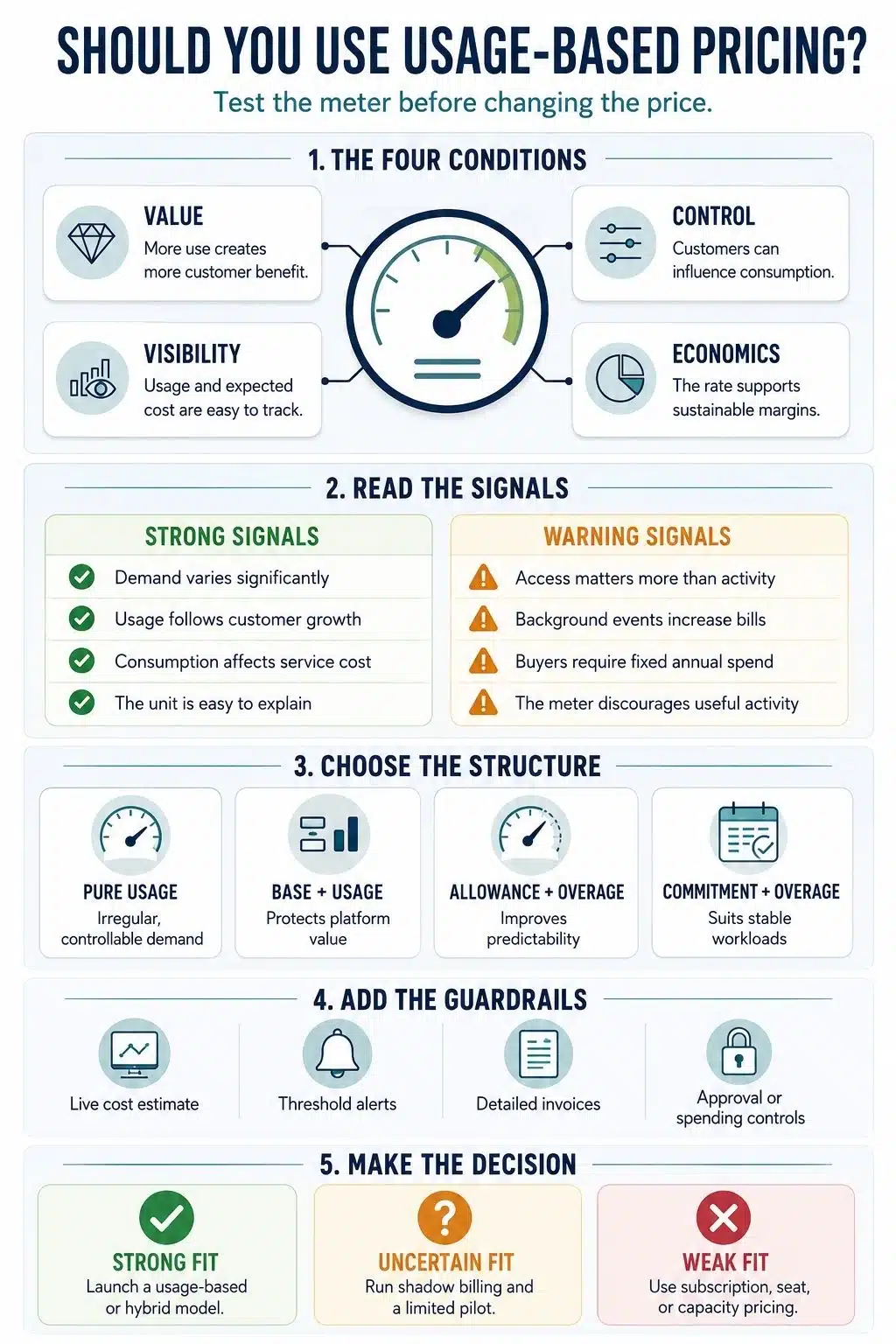
The plan structure decides how financial risk is divided.
Pure Pay as You Go
The customer pays only for the units consumed. This suits irregular demand but creates the greatest variability for both sides.
Base Fee Plus Usage
A fixed fee covers platform value, while a separate charge reflects consumption. It makes sense when low-usage customers still benefit from security, availability, integrations, or support.
Included Usage Plus Overage
The plan includes an allowance, with extra use billed separately. The base bill is predictable, although poor visibility can still make overages surprising.
Prepaid Credits
Customers spend prepaid credits across different services. This can unify several technical units but make prices harder to compare. Buyers should be able to translate credits into realistic activity without specialist help.
Minimum Commitment Plus Overage
The customer commits to baseline spend or use, often for a lower rate, and pays for extra consumption. It suits predictable demand, but unused commitments create waste.
Rates may also change with volume. Some plans price each block differently; others change the applicable rate after a threshold. Similar wording can still produce very different bills, so worked examples matter.
When Does Usage-Based Pricing Work?
The model is strongest when use varies meaningfully and more use generally means more value. It also helps when customers want to begin without a large commitment and expand without repeatedly changing plans.
Good candidates usually share several traits:
- The product records consumption automatically and reliably.
- Customers understand the billable unit and can influence it.
- Demand varies across accounts, projects, or months.
- Higher activity increases the provider’s cost to serve.
- Product use can grow without a matching increase in employee seats.
- Buyers are already comfortable forecasting variable demand.
- The provider can support metering, reconciliation, variable invoices, and disputes.
This is why usage pricing feels natural in cloud infrastructure, APIs, communications, payments, data processing, logistics, and many AI services. AWS meters resources such as compute. Twilio charges for visible activities such as messages and voice minutes. Snowflake connects compute consumption to credits. The units differ, but each can be tied to a workload the customer recognizes.
They also show why hybrid pricing is common. Uncertain demand may suit pay as you go; a stable workload may suit a commitment. One structure rarely fits every customer stage.
When Usage-Based Pricing Becomes a Poor Fit
Some products deliver value even when visible activity is low. A quiet month does not make security software worthless; the customer is also paying for readiness and continuous protection.
The same applies to compliance tools and products used occasionally for high-stakes work. Access or availability may matter more than the number of clicks, scans, or reports.
I become cautious when background activity raises the bill without a deliberate customer choice. Charging for every experiment can also slow the behavior that helps new users discover value.
There are other warning signs:
- Buyers need firm annual budgets and cannot accept open-ended costs.
- Usage is rare, but each event carries substantial value.
- Most of the provider’s costs are fixed rather than consumption-driven.
- Metering data is incomplete, delayed, or difficult to verify.
- The proposed metric rewards waste or discourages useful activity.
- Customers cannot connect the unit on the invoice to the outcome they bought.
A charge on every query, export, message, or automated action can become a tax on engagement. Customers may delay jobs, limit access, or avoid experimentation simply to protect the budget.
That restraint is not always bad. If a workload consumes expensive resources, pricing can encourage sensible use. But there is a difference between reducing waste and making customers afraid to use the product. A pricing model should not work against adoption.
Predictability Has to Be Designed In
Variable pricing shifts part of the planning burden to the customer. That can be reasonable, but only if the product gives the customer enough information to manage it.
A live view should show consumption and estimated spend. Billable units need plain definitions. Alerts should arrive early enough for someone to act. Invoices must connect charges to recorded use, with a clear route for corrections or disputes.
Customers may also need allowances, commitments, workload controls, approval rules, or genuine spending limits. These safeguards are not interchangeable. A budget email does not stop a charge. A workload limit may stop activity without limiting every service. A hard cap may prevent spending but also interrupt important production work.
Automatically shutting down a critical service may cost far more than the overage. A warning, approval request, reduced capacity, or feature-specific limit may be safer than a complete stop. The control should match the consequence.
What Usage-Based Pricing Changes Inside the Business
Usage-based pricing is not a billing feature that finance can implement alone.
Product leaders choose the metric and packaging. Engineering and data teams define valid events, timestamps, duplicate handling, and recovery. Finance owns reconciliation, credits, margins, and forecasts. Sales must avoid terms the billing system cannot represent. Support needs the same usage picture the customer sees.
The buyer takes on work too. Someone must monitor budgets, allocate spend, and investigate unusual use. Larger customers may need forecasts by department or project before approving a contract.
This operational burden does not make the model wrong. It does mean that flexible pricing needs stronger visibility than a fixed monthly bill.
How to Test Usage-Based Pricing Before Launch
A pricing spreadsheet can show attractive revenue. It cannot show how customers will react when each action has a visible cost.
Start by defining what customers are really buying. Then compare several possible metrics, including customer outcomes, visible product activities, and internal cost drivers. Historical usage can reveal seasonality, inactive periods, extreme users, and differences between customer groups.
Model more than one structure because each distributes risk differently. An attractive average can hide painful bills for a small but important group.
Before charging anyone, run shadow billing. Produce realistic invoices without collecting the variable amount, then compare them with raw usage. This exposes missing events, duplicates, confusing rate rules, and unexpected totals while mistakes are still internal.
Customer comprehension matters as much as billing accuracy. Ask buyers to estimate a bill, explain the unit, and identify activities they might reduce. If they cannot predict the cost, or plan to suppress valuable use, the offer needs work.
Only then does a controlled pilot make sense. Start with new or willing customers, keep a clear migration path, and make dashboards, alerts, invoice details, correction rules, and internal ownership part of the launch rather than later improvements.
Choose a Meter Customers Can Defend
I do not see usage-based pricing as the natural successor to subscriptions. It is one way of dividing financial risk between a provider and its customers.
It works when the unit reflects value, customers can control their consumption, and the provider can explain every charge. It becomes difficult to trust when an internal technical event is passed to the buyer without context or when flexibility arrives without predictability.
The final test is practical. The unit should make sense in a sales conversation, fit the customer’s budgeting process, survive a close reading of the invoice, and support the provider’s economics. If it fails in any of those places, the metric or packaging needs more work before customers are asked to rely on it.
Frequently Asked Questions on Usage-Based Pricing
1. Is Usage-Based Pricing the Same as Pay as You Go?
No. Pay as you go is one form of usage-based pricing. Other forms combine variable charges with a fixed fee, included allowance, prepaid credits, or minimum commitment.
2. What Is a Simple Example of Usage-Based Pricing?
A communications service may charge according to the number of messages sent or voice minutes used. The customer’s bill changes with the measured activity.
3. What Is the Difference Between Usage-Based and Subscription Pricing?
A fixed subscription charges for access during a set period. Usage-based pricing changes with measured consumption. A hybrid plan can combine both approaches.
4. How Can Companies Reduce Bill Shock?
They can provide live usage and cost estimates, threshold alerts, unusual-activity warnings, included allowances, customer controls, and detailed invoices. Where appropriate, they can also offer commitments or enforceable caps. An alert alone does not stop spending.
5. Is Usage-Based Pricing Suitable for Every SaaS Product?
No. It is a weak fit when use does not reflect value, customers cannot control the unit, metering is unreliable, or variable bills create more purchasing friction than flexibility.