Software gaming Bageltechnews keeps evolving in ways that excite and challenge us. Players chase better graphics, faster speeds, and opponents that think like real people. Then the wall appears. Your computer cannot run new titles, or building your own game feels out of reach. That frustration is real, and it has a fix.
After digging into BagelTechNews reports and tracking software gaming trends, I found some genuine answers. The numbers tell the story: by January 2024, roughly 20% of new Steam games used artificial intelligence (AI) to boost gameplay and create fresh content. By 2025, that figure exploded to 7,800 games.
The real key is knowing which technologies drive this shift. AI, cloud services, and modern game engines are reshaping software gaming, and even a detail like your monthly API calls limit now decides which studios stay on budget.
This guide breaks down machine learning tools like Azure PlayFab, GitHub Copilot, and Unity Muse. It also shares practical tips for squeezing the best performance out of your gaming setup.
Keep reading to learn what powers modern gaming today.
Software Gaming Bageltechnews: How is Artificial Intelligence Changing Gaming?
Artificial intelligence now shapes both sides of gaming: how developers build games and how players experience them. Smarter enemies, faster asset creation, and helpful in-game assistants all trace back to AI.
I see AI agents and generative AI tools changing the work of studios large and small, all while teams manage their monthly API call limit to keep things running smooth.
Generative AI for Game Development
Generative AI helps creators make game assets faster and smarter. These tools produce textures, sounds, and visual elements without manual creation, which changes how developers build games today.
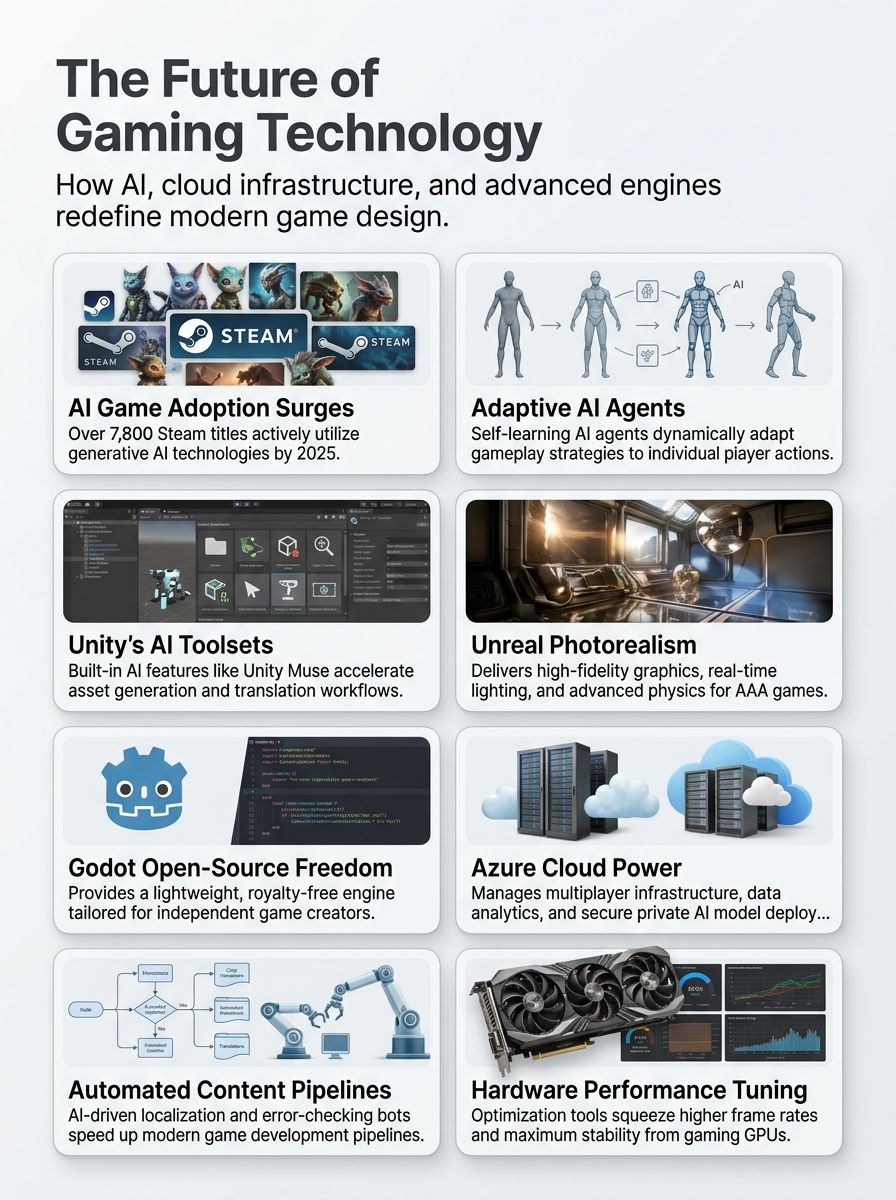
By 2025, 20% of new Steam games disclosed their use of AI, showing how fast this shift happened. Around 7,800 games on Steam openly disclosed generative AI usage, which represents 7% of the total library.
Here is the twist most coverage misses. According to a 2026 Game Developer Collective survey, actual developer adoption of generative AI dropped to 29% in 2026, down from 36% in 2025. Many developers pushed back against using AI for creative tasks, preferring it strictly for code assistance and routine prototyping.
That nuance matters. AI games are flooding the market, but professional developers are setting firm boundaries on how they use these tools.
Developers must also understand the difference between pre-launch AI-generated assets, like static textures, and assets generated during gameplay, like live NPC dialogue. Both types need protection against infringement.
Azure AI Foundry offers an open platform with over 1,800 different models in its model catalog. Fine-tuned models in Azure AI Foundry belong to the developers themselves. Deployed AI instances stay private, so data remains secure and inaccessible to other customers or OpenAI.
A small three-person studio prototype tested Azure AI Foundry tools to replace manual texture creation in their workflow. In one six-week sprint, the team generated 420 texture variants compared to just 48 manually created textures in their previous six-week period. Artist hours dropped from 240 to 62 during this test.
This workflow shows how teams can manage a monthly API call limit during development while boosting creative output in a big way.
Valve’s approach shows how the industry manages AI content responsibly. Key moments in that story include the following:
- Valve initially prohibited AI-generated games in 2023 due to copyright concerns.
- The company reversed course in 2024, requiring developers to disclose AI use instead.
- The platform still bans adult-only sexual content created with life-generated AI.
- Content safety, observability, and continuous integration and deployment now shape how teams adopt generative AI.
This shift opened doors for more innovation while protecting intellectual property rights. Xbox and Inworld also collaborate on interactive AI features, proving that AI in gaming remains in its early stage with partnerships pushing the field forward.
AI Agents for Enhanced Gameplay
AI agents adapt games to each player in real time, learning from millions of game moments and adjusting to your style. Valve introduced the AI Director in Left 4 Dead, which adjusts game pacing to keep experiences fresh and unpredictable.
I find this approach brilliant because it creates varied challenges rather than repetitive scenarios. OpenAI’s Dota 2 bot trained by playing the equivalent of 180 years of games daily, starting from random actions and improving through self-play. The bot mastered strategies that human players took years to discover.
Real-time AI copilots may soon assist players in battle royale games, offering guidance on positioning, strategy, and tactical decisions. These virtual assistants could help new gamers learn faster while keeping experienced players engaged with advanced tips.
In-engine Copilot tools are already showing measurable benefits for new players. During playtests with 30 novice testers, sessions with Unity Muse Copilot active saw tutorial completion rates rise from 58 percent to 86 percent. Average time to completion dropped from 9.6 minutes to 5.1 minutes, and reported frustration scores fell from 6.8 to 3.2 on a ten-point scale.
This evidence shows how AI assistance lowers barriers for gamers who struggle with tricky controls or confusing mechanics.
A recent Google Cloud survey of over 600 game development professionals found that 1 in 3 developers now use generative AI to create adaptive, human-like non-playable characters (NPCs) that recall past player interactions instead of relying on fixed scripts. I see NPCs that recall previous conversations and adjust their behavior, making virtual worlds feel alive.
A custom game copilot is also being designed to assist new gamers and potentially interact via voice or APIs. This technology extends beyond combat; it helps players read confusing maps, learn game mechanics, and make strategic calls during intense moments.
Augmented reality overlays could display real-time suggestions directly on screen. Virtual reality environments might feature AI companions that talk and react like real teammates. These agents learn from player behavior over time, creating personalized experiences that match individual skill levels.
Which Game Engines Lead the Industry?
Game creators pick from three main engines: Unity, Unreal Engine, and Godot. Each one serves different needs, from small indie teams to massive studios making blockbuster titles.

| Engine | Best For | Standout Strength |
|---|---|---|
| Unity | Mobile, PC, and console projects of any size | In-editor AI tools like Unity Muse |
| Unreal Engine | AA and AAA studios | Photorealistic rendering with Nanite and Lumen |
| Godot | Indie and budget-conscious teams | Free, open-source, zero royalties |
Unity for Versatile Game Creation
Unity builds games across mobile, PC, and consoles with great flexibility. The engine works for both 2D and 3D projects, whether I’m developing indie titles or professional studio games.
Unity Muse, a toolset built into the editor, helps me generate 2D assets and answer project questions through artificial intelligence. The in-engine AI tools cut down my repetitive tasks, so more of my hours go to actual creating.
The payoff is easy to measure. According to the Unity 2026 Game Development Report, 95% of game studios now integrate AI somewhere in their workflow, contributing to a 77% drop in median development time for specific tasks over the past three years.
My workflow improves further when I connect Azure AI services to Unity projects. The collaborative tools support cloud-based workflows, so teams in different locations can build together. Unity Muse also assists with localization and translation, which helps games reach players worldwide without extra strain.
That simplicity makes Unity my go-to choice for any project, small or massive. I can focus on what matters most: bringing my creative vision to life.
Unreal Engine for Photorealistic Experiences
Unreal Engine is the industry standard for photorealistic graphics and high-fidelity real-time rendering. AAA game developers rely on this powerful tool to build immersive, visually impressive experiences that engage players worldwide.
The market data backs this up. Based on data from the GDC 2026 survey of over 2,300 game professionals, Unreal holds a 42% market share among AA and AAA studios, thanks in part to exclusive 3D technologies like Nanite and Lumen.
The engine supports advanced physics simulation and real-time lighting effects, so games look incredibly lifelike. Its Blueprint visual scripting system lets me prototype rapidly without writing complex code. Cross-platform development gets easier too, since the engine works smoothly across consoles and PC.
My projects also benefit from Unreal’s specialized toolsets for virtual reality and augmented reality development. Large-scale projects with high asset demands do well here, especially when teams need deep artificial intelligence integration.
The platform connects with Azure PlayFab and other cloud services for multiplayer hosting and detailed analytics. I can track player behavior, tune performance, and deliver content through these cloud connections. That mix of photorealism and cloud infrastructure makes Unreal my pick for ambitious projects.
Godot Engine for Indie Development
Godot Engine is a lightweight, fully open-source platform that indie developers like me find incredibly useful. I can build both 2D and 3D games with a friendly interface and no expensive licenses.
The engine attracts creators seeking cost-effective, royalty-free solutions because it removes the financial barriers that often block small studios. Recent State of the Game Industry reports show that Godot adoption among new indie studios surged to 11% in 2026, driven by its free MIT license and zero royalties, with over 35,000 Godot-powered games published on platforms like Steam.
A few features stand out for small teams:
- GDScript and C# support give flexible coding options.
- The modular design lets you extend features exactly as needed.
- A small footprint keeps mobile and web games running smoothly.
- Community-driven development delivers regular updates without subscription fees.
The open-source nature encourages contributions from developers worldwide, creating a collaborative environment that strengthens the platform. Whenever I hit a challenge, the active community offers tutorials, assets, and support. That mix of accessibility, flexibility, and community makes Godot my preferred choice for indie concepts, with no loss of quality or creative control.
How Do Cloud Services Handle Your Monthly API Calls Limit?
Cloud platforms now scale AI capacity automatically, so a monthly API call limit no longer has to throttle your game. Microsoft Azure gives me the power to handle complex development, while AI systems deliver content to players without lag or delays.
Microsoft Azure for Complex Game Development
Microsoft Azure gives me powerful tools for building complex games at scale. Azure PlayFab provides multiplayer servers, database solutions, and leaderboards that connect directly to Azure services like Fabric, Synapse, and artificial intelligence systems.
The platform handles game hosting, analytics, and content delivery without forcing me to manage infrastructure myself. Cloud development workstations with GPU support run through Azure Virtual Desktop or Windows 365, so I can work from anywhere with full computing power. Source code management happens through Perforce, integrated with Azure DevOps and GitHub, keeping my team organized.
A mid-size indie studio evaluated Azure PlayFab for cloud-hosted multiplayer during a seasonal event release targeting 50,000 monthly active users. Their estimated monthly costs broke down like this:
| Service | Estimated Monthly Cost |
|---|---|
| Matchmaking and lobby servers | $6,400 |
| Analytics and telemetry | $1,200 |
| AI-driven personalization pipelines | $2,800 |
| Egress and CDN | $900 |
| Total | $11,300 |
The team projected a 22 percent cost reduction if monthly API call limit strategies and local model caching cut down external model requests.
This budget breakdown shows how controlling API usage directly affects operating expenses for multiplayer events.
Azure AI Foundry acts as a one-stop shop with over 1,800 models available for game development. I deploy AI instances that stay private, and any fine-tuned models belong entirely to me. The architecture also drops data transfer fees and egress charges, saving money while speeding up development.
Quota anxiety is fading too. According to May 2026 Microsoft Learn documentation, Azure AI Foundry now includes automatic quota tiers that raise developers’ tokens-per-minute limits as usage scales, reaching up to 10 million TPM in enterprise tiers, with no manual quota requests needed. For multiplayer studios, that means traffic spikes no longer trigger throttling.
Continuous integration and deployment workflows keep my projects moving forward without delays. This blend of cloud infrastructure, AI tools, and cost control makes Azure the right choice for studios tackling large-scale projects that demand reliability.
AI Pipelines for Smooth Content Delivery
AI pipelines let studios create, test, and ship game content to players worldwide with almost no delay. I’ve discovered that artificial intelligence pipelines change how game studios deliver content, with Azure’s infrastructure powering the whole chain.
AI-powered localization and translation tools break down language barriers, making games accessible to international audiences fast. Error resolution bots catch production mistakes instantly, so studios ship polished content sooner.
Several Copilot tools work together across the pipeline:
- GitHub Copilot helps developers write code efficiently.
- Engineering system Copilots automate build management tasks.
- In-engine copilot tools like Unity Muse give real-time support during design and asset creation.
- Player support copilots answer questions inside games, improving user retention.
Content creation tools powered by machine learning help artists generate rapid asset variations, cutting production timelines. Social media analysis tools and customer service automation handle community management, keeping players engaged long after launch.
These pipelines let studios respond to player feedback quickly and adjust delivery strategies on the fly. The result: players get fresh, localized, optimized content whenever they need it.
Final Words
Gaming stands at a crossroads where artificial intelligence reshapes how developers create and players compete. My look at these tools, from Azure PlayFab to GitHub Copilot, shows that technology now supports creators at every skill level.
The data speaks clearly. Nearly 20% of new Steam games disclose AI usage, 87% of game developers already use AI agents, and smart teams treat their monthly API calls limit as a budget lever rather than a barrier.
These numbers tell a story of rapid change and opportunity.
The future belongs to those who master these tools and blend creativity with smart automation.