
Most founders make this call at the wrong time. They either commit to a custom-built app before they’ve proven anyone wants the product, or they stay on no-code tools two years past the point those tools can actually support the business. Both mistakes are expensive, just in different currencies: one burns cash on a product nobody needed, the other quietly caps growth while a competitor with better infrastructure pulls ahead.
There’s a more reliable way to make this decision than gut feeling, and it comes down to a handful of concrete signals rather than a calendar date or a funding milestone.
Signs You’re Not Ready for Custom Development Yet
If you haven’t validated that people actually want your product, custom development is premature no matter how much funding you’ve raised. The entire point of an early-stage build is speed and cheap iteration, and no-code or low-code tools exist precisely for this stage. Spending $80,000 and four months building a custom app to test a hypothesis you could test in three weeks with a no-code prototype is a startup-killing mistake disguised as diligence.
The same logic applies if your core workflow is still changing weekly. Custom development assumes a reasonably stable architecture. If your team is still pivoting the product’s core loop based on user feedback, building custom infrastructure around a moving target means rebuilding that infrastructure every time the product changes. Wait until the workflow has settled before locking in the engineering investment.
Signs the Timing Has Actually Arrived
The clearest signal that it’s time to move off no-code is hitting a wall the platform genuinely can’t solve. This usually shows up as a specific, recurring complaint: the app is too slow under real usage, a no-code platform’s limitations are blocking a feature your users are actively asking for, or your data architecture has outgrown what the platform’s database layer can handle gracefully.
A second signal is retention. If you have real users coming back, and your problem has shifted from “will anyone use this” to “how do we keep them and grow usage,” that’s a fundamentally different problem, and it usually needs different infrastructure. Retention-stage products benefit from the performance, offline support, and platform-specific features that custom development unlocks and no-code tools generally can’t match.
A third signal, often the most overlooked, is investor and partner expectations. If you’re approaching a Series A or trying to land enterprise customers, a no-code MVP can become a credibility problem in due diligence, even if the product itself works fine. Custom architecture signals that you’ve built something defensible, not just assembled from existing parts. This is usually the point where founders start researching iOS app development services for startups rather than continuing to push a no-code platform past its limits, since the cost of staying too long on the wrong tool compounds faster than most teams expect.
No-Code, Low-Code, or Custom: Matching the Tool to the Stage
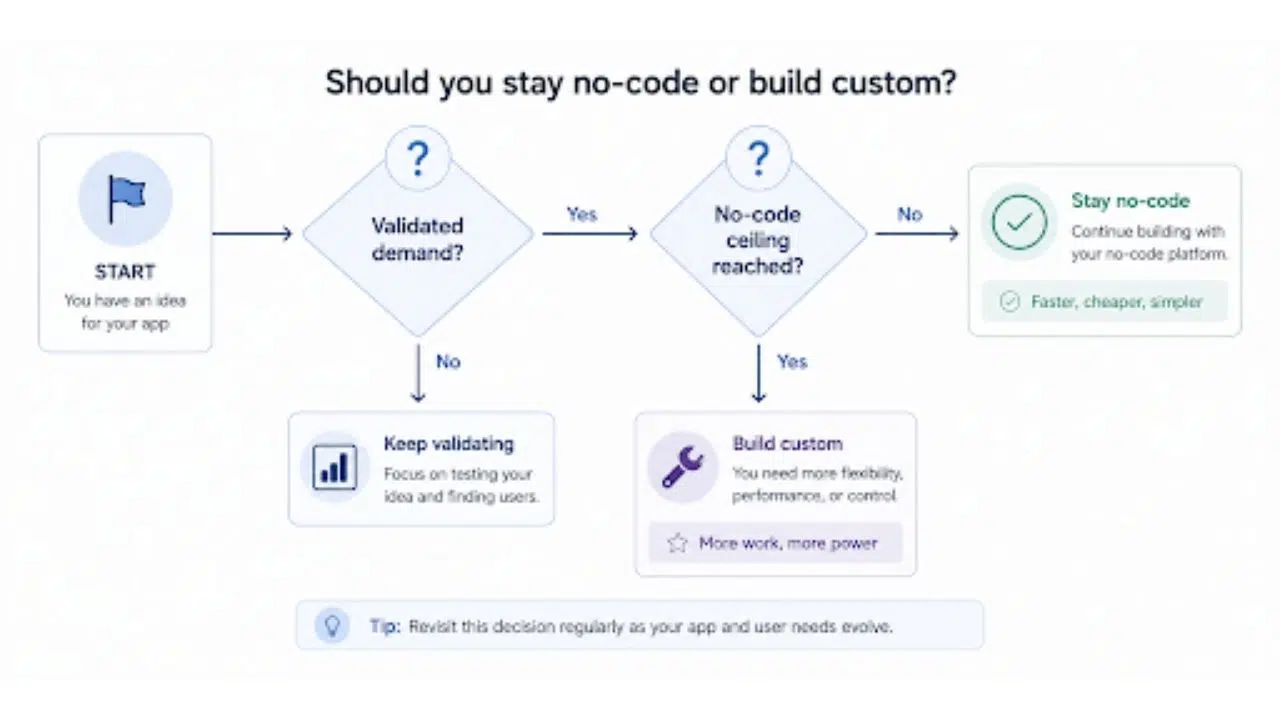
These aren’t competing philosophies so much as different tools for different stages of the same company.
No-code platforms remain the right choice for validating an idea, running a pilot with a small group of users, or building internal tools that never need to scale past a few dozen people. The speed and low upfront cost are the entire value proposition, and that value doesn’t disappear once a company starts growing.
Low-code sits in between: faster than fully custom development, but with more room to extend functionality than a pure no-code platform allows. It’s a reasonable middle step for companies that have outgrown the simplest tools but aren’t yet ready for a full custom build.
Custom development earns its higher cost once an app needs to do something the templated platforms genuinely can’t: complex backend logic, tight integrations with multiple systems, platform-specific performance requirements, or full ownership of the codebase as an asset rather than a rented platform.
What Custom Development Actually Buys a Startup
The honest case for custom development isn’t that it’s inherently better. It’s that it removes constraints that become expensive the longer a company waits to remove them.
Full ownership of the codebase means no platform risk: a no-code provider’s pricing changes, feature deprecations, or shutdown don’t threaten your product. Performance and scalability are designed around your actual usage patterns rather than a generic platform’s assumptions. And the architecture can evolve in any direction the business needs, rather than within whatever boundaries the platform’s templates allow.
None of that matters at the validation stage. All of it starts mattering the moment retention, scale, or investor scrutiny enters the picture.
How to Choose the Right Development Partner Once You’re Ready

Once the signals point toward building custom, the partner you choose matters as much as the decision itself. Look for a team that asks hard questions about your actual usage data before quoting a number, not one that jumps straight to a fixed price based on a feature list alone. A partner who has handled the no-code-to-custom transition before will recognize the specific technical debt that tends to accumulate in early-stage products and plan around it instead of being surprised by it later.
Startups and SMEs in particular benefit from working with teams that specialize in early-stage builds rather than enterprise-focused shops, since the priorities, budget constraints, and speed requirements at this stage look nothing like a Fortune 500 engagement. The right partner treats your growth stage as a constraint to design around, not an inconvenience to work past.
The Bottom Line
The decision to move from no-code to custom development isn’t really about company age, funding stage, or how “serious” the product feels. It’s about whether the specific signals, a platform ceiling, a retention problem, or a credibility requirement, have actually shown up yet. Move too early and you’ve spent real money solving a problem you didn’t have yet. Move too late and a competitor with better infrastructure quietly takes the users you spent two years earning.