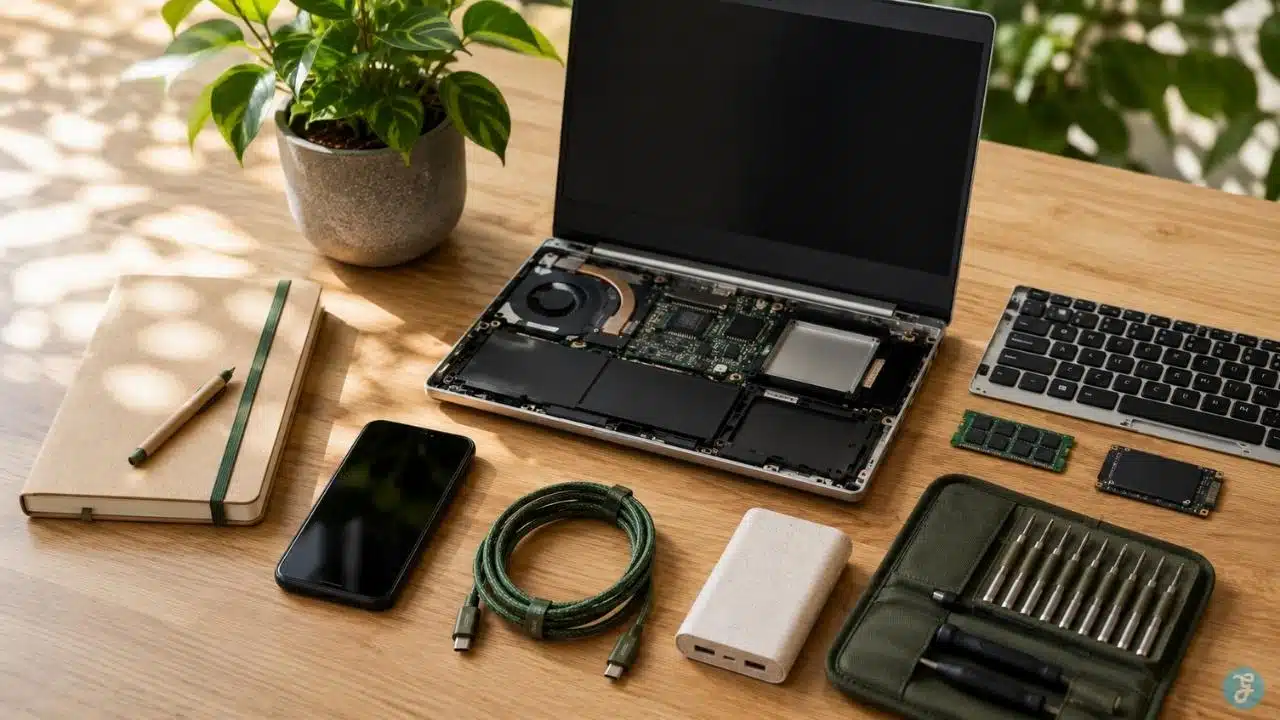
The best eco-friendly tech companies are not just selling sleeker gadgets with greener packaging. They are asking a harder question: why do we replace expensive electronics so fast? That question matters. Phones are sealed. Laptops are hard to upgrade. Chargers break. Headphones fail because of one tiny battery. Old devices sit in drawers for years.
Many people want better tech choices, but the normal market keeps pushing faster upgrades, thinner designs, and shorter product cycles. That is where sustainable electronics become more than a nice idea.
A truly better tech company should help people keep devices longer, repair them more easily, buy refurbished when possible, use fewer virgin materials, reduce packaging waste, or make digital activity less harmful. Some brands do this through repairable hardware. Some focus on refurbished devices. Some make accessories with recycled materials. Some push carbon transparency or fund climate work through digital services.
No tech company is impact-free. Electronics need minerals, factories, energy, logistics, packaging, and end-of-life systems. Even “green” devices can become waste if people replace them too soon. So this list is not about perfect companies. It is about better signals.
These eight green tech brands are worth knowing because they challenge at least one wasteful part of modern technology.
How I Chose These Eco-Friendly Tech Companies
This list does not reward vague sustainability pages. A tech company had to show a clearer reason for inclusion. That reason could be repairability, modular design, refurbished-device access, repair education, recycled materials, plastic-free packaging, carbon labeling, B Corp certification, or a business model that supports lower-impact digital use.
I also looked at usefulness. A company may have a strong mission, but if the product is too niche, hard to access, or unrealistic for normal users, it has limited value.
The review focused on:
- Product lifespan
- Repair and upgrade options
- Refurbished or circular models
- Material choices
- Packaging and recycling
- Transparency
- Real buyer usefulness
- Trade-offs before purchase
That last point is important. Sustainable technology is full of trade-offs. A repairable phone may not have the best camera. A modular laptop may cost more upfront. A refurbished marketplace depends on seller quality. A compostable phone case is only useful if you use it fully and dispose of it properly.
A good tech choice should fit your real needs, not just your values.
1. Fairphone
Fairphone is one of the clearest examples of what ethical tech companies can look like when repairability is built into the product from the start.
Most smartphones are not designed with the owner in mind. They are sealed, difficult to repair, and often replaced when one part fails. Fairphone challenges that model by making phones that are easier to open, repair, and keep in use longer.
Its strongest work is around product lifespan. Fairphone designs devices with replaceable parts, software support, spare parts availability, and repair information. It also talks more openly than most phone companies about supply chains, worker conditions, materials, reuse, and recycling.
This does not mean Fairphone is the best phone for everyone. It usually cannot compete with flagship phones on camera quality, premium design, or raw performance. Availability can also vary by country.
But if you care more about repair, longevity, and fairer electronics than owning the most polished flagship, Fairphone is one of the strongest names in sustainable electronics.
Repair angle: Fairphone is best for users who want a phone they can keep, repair, and understand.
Buyer note: Choose Fairphone for values and lifespan, not for the highest specs on the market.
2. Framework
Framework is changing the laptop conversation by making repairs and upgrades feel normal again. Many laptops are designed in a way that makes repair difficult, expensive, or impractical. Batteries, ports, keyboards, screens, memory, and storage may be hard to access. When something fails or becomes outdated, replacement often feels easier than repair.
Framework takes the opposite approach. Its laptops are modular, repairable, and upgrade-friendly. Users can replace parts, change ports, upgrade components, and buy parts through the Framework Marketplace.
This is important because the most sustainable laptop is often the one that stays useful for longer. If you can replace a battery, upgrade storage, swap a keyboard, or improve performance without buying a whole new machine, the product has a better chance of avoiding early retirement.
Framework is especially appealing to students, developers, remote workers, Linux users, repair-minded buyers, and people who dislike sealed hardware.
The trade-off is that the Framework may cost more upfront than some mass-market laptops. It also works best for people who are comfortable with a more hands-on ownership model.
Laptop logic: Framework is strongest for buyers who want a computer they can maintain, repair, and upgrade over time.
Buyer note: If you prefer sealed, ultra-polished, no-maintenance devices, Framework may feel less familiar. If ownership matters to you, it is one of the best options.
3. Back Market
Back Market is not a device manufacturer. Its value comes from making refurbished electronics easier to buy. That matters because the greenest tech purchase is often not a new device. It is a device that already exists and still has useful life left.
Back Market works as a marketplace for refurbished phones, laptops, tablets, game consoles, smartwatches, headphones, and other electronics. Its role is to make secondhand tech feel less risky by offering grading, warranties, returns, and a more organized buying experience than random peer-to-peer listings.
Refurbished tech can be a strong, sustainable choice because it extends device life and reduces demand for brand-new production. It can also save money.
Still, buyers need to be careful. Refurbished quality depends on testing, grading, battery condition, seller reliability, return policies, and warranty terms. You should read the condition description closely and avoid buying only because the price looks attractive.
Refurbished route: Back Market is useful for people who want lower-cost electronics without defaulting to new.
Buyer note: Pay attention to battery health, warranty, return window, and seller ratings before buying refurbished devices.
4. iFixit
iFixit deserves a place on this list because repair is one of the most important parts of sustainable technology.
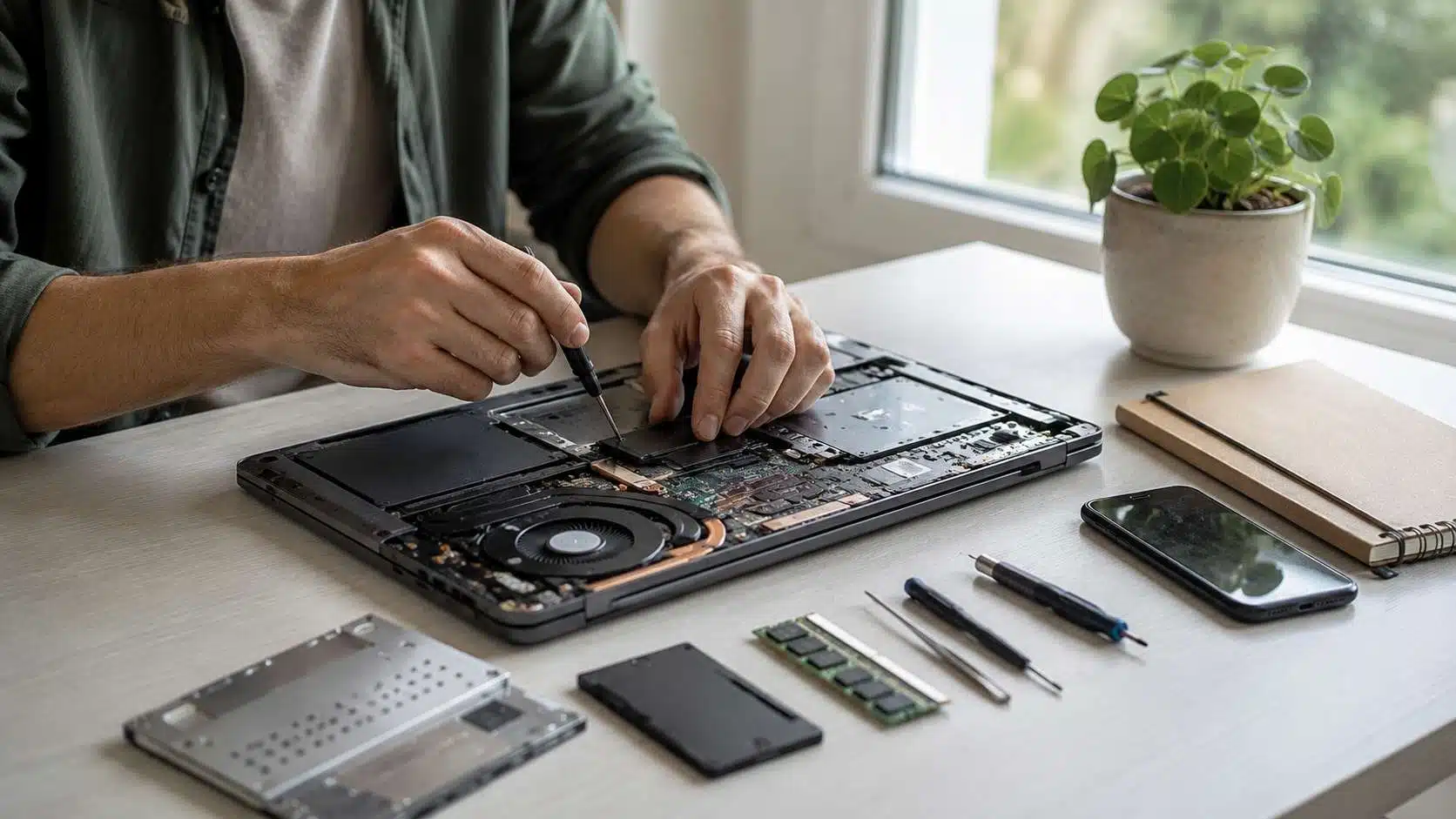
The company provides repair guides, tools, parts, teardown information, and repairability scoring. It has become closely connected with the right-to-repair movement because it gives people the knowledge and tools to fix devices instead of replacing them.
This is a different kind of eco-friendly tech company. iFixit does not make a phone or laptop as its main product. It supports the repair culture that makes phones, laptops, tablets, game consoles, appliances, and other devices last longer.
That matters because many people throw away electronics not because the whole device is dead, but because one part fails. A screen cracks. A battery weakens. A port stops charging. A joystick drifts. A fan gets noisy. Repair knowledge can turn a replacement moment into a maintenance moment.
iFixit is not only for experts. Many guides are step-by-step and visual. Still, repairs require patience, the right tools, and honest awareness of your skill level.
Repair culture: iFixit is strongest for people who want to fix what they own or at least understand whether repair is possible.
Buyer note: Start with simple repairs. Do not open an expensive device unless you understand the risk.
5. Nimble
Nimble focuses on a less glamorous but very common tech category: accessories. Chargers, cables, power banks, wireless chargers, and phone accessories are easy to overlook. Yet this category creates constant waste because cheap accessories break, get lost, or arrive in unnecessary plastic packaging.
Nimble tries to make everyday tech accessories with recycled and lower-impact materials, plastic-free packaging, and recycling support. This makes it a useful option when you actually need a charger, cable, or portable battery.
The practical appeal is simple. You do not need to change your full tech ecosystem. You just choose a better accessory when the old one is truly worn out.
The caution is that no accessory is sustainable if you buy extras you do not need. Many people already have unused cables and chargers in drawers. Start there before buying new.
Accessory lane: Nimble is best for lower-waste chargers, power banks, cables, and small tech essentials.
Buyer note: Buy Nimble when you need a replacement, not as an excuse to collect more gadgets.
6. Pela
Pela is best known for compostable phone cases, which makes it a tech-adjacent company rather than a core electronics maker.
Phone cases are small, but the category is huge. Many cases are made from plastic, bought for style, replaced often, and thrown away when someone changes phones. Pela offers a lower-waste alternative by making compostable cases for popular phone models.
This is useful because phones need protection. A case that helps prevent damage can extend the life of the device. If the case also avoids conventional plastic, that is a better direction.
But compostable does not mean impact-free. Composting depends on conditions, local systems, and correct disposal. A compostable case thrown into a landfill is not the same as one processed properly. Also, the most sustainable case is the one you keep using for the full life of your phone.
Phone protection: Pela is best for people who want a plastic-free case and plan to use it until the phone is replaced.
Buyer note: Do not buy multiple cases for fashion. Pick one durable case and keep it on your phone.
7. Logitech
Logitech is different from the smaller mission-first brands on this list. The reason it belongs here because it’s a mainstream tech company with stronger carbon-label transparency. Logitech has been one of the more visible consumer tech companies using carbon impact labels on products. It also publishes sustainability goals, works on design-for-sustainability, and has climate targets tied to emissions reductions.
This matters because most people do not buy only niche electronics. They buy keyboards, mice, webcams, headsets, speakers, and gaming accessories from mainstream brands. When a larger company makes carbon labeling more visible, it can push the category toward clearer product information.
That said, Logitech is still a company that sells new products at scale. Carbon labels are useful, but they do not automatically make every product low-impact. The most sustainable option may still be repairing, using what you own, buying refurbished, or choosing a product that lasts longer.
Mainstream transparency: Logitech is useful when you need everyday peripherals and want clearer carbon information than most brands provide.
Buyer note: Use carbon labels as one signal, not the whole decision. Durability, repairability, and actual need still matter.
8. Ecosia
Ecosia is not an electronics company, but it is an important green tech brand because it changes a daily digital habit.
Search engines run on infrastructure, energy, ads, and data systems. Ecosia uses its search revenue to fund climate action, with a major focus on tree planting and environmental projects. The company also says it produces enough renewable energy to power searches twice over.
The reason Ecosia matters is habit. People search the web every day. Switching search engines does not require buying a device, replacing hardware, or changing your whole lifestyle. It is a low-friction digital swap.
Ecosia also has a stronger accountability story than many vague green apps because it is B Corp certified and publishes information about its mission and finances.
The limitation is search quality. Some users may prefer Google or another engine for certain searches. Ecosia is also not a replacement for reducing hardware waste or buying fewer electronics. It is a digital service choice, not a full climate solution.
Digital habit: Ecosia is best for people who want an easy, lower-impact search option without buying anything.
Buyer note: Use it where it works for you. Sustainable tech is stronger when it fits naturally into daily behavior.
Quick Comparison of the 8 Companies
| Company | Main Category | Sustainability Strength | Best Fit |
| Fairphone | Smartphones and headphones | Repairable hardware and fairer supply chains | People who want long-life phones |
| Framework | Laptops and PCs | Modular, repairable, upgradeable computers | Laptop buyers who value ownership |
| Back Market | Refurbished electronics marketplace | Extending device life through resale | Shoppers open to refurbished tech |
| iFixit | Repair tools, guides, and parts | Repair knowledge and right-to-repair support | People who want to fix devices |
| Nimble | Tech accessories | Recycled materials and plastic-free packaging | Chargers, cables, and power banks |
| Pela | Phone cases and waste-reduction products | Compostable phone cases | Lower-waste phone protection |
| Logitech | Consumer electronics and peripherals | Carbon labels and design-for-sustainability work | Everyday tech accessories |
| Ecosia | Search engine and digital service | Profits for climate action and renewable energy | Lower-impact daily web search |
Which Eco-Friendly Tech Company Should You Choose?
The right choice depends on your problem.
- If you need a repairable phone, Fairphone is the strongest option.
- Need a laptop that can be upgraded and repaired, Framework is the most interesting choice.
- Want a phone, laptop, tablet, or console at a lower cost? Back Market makes refurbished tech easier to consider.
- If you want to repair what you already own, start with iFixit.
- Need a charger, cable, or power bank? Nimble is a better accessory brand to check.
- If you need a phone case and want to avoid conventional plastic, Pela is useful.
- Buying mainstream peripherals, Logitech’s carbon labels, and sustainability work give you more information than many competitors.
- If you want a low-effort digital habit swap, Ecosia is worth trying.
The best choice is not always the greenest-looking product. It is the one that helps you avoid unnecessary replacement.
How to Buy Sustainable Electronics Without Getting Fooled
Sustainable electronics are complicated because every device has a hidden impact. A phone may use recycled materials, but still be hard to repair. A laptop may be energy efficient, but impossible to upgrade. A charger may come in paper packaging but fail quickly. A company may publish climate goals while still encouraging constant upgrades.
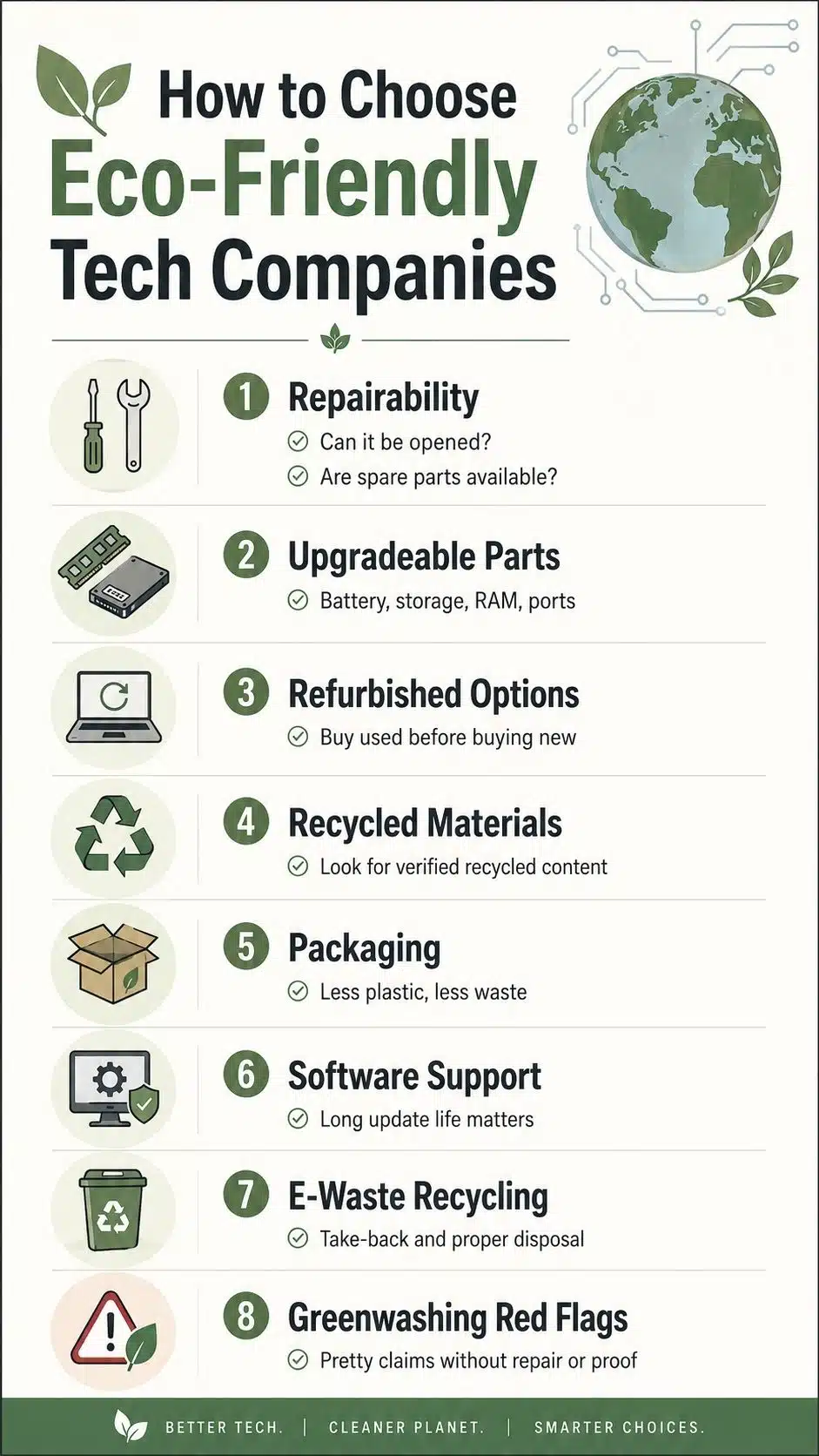
So before buying, ask better questions:
- Can the device be repaired?
- Are spare parts available?
- How long will software updates last?
- Can the battery be replaced?
- Can storage or memory be upgraded?
- Is refurbishing a realistic option?
- Does the company publish clear sustainability information?
- Does the product actually meet your needs for several years?
- Can you keep using what you already own?
The last question is usually the most important. A new “eco” gadget is not automatically better than an older device that still works. Extending the life of what you own is often the strongest move.
Greenwashing Red Flags in Tech
Tech greenwashing often looks polished. You may see recycled aluminum, carbon-neutral shipping, plastic-free packaging, or tree planting on a product page. Those claims can be useful, but they are not enough by themselves.
Be careful when a company talks about sustainability but avoids repairability. A device made with recycled materials can still become waste too quickly if the battery is glued in, parts are unavailable, or software support ends early.
Also watch for vague claims like eco mode, green design, climate-friendly, carbon neutral, sustainable innovation, or responsible tech with no clear explanation.
A stronger tech company should show at least some of these signals:
- Repair guides
- Replacement parts
- Long software support
- Refurbished options
- Trade-in or take-back systems
- Recycled or responsibly sourced materials
- Packaging reduction
- Clear emissions reporting
- Product carbon labels
- Honest discussion of limitations
The best ethical tech companies do not just make a green claim. They make it easier for users to keep technology in use.
Smarter Tech Habits Matter More Than One Brand
Buying from eco-friendly tech companies helps, but habits matter more. Keep your phone longer. Replace the battery before replacing the device. Use a protective case. Repair a cracked screen if the rest of the device works. Buy refurbished when it makes sense. Recycle electronics through proper channels. Avoid buying duplicate chargers, cables, and accessories.
Also clean and maintain your devices. Dust damages laptops. Heat hurts batteries. Cheap chargers can fail quickly. Bad storage habits can make devices feel slow before they are truly obsolete.
A little maintenance can delay replacement. For digital habits, delete what you do not need, use cloud storage thoughtfully, choose renewable-powered services where possible, and avoid upgrading devices only because a new model has been launched.
Sustainable technology is not only about what companies sell. It is also about how long we keep using what we already own.
Finally: Repair, Reuse, Then Buy Better
The strongest lesson from these eco-friendly tech companies is simple: better technology starts with longer product life.
Fairphone and Framework challenge the sealed-device model. Back Market gives existing electronics a second life. iFixit teaches people to repair instead of replace. Nimble and Pela offer better small accessories when replacements are needed. Logitech brings more transparency to mainstream peripherals. Ecosia shows that even digital habits can be redesigned around climate work.
None of these companies makes tech impact-free. But they do point in a better direction: repair more, reuse more, buy refurbished when practical, choose products with clearer proof, and avoid upgrading without a real reason.
That is the kind of technology worth supporting.
Frequently Asked Questions About Eco-Friendly Tech Companies
1. What are the best eco-friendly tech companies to know?
Fairphone, Framework, Back Market, iFixit, Nimble, Pela, Logitech, and Ecosia are strong examples. They focus on repairable devices, refurbished electronics, repair tools, recycled materials, plastic-free accessories, carbon labeling, and climate-focused digital services.
2. Are sustainable electronics really better for the environment?
They can be, especially when they last longer, can be repaired, use fewer virgin materials, or replace the need for new devices. But the biggest benefit often comes from keeping electronics in use longer instead of replacing them too quickly.
3. Is refurbished tech a good, sustainable choice?
Refurbished tech can be a smart choice because it extends the life of devices that already exist. Buyers should still check battery health, warranty, return policy, seller quality, and device condition before buying.
4. What makes a tech company ethical?
An ethical tech company may focus on fairer supply chains, worker conditions, repairability, privacy, transparency, responsible sourcing, emissions reduction, recycling, and product lifespan. No company is perfect, so look for proof rather than broad promises.
5. Are compostable phone cases worth it?
Compostable phone cases can be better than conventional plastic cases if you use them for the full life of your phone and dispose of them properly. They are not an excuse to buy many cases as fashion accessories.
6. How can I reduce my personal e-waste?
Keep devices longer, repair before replacing, replace batteries when possible, buy refurbished, avoid unnecessary accessories, recycle through proper e-waste channels, protect devices from damage, and choose products with long software support.