Growth sounds exciting until your brand starts stretching in five different directions. One team updates the website. Another change to the sales deck. A product team launches a new feature with messaging that nobody approved. Social media starts using a slightly different voice. Customer support explains the offer in its own way. None of this looks dangerous at first. Then one day, customers are confused, your team is tired, and your brand feels bigger but weaker.
That is exactly where brand elevation scale agile solutions become useful. This is not about making a logo cleaner or writing a prettier tagline. It is about building a brand system that can grow, adapt, and stay recognizable while the business keeps moving.
In 2026, brands do not have the luxury of slow planning. Customers compare options fast. AI tools summarize businesses before people even visit their websites. Search results are more crowded. Social discovery is fragmented. Teams are expected to move quickly, but speed without structure usually creates brand chaos.
A strong brand today needs two things at the same time: consistency and movement. It must be clear enough to be trusted, yet flexible enough to respond to new markets, new customer behavior, new channels, and new opportunities. That is the real job of brand elevation scale agile solutions.
What Does Brand Elevation Scale Agile Solutions Mean?
Brand elevation scale agile solutions refers to a practical growth approach that combines three things:
Brand elevation: improving how people understand, remember, and trust your brand.
Scale: building systems that work as the company grows, instead of depending on scattered manual effort.
Agile solutions: using feedback, testing, cross-team collaboration, and fast improvement cycles instead of waiting months to make every decision perfect.
Put simply, it is a framework for growing your brand without breaking the parts that made customers trust you in the first place.
A small business can often rely on instinct. The founder knows the message. The team is close to the customer. Everyone understands the promise because everyone is involved in delivering it. That changes when the business grows.
More people join. More campaigns go live. More products get launched. More markets open. More content gets published. If the brand system stays informal, the company starts scaling confusion.
An agile brand system prevents that. It gives teams enough structure to stay aligned and enough freedom to respond to real market signals.
Why Brands Need Agile Brand Strategy in 2026
Traditional branding often treats brand strategy like a fixed document. You define the mission, values, voice, visual identity, audience, and positioning. Then everyone is expected to follow it. That still matters. A brand without definition becomes forgettable very quickly.
But the old model has a problem. Markets move faster than brand documents. Customer questions change. Competitors reposition. AI search changes discovery. Social platforms reward different formats. Product teams ship faster. Sales teams hear objections that marketing has not yet addressed. If your brand strategy cannot learn, it slowly becomes decorative.
An agile brand strategy keeps the core stable but allows the execution to improve. The promise does not change every week. The logo does not need a redesign every quarter. The brand voice does not swing wildly because one post performed well. Instead, the team keeps testing how the brand promise shows up in real customer situations.
For example: A SaaS company may keep the same core positioning around “simpler workflow automation,” but test different landing page angles for finance teams, HR teams, and agencies.
A wellness brand may keep the same tone of trust and care, but adjust content formats based on whether customers are discovering it through search, TikTok, email, or AI recommendations.
A B2B service company may keep the same expert identity but update sales enablement content every month based on objections heard in calls.
This is how brand elevation becomes practical. You are not guessing what the brand should become. You are learning from the market while protecting the brand’s core.
The Real Problem: Most Brands Scale Their Output Before Their Brand System
Many businesses do not fail because they lack ideas. They fail because their ideas are not connected. They produce more content, more ads, more campaigns, more landing pages, more emails, and more offers. But the brand experience does not get stronger. It gets noisier.
The problem usually appears in small signs:
- The homepage says one thing, but the sales team says another.
- Ads promise speed, but onboarding feels slow.
- Social content sounds playful, but customer support sounds cold.
- Product updates use technical language customers do not understand.
- The brand claims to be premium, but the website experience feels rushed.
- Every campaign starts from scratch because there is no shared system.
This is where scalable brand strategy becomes important. Scaling a brand is not just doing more marketing. It is creating reusable clarity. Teams need shared messaging, customer insights, brand rules, content systems, decision criteria, and feedback loops.
Without those, “brand growth” becomes a fancy name for inconsistency.
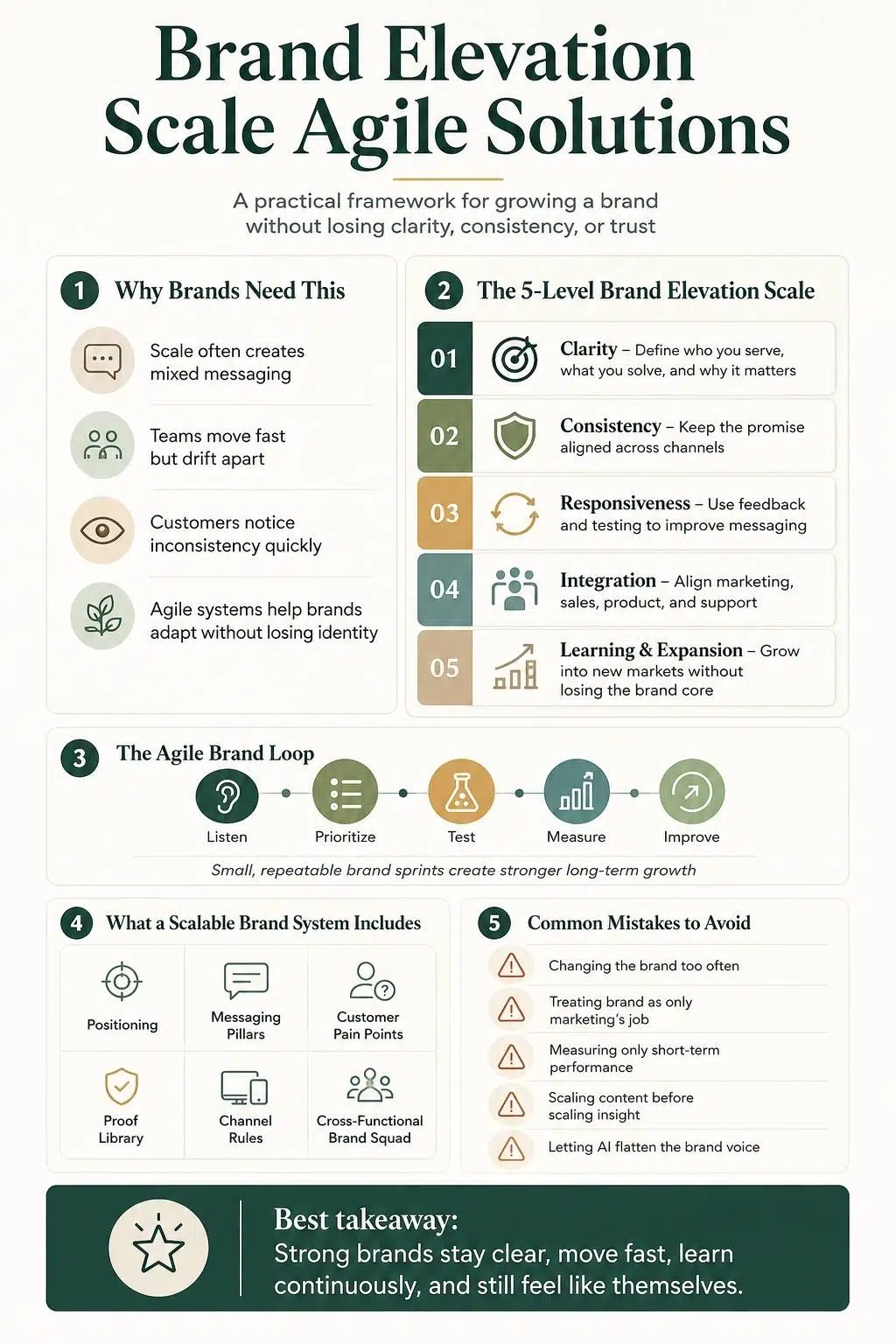
The Brand Elevation Scale: 5 Levels of Growth
A useful way to understand brand elevation scale agile solutions is to think in levels. Most brands do not jump from messy to world-class overnight. They move through stages.
Level 1: Brand Clarity
This is the foundation. At this level, the brand knows what it stands for, who it serves, what problem it solves, and why customers should care.
Brand clarity includes:
- A clear positioning statement
- A defined target audience
- A practical value proposition
- A recognizable voice
- Simple messaging pillars
- Proof points that support claims
The mistake many teams make here is trying to sound bigger than they are. They use vague words like “innovative,” “empowering,” “next-generation,” or “seamless” without explaining what those words mean in the customer’s life.
Clear brands do not hide behind polish. They say the useful thing plainly. A good test is simple: can a new team member explain the brand in 30 seconds without reading from a document? If not, the brand is not ready to scale.
Level 2: Brand Consistency
Once the brand is clear, it needs to become consistent across channels. This does not mean every post, email, and landing page should sound identical. That would be boring. Consistency means customers should feel the same promise everywhere.
The website, emails, product experience, ads, onboarding, support, and sales conversations should all point to the same brand truth.
For example, if your brand is built around making complex work simpler, your own buying process should not feel complicated. If your brand promises expert guidance, your blog should not be shallow. If your brand claims speed, your response time matters.
Brand consistency at scale depends on systems, not memory. Teams need a shared brand hub, approved message examples, visual rules, content templates, customer proof, and a clear review process.
The goal is not to control every sentence. The goal is to prevent avoidable confusion.
Level 3: Brand Responsiveness
This is where agile solutions enter the picture. A responsive brand listens and adjusts. It does not wait a full year to realize customers are confused. It uses data, feedback, customer conversations, search behavior, sales objections, reviews, and support tickets to improve brand communication.
A responsive brand asks:
- What are customers asking before they buy?
- Which claims create trust?
- Which promises feel unclear?
- Which pages lose attention?
- Which objections keep appearing?
- Which content actually helps people decide?
- Which channels attract the right audience?
This level matters because customers are telling brands what they need every day. The issue is that many businesses do not have a system for hearing it.
Agile marketing solutions help teams turn those signals into action. Instead of launching one big campaign and hoping it works, teams test smaller improvements, measure response, and keep refining.
Level 4: Brand Integration
At this level, the brand is no longer treated as a marketing department asset. It becomes part of product, sales, customer success, hiring, leadership, and operations.
That matters because customers do not experience your brand only through ads. They experience it through every touchpoint.
If the product team builds features that do not match the brand promise, customers notice. If sales overpromises, the brand takes the hit. If customer support feels disconnected, trust weakens. If leadership speaks differently from marketing, the market gets mixed signals.
Brand integration creates alignment between what the company says and what it actually does.
This is where cross-functional collaboration becomes a serious advantage. Marketing should not work in isolation. Product, sales, support, and leadership all hold pieces of the brand story. An agile brand system brings those voices together regularly.
Level 5: Brand Learning and Expansion
The highest level is not “perfect branding.” Perfect branding does not exist. The highest level is a brand that keeps learning without losing itself.
At this stage, the company can enter new markets, launch new offers, test new channels, and adapt to changing customer expectations while still feeling like the same brand. This is where brand elevation becomes a growth engine.
The team knows what must stay consistent and what can be tested. They know which metrics matter. They update messaging based on evidence. They use AI carefully without letting it flatten the brand voice. They document what works. They remove what no longer fits.
A learning brand is harder to copy because competitors cannot simply copy the logo, ads, or tagline. They would have to copy the operating system behind the brand.
How Agile Solutions Elevate a Brand
Agile solutions improve brand growth because they make improvement continuous instead of occasional.
A traditional brand refresh might happen every few years. The company hires an agency, updates visuals, changes messaging, launches the new identity, and then slowly watches the market shift again.
Sometimes that is necessary. But many brands do not need a dramatic refresh. They need better weekly learning.
Agile solutions help by creating a rhythm:
- Plan the brand or campaign priority.
- Build a small version.
- Launch or test it.
- Measure customer response.
- Learn what changed.
- Improve the next version.
This rhythm works for landing pages, email campaigns, sales decks, onboarding flows, customer education, thought leadership, and product messaging. The biggest benefit is that teams stop arguing based only on opinion. Creative judgment still matters, but it gets supported by evidence.
For example, instead of debating whether a headline “sounds better,” the team can test whether it helps the right buyers understand the offer faster. Instead of guessing whether customers care about a feature, the team can compare sales calls, search queries, page behavior, and support requests.
Instead of rewriting the entire brand voice, the team can refine weak areas where customers are dropping off. This is no less creative. It is more disciplined creativity.
Building a Scalable Brand Strategy Without Making It Complicated
A scalable brand strategy does not need to be a 90-page document nobody reads. In many companies, the best brand system is simple enough for the team to use every week. Start with these core pieces.
1. A Clear Brand Positioning Statement
Your positioning should explain who you serve, what you help them achieve, and why your approach is different.
A useful format is:
For [target audience], our brand helps [main outcome] by [unique approach], unlike [alternative or common problem].
Example:
For growing e-commerce teams, our platform helps reduce campaign chaos by combining product data, customer segments, and automated content workflows in one place, unlike disconnected tools that create more manual work.
This is not meant to be public copy. It is an internal anchor.
2. Messaging Pillars
Messaging pillars are the main ideas your brand repeats across content and campaigns. Most brands need three to five.
For example:
- Save time without losing quality
- Make decisions from customer data
- Keep teams aligned as campaigns grow
- Build trust through consistent experience
These pillars prevent content from becoming random. Different campaigns can use different angles, but they should connect back to the same strategic themes.
3. Customer Pain Points
Pain points should be specific, not generic. Weak pain point: “Customers want better marketing.”
Stronger pain point: “Marketing teams are publishing faster than they can review, so brand consistency is slipping across channels.”
The more specific the pain point, the stronger the content. This is where experience shows. Readers can feel when a writer understands the actual problem instead of repeating surface-level advice.
4. Proof Library
A proof library keeps evidence ready for marketing and sales.
It can include:
- Case studies
- Customer quotes
- Product data
- Before-and-after examples
- Reviews
- Certifications
- Expert insights
- Process screenshots
- Benchmark results
A brand becomes more trustworthy when its claims are supported. “We help teams move faster” is fine. “Our onboarding process helps teams launch their first campaign in two weeks” is stronger if true.
Never invent proof. Weak proof is better than fake proof, because fake authority eventually damages trust.
5. Channel Rules
A brand should adapt to each channel without becoming unrecognizable. Your LinkedIn voice may be sharper than your help center voice. Your email copy may feel more direct than your blog copy. Your product UI may use fewer words than your landing pages. That is normal.
Channel rules help teams understand what changes and what stays consistent.
A practical rule could be:
- Blog: educational, experienced, detailed
- LinkedIn: direct, opinionated, practical
- Email: concise, helpful, action-focused
- Product copy: clear, calm, low-friction
- Sales deck: proof-led, outcome-focused
Now the brand can flex without drifting.
Where AI Fits Into Brand Elevation Scale Agile Solutions
AI can help brands scale faster, but it can also make them sound painfully average. The difference is whether AI is used as a tool or as a substitute for brand thinking.
Bad AI use looks like this:
- Generic blog posts with no real insight
- Same-sounding social posts across channels
- Over-automated emails that ignore context
- Brand voice reduced to a few adjectives
- Content production without customer understanding
- Fake expertise hidden behind confident wording
Good AI use looks different.
AI can help summarize customer feedback, identify repeated objections, draft first versions of content, generate variations for testing, organize brand assets, analyze search intent, and speed up repetitive work.
But the brand judgment still needs to come from people.
A strong brand team should decide:
- What does our audience actually care about?
- What should we never sound like?
- Which claims can we prove?
- Which topics do we have real authority to discuss?
- Where does automation help, and where does it weaken trust?
- What should be reviewed by a human before publishing?
AI can increase speed. It cannot replace taste, trust, positioning, or lived customer knowledge. That is why agile brand systems matter. They keep AI output connected to real strategy.
A Practical Brand Growth Framework You Can Use
Here is a simple framework for applying brand elevation scale agile solutions inside a growing business.
Step 1: Audit the Current Brand Experience
Start by reviewing every major customer touchpoint.
Look at:
- Homepage
- Product pages
- Landing pages
- Email sequences
- Social profiles
- Sales decks
- Ads
- Onboarding
- Support replies
- Review responses
- Case studies
- Help documentation
Ask one question: Does this feel like one brand? You are looking for gaps, not perfection.
Common issues include outdated copy, inconsistent tone, different value propositions, unclear offers, weak proof, and visuals that no longer match the company’s position.
Step 2: Identify the Brand Friction Points
Brand friction happens when customers hesitate, misunderstand, or lose trust.
Examples include:
- They do not understand what you offer.
- They cannot tell how you are different.
- They like the product but doubt the company.
- They see mixed messages across channels.
- They need too much explanation before taking action.
- They do not believe the claim because proof is missing.
Friction points are often more valuable than vanity metrics. A page may get traffic, but if it creates confusion, it is not elevating the brand.
Step 3: Build a Small Agile Brand Squad
You do not need a huge committee.
A useful agile brand squad may include:
- One brand or marketing lead
- One content or SEO person
- One sales or customer success voice
- One product or operations voice
- One designer or creative partner
The squad’s job is to improve brand clarity, consistency, and performance in short cycles. They should meet regularly, review signals, choose priorities, test improvements, and document what works.
Step 4: Choose One Brand Sprint at a Time
Do not try to fix everything at once. Pick one brand sprint with a clear outcome.
Examples:
- Improve homepage clarity for first-time visitors.
- Refresh sales messaging around one offer.
- Build a proof library for the top three claims.
- Rewrite onboarding emails to reduce confusion.
- Create channel-specific voice guidelines.
- Update product pages based on customer objections.
- Create a content cluster around one core brand topic.
A sprint should be small enough to finish but meaningful enough to matter.
Step 5: Measure Brand and Business Signals Together
Brand work becomes easier to defend when it connects to measurable outcomes.
Useful signals include:
- Branded search growth
- Direct traffic
- Returning visitors
- Conversion rate
- Lead quality
- Sales cycle length
- Customer retention
- Review quality
- Customer support themes
- Engagement from the right audience
- Share of voice
- Assisted conversions
- Content ranking and visibility
Not every brand result appears instantly. Still, you need a measurement habit. Otherwise, brand strategy becomes a matter of taste alone.
Step 6: Turn Learnings Into Brand Assets
This is the step many teams miss. After every sprint, document what worked.
Create reusable assets such as:
- Better headlines
- Stronger proof points
- Updated objection responses
- Audience language examples
- Improved email templates
- Tested landing page sections
- Content angles
- Visual examples
- Do-and-don’t voice samples
This is how agile work compounds. Each sprint should make the next sprint easier.
Common Mistakes Brands Make When Scaling Agile Solutions
Agility helps only when it is guided by strategy. Without that, agile becomes a polite word for chaos. Here are the mistakes to avoid.
Mistake 1: Changing the Brand Too Often
Some teams confuse agility with constant reinvention.
They change positioning after one campaign underperforms. They rewrite the tagline because a competitor launched something new. They shift tone every time a different platform rewards a different style.
That weakens memory.
Customers need repeated, consistent signals before a brand becomes familiar. Agile branding should improve expression, not erase identity every month.
Mistake 2: Treating Brand as Only a Marketing Problem
Marketing may manage the brand, but the whole company creates it.
If support is slow, the brand feels slow. If the product is confusing, the brand feels confusing. If sales exaggerates, the brand feels untrustworthy. If leadership changes direction every quarter, the brand feels unstable.
Brand elevation requires cross-functional ownership.
Mistake 3: Measuring Only Short-Term Performance
Performance metrics matter. Clicks, conversions, and revenue are important. But if you only chase short-term numbers, your brand may become louder without becoming stronger.
A discount campaign may drive sales but weaken premium perception. A viral post may bring attention from the wrong audience. A high-converting landing page may overpromise and create churn later.
Strong brands balance performance with trust, clarity, memory, and customer experience.
Mistake 4: Scaling Content Before Scaling Insight
More content is not always more authority.
Publishing 50 weak articles can damage a brand faster than publishing 10 useful ones. The market is already flooded with generic content. Customers do not need another article that says “know your audience” and “be consistent” without showing how.
Before scaling content, scale insight. Use customer interviews, sales calls, search data, support tickets, community discussions, reviews, and product usage patterns. Then build content from real problems.
Mistake 5: Letting AI Flatten the Brand Voice
AI often produces clean, safe, average content. That can be useful for drafts, but dangerous for brand differentiation.
If every article sounds like it was written by the same polite robot, the brand loses personality.
Human review should protect specificity, judgment, examples, proof, and tone. The final question should always be, “Would our real audience believe this came from us?”
How Small Businesses Can Use This Framework
Small businesses often assume brand systems are only for large companies. That is not true. In fact, smaller teams need brand clarity even more because they have less room for wasted effort.
A small business can start with a simple version:
- One-page brand strategy
- Three messaging pillars
- One customer pain-point list
- One proof folder
- One monthly brand review
- One content or campaign sprint at a time
The goal is not to look corporate. The goal is to stop recreating the brand from scratch every time you publish something.
Small teams can also move faster because they have fewer approval layers. If they listen closely to customers and document what works, they can build a sharper brand than bigger competitors who are stuck in meetings.

How Larger Teams Can Use Brand Elevation Scale Agile Solutions
Larger teams face a different challenge. They usually have more resources, but also more silos.
The website team may not talk to the product team. The paid media team may optimize for leads that sales does not want. The content team may publish educational pieces that do not reflect product positioning. Regional teams may adapt messaging in ways that dilute the brand.
For larger teams, brand elevation scale agile solutions should focus on governance without creating bottlenecks.
That means:
- Shared brand hub
- Clear approval paths
- Modular messaging
- Regional adaptation rules
- Cross-functional planning
- Monthly insight reviews
- Campaign retrospectives
- Brand performance dashboards
- Training for new team members
- AI usage guidelines
The purpose is not to slow people down. It is to help them move quickly in the same direction.
What Success Looks Like
When this approach works, the brand starts feeling easier to manage.
Teams do not need to ask the same questions repeatedly. Content becomes more focused. Sales conversations become clearer. Customers understand the value faster. Campaigns feel connected. Product launches make more sense. The company can test new ideas without confusing the market.
You may notice:
- Stronger brand recall
- Better lead quality
- More consistent messaging
- Faster campaign execution
- Less internal confusion
- Clearer content strategy
- Better customer trust
- More useful feedback loops
- Improved conversion from the right audience
The biggest sign is this: the brand grows, but it still feels like itself. That is harder than it sounds.
Final Thoughts: Build a Brand That Can Move and Still Be Trusted
Brand growth is not just about visibility. A brand can be visible and still forgettable. It can be active and still unclear. It can publish daily and still fail to earn trust.
The stronger path is to build a brand that can move with the market without losing its center. That is why brand elevation scale agile solutions matter. They give growing teams a way to stay clear, consistent, responsive, and useful while everything around them keeps changing.
The brands that win in 2026 will not be the ones shouting the loudest or publishing the most. They will be the ones who learn faster, prove their value clearly, and create a customer experience people can recognize, trust, and return to.
Frequently Asked Questions (FAQs) on Brand Elevation Scale Agile Solutions
1. What are brand elevation scale agile solutions?
Brand elevation scale agile solutions are systems that help a brand grow while staying clear, consistent, and adaptable. They combine brand strategy, scalable processes, customer feedback, and agile marketing methods so teams can improve quickly without confusing the audience.
2. Why is agile strategy important for brand growth?
Agile strategy helps brands respond to customer behavior, market changes, and campaign performance faster. Instead of waiting months to update messaging or content, teams can test smaller improvements, learn from results, and keep refining the brand experience.
3. How do agile solutions improve brand consistency?
Agile solutions improve brand consistency by creating shared systems, review cycles, messaging guidelines, and cross-team collaboration. This helps marketing, sales, product, and support teams communicate the same core promise in ways that fit their channels.
4. Can small businesses use brand elevation scale agile solutions?
Yes. Small businesses can use a simple version with a one-page brand strategy, clear messaging pillars, customer pain-point research, reusable content templates, and regular review cycles. The goal is to create clarity before scaling content, campaigns, or offers.
5. What is the biggest mistake brands make when scaling?
The biggest mistake is scaling output before scaling the brand system. More content, ads, and campaigns will not help if the message is unclear or inconsistent. Brands need shared strategy, proof, customer insight, and agile feedback loops before increasing volume.