When the history of the 21st century is finally codified, the defining conflict will not be remembered as a clash over rare earth minerals, oceanic trade routes, or traditional military staging grounds. It will be universally recognized as the Global AI Talent War 2026. Right now, international policymakers are obsessively tracking how many tens of thousands of GPUs their respective nations possess. They are operating under a deeply flawed, industrial-era delusion. They fundamentally believe that hoarding raw computational power automatically equates to geopolitical supremacy.
They are entirely missing the architecture of the modern revolution.
Silicon is utterly useless without the hyper-specialized human minds required to architect the foundational models. The true, insurmountable bottleneck in the artificial intelligence revolution is not computing availability. It is certainly not access to venture capital. It is human cognition.
Whichever nation manages to attract, aggressively train, and permanently retain the highest concentration of apex AI expertise will win. That nation will hold disproportionate, unassailable influence over how artificial intelligence is built, governed, and deployed worldwide.
We are currently witnessing a breathtaking display of bureaucratic suicide across the Western hemisphere. Governments are willingly spending hundreds of billions of taxpayer dollars subsidizing massive semiconductor fabrication plants. They are constructing multi-billion-dollar cathedrals of silicon to secure physical supply chains.
Then, they deliberately lock the doors so the high priests of computation cannot enter.
By weaponizing their own immigration policies and wrapping skilled worker visas in impenetrable red tape, these nations are actively deporting the exact visionaries required to run the infrastructure they just bankrupted themselves to build.
Global AI dominance is not a collaborative, open-source utopian effort. It is a brutal, unforgiving, zero-sum game. If you deny a brilliant neural network architect a visa due to an arbitrary quota, they do not simply vanish from the global economy. They immediately accept a highly lucrative offer from an adversarial nation that intimately understands the stakes of the current decade.
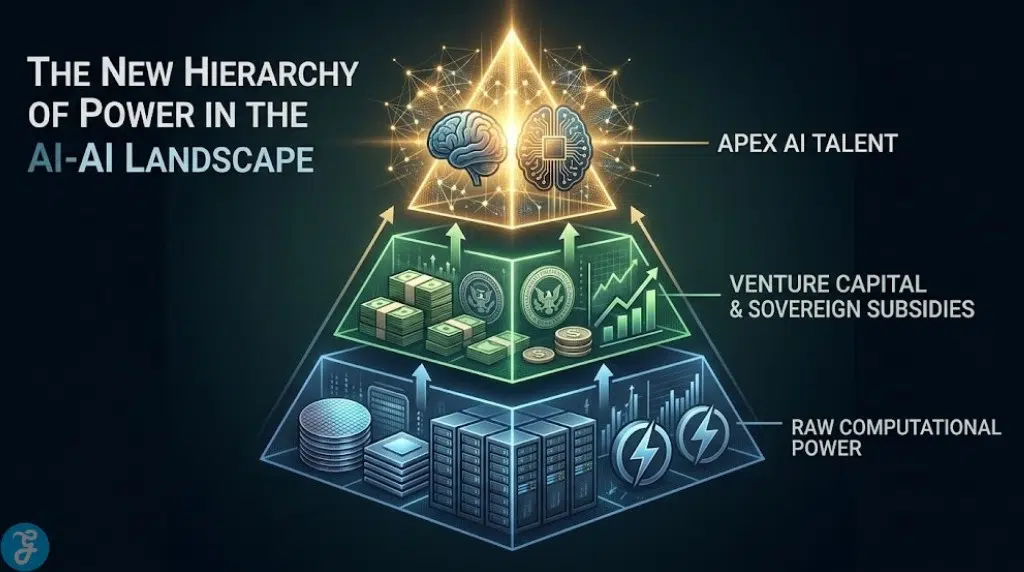
The country that wins this talent war will not just lead a profitable economic sector. They will literally write the operating system for the future of human civilization. They will permanently hardcode their cultural ethics, compliance laws, and geopolitical biases into the algorithms that will dictate the global economy.
To navigate the treacherous landscape of this human capital crisis, we must dissect the primary theaters of conflict where this battle is being waged.
The Hypocrisy of Silicon Subsidies in the Global AI Talent War 2026
The most glaring strategic failure in modern industrial policy is the profound disconnect between hardware investment and human capital acquisition. This disconnect threatens to derail long-term national security objectives entirely.
We have entered an era where political leaders proudly cut the ribbons on sprawling, twenty-billion-dollar fabrication facilities. They tout these facilities as absolute shields against foreign technological embargoes. Yet, these same leaders flatly refuse to reform the immigration pathways necessary to adequately staff them.
A leading-edge AI data center requires vastly more than just reliable electricity and advanced cooling liquid. It requires a highly esoteric blend of yield engineers, distributed systems architects, and specialized machine learning researchers.
These are not skills that can be mass-produced in a generic four-year university program. They are the result of decade-long academic commitments and incredibly rare cognitive aptitudes.
By hyper-focusing exclusively on the physical supply chain of microchips, governments have completely neglected the cognitive supply chain. They are treating the artificial intelligence race exactly like a traditional, 20th-century manufacturing boom. They fail to realize a fundamental truth of the industry: a GPU is just expensive sand until a world-class researcher writes the mathematics to make it think.
If a nation possesses all the compute in the world but none of the top-tier researchers, they are not building an empire. They are simply building an incredibly expensive, highly advanced calculator for their adversaries to rent.
The data grid below contrasts the massive capital deployed for physical infrastructure against the restrictive barriers placed on the human talent required to operate it.
Visas as Weapons of Self-Destruction in the Global AI Talent War 2026
The front lines of this geopolitical conflict are not situated in corporate boardrooms or clandestine military server farms. They are located in the dreary, hopelessly backlogged processing centers of national immigration agencies.
The concept of a “merit-based” immigration system in much of the developed world has devolved into a chaotic, randomized lottery. This broken system treats a globally renowned PhD in natural language processing with the exact same bureaucratic disdain as temporary, seasonal labor. It operates on arbitrary numerical caps rather than strategic national need.
When a leading technology firm attempts to hire a foreign national who holds the key to optimizing their next foundational model, they immediately hit a bureaucratic wall. They are forced into a labyrinth of paperwork, arbitrary department quotas, and processing delays that routinely stretch into multiple years.
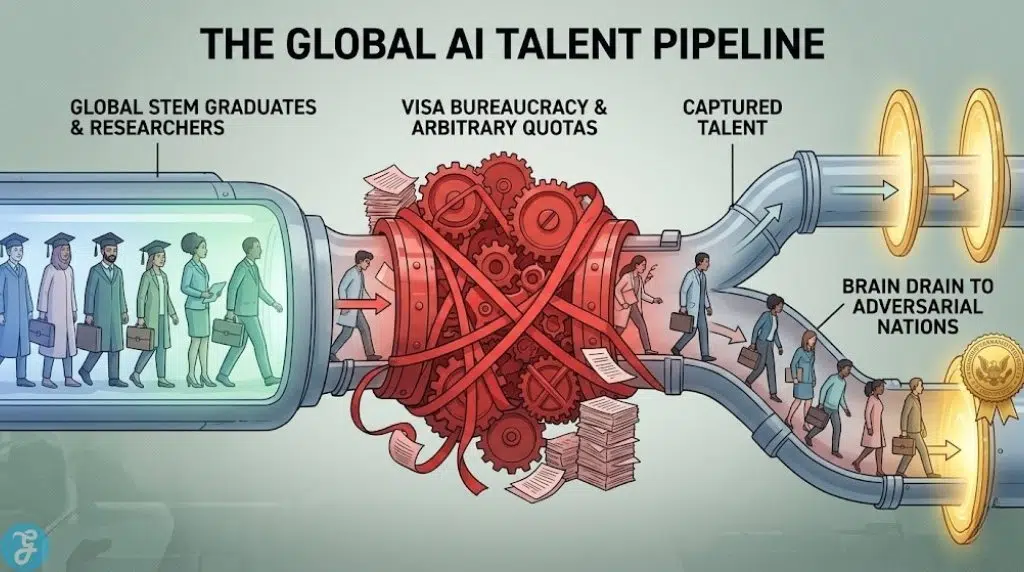
This is not merely an inconvenience for human resources departments. It is a direct, catastrophic threat to national technological sovereignty.
The smartest minds on Earth do not have the patience to beg for entry into a country that clearly does not value them. More importantly, they do not have the need to beg.
While Western nations stubbornly debate arbitrary visa caps to appease domestic political theater, strategic rivals in the Middle East and Asia are rolling out the red carpet.
Adversarial nations are offering tax-free salaries, massive sovereign compute grants, and immediate, unconditional citizenship to anyone who can prove their expertise in generative AI architectures. They understand that importing a genius is the cheapest national security investment a country can make.
This comparative matrix illustrates the weaponization of immigration and how bureaucratic friction directly results in a devastating loss of intellectual capital.
The Compute Gravity Well in the Global AI Talent War 2026
Money alone is no longer the primary currency of recruitment in the artificial intelligence sector.
While competitive salaries are expected, the world’s best minds are drawn exclusively to the locations where they can access the most massive, unfettered computational resources. We have entered an era defined entirely by the “Compute Gravity Well.”
An elite AI architect is essentially useless if they do not have access to tens of thousands of interconnected GPUs to train their models. Theoretical mathematics can only advance so far without the physical architecture required to test it at scale.
The cost of a state-of-the-art training run has skyrocketed past the hundred-million-dollar mark. Because of this astronomical financial barrier, the traditional bastions of innovation—public universities and independent research labs—have been entirely priced out of the game.
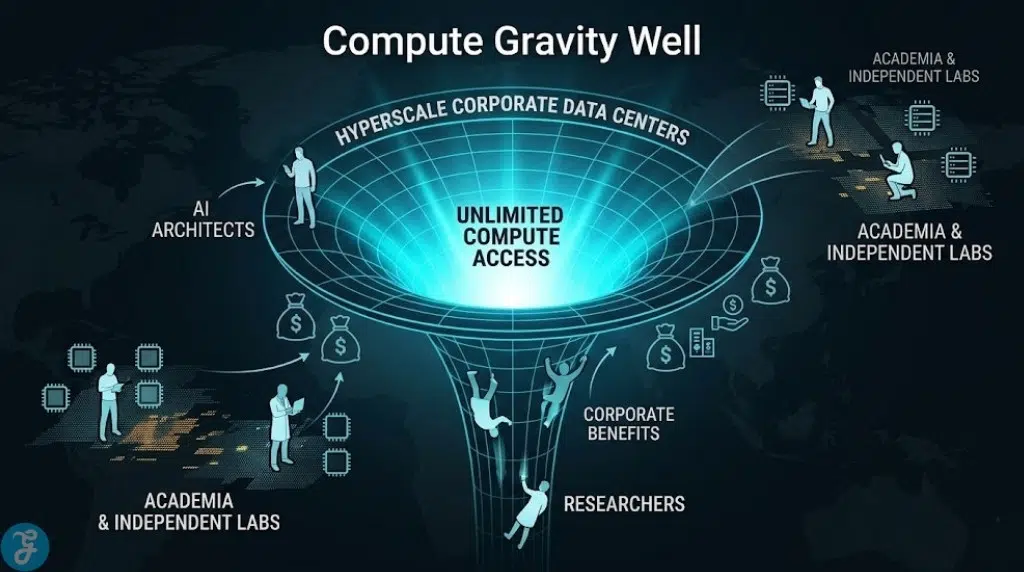
Consequently, the world’s absolute best talent is forced to migrate into the walled gardens of a handful of hyperscale tech monopolies. These corporations act as massive gravity wells. They pull in global talent not just with high salaries, but with the explicit promise of unlimited, immediate compute access. They offer playgrounds that academia simply cannot afford to build.
If a nation wishes to retain its talent, it cannot rely solely on corporate goodwill or patriotic duty. It must establish massive sovereign, public-access compute clusters.
Nations must effectively treat raw computational power as a fundamental public utility. This utility must be designed specifically to keep brilliant minds innovating within sovereign borders rather than fleeing to foreign, privately controlled corporate labs.
The breakdown below contrasts the growing chasm between academic environments and hyperscale corporate environments in the battle for intellectual retention.
Cultural Hardcoding in the Global AI Talent War 2026
The stakes of this conflict extend far beyond corporate profitability or localized economic dominance. The nation that secures the global talent pool will not merely dominate an economic sector. They will permanently hardcode their specific ethical frameworks and geopolitical biases into the foundational models that the rest of the world relies upon.
Artificial intelligence is not a standard, neutral software product. It is a deeply subjective cultural artifact.
When a team of engineers spends months engaging in Reinforcement Learning from Human Feedback (RLHF) to align a model, they are doing much more than fixing bugs. They are fundamentally teaching that model what is acceptable. They define what is dangerous, what is true, and what is false.
This critical alignment process is deeply, inescapably biased by the cultural, political, and ethical environment in which those specific engineers live and work.

If the West loses the talent war, they will inevitably find their economies, their educational systems, and their military logistics running on foundational models that were architected by adversaries. We will effectively be outsourcing our digital morality to nations that may not share our commitment to free speech, democratic processes, or basic human rights.
The algorithms that dictate global loan approvals, medical diagnoses, and information retrieval will be quietly, invisibly shaped by the geopolitical adversaries who possessed the strategic foresight to hire the engineers we turned away.
This analytical matrix demonstrates how human talent permanently shapes the operational reality and societal impact of artificial intelligence models.
The Zero-Sum Apex of the Global AI Talent War 2026
We must stop treating the artificial intelligence labor market as a standard, scalable workforce. The global pool of truly transformational AI talent is astonishingly small. This scarcity transforms the acquisition landscape into a ruthless, zero-sum geopolitical battlefield where capturing one single genius actively damages an adversary.
We must dispel the myth of an abundant, easily replaceable workforce. There are fewer than ten thousand true apex AI architects currently operating on Earth. This makes every single individual a strategic national asset of immeasurable value.
Poaching entire research labs and aggressively recruiting key architects from rival nations is no longer just aggressive corporate human resources. It is a highly classified matter of national security. The highest tier of this talent pool operates on a completely different plane of economic and strategic leverage.
A single visionary architect who discovers a more efficient way to process attention mechanisms or scale sparse mixtures of experts can advance a nation’s AI capabilities by years. They can entirely bypass billions of dollars in hardware deficits through pure mathematical elegance.
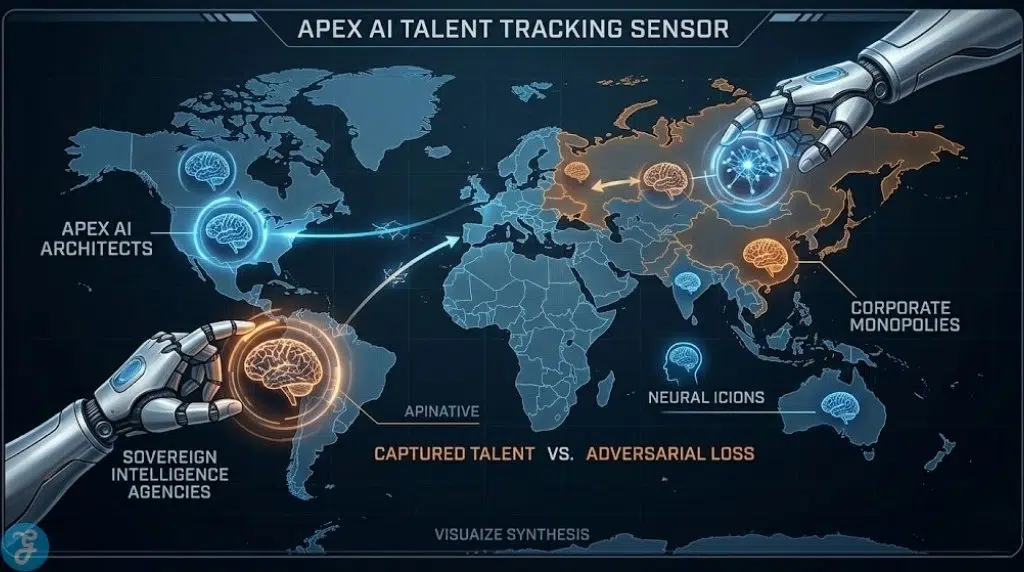
Because this level of genius is so phenomenally rare, the talent war is an absolute zero-sum equation. Every researcher a nation successfully recruits is a researcher explicitly denied to a geopolitical rival. Intelligence agencies worldwide have realized this reality. They are rapidly shifting their focus from traditional espionage and asset recruitment to the aggressive identification, tracking, and poaching of academic talent.
Nations are currently engaging in highly targeted campaigns to alienate foreign researchers from their host countries. They are utilizing targeted propaganda, unprecedented financial incentives, and streamlined visas to orchestrate mass defections of intellectual capital.
This final structural overview outlines the extreme measures nations are taking to secure the apex layer of global technical talent.
| Strategic Action | Traditional HR Approach (Failing) | Geopolitical Intelligence Approach (Winning) |
|---|---|---|
| Target Identification | Waiting passively for candidates to apply through standard corporate portals and online job boards. | Proactively mapping global academic citations and identifying brilliant prodigies long before they graduate. |
| Incentive Structuring | Offering standard market-rate salaries and generic corporate health and benefits packages. | Deploying sovereign wealth funds to offer bespoke, tax-free laboratories and massive compute guarantees. |
| Retention Strategy | Relying on generic corporate culture, office amenities, and legally dubious non-compete clauses. | Treating key architects as protected national security assets, seamlessly integrating them into high-level defense strategies. |
| Adversarial Disruption | Competing passively on the open, highly saturated market for the exact same generic labor pool. | Actively exploiting the bureaucratic visa failures of rival nations to intentionally trigger targeted brain drain. |
The Final Calculus of Technological Sovereignty
The era of complacent, assumed technological dominance has violently ended. The baseline assumption that the brightest minds in the world will automatically flock to specific Western nations simply out of historical habit is a fatal geopolitical miscalculation.
The engineers and architects capable of building the next generation of artificial intelligence are highly mobile. They are aggressively sought after. They are acutely aware of their own immense, unprecedented leverage.
They will not wait in decade-long bureaucratic queues. They will not tolerate underfunded, compute-starved academic environments. And they will certainly not build the future for nations that treat them as political liabilities rather than strategic saviors.
As we move deeper into the reality of the current decade, the equation for global power has been irrevocably simplified.
You can hoard all the rare earth metals on the planet. You can build the most advanced semiconductor fabrication plants in human history. You can stockpile the most massive arrays of computational hardware ever conceived by man.
But if you do not possess the specific human minds required to breathe life into that silicon, you own nothing but a very expensive monument to your own geopolitical hubris.
The rules for the next century of global economics, military strategy, and human interaction are being written right now. They are being codified in the lines of code and the neural weights of foundational models.
The country that has the courage, the foresight, and the bureaucratic agility to secure the talent to write those rules will ultimately rule everyone else.