Struggling with slow survey results and confusing data can make understanding customer needs feel impossible. Many businesses face challenges keeping up with fast-changing markets, and sifting through endless reports only adds more stress. Having the right tools can completely change this process. Generative AI quickly turns raw information into clear insights.
This guide, Using Generative AI for Market Research: A Complete Guide, shows how these platforms make sense of trends, improve survey questions, and build customer personas in minutes.
The guide walks through exact steps that demonstrate just how straightforward and effective AI-driven market research can be.
Using Generative AI For Market Research: A Complete Guide to the Basics
Generative AI uses smart algorithms to create new ideas, text, or answers from raw data. A 2025 report from Precedence Research showed the US generative AI market size hit over $10.9 billion, and a recent McKinsey study found that 92% of companies plan to invest in these tools soon.
Definition of Generative AI
Artificial Intelligence now helps marketers with fresh content creation, rather than just processing old numbers. Generative AI uses machine learning models, like OpenAI’s GPT-4o, to build synthetic personas or draft survey questions in seconds.
A 2025 Wharton report revealed that 82% of US leaders now use AI weekly to write clear summaries fast and test product ideas.
Key differences from traditional analytics
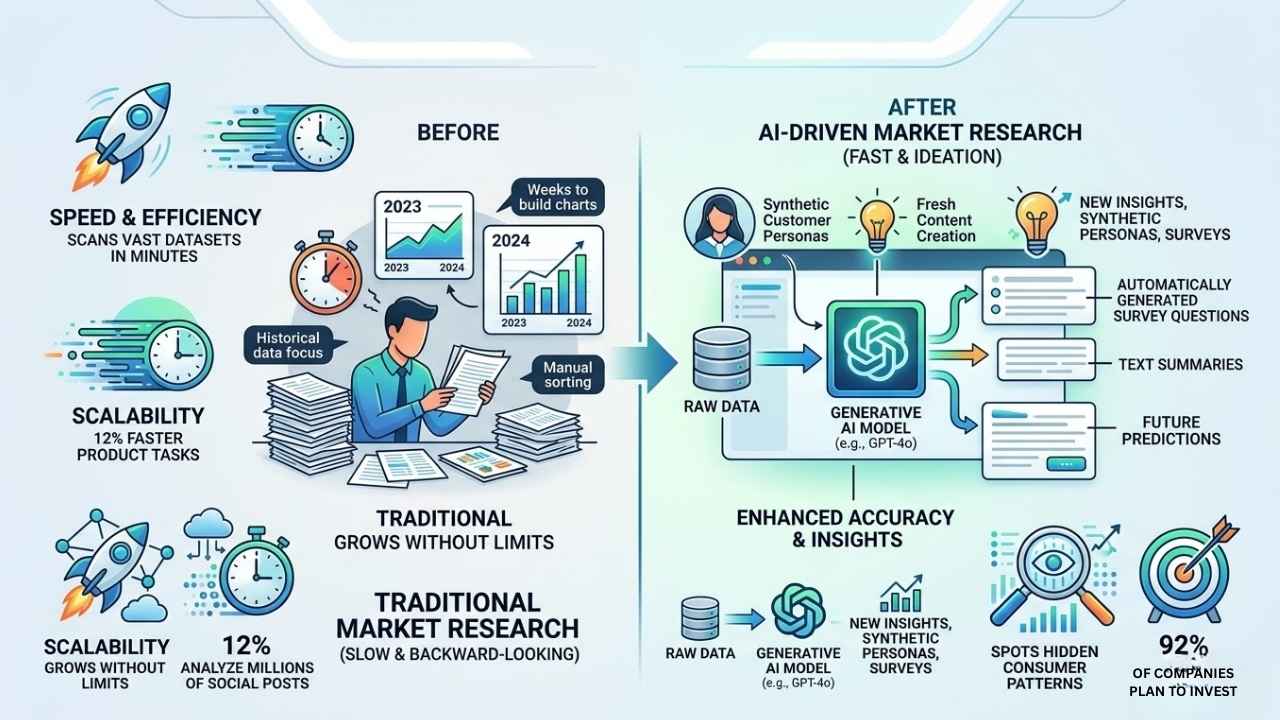
Generative AI completely changes how we handle data. Traditional analytics mostly look at historical numbers to show you what happened yesterday.
Generative AI does so much more by creating synthetic personas and new insights on the fly, allowing you to accurately predict future choices.
Here is a quick breakdown of how the two approaches compare:
| Feature | Traditional Analytics | Generative AI |
|---|---|---|
| Data Focus | Looks backward at historical data and past events. | Predicts future trends and generates new ideas. |
| Processing Time | Takes weeks to build charts and format graphs. | Delivers plain text summaries and insights in minutes. |
| Tool Example | Basic spreadsheet software or legacy databases. | Advanced automated platforms like Quantilope. |
Key Advantages of Using Generative AI
Generative AI handles mountains of market data to streamline your data collection and give you quick answers you can rely on. The financial benefits are also hard to ignore, as a 2025 Wharton study found that three out of four executives reported positive returns on their AI investments.
Speed and efficiency in data processing
Artificial Intelligence tools process market research data at lightning speed. Today, these systems scan vast datasets in minutes and pull out summaries that anyone can easily grasp.
A great example comes from a 2026 Harvard Business School study on Procter & Gamble. The researchers found that P&G teams using an internal AI platform finished product development tasks 12% faster than those working without it.
Scalability for large datasets
Generative AI handles large datasets faster than any human team could manage. You can explore huge pools of customer behavior without slowing down your operations.
Here are a few ways this scalability helps your business:
- Analyze massive feedback: Tools like Meltwater scan millions of social media posts in real time.
- Spot trends early: Machine learning models crunch customer reviews to find new patterns.
- Grow without limits: The technology keeps pace as your dataset grows from thousands to millions of points.
- Shift your focus: Your team can stop sorting data manually and start making better decisions.
Enhanced accuracy and insights
AI spots hidden patterns in consumer insights that people often miss. It creates summaries of huge datasets with incredible accuracy.
For example, Nestlé used generative AI to speed up their new product ideation. They analyzed inputs from over 20 US brands instantly instead of running months of focus groups.
“By using generative AI, Nestlé compressed their product ideation process from six months down to just six weeks, proving how accurate and actionable these insights can be.”
This means you rely on real-time facts instead of old habits or guesswork.
Use Cases of Generative AI in Market Research
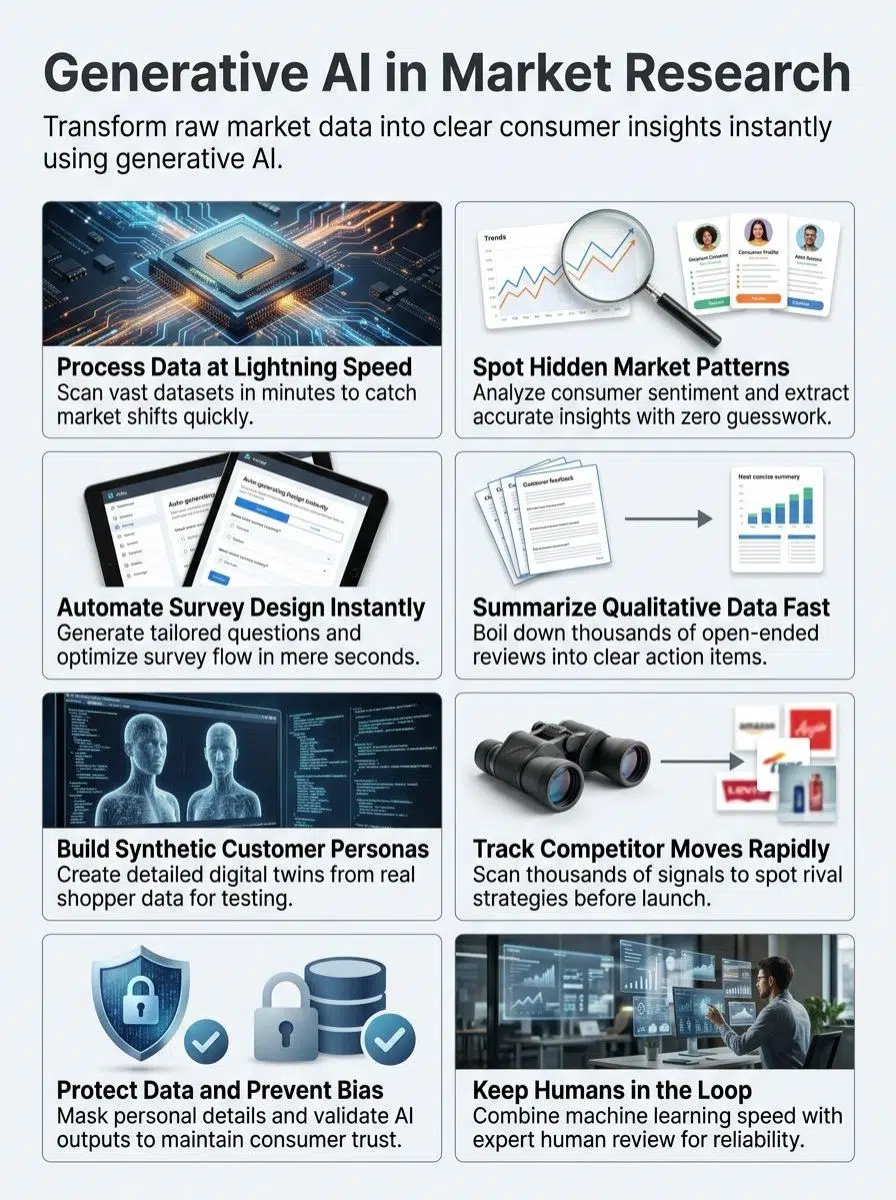
Creative minds use AI for many clever tasks to find new patterns. You can use them to handle survey design, summarize qualitative data, and build detailed personas.
Automating survey design and optimization
Generative AI handles survey design to save hours for your research team. You simply type a prompt, and the system creates a complete question set where you can test wording and question flow in seconds.
Top platforms lead the way here. SurveyMonkey is currently used by 98% of the Fortune 500 for complex studies, while Typeform uses a conversational interface to hit an impressive 57% average completion rate.
Summarizing qualitative data
AI takes mountains of open-ended survey answers and boils them down in minutes. A machine can read thousands of customer reviews to pull out exact likes and dislikes.
This rapid data interpretation process helps you in several specific ways:
- Process unstructured data: Tools like Discuss help researchers analyze live video interviews quickly.
- Extract immediate sentiment: The AI pulls out keywords and emotions without manual coding.
- Spot market shifts: You see consumer insights unfold almost in real time.
- Save valuable time: What used to take a human team weeks now takes just a few clicks.
Developing customer personas
Marketers use Generative AI to build synthetic personas faster than ever. By analyzing social media posts and purchasing habits, the software handles complex behavioral analysis to spot patterns across millions of consumers.
For instance, tools like Glimpse scan hundreds of millions of US consumer signals. They build sample buyers with rich backstories, specific hobbies, and clear price sensitivities.
Detecting market trends and synthesizing insights
Generative AI shakes up market analysis by spotting changes before they make headlines. Top companies track sudden shifts in customer sentiment to predict exactly what shoppers want next.
“Platforms like GWI Spark tap into massive global datasets to assign predictive scores to early signals, giving marketers a massive head start on trends before they go mainstream.”
Performing competitive analysis
AI scans thousands of news articles and reviews to track your rivals. You can spot competitor moves and price drops as they happen.
You no longer have to get lost in raw data. These tools give you a massive advantage:
- Track press releases: AI monitors competitor announcements instantly.
- Compare product features: You can see how your new launch stacks up against the market.
- Test different strategies: Digital twins help you figure out how rivals might react to your changes.
- Make sharper decisions: You act on up-to-date consumer insights rather than outdated reports.
Popular Generative AI Tools for Market Research
New tools use artificial intelligence to speed up your daily research tasks and turn raw data into clear insights. Spending on AI software continues to dominate the US market, so let’s look at some of the top options available today.
Survey automation tools
Survey automation tools speed up both creation and processing by designing questions and spotting unclear wording fast. Enterprise-grade platforms like Qualtrics offer powerful flexibility for complex customer segmentation projects, while tools like SurveySparrow increase completion rates by making the survey feel like a personal chat.
You can use these platforms to check how people feel about an ad instantly, and companies report much deeper insight extraction without needing extra staff hours.
Sentiment analysis platforms
Sentiment analysis platforms sift through mountains of customer feedback and reviews. These platforms help you catch trends before they snowball, protecting your brand’s overall user experience.
Here is a quick comparison of two heavyweights in the industry:
| Platform | Key Feature | Best Used For |
|---|---|---|
| Hootsuite Insights | Powered by Brandwatch to track social conversations. | Understanding audience behavior across the social web. |
| Meltwater Radarly | Monitors millions of posts in real time using AI. | Detecting emerging crises before they escalate. |
Predictive analytics software
Predictive analytics software spots trends fast to show you new opportunities. Generative models read past sales data and sense mood swings on social media to forecast customer behavior with high accuracy.
For example, Tableau uses AI to explain complex data trends in plain English. This helps your business stay ahead by acting on clear predictions instead of guesswork.
Competitive intelligence tools
Competitive intelligence tools analyze competitor moves faster than ever by scanning thousands of market signals every single day. You gain quick snapshots showing which brands are changing their pricing, and here are a few popular tools that make this easy:
- Brand24: Provides influence scores and sentiment analysis to track your online reputation.
- MyMap.AI: Pulls web data to build visual competitor reports instantly through a chat interface.
- Crayon: Tracks rival press releases and market shifts automatically.
Challenges and Ethical Concerns
Generative AI can trip over hidden biases and privacy concerns, and sometimes the technology runs faster than people can keep up. A 2025 Pew Research Center study showed that 66% of US adults are highly concerned about getting inaccurate information from AI, meaning you need a steady hand to avoid losing control of your data.
Addressing AI bias
AI tools learn from data that reflects real-world human mistakes, which means bias can sneak into your predictive analytics. Industry data from Feedough in 2025 showed that 77% of companies had bias-testing tools, but they still found bias in their systems.
For example, AI recruitment tools are 30% more likely to filter out older candidates. You must check AI-generated content against human judgment to spot these problems early.
Ensuring data privacy
Data privacy remains a massive topic in market research. Companies collecting sensitive information must follow strict rules to protect it.
A pro-tip I always share is to treat data privacy as a feature, not just a rule. You can protect your customers by following these best practices:
- Follow local laws: Always adhere to regulations like the CCPA in California.
- Mask personal details: Use anonymization techniques to hide private information.
- Use synthetic data: Create digital twins instead of storing real user profiles.
- Update security: Run regular checks to keep bad actors out of your systems.
Managing over-reliance on AI
Relying too much on Artificial Intelligence creates dangerous blind spots. These tools speed up survey design, but they absolutely do not replace human judgment.
A 2025 Wharton report found that leaders want this technology to enhance human skills, not replace them.
“Synthetic personas created by AI may miss real customer feelings or ignore sudden market shifts that only an experienced human analyst would notice.”
Mixing machine learning with personal knowledge keeps your competitive analysis sharp and grounded in reality.
Best Practices for Implementing Generative AI
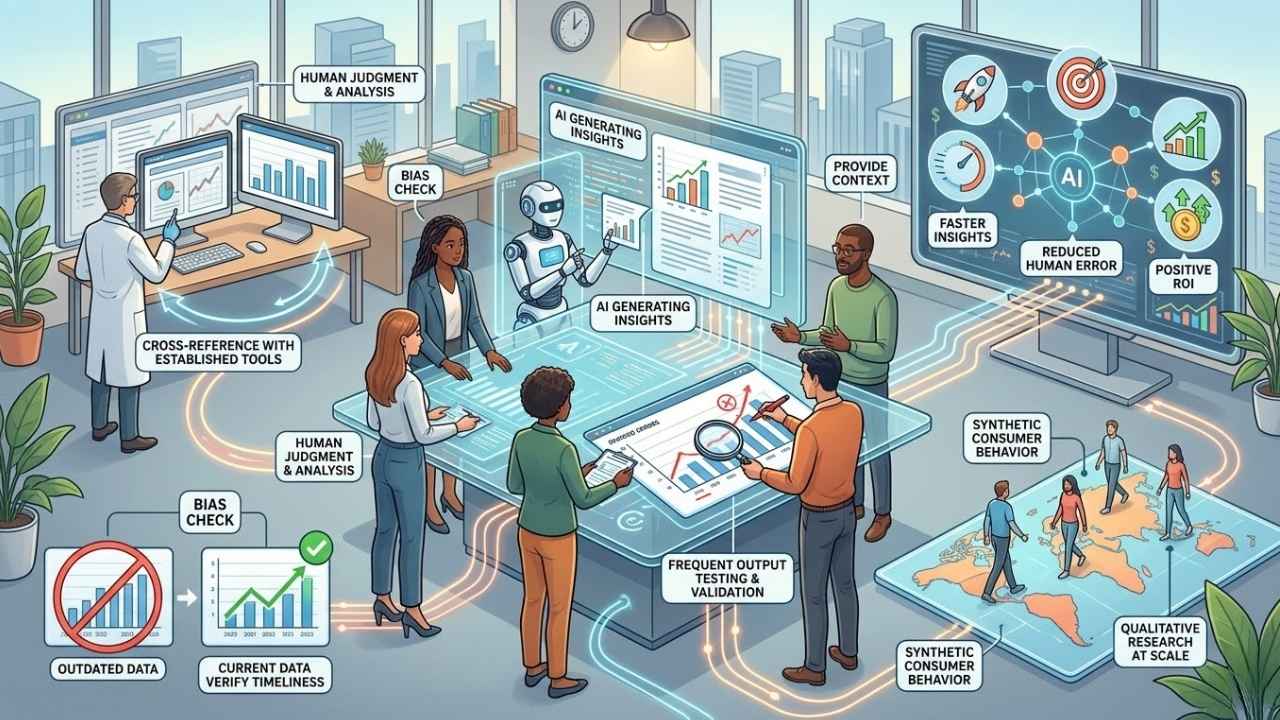
Test your outputs often so surprises stay small and easy to fix. Keep people involved in the process, because machines often miss out on those brilliant moments that only humans catch.
Validating AI-generated outputs
AI can sometimes make mistakes during fast data analysis, so always double-check anything produced by the software. If you use generative AI to analyze competitor moves, verify that the model is not using outdated information from past years.
You should cross-reference outputs with established tools like Nielsen to catch any slipups. Mixing machine learning results with real human review keeps your insight extraction highly reliable.
Maintaining a human-in-the-loop approach
Market research needs a careful balance between artificial intelligence and human judgment. You can use software to process huge datasets, but people must test the assumptions.
Here is why keeping humans involved is so important:
- Validate findings: Analysts catch unusual results that machines miss.
- Check for bias: Humans review automated summaries to ensure fairness.
- Provide context: People understand the real-world reasons behind sudden data shifts.
- Make final calls: Expert eyes must check accuracy before you make big business decisions.
The Future of Market Research with Generative AI
Generative AI is completely changing how companies shape their research strategies. You can now build digital twins that mirror real customer behavior for better market analysis.
The Wharton 2025 report predicts that 2026 will be the inflection point where companies focus on using AI at a massive scale.
“Three out of four leaders reported positive returns on AI investments, and 88% plan to increase their spending in the next year to secure a competitive edge.”
Consumer insights now come faster and with far less human error. As this technology evolves, qualitative research reaches deeper levels without wasting time on endless spreadsheets.
Final Thoughts
Market research is evolving rapidly, and artificial intelligence enables teams to work smarter. These systems provide clear ways to simplify survey design and generate sharper customer insights. Using Generative AI for Market Research: A Complete Guide is designed to give businesses the confidence to start leveraging these powerful tools.
An AI-powered approach can provide a competitive edge by uncovering market trends quickly. Fast, actionable results are within reach—embracing this technology allows businesses to turn insights into action and stay ahead of competitors.