Keeping track of stock is the beating heart of any successful store. Whether you are running a single boutique or a multi location empire you need a system that tells you exactly what is sitting on your shelves. Relying on manual spreadsheets in 2026 is a recipe for stockouts and frustrated customers. Let us dive into the top platforms that can automate this entire process for you.
How We Selected Our 10 Best Retail Inventory Tools
Finding the perfect system means looking past the flashy marketing websites. We filtered our choices based on three main factors. First we looked at how easily the platform syncs with popular point of sale systems and online storefronts. Second we evaluated the pricing structures to ensure there are viable options for both tiny pop up shops and massive warehouse operations. Finally we prioritized platforms that offer real time analytics so you never have to guess when it is time to reorder your best sellers.
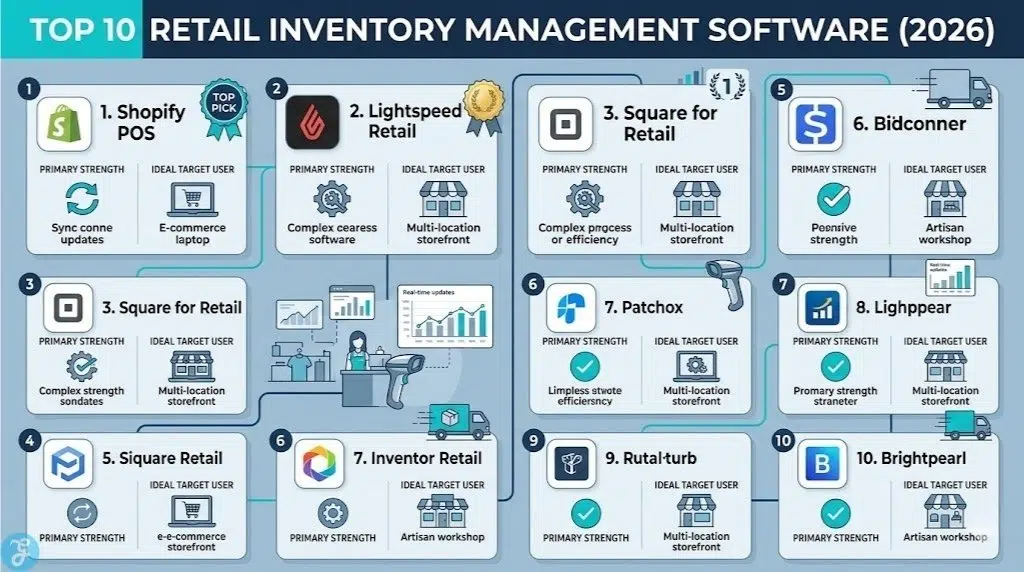
The Top 10 Retail inventory management software Platforms Available Today
Now that you know how we graded these systems it is time to look at the actual tools. Here is our breakdown of the most reliable and feature rich inventory managers currently on the market.
1. Shopify POS
Shopify is no longer just for building websites. Their integrated point of sale system seamlessly connects your physical store inventory with your online stock in real time. This means if someone buys your last blue shirt in the store it instantly shows as out of stock on your website. It is an incredibly smooth ecosystem that removes a ton of daily friction.
Best Feature/For:
-
Retailers who already use Shopify for their ecommerce website
Why We Chose It:
-
Provides a unified dashboard for all online and offline sales
-
Offers native hardware options that look great on any checkout counter
-
Includes excellent mobile app features for managing stock on the go
Things to consider:
-
You are locked into the Shopify payment ecosystem which can get expensive for high volume sellers
For stores with more complex needs than a standard Shopify setup we have our next strong contender.
2. Lightspeed Retail
Lightspeed is built specifically for stores that carry thousands of different variants and complex product matrices. It handles everything from purchase order generation to multi location stock transfers with incredible ease. This platform gives you granular control over your data and is particularly loved by bike shops and apparel retailers. It turns a chaotic back room into a highly organized operation.
Best Feature/For:
-
Businesses with massive product catalogs and multiple brick and mortar locations
Why We Chose It:
-
Features incredibly powerful reporting and analytics tools
-
Handles complex vendor management and automated reordering perfectly
-
Offers built in loyalty programs to keep customers coming back
Things to consider:
-
The learning curve is a bit steep for brand new employees
If Lightspeed feels a little too heavy for your current operation the next option keeps things wonderfully simple.
3. Square for Retail
Square revolutionized how small businesses take payments and their dedicated retail inventory product is just as intuitive. It is completely cloud based and allows you to track cost of goods sold and project your profit margins right from your iPad. The system is designed to get you up and running in minutes rather than weeks. It is the perfect stepping stone for businesses outgrowing basic spreadsheets.
Best Feature/For:
-
Small boutiques and weekend market vendors looking for a fast setup
Why We Chose It:
-
The user interface is foolproof and requires almost zero training
-
Syncs beautifully with the standard Square payment terminals
-
Offers a free tier to help brand new businesses get off the ground safely
Things to consider:
-
Lacks the deep warehouse management features needed by massive enterprise brands
Moving past the absolute basics brings us to a platform that excels at scaling up with your business.
4. Zoho Inventory
Zoho Inventory is part of a massive suite of business applications which makes it an absolute powerhouse for growing retailers. It automates your daily workflows and connects your sales channels to your shipping providers effortlessly. You can track every single item from the moment you order it from your supplier until it lands in your customers hands. It is a fantastic middle ground that balances advanced features with affordable pricing.
Best Feature/For:
-
Growing businesses that want to integrate their inventory with accounting and CRM tools
Why We Chose It:
-
Offers end to end tracking including kitting and bundling options
-
Provides excellent shipping integrations with major carriers out of the box
-
The pricing model is very generous for the amount of features you get
Things to consider:
-
The interface can feel a bit dated compared to newer startup software
For retailers who manage incredibly complex supply chains our next pick is an absolute beast.
5. Cin7 Core
Cin7 Core is designed for product sellers who need to manage multiple warehouses alongside their retail storefronts. It brings all your B2B and B2C sales channels together under one massive digital roof. The system is brilliant at handling complex manufacturing workflows and international currency conversions. It gives you total visibility over your entire supply chain network.
Best Feature/For:
-
Omnichannel brands that manufacture their own goods and sell wholesale
Why We Chose It:
-
Handles complex multi warehouse routing with incredible precision
-
Integrates flawlessly with top tier accounting software like Xero
-
Provides massive scalability for brands planning global expansion
Things to consider:
-
The implementation process can take weeks and requires dedicated project management
If you do a lot of your retail business through giant online marketplaces you will love the next platform.
6. Veeqo
Veeqo was recently acquired by Amazon which makes it an absolute dream for retailers who heavily utilize the Amazon fulfillment network alongside their own stores. The best part is that the core software is entirely free to use. It pulls all your orders from various channels and gives you discounted shipping rates right out of the gate. It is a incredibly cost effective way to get your stock under control.
Best Feature/For:
-
Amazon sellers who also run their own physical or digital retail stores
Why We Chose It:
-
The core inventory and shipping software is completely free to use
-
Provides deep and reliable integrations with the Amazon ecosystem
-
Offers access to heavily discounted shipping labels directly in the app
Things to consider:
-
Customer support can be slow since it operates on a free software model
Some retailers actually make the products they sell and they need a tool built specifically for that workflow.
7. Katana
Katana is a visual platform built specifically for modern makers and direct to consumer retail brands. It tracks your raw materials just as closely as it tracks your finished retail products on the shelf. The visual dashboard uses a color coded system to show you exactly what you can build based on your current material stock. It completely eliminates the guesswork from your production schedule.
Best Feature/For:
-
Artisan retailers and small scale manufacturers
Why We Chose It:
-
The visual interface is stunning and incredibly easy to understand at a glance
-
Tracks raw material inventory perfectly alongside finished goods
-
Helps prevent out of stock situations on your most popular handmade items
Things to consider:
-
Not ideal if you strictly buy and resell finished goods from other vendors
When you are managing tens of thousands of orders across multiple countries you need serious firepower like our next option.
8. Linnworks
Linnworks is an enterprise grade tool designed to connect your retail operations to the rest of the world. It automates the entire commerce journey from stock control to order fulfillment across endless sales channels. This platform is built to handle massive order volumes without breaking a sweat or slowing down your operations. It acts as the central brain for high velocity retail businesses.
Best Feature/For:
-
High volume international retailers pushing thousands of orders daily
Why We Chose It:
-
Connects to virtually every major marketplace and shopping cart globally
-
Automates complex routing rules to ensure the cheapest shipping methods
-
Provides enterprise level analytics to guide your purchasing decisions
Things to consider:
-
The monthly cost is substantial and requires a custom quote
For retailers who are deeply entrenched in the QuickBooks ecosystem the next option is a natural fit.
9. Fishbowl
Fishbowl has been the go to inventory add on for QuickBooks users for years. It takes the basic accounting features of QuickBooks and supercharges them with advanced warehouse and retail stock management tools. You get features like barcode scanning and part tracking without having to change your entire accounting setup. It bridges the gap between the warehouse floor and the accountants desk perfectly.
Best Feature/For:
-
Established businesses strictly utilizing QuickBooks Desktop or Online
Why We Chose It:
-
Offers the most robust QuickBooks integration on the market
-
Includes advanced features like serial number and lot tracking
-
Supports heavy duty barcode scanning hardware for busy warehouses
Things to consider:
-
The user interface is extremely dated and feels like legacy software
Our final pick is designed specifically for retailers who want a single system to run their entire company.
10. Brightpearl
Brightpearl is a retail operating system that combines inventory management with accounting and order fulfillment. It is built to handle the chaotic spikes in demand that happen during major retail holidays like Black Friday. The platform automates your entire back office so you can focus strictly on marketing and customer experience. It is a premium product designed for brands experiencing hyper growth.
Best Feature/For:
-
Fast growing retail brands doing over a million dollars in annual revenue
Why We Chose It:
-
Combines inventory financials and CRM into one centralized hub
-
Built to handle massive order spikes without crashing or lagging
-
Offers an incredibly detailed automation engine to replace manual tasks
Things to consider:
-
It is an incredibly expensive platform aimed strictly at larger enterprises
To help you digest all of this information we have put together a quick reference guide.
An Overview Of 10 Retail inventory management software Options
Seeing all these platforms side by side helps clarify which tools dominate specific corners of the retail market. We have organized them by their primary strengths to make comparison easy.
Overview Comparison Table
Below is a direct comparison of all ten platforms focusing on their main advantage and target user base.
| Software Name | Primary Strength | Ideal Target User | Pricing Tier |
| Shopify POS | Omnichannel syncing | Ecommerce driven retailers | Medium |
| Lightspeed Retail | Complex variants | Multi location stores | Medium |
| Square for Retail | Ease of use | Small boutiques | Low to Medium |
| Zoho Inventory | App ecosystem | Growing multichannel brands | Low |
| Cin7 Core | Wholesale routing | B2B and B2C manufacturers | High |
| Veeqo | Free Amazon tools | Amazon hybrid sellers | Free |
| Katana | Visual production | Artisan manufacturers | Medium |
| Linnworks | Global marketplaces | International enterprises | High |
| Fishbowl | Accounting sync | QuickBooks heavy users | High |
| Brightpearl | High order volume | Hyper growth brands | Very High |
Understanding the broad landscape is great but narrowing it down to the absolute best options is even better.
Our Top 3 Picks and Why?
While every platform on this list is excellent a few truly stand out for the average modern retailer.
-
Shopify POS: It wins our top spot simply because it offers the most frictionless bridge between online and offline selling right out of the box.
-
Lightspeed Retail: We love this platform because it handles complex apparel matrices and dense vendor catalogs better than anything else on the market.
-
Square for Retail: This takes our third spot because it democratizes inventory tracking by making it incredibly accessible and affordable for absolute beginners.
Now that we have reviewed the top contenders you need to know how to pick the right one for your specific store.
Buyer’s Guide: How to Choose the Right Retail inventory management software by Yourself?
Selecting the right platform is a huge operational commitment and migrating your data later is always a massive headache. You need to get this decision right the first time to protect your sanity.
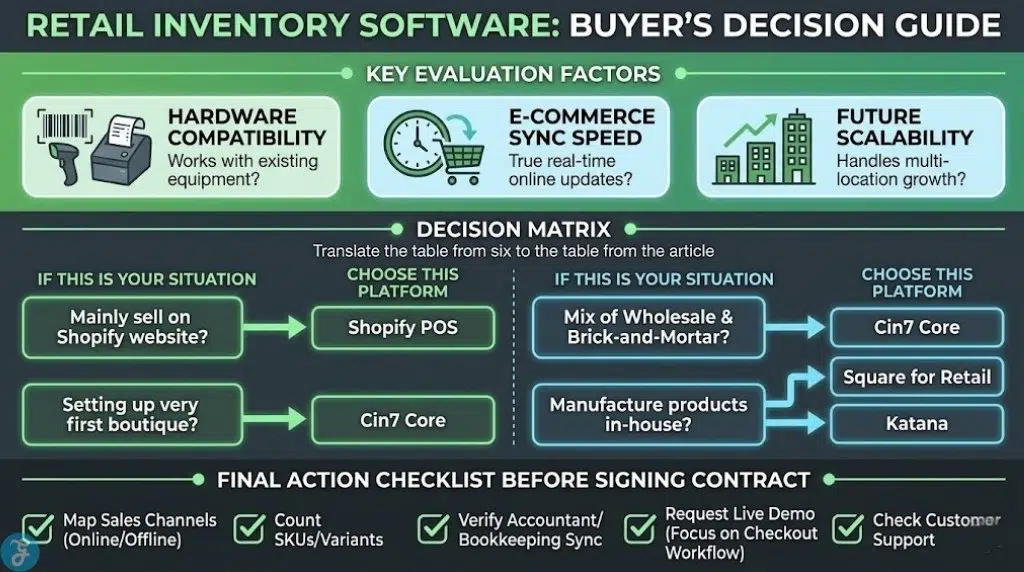
Here is the core selection framework you should use to evaluate your needs:
-
Hardware Compatibility: Ensure the new software works seamlessly with your existing barcode scanners and receipt printers so you do not have to buy new equipment.
-
E-commerce Sync Speed: Verify that the system updates your online store inventory in true real time to prevent embarrassing overselling situations.
-
Future Scalability: Pick a platform that can easily handle multiple warehouses or new franchise locations as your brand continues to grow.
To make this easier we have built a matrix to guide your structural choices.
Below is a decision matrix to help you match your specific retail situation with the correct software route.
| Choose this strategy… | If your primary retail situation is… |
| Choose Shopify POS if… | You already drive most of your sales through a custom Shopify website. |
| Choose Cin7 Core if… | You operate a complex mix of wholesale accounts and physical retail shops. |
| Choose Square for Retail if… | You are setting up your very first brick and mortar boutique this weekend. |
| Choose Katana if… | You assemble or manufacture your own products in house before selling them. |
Before you sign any long term vendor contracts make sure you run through our final checklist.
The Final Checklist:
-
Map out all the different online and offline sales channels you currently use.
-
Count exactly how many physical variants or SKUs you carry in your store.
-
Ask your accountant which software integrates best with your current bookkeeping setup.
-
Request a live demo from the vendor focusing specifically on your daily checkout workflows.
-
Read external reviews about their customer support response times during major holiday sales.
Taking Control Of Your Store Shelves
Managing your stock does not have to be a nightmare of messy spreadsheets and manual counting errors. By upgrading to a modern system you free up your valuable time to focus on actually growing your brand and talking to your customers face to face. Review your current daily bottlenecks and choose a system that makes your retail life significantly easier.