


You know that feeling you get on a Sunday evening? The one where your stomach tightens just thinking about the week ahead. You might wake up and ask yourself, “Why am I actually doing this job?” If that sounds familiar, you are definitely not alone. Many of us feel stuck or lost in our careers right now. We chase paychecks, but the passion just isn’t there anymore. It leaves us feeling empty, tired, and restless.
But what if you could change that without quitting your job tomorrow?
There is a Japanese concept called Ikigai that focuses on finding true purpose. It is all about finding the sweet spot between what you love, what you are good at, what the world needs, and how you can earn a living.
What is Ikigai?
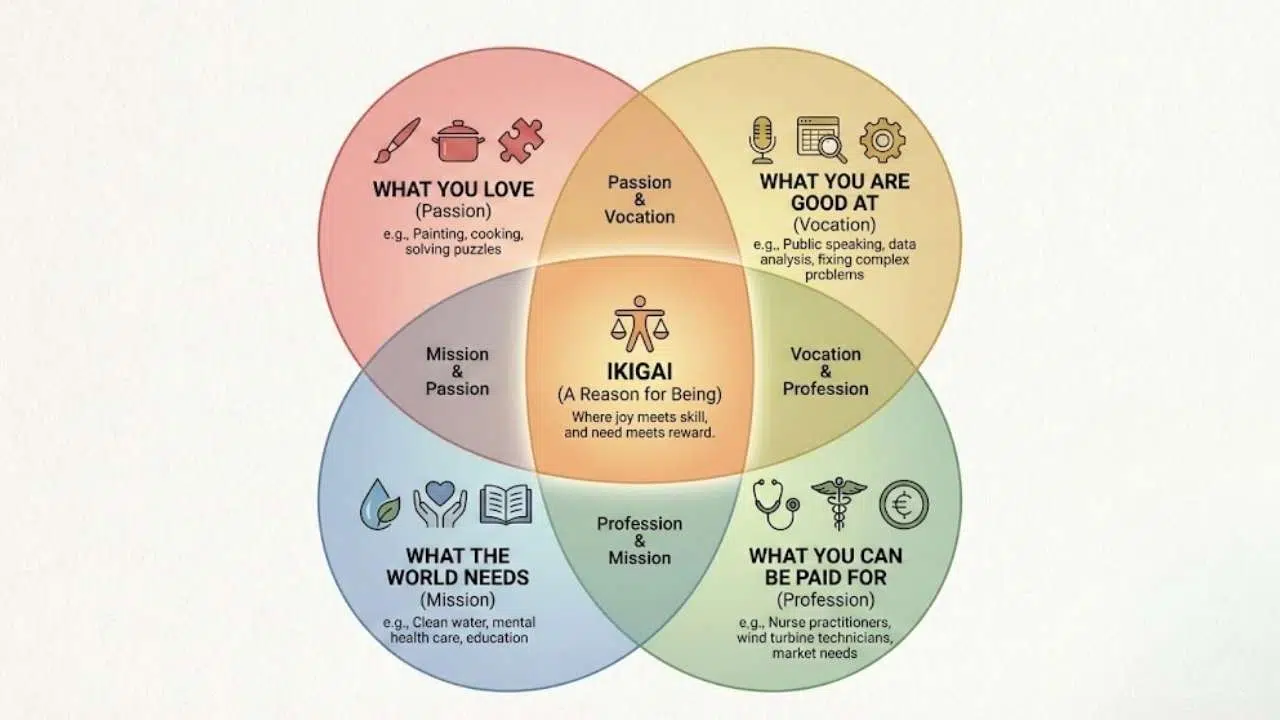
Ikigai comes from Japan, and it shapes how many people there find deep meaning in their lives. It is not just a buzzword. It is a framework that mixes your skills, your passions, and the needs of society into one clear purpose.
Origins and cultural significance
In Japan, people view ikigai as the secret to a long and happy life. The word translates roughly to “a reason for being.” It asks you to answer four big questions: What do you love? What are you good at? What does the world need? And what can you be paid for?
Dan Buettner, the National Geographic fellow who studies the “Blue Zones” where people live the longest, found something amazing in Okinawa. He noted that knowing your sense of purpose is worth up to seven years of extra life expectancy. That is a powerful reason to start searching for yours.
Families in Okinawa often credit their wellness and joy to this concept. Elders there live active lives well past 100 years old. This mindset is not just about work. It shapes every part of daily living, from fitness and family ties to how they manage their finances.
The four key components of Ikigai
What you love sits at the heart of Ikigai. This is your passion. It could be painting after work, cooking for friends, or solving complex puzzles.
Next comes what you are good at. This is your vocation. Some people are natural public speakers who light up a room. Others are data wizards who can fix complex spreadsheets in seconds.
What the world needs acts as your compass. This connects you to a mission. Maybe you care deeply about clean water projects, better mental health care, or helping children learn to read.
The last part involves what you can be paid for. This is your profession. You need to identify jobs that match your skills and meet real market needs. For example, the Bureau of Labor Statistics projects massive growth for nurse practitioners and wind turbine technicians through 2034. These are roles that pay well and solve real problems.
Ikigai fits where all these ideas blend together. It is where joy meets skill, and need meets reward. This balance creates a strong professional identity that stays true to your values.
Why Ikigai Matters for Professionals in 2026
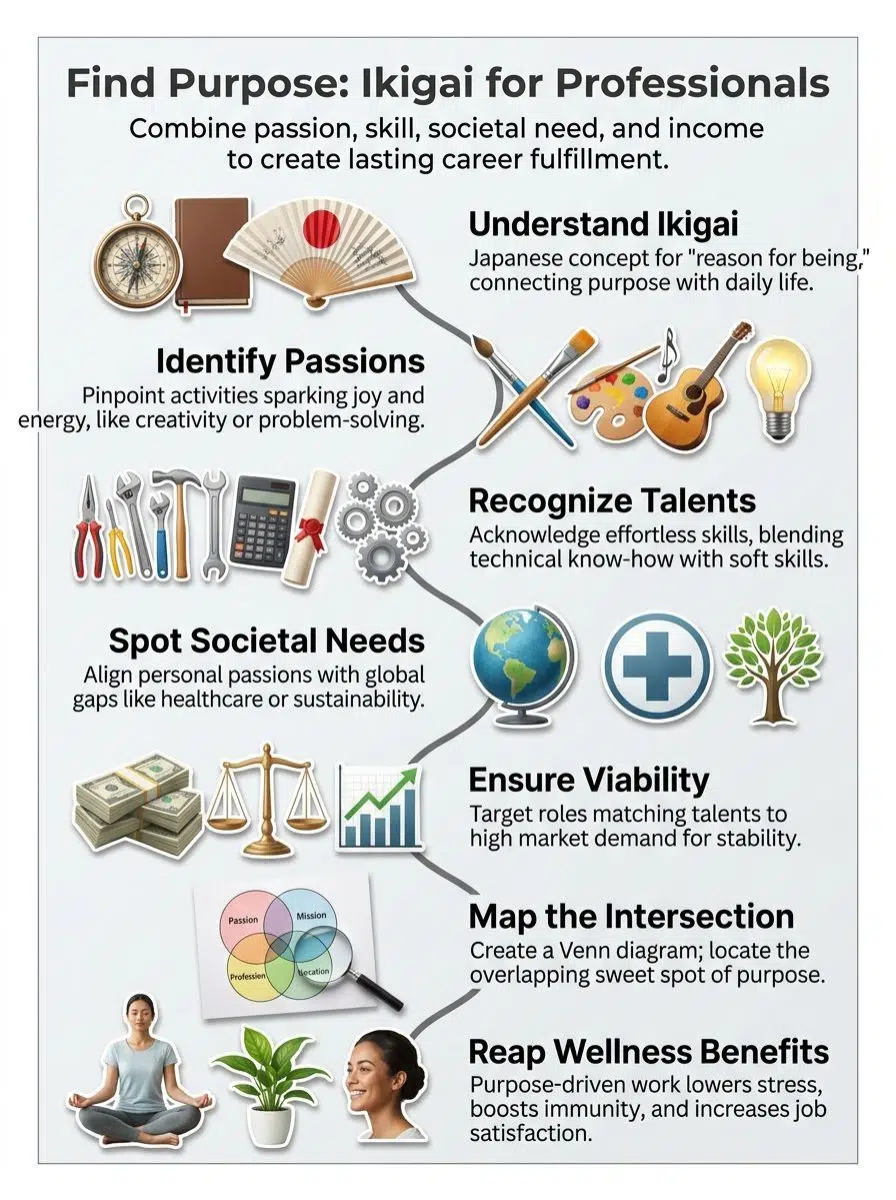
Finding purpose at work helps people stay motivated and happy. Ikigai gives professionals a clear path to build a meaningful life while building their careers. It stops the feeling of just “grinding” for a paycheck.
Aligning purpose with career goals
Ikigai asks you to blend passion, skills, and real needs. Imagine a teacher who enjoys music but also wants to help kids build confidence. By teaching music at a school, she finds both joy and purpose.
In 2026, many professionals use Ikigai’s four questions as a strategic tool for career development. They think about what they love and what they do well. But they also look at the market. They ask how they can earn money with those skills and which jobs actually make the world better.
This method does not just focus on finances or quick success. It supports balance and long-term satisfaction. Professionals look at their lives as a whole. Work-life balance becomes just as important as promotions.
“Purpose is the convergence of values, passions, what you like to do, and what you’re good at.” — Dan Buettner
Addressing modern workplace challenges
We are facing some tough stats right now. A 2025 study from Moodle and Censuswide found that 66% of American employees report feeling burnout. For Gen Z and Millennials, that number is even higher, topping 80%.
Many professionals in 2026 face stress, fast change, and the pressure of AI integration. Demands pile high, and work-life balance feels like juggling flaming torches.
Pulling the Ikigai framework into your daily routine helps you step back. You can ask yourself what truly brings joy instead of just ticking off tasks. Answering those four simple questions gives you solid ground to stand on.
Studies consistently show that people who feel fulfillment in their jobs get sick less often. Even during rapid economic shifts, having a strong sense of meaning ties you to your career path while keeping your wellness front and center.
The Four Circles of Ikigai
The four circles help you spot what gives your life fuel and meaning. These guideposts spark ideas about where your purpose might grow next. Let’s break them down one by one.
What you love (Passion)
Passion lights the spark for purpose. Think about what makes you smile or forget the clock at work. Psychologist Mihaly Csikszentmihalyi calls this the “flow state.” It is that feeling when you are so absorbed in a task that time seems to disappear.
Pay attention to small moments that give you energy instead of draining it. A chef may love to create recipes. A teacher may thrive on helping children grow confident. A fitness coach might feel alive guiding others toward wellness goals.
Each person’s joy looks different. In Japan, people find meaning and happiness by doing things they truly enjoy every day. These simple clues can open doors to fulfillment and long-term career satisfaction.
What you are good at (Vocation)
Everyone has skills. Some shine at solving math puzzles, while others keep a calm head in busy places. Take time to see what work feels easy to you and where your results stand out.
If you are struggling to name your talents, try a tool like CliftonStrengths. It helps you identify your top natural themes, so you can stop fixing your weaknesses and start building on your strengths.
In 2026, jobs often blend tech smarts with soft skills like teamwork. Skills grow over time as you practice. But real proof often comes from your friends or coworkers. Ask them, “What is the one thing you would always call me for help with?” Their answers might surprise you.
What the world needs (Mission)
The world needs people who spot problems and are ready to help. This circle is about looking outside yourself. In 2026, we see huge demand for professionals who can solve complex global issues.
Think about the UN Sustainable Development Goals. Are you passionate about affordable energy, quality education, or good health? Ikigai guides you to see where your passions meet society’s big gaps.
Many jobs now ask for more than just skill. They need heart and purpose as well. Companies want professionals who align their goals with societal needs. Helping others fills lives with meaning and bridges the gap between your career and what the world truly needs right now.
What you can be paid for (Profession)
Jobs that pay well often match your skills and what society values. You have to be practical here. In 2026, tech workers like data scientists and information security analysts earn good money because demand is high.
Health care fields also offer steady income. With an aging population, the need for nurses and therapists is higher than ever. Even artisans who bake or craft can find markets online to sell their work for a price.
Delivering something people need brings both purpose and a paycheck together. Finding your Ikigai includes understanding where your talents meet financial needs in today’s world. It aligns passion with profit to support your happiness.
Steps to Discover Your Ikigai
Finding your Ikigai is a journey. Every step you take brings you closer to understanding what lights that spark in your life. Here are simple ways to start today.
Create space for reflection
Carve out quiet spots in your day. It can be just ten minutes with a cup of tea or a short walk. Many professionals find clarity by using a technique called “Morning Pages,” popularized by Julia Cameron. You simply write three pages of stream-of-consciousness thoughts first thing in the morning.
Ikigai calls for honest self-checks about passion, values, and skills. By slowing down to ask what sparks joy, you can spot gaps between your current routine and your true purpose. Many Japanese workers hold on to small daily habits to sharpen focus.
You might just jot down three good things from the day. Even busy careers need room for checking in with yourself. Otherwise, stress will outweigh life satisfaction.
Map the four circles
Grab a blank page and sketch four overlapping circles, just like a Venn diagram. Label each circle: “What you love,” “What you are good at,” “What the world needs,” and “What you can be paid for.”
Fill in each section with honest answers. Do not overthink it. For example, maybe teaching lights you up. Maybe coding is your skill set. Maybe the world craves skilled teachers, and tech jobs pay well.
Watch where your words overlap in these circles. That spot holds clues to your purpose. Japanese culture treats finding this sweet spot as key to wellness. The more connections you find on paper, the closer you get to Ikigai.
Identify patterns and connections
Flip through your answers to the four Ikigai circles. Look for themes that keep popping up like old friends in every list.
Maybe “teaching” shows up under things you love and skills you have. Perhaps “helping others” fits with both your passion and a big need in society right now. These patterns act as clues pointing straight toward your deeper purpose.
Jot down words or phrases that appear more than once. Spotting these common threads brings those “aha!” moments. For example, someone who loves fitness and enjoys guiding people might notice a demand for corporate wellness coaches.
Take actionable steps toward your purpose
Start small with daily habits. Write down one thing you love or a skill you enjoy using. Try to blend these areas into your tasks at work or home.
If you care about wellness and are good at teaching, offer to run short fitness breaks with your team. Track your efforts in a journal each week. Patterns will show where passion meets value.
Set clear goals tied to what the world needs. If helping others brings fulfillment, volunteer for projects outside your usual role. Suggest new ideas that solve real problems at work. Purpose grows when you take steady action, not just when you dream big dreams.
Applying Ikigai to Your Career
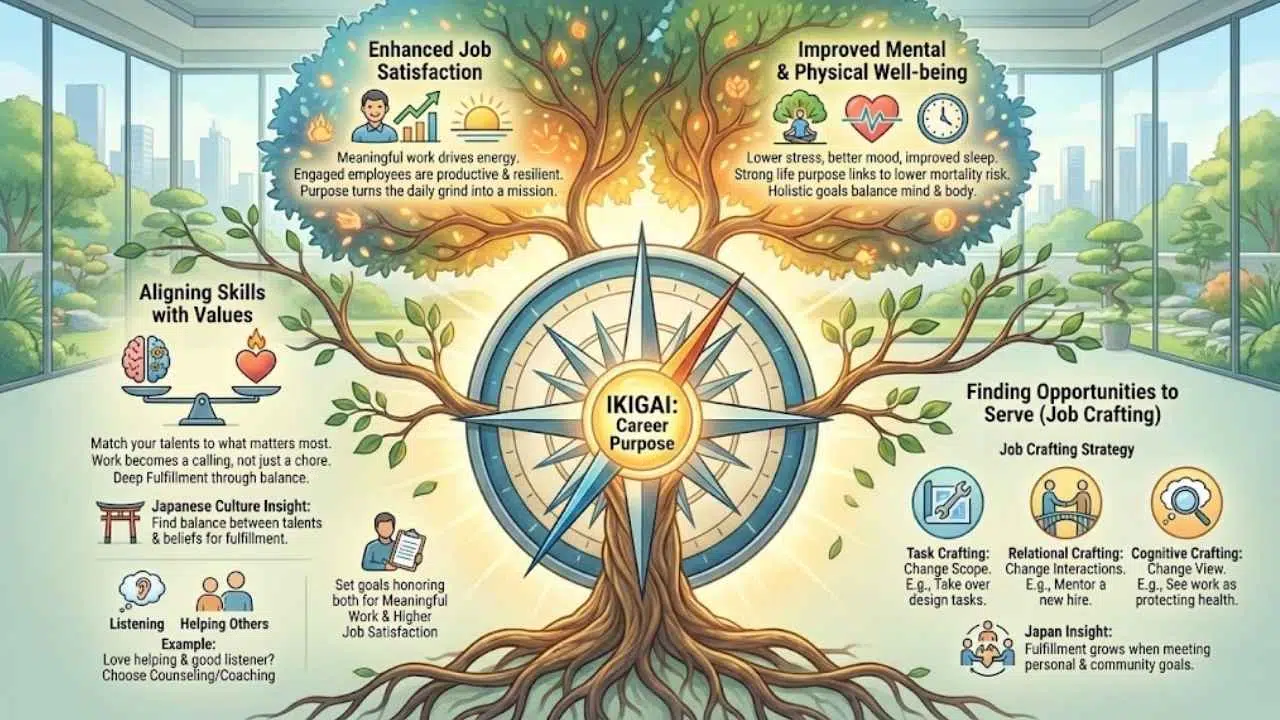
You can shape your work life with Ikigai by matching what matters to you with how you spend your weekdays. This approach brings meaning and sparks fresh energy.
Aligning skills with values
Matching your skills to what matters most to you makes work feel less like a chore and more like a calling. In Japanese culture, Ikigai teaches that finding balance between your talents and your personal beliefs leads to deeper fulfillment.
Say you love helping others and are good at listening. Roles in counseling or coaching let those strengths shine while serving real needs. Many professionals in 2026 seek careers that mix passion with purpose, not just paychecks.
Setting goals that honor both your skills and values steers you toward meaningful work. This approach does more than boost productivity. It supports well-being too, as people who blend their abilities with their core beliefs report higher job satisfaction.
Finding opportunities to serve societal needs
You do not always need to change jobs to find purpose. You can use a strategy called “Job Crafting,” a concept developed by researchers Amy Wrzesniewski and Jane E. Dutton. This means redefining your current job to better fit your strengths.
There are three ways to do this:
- Task Crafting: Change the scope of your job. If you love design, ask to take over the slide decks for your team meetings.
- Relational Crafting: Change who you interact with. Mentor a new hire or connect with a different department.
- Cognitive Crafting: Change how you see your job. A hospital cleaner might view their work not as cleaning, but as protecting patient health.
Ikigai teaches that fulfillment grows when we meet both personal and community goals. Japan shows us this idea works well. Many people there live long, happy lives by helping others as part of their routine.
Benefits of Living with Ikigai
You start each day with a sense of meaning in your work. It is almost like your morning coffee, but better. Life feels lighter when passion and purpose steer the wheel.
Enhanced job satisfaction
Feeling lost at work feels like hitting a brick wall every Monday. Ikigai sweeps out that fog and lets you see why your role matters. Professionals in Japan link purpose with everyday tasks, and this raises smiles across offices.
Gallup’s 2025 State of the Global Workplace report shows that engaged employees are significantly more productive and resilient. Matching skills, values, and passions turns the daily grind into something meaningful.
Imagine using what you love to solve problems the world actually cares about. That mix gives energy on tough days and keeps stress down. In short, finding purpose makes clocking in feel more like showing up for an important mission.
Improved mental and physical well-being
People in Japan see Ikigai as a key to long and happy lives. Studies show that having a clear purpose lowers stress. It can boost your mood and help you sleep better at night.
People who match their work with what they love often report fewer sick days. A JAMA Network Open study found that a strong life purpose is associated with a lower risk of mortality.
Setting holistic goals, such as caring for family or staying fit, helps balance mind and body too. Aligning passion with skills can turn daily tasks into joyful habits that improve wellness across the board.
Final Thoughts
Finding purpose through Ikigai can give your career fresh meaning and stronger balance. The four circles are simple steps anyone can try to match what they love with what they do for a living.
Using this method brings more happiness, job satisfaction, and even better health over time. If you are curious to keep learning, check out books like Ikigai: The Japanese Secret to a Long and Happy Life for deeper insights. Start today by asking yourself those four questions. The answers might just change how your Mondays feel forever.























