5G has been around long enough that the conversation is changing. People still care about speed, but they care even more about stability, coverage, and whether their network holds up at rush hour. That is why “innovation” matters now. It is not about a new logo on your phone. It is about real upgrades like Standalone 5G, smarter radios, edge computing, and features that reduce lag.
This guide focuses on what makes a network truly forward-looking in 2026. You will see 12 operators that stand out for capability, scale, and practical rollouts. Some are famous for performance awards. Others stand out because they deploy advanced features early, at national scale. The goal is not to crown one global winner. The goal is to help you understand what leadership looks like and how to choose what is best for you.
| What This Article Covers | Why It’s Useful |
| The difference between basic 5G and advanced 5G | Helps you avoid marketing traps |
| 12 operators that show clear innovation signals | Gives you a realistic shortlist |
| How Standalone, slicing, edge, and AI improve experience | Explains benefits in plain terms |
| A simple framework to pick the right network | Helps you choose with confidence |
Why 5G Innovation Matters In 2026
Innovation is the bridge between “I have 5G” and “my 5G feels better every day.” Early 5G was mostly about rollout maps and coverage headlines. Now the best upgrades happen behind the scenes. The core network is becoming cloud-native, radios are getting smarter, and operators are designing 5G to behave differently for different apps.
In real life, innovation shows up as fewer dead zones, smoother video calls, and better performance when a stadium or downtown area is crowded. It also matters for business. Factories, ports, hospitals, and campuses need predictable wireless performance, not just peak speed. That drives investment into Standalone 5G, network slicing, and edge computing.
If you want a quick mental model, think of innovation as “consistency plus capability.” Consistency means the network performs well more often. Capability means the network can support new products like fixed wireless home internet, private 5G, and low-latency services.
| Innovation Theme | What It Improves |
| Standalone 5G (SA) | Better control of latency and new features |
| Smarter RAN coordination | Better speeds under load |
| Network slicing | More predictable performance for priority apps |
| Edge computing (MEC) | Faster response times for real-time use |
| 5G-Advanced direction | Efficiency, capacity, and AI-driven improvements |
How This List Of “Best 5G Networks” Was Built

This is not a simple “fastest speed” leaderboard. A network can be innovative even if it is not #1 in every speed chart. Innovation can mean a mature Standalone rollout, consumer slicing that actually ships, or AI tools that improve stability on the live network.
To keep the list fair, the criteria focus on visible, repeatable signals. That includes commercial deployments (not just lab demos), clear architecture progress, and practical outcomes like improved consistency and stronger performance in crowded areas. It also includes enterprise readiness, because advanced 5G features often appear in business use cases first.
This list is global, so it also accounts for market reality. Some countries have more mid-band spectrum. Some have dense cities where advanced features are easier to scale. Some have regulatory environments that push faster upgrades. The key is not to compare countries like-for-like, but to compare leadership within each environment.
| Selection Criteria | What It Means |
| Standalone progress | Real SA access beyond small test zones |
| Feature delivery | Slicing, MEC, advanced carrier aggregation, automation |
| Scale and execution | Rollouts that reach millions of users |
| Real-world value | Reliability, consistency, and user experience |
| Enterprise readiness | Private 5G, SLAs, security posture, edge options |
Quick Definitions To Make The Rest Easy To Read
Many 5G terms sound complex, but the ideas are simple. 5G Non-Standalone uses a 4G core, so some advanced features are limited. 5G Standalone uses a 5G core, which enables more advanced control and smarter services.
Network slicing is like creating virtual “lanes” on the same network. One lane can be optimized for gaming latency. Another can be optimized for video upload. A third can serve a factory with strict reliability needs. Edge computing moves computing closer to users so apps respond faster.
5G-Advanced is the next phase of 5G evolution. It focuses on better efficiency, smarter networks, and stronger uplink and mobility performance. You do not need to memorize version numbers. Just remember that 5G keeps evolving, and the most advanced networks act like living systems that improve over time.
| Term | Plain Meaning |
| NSA vs SA | NSA leans on 4G core; SA uses 5G core |
| Slicing | Virtual lanes for different services |
| MEC / Edge | Computing closer to users for faster response |
| RAN coordination | Smarter management of nearby cell sites |
| 5G-Advanced | Next stage of 5G performance and intelligence |
At-A-Glance View Of 12 Innovation Leaders
This table is a fast scan, not a strict ranking. Each operator below has a different “innovation signature.” Some lead with Standalone scale. Some lead with slicing. Some lead with AI. Some lead with extreme capacity strategies.
Use this as a map. Then read the individual sections to understand what each network is trying to optimize and who benefits most. If you are choosing a carrier, you should still verify your city’s coverage and congestion patterns.
| Operator | Market | Innovation Signature | Best For |
| T-Mobile | USA | Strong real-world 5G experience momentum | Everyday speed + broad 5G use |
| Verizon | USA | Capacity and premium-layer strategy | Dense city performance |
| AT&T | USA | Availability + broad footprint | Consistent coverage needs |
| EE | UK | Advanced RAN coordination and aggregation | Urban performance gains |
| Telekom Deutschland | Germany | SA scale + consumer SA services | SA-first experience |
| SK Telecom | South Korea | SA + slicing + edge focus | Feature-driven 5G |
| KT | South Korea | AI-RAN approach | Stability and smart optimization |
| NTT DOCOMO | Japan | Open architecture experimentation | Future network models |
| Reliance Jio | India | SA at scale + FWA leadership | Mass-market 5G adoption |
| China Mobile | China | 5G-Advanced push | Next-phase capacity upgrades |
| Telstra | Australia | SA progress + capability demos | SA readiness + device ecosystem |
| Singtel | Singapore | Nationwide slicing to consumers | Consistency and priority handling |
T-Mobile (United States): Scale Meets Real-World Experience
T-Mobile’s 5G story is often described through everyday experience. That includes how fast things load, how stable video calls feel, and how often users remain on 5G without dropping back to LTE. T-Mobile has built a reputation for making 5G feel usable across a wide footprint, which matters more than peak speed for most people.
A big reason is execution. Strong coverage plus consistent mid-band performance tends to create better “typical” results. Another reason is momentum in building a network that can evolve. Networks that keep improving their core and their radio coordination can deliver better results without waiting for brand-new spectrum.
If you are a heavy mobile data user, the “best” network is often the one that stays fast at busy times. That is where capacity planning and spectrum strategy matter. T-Mobile’s innovation is less about one flashy feature and more about steady improvements that show up in daily use.
| Key Point | Why It Matters |
| Strong day-to-day usability focus | Better “typical” performance |
| Broad 5G presence | Fewer forced fallbacks to LTE |
| Execution at scale | Improvements impact more users |
| Clear upgrade momentum | Better long-term experience trajectory |
Verizon (United States): Premium Capacity And Performance Engineering
Verizon’s 5G strategy is often tied to capacity and engineering discipline. In many markets, Verizon competes on premium performance layers, especially in dense cities and high-demand corridors. This is the kind of network that can feel “unbreakable” when it is well built in your area.
Innovation here often looks like intelligent densification, better antenna planning, and refined spectrum use. It also shows up in enterprise solutions, where performance, security, and service design matter. Verizon tends to treat 5G as both a consumer network and a business platform.
For consumers, Verizon’s biggest value appears when the local build matches your lifestyle. If you spend time in crowded downtowns, stadium zones, business districts, or transit corridors, capacity matters. Verizon’s approach aims to win in those places.
| Key Point | Why It Matters |
| Capacity-first strategy | Better performance under heavy demand |
| Dense-market strength | Stronger experience in busy zones |
| Enterprise platform mindset | Faster adoption of advanced services |
| Engineering discipline | Consistency improvements over time |
AT&T (United States): Availability And Practical Coverage Strength
AT&T’s strength is often availability. That means people can access 5G more consistently while moving through daily life. It may not always lead every speed chart in every city, but strong availability can beat “faster but patchy,” especially for users who travel within a metro area or across regions.
Innovation in this context is not always flashy. It can mean a better upgrade path, steady modernization, and a balanced approach to coverage and capacity. A network that keeps users connected smoothly can deliver high satisfaction even if it is not the most viral on social media.
AT&T also tends to be a serious enterprise player, which helps drive investment in reliability and business features. Many advanced network capabilities appear in enterprise products first, then trickle into broader consumer improvements.
| Key Point | Why It Matters |
| High availability focus | Fewer drops and fallbacks |
| Broad footprint approach | Good for travel and mixed environments |
| Steady modernization | Practical improvements over time |
| Business ecosystem strength | Adds pressure to improve reliability |
EE (United Kingdom): Smarter Radios For Better Urban Performance
EE’s innovation story is a great example of “invisible upgrades” that make real differences. Instead of only building more towers, the network can get smarter about how it uses existing capacity. When a nearby cell has spare resources, advanced coordination can help share that capacity more effectively.
In plain terms, this targets a problem most people recognize. In crowded places, your phone might show full bars but still feel slow. That happens because many users share the same resources. Smarter coordination helps balance load and improve performance.
EE’s approach is valuable because it is not tied to one device model or one marketing plan. It is a network-level upgrade. If you care about performance in city centers, transport hubs, and dense neighborhoods, these upgrades can matter more than raw spectrum totals.
| Key Point | Why It Matters |
| Advanced coordination approach | Better use of nearby capacity |
| Performance under load | Helps when demand spikes |
| Urban optimization | Stronger city-center experience |
| Network-level innovation | Benefits many users at once |
Telekom Deutschland (Germany): Standalone Scale And Consumer SA Services

Germany stands out because Standalone 5G is moving toward mainstream consumer relevance. Many markets still treat SA as an enterprise tool or a limited pilot. When a major operator pushes SA widely, it creates a stronger base for features like slicing and better latency control.
Telekom Deutschland’s innovation signal is “SA at scale.” That matters because advanced 5G is not just about technical capability. It is about access. If most users cannot touch SA, slicing and advanced services remain niche.
Germany’s market also highlights an important trend: specialized consumer experiences. Gaming-focused low-latency services, priority handling, and reliability tiers are early signs of how operators might monetize advanced 5G in the future.
| Key Point | Why It Matters |
| SA at wide scale | Enables advanced 5G features broadly |
| Consumer SA products | Moves SA beyond business-only |
| Latency-focused positioning | Targets real user pain points |
| Foundation for slicing | Prepares the network for tiered services |
SK Telecom (South Korea): Feature-Driven 5G With Slicing And Edge
South Korea remains one of the most important markets to watch for mobile innovation. SK Telecom’s signature is a feature stack: Standalone 5G combined with slicing and edge computing. That trio matters because it shows a complete vision of how advanced 5G should behave.
Slicing can improve predictability for priority services. Edge computing can reduce response times by bringing computation closer to users. When both are built on SA, the network can handle different needs more intelligently. That is useful for cloud gaming, smart factories, transport systems, and high-density consumer use.
Even if you are not running a factory, you benefit when operators build the network to handle demanding use cases. Those investments often improve general stability, reduce congestion issues, and strengthen the overall quality of service.
| Key Point | Why It Matters |
| SA + slicing + edge stack | Complete advanced 5G blueprint |
| Use-case clarity | Shows practical value beyond speed |
| Low-latency direction | Helps real-time apps and gaming |
| Strong innovation culture | Faster rollouts of new capabilities |
KT (South Korea): AI-RAN And Smarter Network Performance
KT stands out for pushing AI into radio network optimization. Instead of treating the network as a static system, AI tools can help it adapt to changing conditions. Radio environments change constantly. People move, buildings reflect signals, weather can affect propagation, and usage patterns spike without warning.
AI-RAN aims to improve stability and throughput by learning patterns and adjusting behavior. That can mean better scheduling of radio resources, improved handling of multi-user MIMO, and smarter decisions during congestion. For everyday users, the benefit is fewer “mystery slowdowns” and more consistent performance.
AI is not a magic fix. It must be deployed carefully, tested on live networks, and integrated with modern core systems. That is why KT’s focus on live-network trials is a meaningful innovation signal.
| Key Point | Why It Matters |
| AI-driven radio optimization | Improves consistency in changing conditions |
| Stability focus | Fewer drops and stalls |
| Live-network experimentation | More credible than lab-only claims |
| Future operations advantage | Automation reduces manual tuning needs |
NTT DOCOMO (Japan): Open Architecture And Long-Term Network Design
DOCOMO’s innovation story is less about short-term speed headlines and more about how networks are built. Open approaches, multi-vendor ecosystems, and architectural flexibility matter because 5G is not the end of the road. Operators are already thinking about how to scale upgrades faster, reduce dependency risks, and improve agility.
Open architecture experimentation can encourage faster innovation cycles. It can also support more specialized deployments, especially when combined with virtualization and cloud-native cores. That matters for enterprises that want customized networks, and for consumers who benefit when operators can upgrade faster and more efficiently.
DOCOMO also reflects Japan’s broader approach: careful engineering, strong partnerships, and long-term planning. This tends to produce reliable progress that may not look dramatic in a single month, but adds up over years.
| Key Point | Why It Matters |
| Open ecosystem mindset | More flexibility and vendor diversity |
| Long-term architecture focus | Better upgrade agility over time |
| Strong engineering culture | Reliability and consistent modernization |
| Future-ready planning | Supports the next phases of 5G evolution |
Reliance Jio (India): Standalone At Scale And Mass Adoption
Reliance Jio is a standout example of scale. Innovation is not only about inventing something new. It is also about deploying advanced technology to millions of users quickly. Jio’s 5G story is often framed around Standalone architecture and rapid rollout, which helps bring advanced 5G capabilities to a broad population.
Jio is also a major player in fixed wireless access (FWA). FWA is one of the clearest “5G changes lives” use cases because it delivers broadband-like service without a cable. In markets where fiber is limited, FWA can be a practical alternative.
India’s market dynamics make this story even more interesting. High demand, fast adoption, and huge user counts create pressure to execute efficiently. When an operator succeeds in that environment, it signals strong capability in network planning and rollout operations.
| Key Point | Why It Matters |
| SA at massive scale | Advanced 5G reaches more users |
| Strong adoption momentum | Ecosystem matures quickly |
| FWA leadership | 5G becomes a home internet option |
| Execution under pressure | Proves rollout and optimization strength |
China Mobile (China): 5G-Advanced Momentum And Infrastructure Power
China Mobile stands out because of the pace and scale of network upgrades. 5G-Advanced is becoming a major focus, and large-scale rollouts matter because they push device ecosystems, vendor readiness, and real-world optimization faster.
When a market deploys next-phase upgrades broadly, it creates a feedback loop. More users touch the technology. More data flows through it. More optimization happens. More devices support it. This can accelerate the shift from “trial” to “normal.”
For readers outside China, the key lesson is direction. China Mobile’s investments show where 5G is going next: more capacity, better efficiency, and stronger integration of intelligence into the network.
| Key Point | Why It Matters |
| 5G-Advanced push | Next-phase performance and efficiency |
| Scale of upgrades | Faster ecosystem maturity |
| Rapid optimization loop | Real-world tuning improves results |
| Global direction signal | Indicates where the industry is headed |
Telstra (Australia): Standalone Readiness And Capability Proof
Telstra is a strong example of a mature operator balancing consumer readiness with advanced capability demonstrations. Capability demos can prove what is possible with the right spectrum, hardware, and optimization. Consumer readiness signals that SA is not just a lab achievement, but part of a real customer experience path.
Australia’s geography also influences innovation. Coverage over large areas and consistent performance in mixed environments can be harder than optimizing one dense city. Operators that perform well across varied conditions often invest heavily in planning, backhaul, and resilience.
Telstra’s story is valuable because it blends practical rollout with a clear roadmap. That combination often produces steady improvements that users feel over time.
| Key Point | Why It Matters |
| SA readiness signals | Advanced 5G becomes usable for customers |
| Capability demonstrations | Proof of network headroom |
| Mixed-environment performance | Balances metro and broader coverage |
| Strong roadmap clarity | Helps future upgrades land faster |
Singtel (Singapore): Nationwide Slicing Goes Consumer
Singtel stands out because network slicing is moving into mainstream consumer positioning. Many operators talk about slicing as an enterprise-only tool. When slicing becomes part of a consumer offering, it signals two important things. First, the operator has enough confidence in SA capability to ship it broadly. Second, it believes users will feel a difference.
Singapore is an ideal environment for advanced rollouts: dense coverage, high device penetration, and strong demand. That makes it a great testing ground for features that improve consistency, priority handling, and user experience in busy areas.
Singtel’s approach also hints at a future where networks offer more personalized “quality tiers.” That is controversial in some markets, but it is clearly part of how operators think about monetizing advanced 5G.
| Key Point | Why It Matters |
| Consumer slicing positioning | Advanced feature becomes mainstream |
| Consistency and priority handling | Better performance for key services |
| Dense market advantage | Faster feature scaling and optimization |
| Future service tiers | Signals new ways networks may be sold |
What These 12 Leaders Have In Common
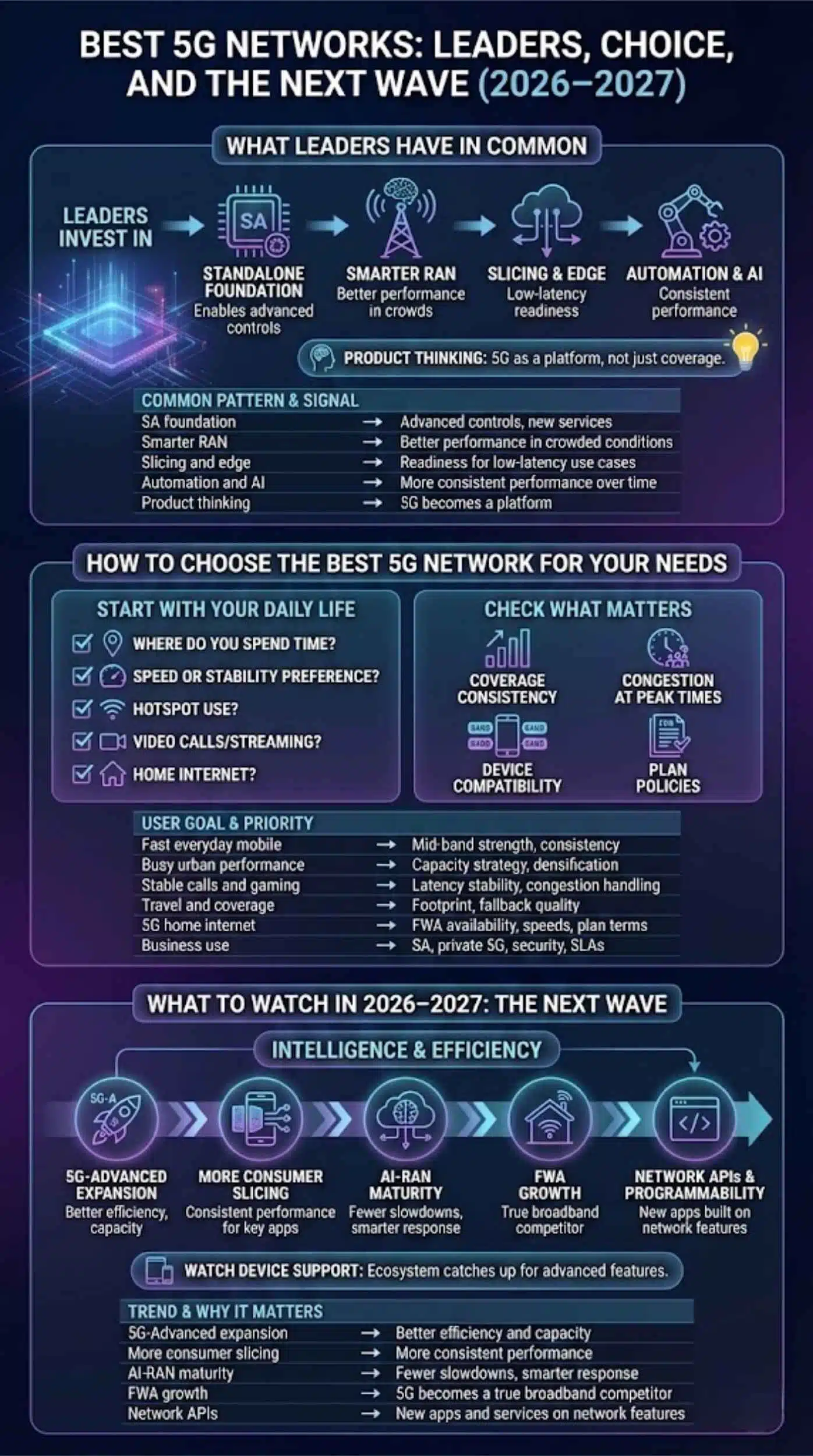
Across countries and business models, the same patterns keep appearing. The leaders invest in Standalone foundations. They modernize the core. They treat radios as software systems that can improve with smarter coordination. They build products, not just coverage maps.
They also show a willingness to ship features. That matters because innovation without delivery is just PR. When networks push slicing, edge, and AI optimization into real operations, they create measurable improvements. That is how user experience evolves.
This is also why the phrase best 5G networks is tricky. The “best” in one city may not be the best in another. But innovation leadership is easier to see, because it shows up in capability upgrades, product design, and long-term roadmaps.
| Common Pattern | What It Signals |
| SA foundation | Enables advanced controls and new services |
| Smarter RAN | Better performance in crowded conditions |
| Slicing and edge | Readiness for low-latency use cases |
| Automation and AI | More consistent performance over time |
| Product thinking | 5G becomes a platform, not just coverage |
How To Choose The Best 5G Network For Your Needs
Choosing the best network is local. A global leader can still be weak in a specific neighborhood. That is why you should combine innovation signals with practical checking.
Start with your daily life:
- Where do you spend most of your time?
- Do you care more about download speed, upload speed, or stability?
- Do you often use hotspots?
- Do you rely on video calls or live streaming?
- Do you need home internet?
Then check what actually matters:
- Coverage consistency in your areas
- Congestion at peak times
- Device compatibility with local bands
- Plan policies that affect performance (like deprioritization)
| User Goal | What To Prioritize |
| Fast everyday mobile | Mid-band strength and consistency |
| Busy urban performance | Capacity strategy and densification |
| Stable calls and gaming | Latency stability and congestion handling |
| Travel and coverage | Footprint and fallback quality |
| 5G home internet | FWA availability, typical speeds, plan terms |
| Business use | SA, private 5G options, security, SLAs |
Best 5G Networks And The Next Wave: What To Watch In 2026–2027
The next wave of 5G is about intelligence and efficiency, not just raw speed. Expect more automation, more AI-driven optimization, and stronger uplink improvements. Expect more service differentiation, especially as slicing becomes easier to deploy and manage.
Also expect fixed wireless access to keep growing in many markets. It is one of the most direct ways for 5G to compete with wired broadband, especially where fiber rollout is slow.
Finally, watch device support. Advanced networks only feel advanced when phones, routers, and modems support the right combinations of bands and features. Over time, device ecosystems catch up, and advanced features become normal.
| Trend | Why It Matters |
| 5G-Advanced expansion | Better efficiency and capacity for crowded networks |
| More consumer slicing | More consistent performance for key apps |
| AI-RAN maturity | Fewer slowdowns, smarter congestion response |
| FWA growth | 5G becomes a true broadband competitor |
| Network APIs and programmability | New apps and services built on network features |
Wrap-Up: The Best 5G Networks Are Built For Consistency And Capability
The best 5G networks are not only the ones that can hit a huge speed number in perfect conditions. They are the ones that keep improving the experience where you actually live and work. Innovation today means Standalone foundations, smarter radios, better congestion handling, and advanced features that ship to real customers.
If you remember one thing, remember this: leadership is visible in delivery. When a network rolls out SA broadly, pushes slicing or edge into real offerings, and uses automation to improve stability, it is building for the future.
So use this guide as a smart filter. Then test locally, compare plans, and pick the carrier that performs best in your world. That is how you turn a global list of innovation leaders into your personal answer for best 5G networks.
FAQs
What Makes A Network One Of The Best 5G Networks?
A “best” network is the one that performs reliably where you live and work. Innovation leadership helps because it predicts future improvements. Look for strong coverage, consistent performance at peak times, and a clear Standalone and feature roadmap.
What Is The Difference Between 5G NSA And 5G SA?
NSA uses a 4G core, while SA uses a 5G core. SA is more future-ready because it supports advanced controls and features like slicing more naturally. In simple terms, SA is closer to “full 5G.”
Does The Best 5G Network Always Mean The Fastest Speed?
No. Speed tests can be misleading if they are taken in ideal spots. Many people get more value from consistency, strong coverage, and stable performance in crowded places.
What Is Network Slicing In Simple Terms?
Network slicing creates separate virtual lanes on the same network. One lane can prioritize low latency. Another can prioritize reliability. This can help critical services perform better even when networks are busy.
Is 5G Home Internet A Real Alternative To Fiber?
It can be, especially where fiber is limited. The best outcome depends on location, tower load, and plan terms. In some areas, FWA can deliver strong speeds. In others, fiber still wins for consistency.
How Do I Verify The Best 5G Network In My City?
Use a mix of methods. Check multiple independent tests, ask local users, and do your own testing in your normal locations. Your personal experience is the most honest data.