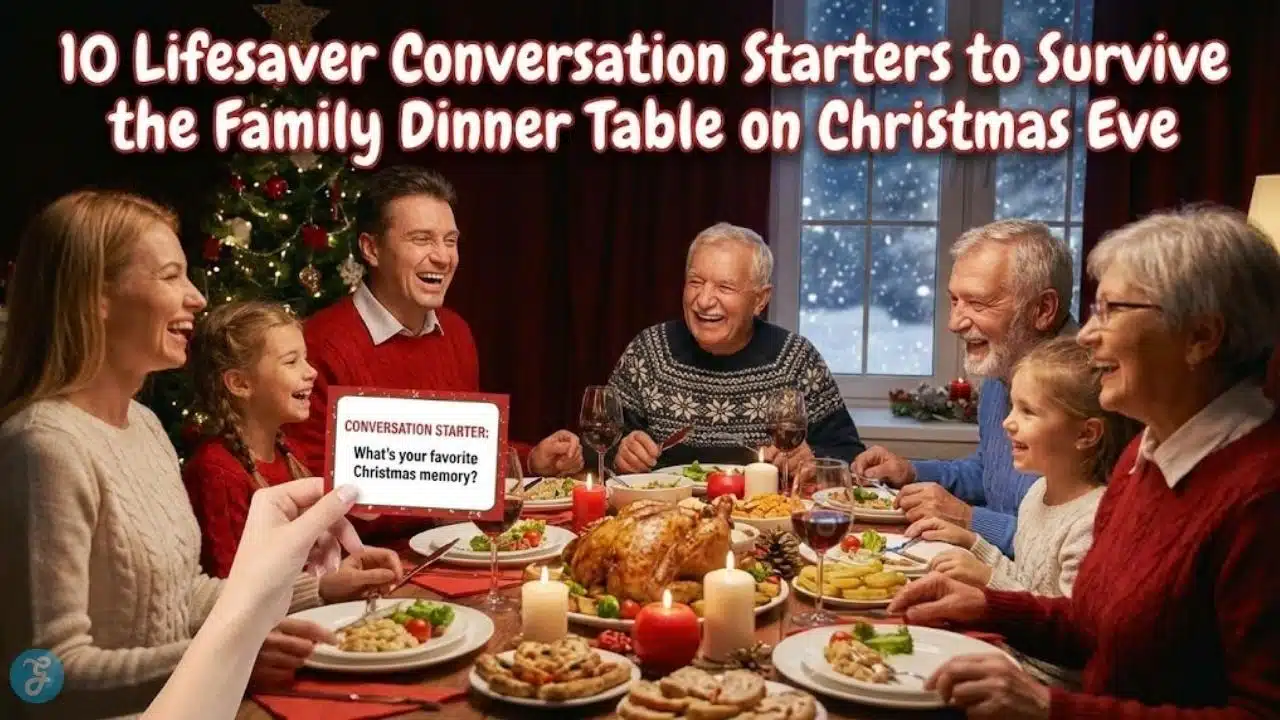
Christmas Eve dinner conversation starters can be magical, and also weirdly intense. One minute everyone’s passing plates and laughing, the next minute the table is silent like a library or someone is confidently starting a debate nobody ordered.
That’s why I love keeping a small “mental list” of Family dinner conversation starters ready to go. Not cheesy icebreakers, just simple prompts that invite stories, pull quiet people in, and gently steer the room away from landmines. You don’t have to be the loud one to use them. You just need one well-timed question and a calm follow-up.
Why Christmas Eve Dinner Conversations Turn Awkward So Fast
Holiday dinners pack a lot into a few hours. People show up hungry, tired, and overstimulated, and everybody arrives carrying their own private stress. Even happy families feel the pressure of making a “perfect” night happen.
Then there’s the mix of generations. Different humor, different values, different energy, and different conversational habits all collide at one table. One person wants deep connection, one person wants jokes, and one person wants everyone to agree on everything.
Old family roles also reappear fast. The storyteller becomes the storyteller again. The critic becomes the critic again. The silent one becomes even quieter because they’re surrounded by louder personalities.
Awkwardness usually shows up in two classic forms. You either get the long silence where nobody knows what to say, or you get the sudden sharp topic where the whole temperature drops. Both are fixable without calling attention to the problem.
The Dinner Table Conversation Formula That Works Every Time
A reliable holiday prompt is usually a two-step question. Step one is easy, pleasant, and low-risk. Step two asks for a detail that turns the answer into a story.
Step one examples include favorites, small wins, funny moments, and harmless preferences. Step two includes follow-ups like “what happened next?” or “what made it memorable?” This format reduces one-word answers and keeps the mood from drifting into debate.
Also, treat your role like a friendly guide, not a host with a microphone. Ask the question, listen, and let someone else shine. If you keep stacking follow-ups, the table starts feeling like an interview, and people tense up.
When you get a good answer, reward it. A simple “No way, tell me more” is powerful because it signals safety and interest. It also encourages the next person to answer more openly.
How to Use Family Christmas Eve Dinner Conversation Starters Effectively?
The trick is delivery. Don’t announce, “Okay everyone, icebreaker time.” Just drop a question naturally while passing food or reacting to something that’s already happening at the table.
Timing matters. Early in the meal, use light prompts that warm people up, like food, movies, or funny small moments. Once people have eaten and relaxed, you can shift into nostalgic questions, tradition talk, and gentle reflection.
Avoid putting someone on the spot with a high-pressure prompt. Instead of “What is your five-year plan?” use “What’s something small you’ve been enjoying lately?” That gives people an easy win and keeps the vibe cozy.
If you’re worried about certain topics, choose experience-based questions rather than opinion-based ones. Experiences invite storytelling, and storytelling creates connection. Opinions invite arguments, especially when someone treats the dinner table like a comment section.
Read the Room First
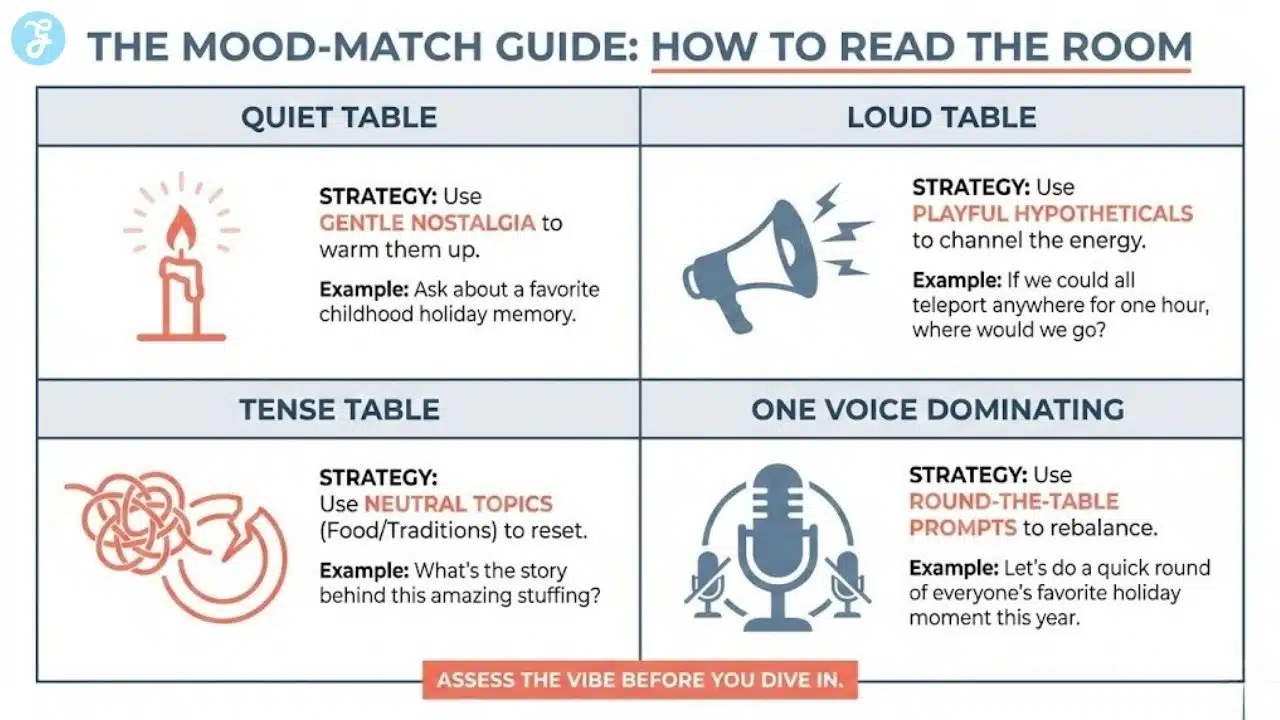
Before you toss a question out, look at what the table needs. Is it quiet because people are shy, or quiet because someone just said something heavy? Is it loud because people are happy, or loud because two people are talking over everyone?
Here’s a quick “mood match” guide you can use in your head.
| Table Mood | Best Question Style | Best Goal |
|---|---|---|
| Quiet, polite, slow | Gentle nostalgia, easy favorites | Warm people up |
| Loud, silly, chaotic | Playful hypotheticals, quick games | Channel the energy |
| Tense, prickly | Neutral stories, food, traditions | Reset without drama |
| One person dominating | Round-the-table prompts | Rebalance attention |
| Mixed ages and kids | Short, concrete prompts | Include everyone |
If you sense a fragile moment, keep it soft. Ask about food, a funny memory, a comfort show, or a harmless tradition. Those topics are the conversational equivalent of hot tea.
Before the 10 Starters, Set One Tiny House Rule
This helps more than people realize. Aim for “no speeches, just stories.” You’re not banning long answers, you’re guiding the tone toward moments and memories instead of lectures.
If you want an even simpler rule, use “two people, then rotate.” After two people answer, move the spotlight. This prevents one voice from swallowing the whole dinner.
You can also set a quiet boundary without sounding bossy. If a topic gets sharp, say, “Let’s keep it light tonight,” and pivot immediately. The pivot is what makes the boundary feel normal instead of awkward.
Here Are 10 Lifesaver Conversation Starters for Christmas Eve
Each starter below includes three things you can use in real time: a quick way to ask it, follow-ups that keep it alive, and an optional pivot line if the energy shifts. Pick one, then let the room do the work.
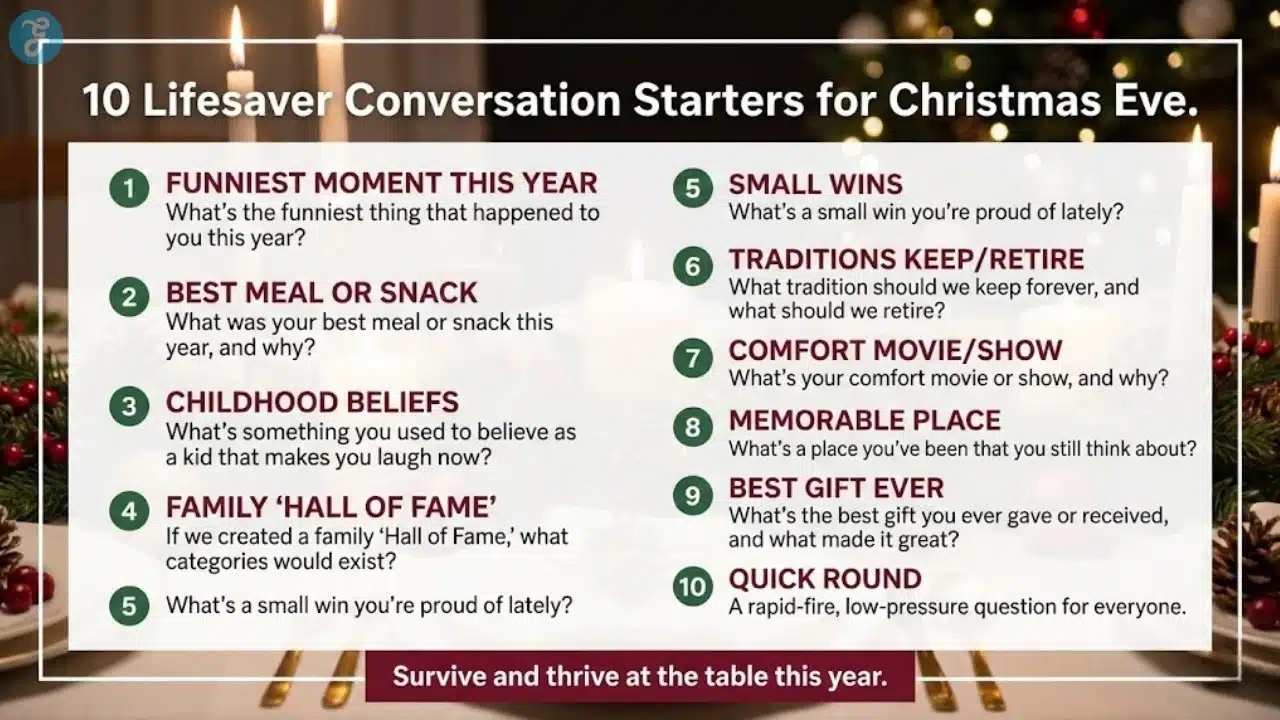
1) What’s the Funniest Thing That Happened to You This Year?
This starter works because it invites laughter and lowers everyone’s guard. Even people who don’t love talking usually have one small story they can share.
Follow-ups that keep it going:
-
“What happened right before it got funny?”
-
“Who was there when it happened?”
-
“What was the moment you realized you’d tell this story forever?”
If someone says “nothing funny,” give them a menu:
-
“Work funny, travel funny, kid funny, pet funny, or accidental mistake funny?”
If the story starts drifting into negativity, pivot:
-
“Okay, funniest harmless mistake counts too. Those are the best ones.”
2) What Was Your Best Meal or Snack This Year?
Food is safe, universal, and instantly vivid. People don’t have to be “interesting” to answer, they just have to remember what tasted great.
Follow-ups:
-
“Was it the food or the company that made it amazing?”
-
“If you could eat it again tomorrow, would you?”
-
“What was the best part of it, the flavor or the moment?”
Optional table booster:
-
“If we had to add one dish next year, what should it be and why?”
If someone starts comparing prices or turning it into a rant, pivot:
-
“Forget cost. Pure taste and vibes only.”
3) What’s a Small Win You’re Proud of Lately?
Small wins keep things inclusive. Not everyone wants to talk about big achievements at a family dinner, and “small” gives people a safe way in.
Follow-ups:
-
“What helped you pull it off?”
-
“What was the hardest part?”
-
“What’s the one thing you learned from it?”
If you want to keep it light:
-
“Even something silly counts, like finally fixing a drawer or surviving a tough week.”
If the answer gets heavy, respond warmly and move on:
-
“That’s real. Thank you for sharing. Who else has a small win?”
4) What’s Something You Used to Believe as a Kid That Makes You Laugh Now?
This one is pure entertainment and it works across generations. It also creates a friendly wave of “me too” answers, which makes the table feel united.
Follow-ups:
-
“Who told you that?”
-
“What made you finally realize it wasn’t true?”
-
“Did you convince anyone else it was real?”
If people need examples, offer a few:
-
“Like thinking adults know everything, or that quicksand is everywhere.”
If it starts becoming teasing, pivot:
-
“Keep it kind. We’re laughing with each other, not at each other.”
5) If You Could Replay One Day From Your Childhood, Which Day Would It Be?
Nostalgia is powerful because it invites storytelling instead of opinions. It also pulls in multiple relatives who remember the same events.
Follow-ups:
-
“What do you remember eating or smelling that day?”
-
“What was the best moment, like the highlight scene?”
-
“Who else was there that you wish you could call back into the room?”
If someone hesitates, offer an alternate frame:
-
“It can be a small day too, like a lazy afternoon.”
If the mood gets sentimental and uncomfortable, pivot:
-
“Okay, funny childhood moment also counts. Give us the blooper reel.”
6) What Tradition Should We Keep Forever, and What Tradition Could We Retire?
This one is fun because it’s playful and practical at the same time. The key is to keep it in the “gentle roast” zone, not the “family complaint meeting” zone.
Follow-ups:
-
“What would you replace it with?”
-
“What’s the best version of that tradition when it goes right?”
-
“What tiny tweak would make it better next year?”
A quick rule that prevents arguments:
-
“No debates. Just pick one keep and one retire.”
If someone gets defensive, pivot:
-
“We’re brainstorming, not voting. Everybody gets a personal answer.”
7) What’s Your Comfort Movie or Show, and Why Does It Work on You?
Entertainment questions are safe and revealing. They allow people to share taste without needing to justify their entire personality.
Follow-ups:
-
“What scene always gets you?”
-
“Do you watch it alone or with someone?”
-
“What was your comfort movie when you were my age?”
If you want to make it holiday-specific:
-
“Okay, now holiday comfort movie. No judgment.”
If the table starts arguing about what’s “good,” pivot:
-
“This isn’t a film class. It’s comfort, not awards.”
8) What’s a Place You’ve Been That You Still Think About?
“Place” can be a country, a neighborhood, a childhood kitchen, a lake, a café, or a random street. The goal is sensory storytelling.
Follow-ups:
-
“What made it stick in your mind?”
-
“If you could teleport there for one hour, what would you do?”
-
“Who were you with, or were you alone?”
Optional prompt to get vivid answers:
-
“Describe it like a movie scene in 10 seconds.”
If someone starts turning it into travel flexing, pivot:
-
“It can be local too. A place five minutes away that feels special counts.”
9) What’s the Best Gift You Ever Gave or Received, and What Made It Great?
This keeps Christmas Eve feeling festive without turning into a money conversation. The best answers are usually about thoughtfulness, timing, or meaning.
Follow-ups:
-
“What was your reaction in the moment?”
-
“Do you still have it?”
-
“What made it feel so personal?”
A simple boundary that keeps it healthy:
-
“No prices, just stories.”
If someone starts comparing gifts, pivot:
-
“Different love languages, different seasons. We’re collecting memories here.”
10) If We Created a Family ‘Hall of Fame,’ What Categories Would Exist?
This is a playful closer that spreads positive attention around the table. It also creates mini stories because people start giving evidence.
Category ideas you can use:
-
Best storyteller
-
Most reliable helper
-
Funniest texter
-
Most likely to bring snacks
-
Best comeback after a rough year
-
Calmest in a crisis
Follow-ups:
-
“What’s the evidence?”
-
“What legendary moment earned it?”
-
“Who gets an honorable mention?”
If you want to make it a quick game:
-
“Everyone nominates one category and one person. Keep it kind.”
Fast Follow-Ups That Keep Any Starter Alive
You don’t need a hundred questions. You need three follow-ups that fit almost anything and keep the conversation story-shaped.
Here are the best ones:
-
“What happened next?”
-
“What surprised you about that?”
-
“What’s the part you’ll remember in five years?”
These work because they invite details, not opinions. Details create laughter and connection without pulling the table into debate.
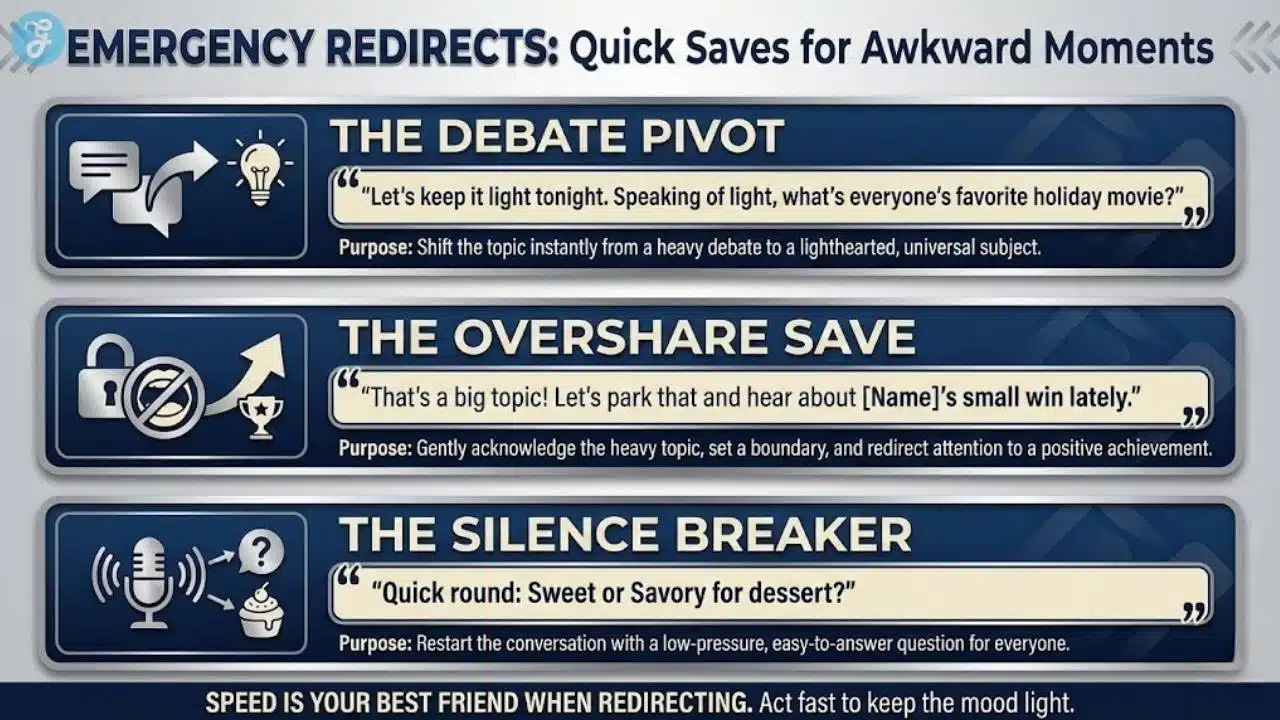
Quick Saves When a Topic Turns Awkward
Sometimes a conversation goes sideways. You don’t need to correct anyone, and you don’t need to lecture the table. You just need a neutral redirect and a safe next question.
Use this like a small emergency kit.
| Awkward Moment | Gentle Redirect Line | Safe Next Question |
|---|---|---|
| Debate is starting | “Let’s keep it light tonight.” | “What’s everyone’s favorite holiday dessert?” |
| Someone overshares | “That’s a big one, let’s park it for later.” | “What’s a small win you’ve had recently?” |
| Passive-aggressive comment | “Anyway, back to the good stuff.” | “What tradition should we keep forever?” |
| Long silence | “Quick round, pick one.” | “Comedy or holiday classic for movie night?” |
| One person is dominating | “I want to hear your version too.” | “What’s a place you still think about?” |
The important part is speed. Say the redirect, then immediately ask the next question so people have somewhere to go.
A Topic Menu That Avoids Landmines
If your family has a history of certain topics exploding, you don’t have to play with fire. Keep a mental menu of safe lanes that are still interesting.
Here’s a simple guide.
| Safe Lane | Why It Works | Easy Prompt |
|---|---|---|
| Food | Universal, sensory, positive | “Best snack this year?” |
| Nostalgia | Stories beat opinions | “Replay one childhood day?” |
| Entertainment | Low stakes, fun | “Comfort movie and why?” |
| Traditions | Festive, shared context | “Keep one, retire one?” |
| Small wins | Inclusive and warm | “What’s a small win lately?” |
If someone tries to drag the table into a hot take, switch lanes immediately. Think of it like changing the music when the vibe feels off.
How to Include Quiet People Without Putting Them on the Spot
Some relatives are quiet because they’re shy. Some are quiet because they’re tired. Some are quiet because they don’t want attention. Respect that, and invite gently.
Use prompts that allow short answers. Questions like “pick one” or “this or that” are easy entry points because they don’t require a speech. Then, if they seem comfortable, you can ask one soft follow-up.
Try these low-pressure formats:
-
“Quick choice: sweet or savory?”
-
“Pick one: cozy movie night or board games?”
-
“What’s one small thing you enjoyed this month?”
If someone answers briefly, accept it warmly and move on. A comfortable table is one where people feel safe to talk, and also safe to not talk.
Mini Games That Feel Natural at the Table
Not everyone loves direct questions, but most people enjoy a light game if it doesn’t feel forced. These are “low cringe” options that work even with skeptical relatives.
Here are a few that take no supplies:
-
Two Truths and a Lie, but keep it short and harmless
-
“Best and Worst,” like the best moment this month, and the worst harmless mistake
-
“Name That Smell,” describing a holiday smell that brings back a memory
-
“Family Superlatives,” the Hall of Fame categories from above
If your table likes structure, do a quick round. If your table likes chaos, let it pop up naturally when the energy dips.
A good rule is to stop while it’s still fun. Don’t squeeze the game until it becomes a performance. Use it as a spark, then return to normal dinner talk.
Mistakes That Make the Table Feel Worse
Even good intentions can backfire if the prompt is too sharp or too personal. Avoid questions that sound like exams, therapy, or judgment.
Try not to do these:
-
Asking someone about marriage, babies, money, or weight
-
Asking “why” questions that sound like criticism
-
Asking about controversial news topics when people are already tense
-
Forcing deep gratitude rounds when the room is not in that mood
Also, avoid stacking too many questions in a row. Ask one, listen, and let the story unfold. The goal is a warm table, not a rapid-fire Q&A session.
Make Christmas Eve Feel Easy Again
You don’t need perfect chemistry to have a great night. You need one good question, two good follow-ups, and the confidence to pivot when things get sharp. When you use Family dinner conversation starters like a quiet toolkit, you stop trying to “perform” and start helping the room relax.
Ask something story-based early, keep the tone light, and reward answers with curiosity. If the vibe wobbles, redirect gently and give the table a safer lane. That’s how you turn a night you dread into a night you actually remember.
Frequently Asked Questions (FAQs)
Here are some of the most frequently asked questions and their answers:
What if my family hates “icebreaker” questions?
Don’t label it as an icebreaker. Ask casually while passing a dish, like you’re genuinely curious. Choose something simple like food, a comfort show, or a funny, harmless moment.
How do I stop one person from turning everything into an argument?
Don’t debate, redirect. Use a line like “Let’s keep it light tonight,” then immediately ask a story-based question to someone else. Speedy pivots prevent the table from spiraling.
Which starters work best with kids at the table?
Kids do best with concrete and playful prompts. Ask about their favorite part of Christmas, a funny moment this week, or a silly Hall of Fame category they invent. Keep the follow-ups short so they stay engaged.
What topics should I avoid on Christmas Eve?
Avoid anything that tends to feel personal or judgmental, like money, relationships, weight, or life choices. If your family has recurring hot-button topics, skip them and stick to food, traditions, entertainment, and memories.
What if I accidentally make things awkward?
Acknowledge it lightly and move on. A quick “That came out weird” with a smile usually resets the room. Then pivot to a safe question like dessert favorites or comfort movies.
I’m introverted, do I have to carry the conversation?
No. Ask one question and focus on listening well. A single follow-up like “What happened next?” is enough to contribute without performing.