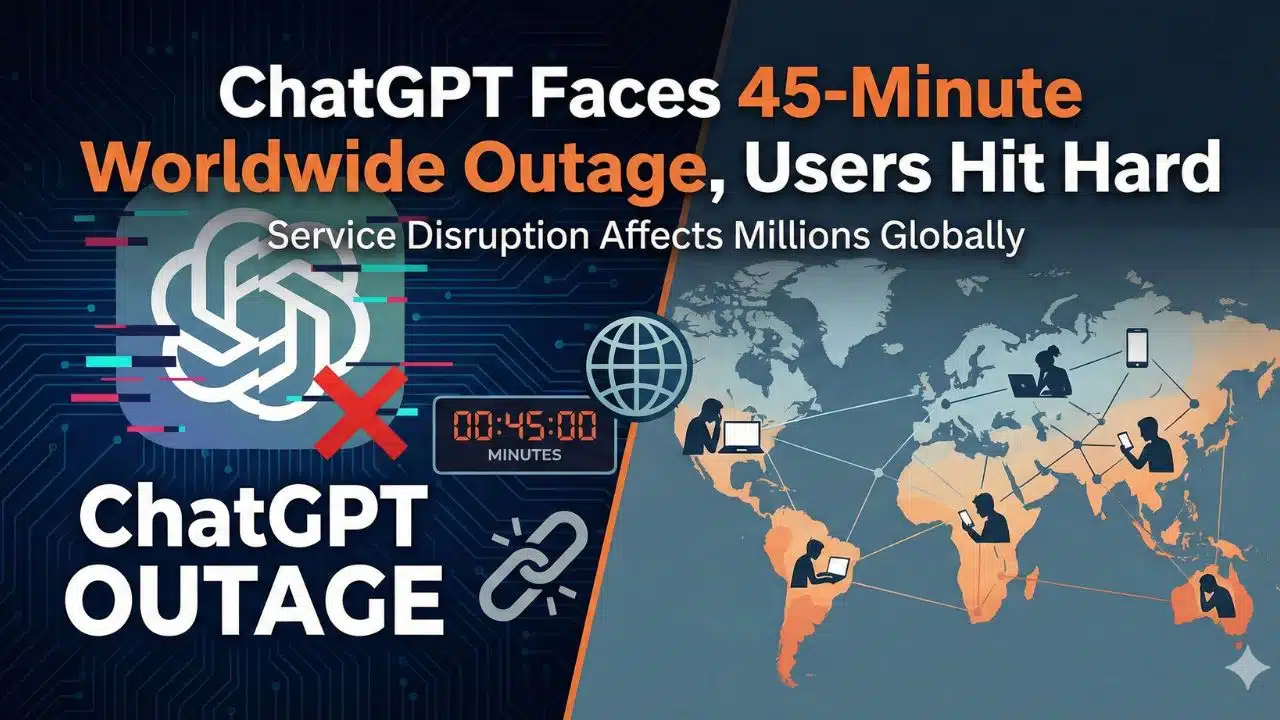
OpenAI’s ChatGPT platform experienced a large-scale outage on December 2, 2025, interrupting access for tens of thousands of users worldwide and highlighting the growing dependence on artificial intelligence systems for daily tasks. The disruption lasted roughly 45 minutes and began around 2:30 PM ET, affecting both casual users and professionals who rely on the chatbot for work, research, and content creation.
During the outage, users encountered persistent error screens, unresponsive interfaces, and stalled loading indicators that prevented any form of interaction with the AI. Real-time monitoring from Downdetector recorded a rapid climb in problem reports, crossing more than 30,000 submissions during the peak of the breakdown. The sudden surge demonstrated how deeply integrated ChatGPT has become in global digital workflows.
OpenAI acknowledged the issue through its status dashboard, reporting unusually high error rates that impaired normal functionality. Internal teams initiated mitigation procedures shortly afterward, stabilizing the service and gradually restoring access. The company later confirmed that a routing misconfiguration within its infrastructure had disrupted traffic flow across essential systems, temporarily preventing user requests from reaching the model.
Technical Missteps Expose Infrastructure Vulnerabilities
The cause of the outage — a routing misconfiguration — occurs when internal systems send requests along incorrect network paths. Such errors can overload parts of a distributed network or cause requests to simply fail without reaching their intended destination. With a platform as large as ChatGPT, even minor routing mistakes can cascade into global service interruptions, especially during peak traffic hours.
This event underscored the complexity of maintaining global AI systems that operate at massive scale. ChatGPT now serves hundreds of millions of weekly users across devices, regions, and industries. Any disruption, even a brief one, can ripple through professional environments, educational institutions, development workflows, and media operations that depend heavily on fast, reliable AI responses.
For individuals and teams who integrate ChatGPT into daily tasks — from coding and translation to meeting summaries and research — even short disruptions highlight the fragility of AI-dependent processes.
A Second Outage Strikes Within 24 Hours
On December 3, only hours after the first disruption was resolved, ChatGPT faced a second service failure. This time the issue targeted Codex-related processes — the backend component responsible for code generation, debugging assistance, and other programming-focused functionalities.
This second outage also lasted approximately 45 minutes and was visible to developers who rely on ChatGPT to supplement or automate their coding workflows. OpenAI’s logs showed elevated failure rates in code execution tasks before engineers were able to correct the problem.
Although the second outage was narrower in scope than the previous day’s event, the back-to-back failures raised concerns among users and analysts about the stability of OpenAI’s infrastructure, especially as demand for AI-powered applications continues to climb sharply across sectors.
Growing Pressure Inside OpenAI as Competition Intensifies
The outages came at a time when OpenAI was already undergoing significant internal pressure. On the same day as the first outage, OpenAI’s leadership initiated what has been described internally as a heightened priority period aimed at improving ChatGPT’s overall performance.
CEO Sam Altman instructed teams across the company to shift their focus almost entirely toward enhancing ChatGPT’s reliability, speed, and personalization capabilities. This strategic pivot involved delaying or reducing work on several upcoming initiatives, including advertising partnerships, specialized AI agents for health and shopping, and new research-oriented tools.
This internal concentration on core functionality stems from increasing competition in the AI landscape. Google’s Gemini ecosystem has been expanding rapidly, with its user base growing into the hundreds of millions. Recent benchmark results have shown Gemini models performing competitively against ChatGPT in various evaluations, intensifying industry comparisons.
Despite ChatGPT maintaining a commanding share of the global AI assistant market, OpenAI’s leadership views improved stability and performance as essential to maintaining its position. Frequent disruptions — even short-term ones — can encourage users to explore alternatives, especially as rival products build stronger ecosystems and integrations.
The Scale of ChatGPT’s User Load Raises the Stakes
ChatGPT’s user base has expanded dramatically since its public launch, now exceeding 800 million weekly active users as of late 2025. This represents nearly one-tenth of the adult population worldwide. With such a vast and diverse global audience, system reliability becomes a cornerstone of user trust.
The December outages demonstrated how even brief technical issues can generate immediate and widespread disruption. Millions of individuals — including students, journalists, programmers, customer support teams, physicians using AI-assisted tools, and businesses leveraging ChatGPT for internal automation — depend on constant uptime.
As AI becomes more deeply embedded in professional and personal environments, any service instability directly affects productivity, decision-making, and digital operations. This places immense pressure on AI developers like OpenAI to ensure uninterrupted access and rapid recovery during unexpected failures.
Security Challenges Add to OpenAI’s Recent Strain
The service disruptions also followed a recent disclosure about a security breach involving Mixpanel, a third-party analytics vendor used by OpenAI. On November 26, OpenAI revealed that an unauthorized actor had gained access to Mixpanel’s systems earlier in the month, obtaining a dataset containing limited information about API users. The accessed data included user names, email addresses, approximate locations, and non-sensitive device metadata.
While no passwords, API keys, or ChatGPT user data were compromised, OpenAI terminated its relationship with Mixpanel and initiated extensive security audits across its vendor network. This incident added to a growing sense of urgency within the company to strengthen both operational reliability and data protection measures.
The timing of the breach disclosure — occurring shortly before two consecutive outages — intensified scrutiny from industry analysts, enterprise customers, and the broader AI community regarding OpenAI’s capacity to balance growth with stability and security.
A Critical Moment for OpenAI and the Future of AI Services
The combination of widespread outages, internal restructuring of priorities, competitive pressure, and recent security concerns marks a pivotal moment for OpenAI. As ChatGPT evolves from a consumer novelty into a cornerstone technology used by millions of businesses, institutions, and individuals, expectations for reliability continue to rise.
These incidents underscore broader questions facing the AI industry:
-
How resilient are large-scale AI platforms under extreme load?
-
What safeguards are needed to prevent cascading technical failures?
-
How can companies protect sensitive data while depending on third-party analytics services?
-
What role will competition play in driving innovation and system reliability?
For OpenAI, strengthening infrastructure, improving service uptime, and ensuring transparent communication during outages will be crucial in maintaining user trust and global market leadership.
As AI becomes an indispensable tool for daily life, the events of early December 2025 serve as a clear reminder that the stability of AI systems is now just as important as their intelligence.