

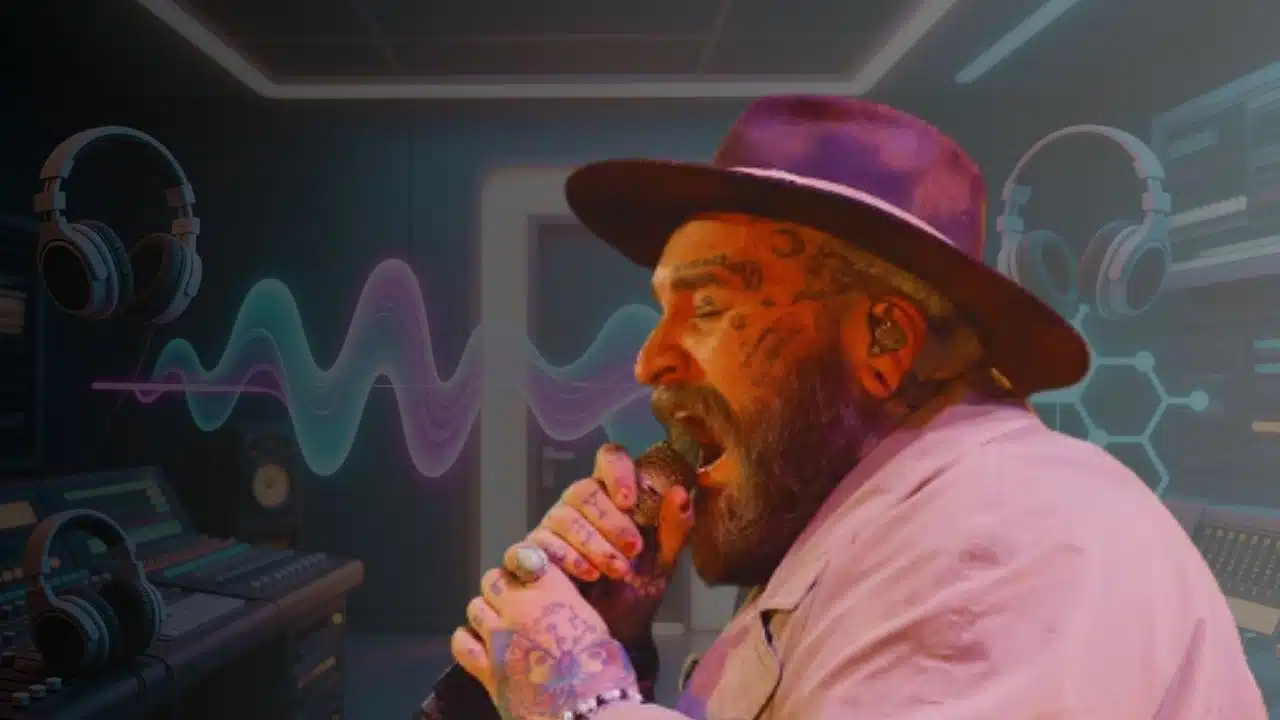
Grammy-nominated singer Teddy Swims has found himself at the center of an industry-wide debate after openly discussing his use of artificial intelligence tools during a public appearance. What began as a candid explanation of his creative process at SXSW Sydney has now escalated into a larger conversation about the future of music, artistic authenticity, and how rapidly evolving technology is reshaping the relationship between artists, producers, and the public.
During the event, Swims explained that AI had become a practical tool in his songwriting workflow, describing it as “truly amazing” for speeding up tasks that would normally require hours in a studio. He noted that his producers can modify lyrics, rework vocal lines, or shift the genre of a song without the need for lengthy reshoots or repeated attempts to perfect a single phrase. According to Swims, AI can instantly test how a track might sound as a ballad, a rock anthem, a country version, or something entirely different, giving him more room to experiment without exhausting time, budget, or creative energy.
While he emphasized that AI cannot replicate the emotional core that defines meaningful music, his remarks have resurfaced across social media, sparking a wave of backlash from musicians and listeners who fear technology is beginning to overshadow human creativity. Many fans expressed disappointment, arguing that an artist known for his soulful vocals and vulnerable songwriting should not rely on algorithmic assistance. Others accused him of contradicting his own concerns about AI misuse in music, reigniting tensions at a moment when the industry is already split over the technology’s accelerating influence.
Industry at a Crossroads as AI Music Raises Ethical and Economic Concerns
Teddy Swims’ comments landed at a time when the global music business is confronting unprecedented challenges tied to artificial intelligence. The conversation intensified after Breaking Rust — a completely AI-generated act — topped Billboard’s Country Digital Song Sales chart with “Walk My Walk.” The song became controversial when it was revealed that its vocal style mirrored that of country artist Blanco Brown without his consent or awareness. The case highlighted fears that AI systems may replicate voices, styles, and artistic signatures without crediting the original creators.
The concern gains further weight as major record labels shift their stance from legal battles to collaboration. Universal Music Group, Warner Music Group, and Sony Music Entertainment have recently settled high-profile copyright disputes with AI companies such as Suno and Udio. Instead of pursuing prolonged litigation, the labels have agreed to licensing frameworks that will permit users to remix, recreate, or generate new music based on existing artists — but only beginning in 2026 and with strict opt-in requirements.
These deals mark a significant strategic shift. They acknowledge that AI-generated music is not going away and instead attempt to create a regulated environment where artists retain control over their likeness, voice, and catalog. However, the agreements have also caused anxiety among musicians who fear that even licensed use of AI may dilute the value of human-crafted work and create a competitive disadvantage for artists who choose not to participate.
At the same time, more than 1,000 musicians across the UK and beyond — including Paul McCartney, Kate Bush, and Damon Albarn — are preparing a silent protest album slated for release this December. The project targets proposed UK copyright reforms that could allow AI developers to train their models on copyrighted songs without permission. McCartney’s contribution, an audio recording of an empty studio, symbolizes what he and other artists view as the potential cultural void that might emerge if legal protections fail to safeguard human creativity.
A Divided Response as Artists Confront Both the Promise and Threat of AI
Teddy Swims himself acknowledged the darker implications of AI. He recounted discovering that someone online had created a fully AI-generated song using his voice without consent. When Swims attempted to sample the chorus from that track for his own work, he was told he would need to negotiate with the AI creator to obtain rights — despite the fact that the voice used was his own. He called the situation “ridiculous,” pointing to the confusion and legal gray areas that AI is rapidly creating within the music landscape.
His manager, Luke Conway, added that thousands of AI-generated Teddy Swims songs appear on YouTube every day, many of them receiving views and engagement that compete with his official releases. Conway argued that such content should not be treated on the same level as music created by the artist and his team, especially when it can divert royalty streams away from legitimate work.
Yet some critics say Swims cannot condemn unauthorized AI usage while relying on similar technology behind the scenes. This perceived contradiction has fueled much of the public backlash. Online reactions range from disappointment to accusations of hypocrisy, reflecting how emotionally charged the topic has become for musicians and listeners alike.
A recent study by the music platform Deezer further intensified the debate. According to its findings, 97% of listeners struggle to distinguish AI-generated music from human-made tracks. For many artists, this statistic is alarming, suggesting the possibility of a future in which their creative identity — their voice, style, and artistic fingerprint — can be replicated and commodified with little oversight. Musician Mark Henry Phillips captured this anxiety when he remarked that AI has made his once-specialized skills far less unique, stating that from both “a musical and economic point of view,” AI may soon outperform human creators entirely.
What Teddy Swims’ Controversy Says About the Future of Music
The reaction to Teddy Swims’ comments reveals a deep divide in the music community. Supporters argue that AI is simply another tool — much like autotune, synthesizers, or digital audio workstations once were — and that innovation has always shaped the evolution of music. Critics counter that AI represents a far more disruptive force: one capable not only of assisting human creativity but of imitating and potentially replacing it.
Swims maintains that AI cannot replicate lived experience, emotional imperfections, or the human touch that gives music meaning. However, the backlash he faces underscores how fragile public trust has become when it comes to blending technology with art. As AI continues to advance, the industry must confront major questions about originality, ownership, economic fairness, and the very definition of what it means to be an artist.
The controversy highlights the complexity of this transition period. The music world is standing at a crossroads where innovation promises limitless possibilities, yet simultaneously casts uncertainty over the livelihoods, identities, and futures of songwriters and performers. As the debate grows louder, Teddy Swims’ experience serves as a revealing snapshot of the broader struggle: a creative industry racing to adapt, protect its artists, and define its values amid a rapidly changing technological era.






















