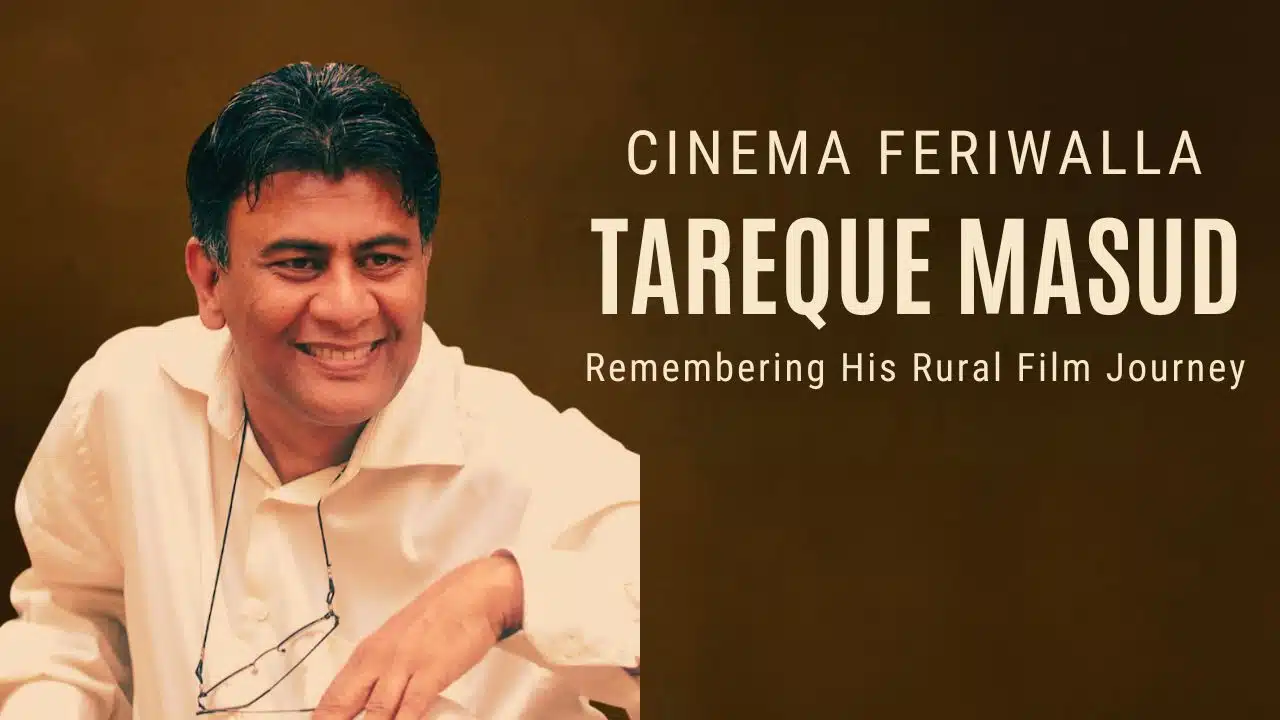
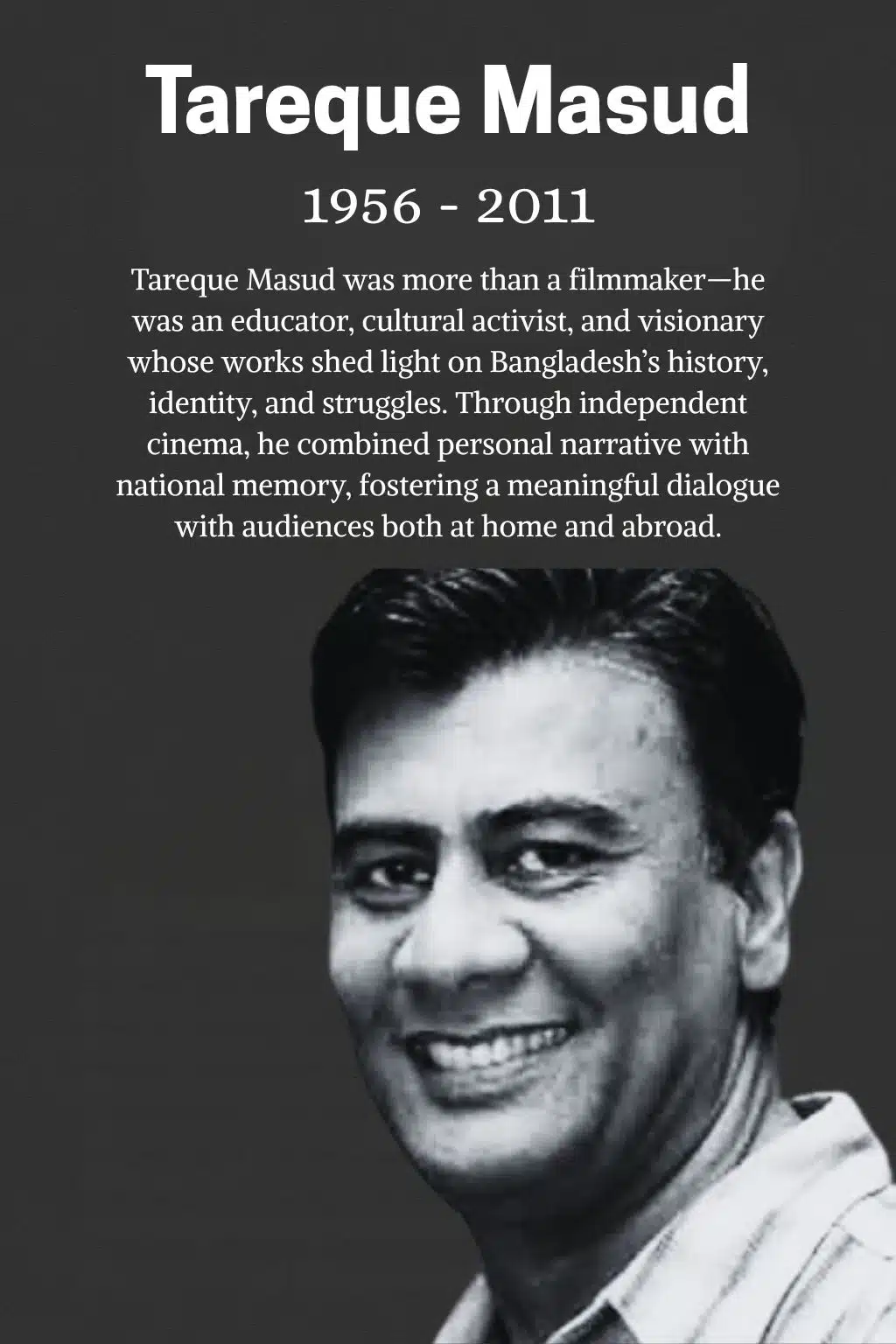
Today marks the 14th death anniversary of Tareque Masud, one of Bangladesh’s most loved filmmakers. A tragic car accident in 2011 took his life far too early, but his work and vision still shine brightly in our hearts.
Known as the “Cinema Feriwalla,” Tareque Masud believed cinema was not only for city theaters—it was for every person, in every corner of the country. He dreamed of taking films to places where there were no cinemas, no ticket counters, and sometimes, not even electricity.
With a projector, a screen, and a van, he brought moving stories to villages, showing that films could be powerful tools for learning, remembering, and inspiring.
Who Was Tareque Masud?
Tareque Masud was born on 6 December 1956 in Nurpur village, Bhanga, Faridpur. His early years were spent in a madrasa, where he studied for eight years. The 1971 Liberation War changed his life forever. During the war, schools closed, and like many young Bangladeshis, he grew up hearing stories of courage and loss.
After independence, he returned to his studies, completing his Higher Secondary Certificate (HSC) at Notre Dame College and later earning a master’s degree in history from the University of Dhaka.
In his student years, Tareque developed a love for films, especially those that told real stories about people. He became active in the Bangladesh Short Film Forum, helping to organize film festivals and support independent filmmakers. From the start, his vision of cinema was very clear—it was not just entertainment; it was a way to connect people, preserve history, and build national identity.
Tareque Masud – Biography Table
| Field | Details |
|---|---|
| Full Name | Tareque Masud |
| Nickname / Title | Cinema Feriwalla |
| Date of Birth | 6 December 1956 |
| Place of Birth | Nurpur village, Bhanga Upazila, Faridpur District, East Pakistan (now Bangladesh) |
| Date of Death | 13 August 2011 |
| Place of Death | Manikganj District, Bangladesh |
| Cause of Death | Road accident while scouting for his next film Kagojer Phool |
| Nationality | Bangladeshi |
| Education | – Madrasa education (8 years) – Notre Dame College, Dhaka (HSC) – MA in History, University of Dhaka |
| Occupation | Filmmaker, Producer, Screenwriter, Lyricist, Cultural Activist |
| Years Active | 1980s–2011 |
| Spouse | Catherine Masud (American-born filmmaker, editor, and producer) |
| Children | One son |
| Notable Works (Documentaries) | Adam Surat (1989), Muktir Gaan (1995), Muktir Kotha (1999), Narir Kotha (2000) |
| Notable Works (Feature Films) | Matir Moina (2002), Ontarjatra (2006), Runway (2010) |
| Awards & Honors | – FIPRESCI Prize, Cannes Film Festival (2002, Matir Moina) – Bangladesh National Film Award for Best Screenplay (Matir Moina) – Ekushey Padak (Posthumous, 2012) |
| Known For | – Pioneering independent cinema in Bangladesh – Using film to document history and social change – Bringing films to rural audiences as “Cinema Feriwalla” |
| Legacy Institutions | Tareque Masud Memorial Trust (founded 2012) |
| Google Doodle | Honored on his 62nd birthday, 6 December 2018 |
| Final Project | Kagojer Phool (The Paper Flower)—unfinished at the time of his death |
The Birth of the “Cinema Feriwalla” Concept
The idea of the “Cinema Feriwalla” came from a simple but powerful thought: Why should films only be for city audiences? In Bangladesh, most villages had no cinema halls, and many rural people had never seen a film projected on a big screen. Tareque saw this as a gap he could fill. Inspired by the traditional jatra theatre groups and folk storytellers who travelled from village to village, he decided to take his films directly to the people.
With his wife and creative partner Catherine Masud, he started mobile film screenings. These screenings were not commercial; they were free community events. The goal was to bring stories of Bangladesh—its history, struggles, and culture—to those who were often left out of the national conversation. This was the birth of his identity as the Cinema Feriwalla, the man who carried films like a vendor carries goods, delivering them door-to-door across the country.
The Films That Travelled Across Villages
Several of Tareque Masud’s films were perfect for these rural screenings because they spoke directly to the people’s hearts.
Muktir Gaan (Song of Freedom, 1995)
This documentary followed a cultural troupe that travelled to the frontlines during the 1971 Liberation War, singing songs to inspire fighters and villagers. When shown in rural areas, it touched deep emotions. Many older villagers remembered those days, while the younger ones learned about the war in a way history books could not capture.
Muktir Kotha (Words of Freedom, 1999)
This film was created after Muktir Gaan. While screening the first film in villages, Tareque and Catherine recorded conversations with audiences. People shared personal stories of the war that had never been told publicly. Muktir Kotha became a collection of these voices, turning the audience into the storytellers.
Adam Surat (The Inner Strength, 1989)
A portrait of the famous Bangladeshi artist SM Sultan, this documentary brought the life and work of a rural-born genius to the very people he represented. It was a reminder that art can come from anywhere, even the smallest villages.
| Film Title | Year | Theme/Focus | Rural Audience Impact |
|---|---|---|---|
| Muktir Gaan | 1995 | Liberation War cultural troupe | Evoked patriotism, shared memories, and emotional unity |
| Muktir Kotha | 1999 | War stories from ordinary people | Empowered villagers to share their own untold histories |
| Adam Surat | 1989 | Life of artist SM Sultan | Inspired rural artists and celebrated village talent |
Taking the Screen to the People
The process of taking films to villages was not easy. Tareque and his team carried projectors, generators, screens, and sound systems in a van or small truck. In places without electricity, they relied on generators. Sometimes screenings were set up in school fields, sometimes in open markets, and sometimes under large banyan trees.
Announcements were made through local leaders, community elders, or even by microphone at the village market. On the screening night, hundreds of people—children, farmers, women, and elders—would gather, often walking long distances. For many, it was their first experience of seeing a film on a big screen.
After each screening, discussions were encouraged. Villagers would share their thoughts, ask questions, and sometimes even argue about the messages in the films. This turned the screenings into community dialogues, where people reflected on their history, culture, and social issues.
But there were challenges too. Power failures, heavy rains, political unrest, and even censorship attempts sometimes interrupted the events. Yet, Tareque never let these obstacles stop him. His passion kept the Cinema Feriwalla mission alive.
Cultural Impact and Social Awakening
Tareque Masud’s rural screenings were more than entertainment—they were acts of cultural preservation. In many villages, the Liberation War had become a distant memory, especially for younger generations. By showing films like Muktir Gaan, he kept that memory alive, ensuring that the sacrifices and struggles were not forgotten.
The screenings also sparked intergenerational conversations. Grandparents would tell war stories to their grandchildren after watching the films. Local artists felt encouraged to create, and community members began to value their own histories and traditions.
In this way, Tareque’s mobile cinema built a bridge between the past and the present, between art and ordinary life.
The Legacy of the Cinema Feriwalla
Tareque Masud’s death in 2011 was a huge loss for Bangladesh’s cultural community. But his legacy continues through the Tareque Masud Memorial Trust, founded by Catherine Masud. The trust works to preserve his films, organize screenings, and train young filmmakers.
The Cinema Feriwalla idea has also inspired others. Today, mobile cinema is used for education, health awareness, and cultural programs in rural Bangladesh. Internationally, similar initiatives in Africa, Latin America, and India show that the idea of bringing films to the people is universal.
Lessons for Today’s Filmmakers
Tareque Masud’s journey offers important lessons for anyone working in film today:
-
Go beyond urban audiences—true impact happens when you connect with all sections of society.
-
Tell authentic stories—stories rooted in culture and reality touch hearts.
-
Be resourceful—creativity often grows in the face of limitations.
-
Use cinema for change—films can open minds, spark debate, and inspire action.
Takeaways
The name “Cinema Feriwalla” perfectly describes Tareque Masud—a man who carried stories like treasures, delivering them to people who had never seen such magic before. Fourteen years after his untimely passing, his work still travels—not just on screens, but in the hearts of those who watched under the stars in village fields.
Tareque Masud showed us that cinema is not just about watching; it is about feeling, learning, and remembering. His travelling projector may have stopped, but his light continues to guide Bangladesh’s cultural journey.