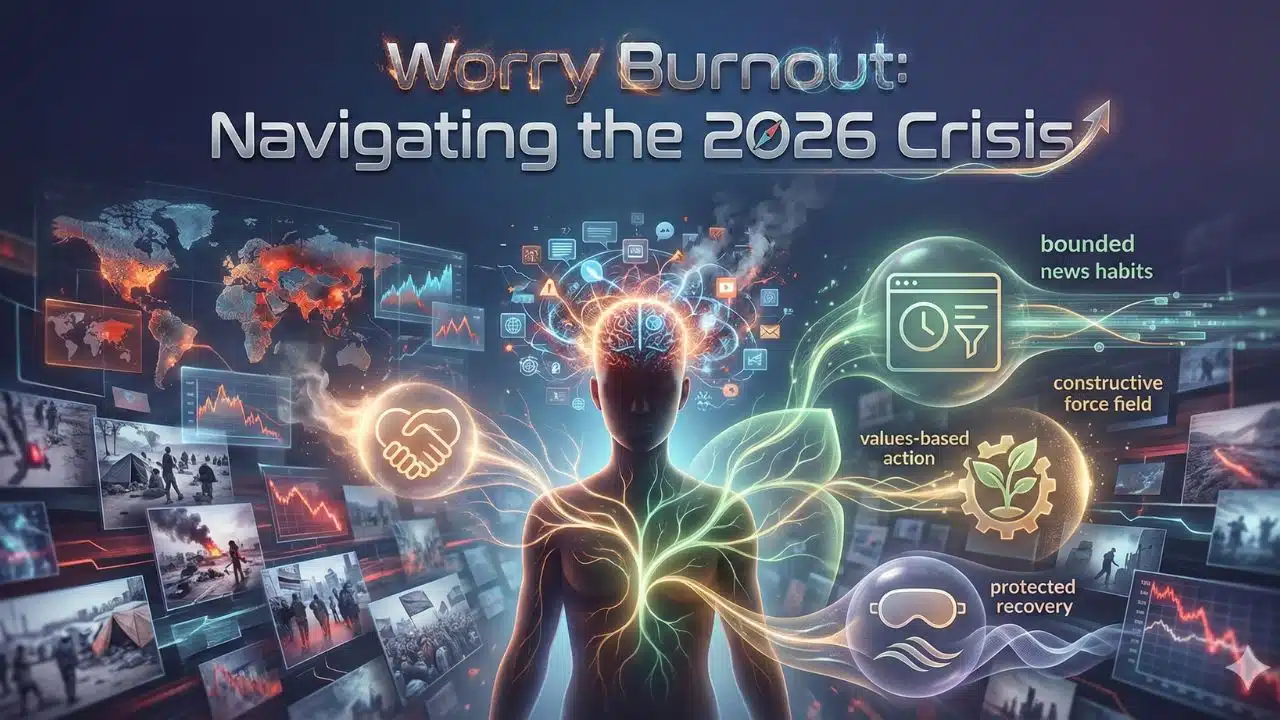
Worry burnout is rising because today’s threats feel constant, borderless, and impossible to “solve.” When war, displacement, and political fragmentation collide with nonstop feeds, the brain stays in alert mode. The result is a distinct exhaustion: not just fear, but fatigue from always anticipating what breaks next.
How We Got Here: From Discrete Crises To Chronic Uncertainty
For most of modern history, people processed upheaval in bursts: a war began, a recession hit, a disaster struck, then life reorganized around a “new normal.” What feels different entering 2026 is that the “new normal” is uncertainty itself.
One obvious driver is the scale and persistence of global conflict and displacement. In June 2025 reporting that cited UNHCR figures, forced displacement was described at 122.1 million as of April 2025, up from 120 million a year earlier, with 73.5 million internally displaced at the end of the prior year. The same reporting highlighted how major crises stack rather than resolve, with Sudan’s displacement above 14 million, Syria at 13.5 million, Afghanistan above 10 million, and Ukraine at 8.8 million.
At the same time, the conflict environment is becoming harder to mentally compartmentalize. The Institute for Economics & Peace (IEP), in its Global Peace Index 2025 materials released in June 2025, described a “Great Fragmentation,” noting 59 active state-based conflicts (the most since World War II) and 152,000 conflict-related deaths recorded in 2024. IEP also estimated the global economic impact of violence at $19.97 trillion in 2024 (11.6% of global GDP). These are macro statistics, but they function psychologically as micro stressors: they signal that instability is not episodic; it is systemic.
Then there is the humanitarian “capacity crunch.” Reuters reported on March 20, 2025 that UNHCR warned donor funding cuts could put millions of lives at risk, describing a cash-flow crisis and the freezing of over $300 million of planned activities, alongside a reminder that the U.S. had provided over $2 billion in donations in 2024 (about 40% of UNHCR donations). Even if readers do not track budgets, the psychological message is loud: the systems meant to stabilize the world look strained.
This is the backdrop for worry burnout: a sustained, low-grade sense that the world is volatile and too big for any single person to meaningfully influence.
What “Worry Burnout” Actually Is (And Why It Feels Different)
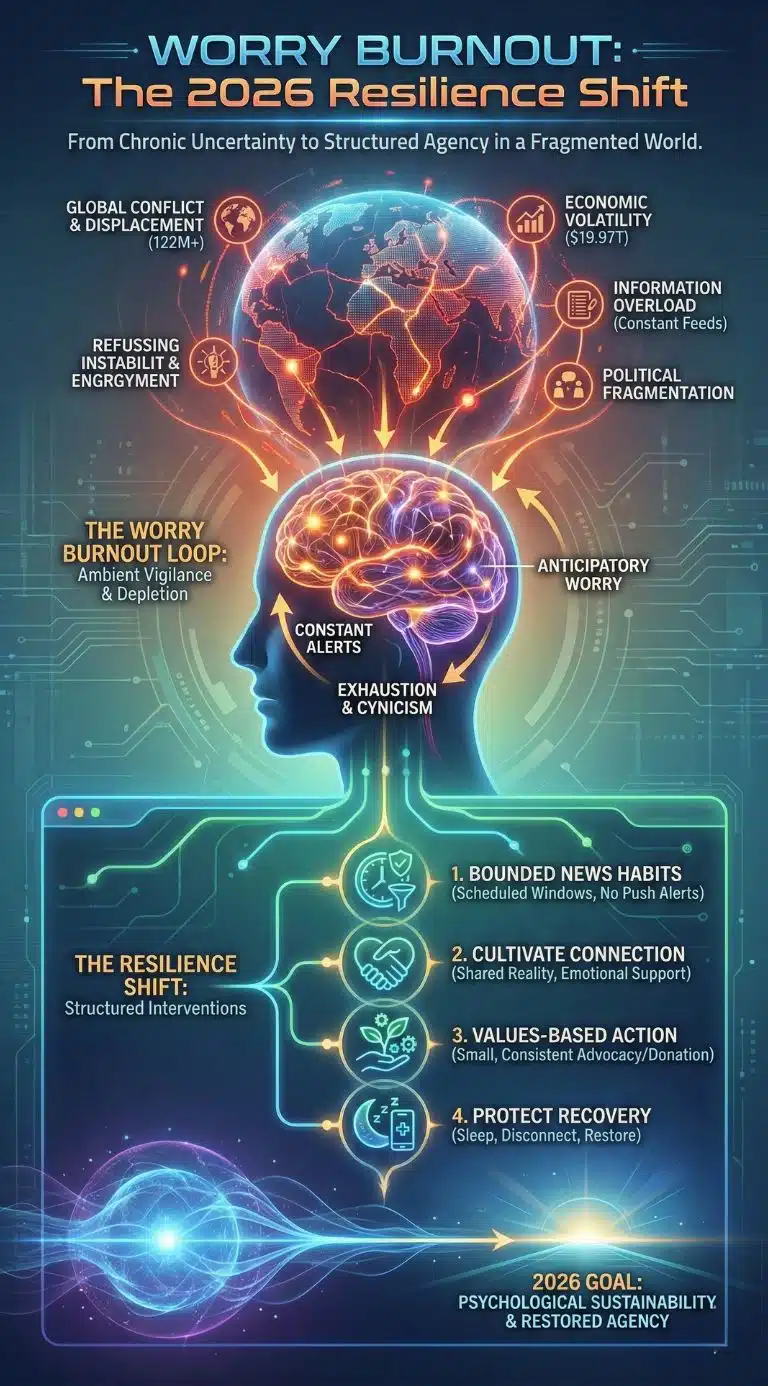
“Worry burnout” is not a formal diagnosis in the way major depressive disorder or generalized anxiety disorder is. It is better understood as a pattern: chronic anticipatory worry plus depletion.
A useful popular framing emerged during the pandemic: prolonged uncertainty produces vigilance that might be sustainable for weeks, but not for years. A University of Michigan psychology explainer (December 2021) captured the core idea: long-running uncertainty and repeated stressors can overwhelm coping capacity, and acute stress can gradually harden into exhaustion, cynicism, and hopelessness.
What makes 2026’s version distinct is that the “object” of worry is often not personal and solvable (a deadline, a bill, a relationship conflict). It is structural and global: war, political instability, climate shocks, disinformation, economic fragmentation. When your brain cannot identify a clear action that ends the threat, it tends to default to a loop: monitor more, predict more, brace more. Over time, that loop drains motivation, concentration, and emotional range.
Here is a practical way clinicians and mental health educators separate overlapping concepts in real-world conversations:
| Worry Burnout | Generalized Anxiety Pattern | Occupational Burnout | Acute Stress Reaction | |
|---|---|---|---|---|
| Core feeling | “I’m tired of being on alert” | “I can’t stop worrying” | “I’m empty and cynical about work” | “I feel shocked, keyed up” |
| Main driver | Chronic uncertainty + helplessness | Persistent worry across domains | Work demands + low control | A discrete traumatic event |
| Common behaviors | Doomscrolling, checking, withdrawal | Reassurance seeking, avoidance | Detachment, reduced performance | Hypervigilance, intrusive thoughts |
| What helps most | Boundaries, connection, meaning, action | CBT/ACT skills, exposure, regulation | Work redesign, rest, values reset | Stabilization, safety, support |
Worry burnout can coexist with anxiety or depression, and that matters clinically. The intervention is not simply “relax more.” It is often “rebuild control where possible, and rebuild recovery where it is missing.”
Key Statistics That Explain Why This Feels So Heavy Right Now
-
The Institute for Economics & Peace reported 59 active state-based conflicts and 152,000 conflict-related deaths in 2024 in its Global Peace Index 2025 materials (June 2025).
-
IEP estimated the economic impact of violence at $19.97 trillion in 2024, equivalent to 11.6% of global GDP (Global Peace Index 2025).
-
UNHCR figures cited in major reporting put forced displacement at 122.1 million as of April 2025, with internal displacement at 73.5 million at the end of the prior year.
-
The American Psychological Association’s 2025 “Stress in America” findings, reported November 6, 2025, found 54% felt isolated often or some of the time, and 69% said they needed more emotional support than they received.
-
Pew Research Center (October 15, 2025) reported Americans say news makes them feel informed (46%), but also angry (42%), sad (38%), and scared (27%) often or sometimes.
-
Gallup’s global emotion tracking (summarized in June 2024 reporting) cited 37% stress and 40% worry, with wide cross-country variation.
These numbers are not just “bad news.” They are a map of what your nervous system is being asked to digest.
Why Geopolitical Unrest Converts Into Worry Burnout
Threat Without A Finish Line
The brain’s threat system is built for problems that end: fight, flee, recover. Geopolitical unrest rarely offers that arc. The Institute for Economics & Peace described conflicts becoming more internationalized, noting 78 countries involved in conflicts beyond their borders in 2024 and warning that the conditions that precede conflict have deteriorated sharply.
When threats are diffuse and durable, many people develop “ambient vigilance,” a background readiness that never fully powers down. That is metabolically expensive and psychologically corrosive. You can stay alert through a storm. You cannot stay alert through a climate.
Information Overload Turns “Staying Informed” Into A Stress Behavior
News used to arrive in packages. Now it arrives as a stream, optimized for attention.
Pew’s October 2025 findings illustrate the emotional paradox: news makes people feel informed, but it also reliably produces anger, sadness, and fear. That combination is a recipe for compulsive checking. Anger and fear push you to seek certainty. Certainty feels soothing for a moment, so you check again. The loop becomes self-reinforcing.
Gallup’s global emotion data adds an important nuance: many people still report positive daily experiences even while stress and worry remain high in a substantial share of the population. The point is not that people are only suffering. The point is that many are carrying mixed emotional states: functioning on the outside, unsettled underneath.
Doomscrolling Is Often An Attempt To Manage Uncertainty (That Backfires)
A 2024 peer-reviewed study in Personality and Individual Differences modeled doomscrolling as part of a psychological mechanism: trait anxiety increases intolerance of uncertainty, and lower psychological resilience offers less protection. In the analysis, intolerance of uncertainty was positively associated with doomscrolling, while resilience was negatively associated with doomscrolling.
Translated into plain language: people often scroll not because they enjoy it, but because ambiguity feels unbearable. Scrolling promises clarity. Instead, it delivers more threat cues, keeping the nervous system activated.
This also helps explain why “just stop scrolling” rarely works as advice. If scrolling is being used as an anxiety-management strategy, removing it without replacement can increase distress. A better approach is substitution: bounded information windows plus skills that directly increase tolerance for uncertainty.
Social Division And Loneliness Remove The Shock Absorbers
Resilience is not only an inner trait. It is also environmental: relationships, trust, community, and the sense that someone else is tracking the world with you.
The APA’s 2025 survey findings, reported in November 2025, point to a population-level deficit in connection: more than half reported feeling isolated often or some of the time, and nearly seven in ten said they needed more emotional support than they received. Among people stressed by societal division, isolation and loneliness indicators were higher.
This matters because connection changes how the brain codes threat. Shared reality reduces cognitive load. Isolation magnifies it. In a year of geopolitical unrest, social fragmentation turns “world problems” into “private burdens.”
Empathy Overload And Moral Distress Blur The Line Between Care And Collapse
When people consume images of suffering at scale, many experience a specific kind of fatigue: not indifference, but depletion. The emotional system keeps mobilizing compassion without receiving closure, efficacy, or relief.
This is one reason worry burnout can include guilt. People sense they “should” care, and they do care, but caring continuously without boundaries becomes destabilizing. Moral distress grows when a person feels responsible to respond but lacks a realistic pathway to do so.
The Body Shows Up In The Data, Not Just The Mind
Worry burnout is often described cognitively, but it frequently presents physically: fatigue, headaches, irritability, sleep disruption.
The APA’s 2025 survey findings reported that people with higher loneliness were far more likely to report symptoms like depressed mood, nervousness or anxiety, fatigue, and headaches than those with low loneliness. That is a reminder that emotional strain is not abstract. It is embodied.
A Practical Before Vs After Lens: What Changed In The Worry Economy
| Earlier News Cycles | 2024–2026 Unrest Pattern | Why It Burns People Out | |
|---|---|---|---|
| Threat exposure | Periodic | Continuous | No recovery window |
| Information format | Scheduled | Infinite scroll | Checking becomes compulsion |
| Social support | Local, face-to-face | Fragmented, polarized | Fewer stabilizing conversations |
| Sense of agency | Higher | Lower | Worry rises when action feels pointless |
| Emotional mix | Fear, then relief | Fear + anger + sadness + uncertainty | Mixed states are harder to metabolize |
This is not nostalgia. It is an argument that our mental health tools have not caught up to our threat environment.
Clinical Strategies That Build Mental Resilience Without Ignoring Reality
The most effective approach is not “stop caring.” It is “care with structure.”
Build A Bounded News Habit
A clinically useful goal is informed enough to act, not flooded enough to collapse.
-
Pick two news windows per day (example: 20 minutes in the morning, 20 minutes in the evening).
-
Choose one primary source for updates and one for deeper analysis, instead of 10 partial feeds.
-
Turn off push alerts for everything except personal safety and essential services.
-
Decide in advance what you do after reading (walk, stretch, shower, call someone). You are training your nervous system that threat cues are followed by recovery.
This works because it breaks the variable-reward loop of feeds. You are replacing compulsion with a predictable routine.
Train Uncertainty Tolerance
The doomscrolling research points to intolerance of uncertainty as a driver. Clinically, that becomes a skills target.
-
Label the uncertainty: “I don’t know what will happen, and my brain is trying to close that gap.”
-
Name the controllables: what you can do this week (vote, donate, prepare, support someone, adjust finances).
-
Worry postponement: schedule a 15-minute “worry window.” If worry shows up outside it, write it down and defer it.
-
Probability checking: ask “what is likely” versus “what is possible.” Worry burnout often treats possibility as probability.
These are simple tools, but they work because they alter the cognitive mechanism that fuels checking.
Convert Worry Into Values-Based Action
One of the biggest accelerants of worry burnout is helplessness. A small, consistent action restores agency.
-
If your worry is humanitarian: set a monthly donation and a monthly advocacy action.
-
If your worry is misinformation: support media literacy, model verification habits, and avoid rage sharing.
-
If your worry is safety: create a plan once, then stop repeatedly “re-planning” as a disguised form of rumination.
Values-based action is not activism-as-performance. It is action-as-regulation: the nervous system calms when it feels it has done what it can.
Treat Connection As A Core Intervention
The APA findings suggest emotional support needs are not being met at scale. That makes connection a frontline resilience tool.
A realistic prescription:
-
One high-quality conversation per week where you do not only trade headlines.
-
One shared activity per week (walk, meal, prayer, sport, volunteering).
-
One community container (group, club, neighborhood project).
The brain handles threat better when it is not alone with it.
Protect Sleep Like A Security Asset
You do not need perfect wellness to reduce worry burnout, but you do need recovery.
-
Stop conflict content and breaking updates 60 minutes before bed.
-
If you must read, shift to analysis rather than live updates at night.
-
Keep your phone out of reach to break reflex checking.
For many people, “my anxiety is worse” is partly “my sleep is worse.”
Know When This Has Crossed Into Treatable Anxiety Or Depression
Worry burnout can be normal and expected. It can also tip into a clinical condition that deserves treatment.
Consider professional support if:
-
Worry impairs work, relationships, or sleep most days for weeks
-
You cannot disengage from checking behaviors
-
You are using alcohol or substances to blunt activation
-
You feel persistently hopeless, numb, or detached
That is not weakness. It is an overloaded system asking for care.
A Clinical Toolbox For 2026: Matching The Strategy To The Mechanism
| What You Notice | Likely Mechanism | Strategy That Fits | What “Success” Looks Like |
|---|---|---|---|
| Compulsive checking | Uncertainty intolerance | Scheduled news windows + worry postponement | You check by choice, not reflex |
| Feeling numb or detached | Emotional overload | Boundaries + connection + meaning practices | Feeling returns without flooding |
| Irritability, snapping | Chronic activation | Movement, sleep protection, limit night news | Shorter fuse becomes longer |
| Guilt for disengaging | Moral distress | Values-based action plan | You help without self-erasure |
| Rumination at bedtime | Threat system stuck “on” | Wind-down routine, phone out of reach | Sleep becomes more predictable |
The core message is simple: resilience is not a personality trait you either have or lack. It is a set of interventions that can be matched to what is actually driving distress.
Expert Perspectives And Neutrality: Two Truths To Hold At Once
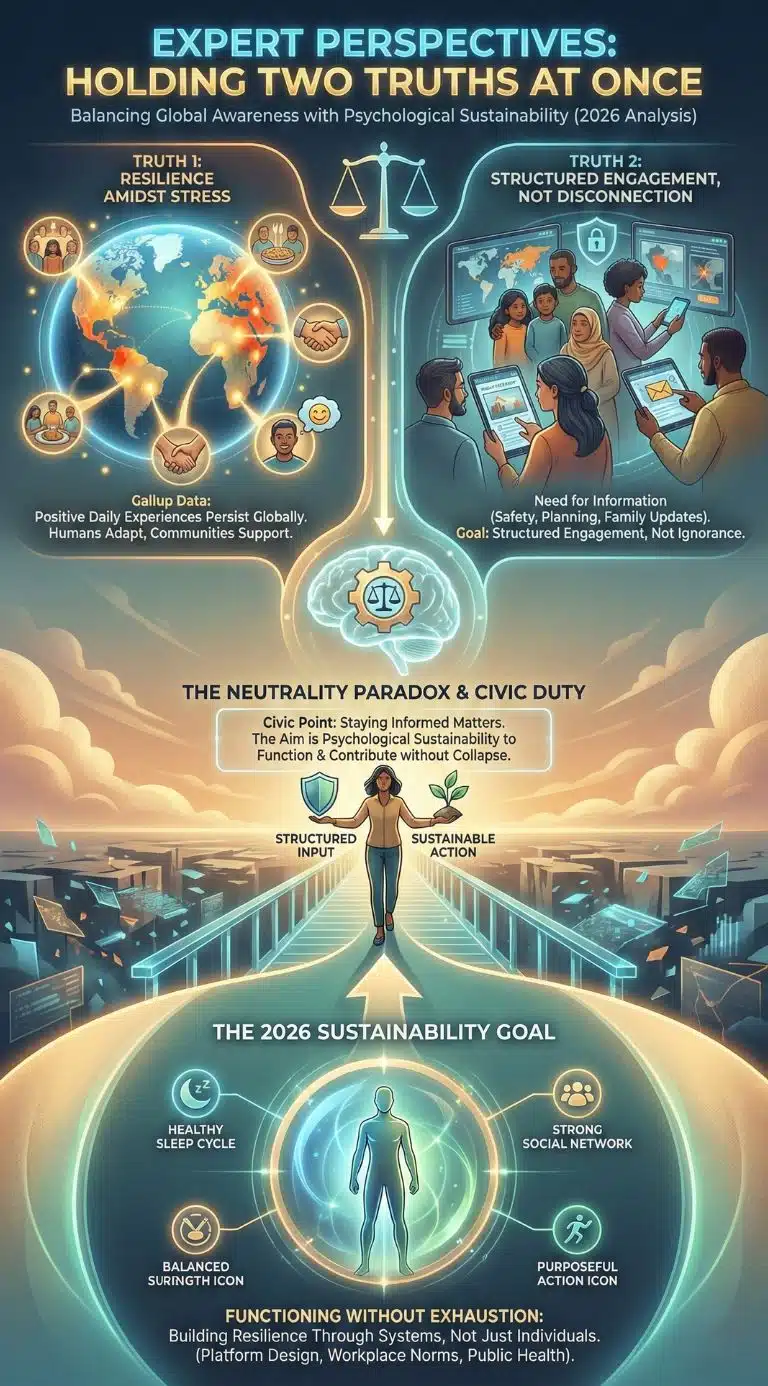
A balanced analysis has to hold two realities.
First: the world is not only getting worse. Gallup’s tracking suggests many positive daily experiences remain high globally even as stress and worry persist. Humans adapt, communities support each other, and many people are not living in constant panic.
Second: telling people to “just log off” can be an incomplete answer. Some readers need news for safety, migration planning, remittances, or family updates in conflict zones. For them, the goal is not disconnection. It is structured engagement.
A third point is civic: staying informed matters. The aim is not ignorance. The aim is psychological sustainability, so people can keep functioning and contributing without collapsing into exhaustion.
What Comes Next: Why 2026 May Intensify The Strain And What To Watch
Conflict analysts are describing a world where fragmentation continues: more internationalized conflicts, higher militarization, and weaker investment in prevention. If that trajectory holds, worry burnout becomes less like a personal problem and more like a public health pattern.
Milestones that are likely to shape mental resilience in the near term:
-
Conflict intensity and spillover risk: more actors involved and more regions pulled in (as flagged in IEP’s 2025 peace briefings).
-
Humanitarian funding stability: funding volatility amplifies suffering and also amplifies helplessness cues globally (as discussed in UNHCR warnings reported in March 2025).
-
Information quality and polarization: IEP has warned that information quality and press freedom have deteriorated even as access improves, which makes it harder to “feel informed” without becoming inflamed.
-
Public emotional climate: Pew’s data shows news consumption often produces anger, sadness, and fear alongside feeling informed, which can sustain activation if not buffered.
The long-term implication is that resilience in 2026 will increasingly depend on systems, not only individuals: platform design, community institutions, workplace norms, and public health messaging that treats chronic uncertainty as a real exposure.
Final Thoughts: The Resilience Shift That Matters Most
Worry burnout is not a failure to cope. It is what happens when the mind uses yesterday’s tools (constant monitoring, constant prediction) on today’s environment (constant threat cues, low control, high ambiguity).
The practical pivot for 2026 is this: stop trying to “finish” the worry, and start trying to structure it. Bound the input. Train uncertainty tolerance. Convert values into action. Rebuild connection. Protect recovery. These are not slogans. They are concrete interventions that return agency to a nervous system living in a fragmented world.