The world of nuclear strategy was thrown into disarray on Thursday following President Donald Trump’s abrupt order to resume U.S. nuclear testing for the first time in 33 years. The directive, posted on social media, has shattered a long-standing global moratorium and left allies and adversaries scrambling to understand its true meaning: Is this a literal return to explosive tests, a dangerous misstatement, or a high-stakes geopolitical gambit?
The order, announced just minutes before a crucial meeting with Chinese President Xi Jinping in South Korea, cites the need to match “other countries testing programs.” However, arms control experts immediately challenged the basis of this claim, pointing out that no major nuclear power has conducted a live nuclear explosion this century.
This investigative article deconstructs the president’s claim, analyzes the multiple, conflicting interpretations of his order, and outlines the catastrophic-level risks of this sudden policy shift.
- The Order: On Oct. 30, 2025, President Trump ordered the “Department of War” (sic) to “start testing our Nuclear Weapons on an equal basis” with rivals, adding the “process will begin immediately.
- The Moratorium: This order directly challenges a U.S. voluntary moratorium on all explosive nuclear tests that has been firmly in place since September 23, 1992.
- The ‘Why’: Trump’s order appears to be a reaction to recent Russian tests of nuclear-powered delivery systems (like the Burevestnik missile), which experts note are not the same as testing nuclear warheads.
- The Ambiguity: It remains critically unclear if Trump is ordering:
- A resumption of live nuclear explosions.
- Tests of delivery systems (like missiles), which the U.S. already does.
- A negotiating ploy to gain leverage over Russia and China.
- Expert Reaction: Arms control experts have near-unanimously condemned the order as “reckless,” “dangerous,” and based on a false premise, warning it could trigger a global chain reaction of testing.
- The Reality: Even if the order is for live explosions, experts assess it would take the U.S. 18 to 36 months and hundreds of millions of dollars to prepare the Nevada Test Site for a scientifically useful test.
A 33-Year Taboo Broken
The bombshell announcement landed on Thursday, Oct. 30, 2025, via a post on President Trump’s Truth Social platform.
“The United States has more Nuclear Weapons than any other country. Russia is second, and China is a distant third, but will be even within 5 years,” he wrote, incorrectly. Because of other countries testing programs, I have instructed the Department of War to start testing our Nuclear Weapons on an equal basis. That process will begin immediately.”
The timing was unmistakable. The post went live just minutes before President Trump sat down with Chinese President Xi Jinping in Busan, South Korea, suggesting to many analysts that the order was, at least in part, a calculated display of strength for a high-stakes trade and security meeting.
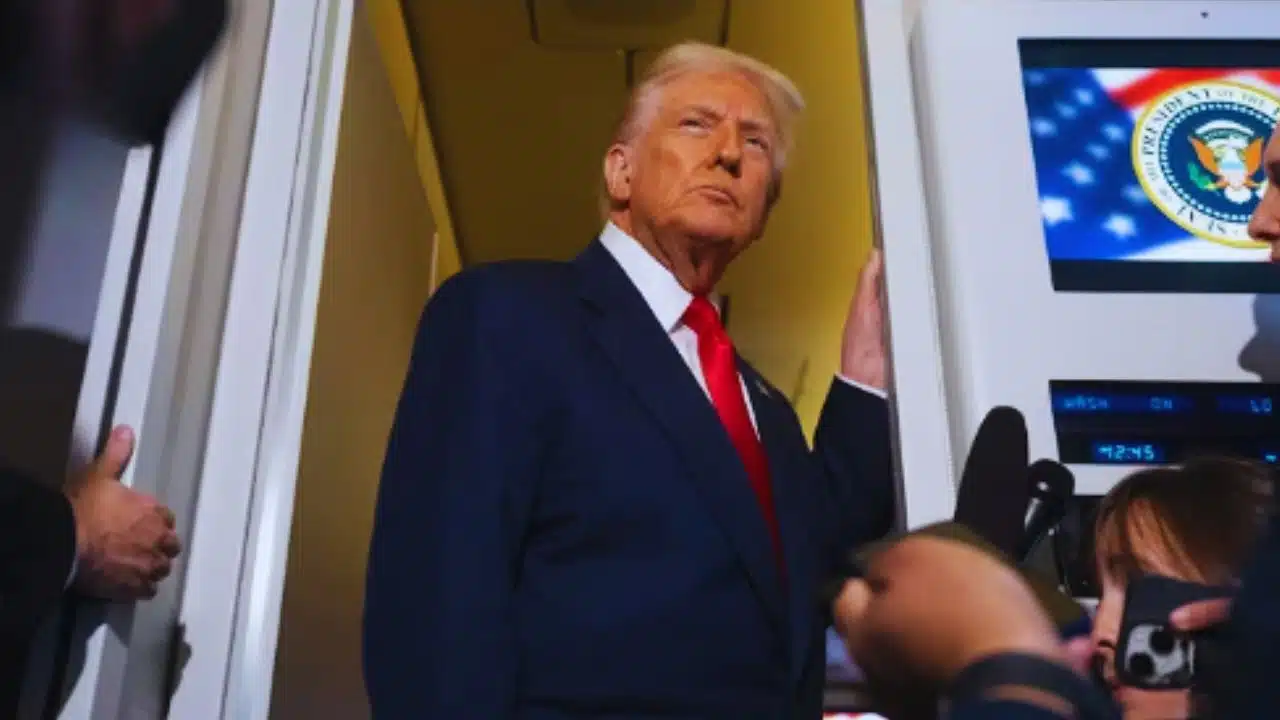
Later, speaking to reporters aboard Air Force One, Trump doubled down, though his comments only deepened the confusion. “I see them testing,” he said, “and I say, ‘Well if they’re going to test I guess we have to test.'”
The problem with this justification, as experts swiftly noted, is that the “testing” he sees is not what he implies.
What Does Trump Mean by ‘Nuclear Testing’?
The president’s order is dangerously ambiguous. His words have sparked a global debate as experts parse three distinct possibilities, ranging from a misunderstanding of terms to a deliberate, world-altering strategic shift.
Interpretation 1: A ‘Dangerous Conflation’ of Terms
The most charitable and, according to many experts, most likely interpretation is that President Trump is fundamentally confusing two different types of “nuclear tests.”
- What Russia is doing: In recent weeks, Russia has conducted high-profile, provocative tests of its new delivery systems, including the Burevestnik nuclear-powered cruise missile and the Poseidon nuclear-powered underwater drone. These weapons use small nuclear reactors for propulsion, giving them near-unlimited range.
- What Trump’s order implies: He is ordering tests of nuclear warheads—the actual explosive detonations that have been banned by global norm since the 1990s.
No major power—not the U.S., Russia, or China—has conducted a live nuclear warhead explosion in decades. (Russia’s last was in 1990, the U.S. in 1992, and China in 1996).
Experts suggest Trump sees the word “nuclear” in Russia’s announcements and assumes parity requires the U.S. to detonate a bomb.
My assumption is he was talking about testing delivery vehicles given that he instructed the Department of War and this is coming in the context of some media coverage about the Russian testing,” said Reid Pauly, an expert on nuclear security policy at Brown University.
Interpretation 2: A Return to Explosive Detonations
The most terrifying interpretation is that the order is literal.
This would mean the U.S. intends to end its 33-year moratorium and prepare the Nevada National Security Site for an underground nuclear explosion. This would be a seismic shock to the global order.
This move would effectively kill the Comprehensive Nuclear-Test-Ban Treaty (CTBT). The CTBT, adopted in 1996, bans all nuclear explosions worldwide. While the U.S. has signed it, the Senate has never ratified it, leaving the U.S. in a state of voluntary, but not legally binding, compliance.
If the U.S. breaks the taboo, there is nothing stopping Russia, China, India, Pakistan, and North Korea from immediately following suit. “If the U.S. started testing nuclear bombs,” Pauly warned, “other states would likely resume explosive testing as well.”
Interpretation 3: A High-Stakes Negotiating Tactic
The third view is that the order is pure political theater—a classic Trumpian negotiating tactic.
By issuing a terrifying, ambiguous order just before meeting President Xi, Trump creates immense leverage. He manufactures a crisis that he can then “solve” by walking back the order in exchange for concessions from China or Russia on trade or arms control.
Trump may want to generate leverage or a strongman impression before negotiating with Xi, whether the topic is trade or nuclear weapons,” noted an analysis from the Center for Strategic and International Studies (CSIS).
The risk of this strategy is that it “lets the genie out of the bottle.” By making the unthinkable (resuming tests) a plausible policy option, he normalizes it, and adversaries may begin their own test preparations, assuming the U.S. is acting in bad faith.
Arsenals, Readiness, and Cost
The president’s order is not only provocative but, in parts, factually flawed and logistically challenging.
The State of the Arsenals
President Trump’s claim that the U.S. has “more Nuclear Weapons than any other country” is incorrect.
- Fact Check: According to the latest 2025 data from monitoring groups like the Stockholm International Peace Research Institute (SIPRI) and the Federation of American Scientists (FAS), Russia possesses the largest stockpile.
- Russia: Approximately 5,489 total warheads (deployed, reserved, and retired).
- United States: Approximately 5,177 total warheads.
- China: A distant third, but growing fast. Its stockpile has reportedly expanded from ~350 in 2022 to over 600 today, with projections it could reach 1,000 by 2030.
The 3-Year Wind-Up to a ‘Real’ Test
The president’s call for the process to “begin immediately” belies the immense logistical, scientific, and financial hurdles. The U.S. nuclear testing complex has been dormant for 33 years.
- Readiness: While the National Nuclear Security Administration (NNSA) is officially tasked with maintaining readiness to test, its definition of “readiness” has been 24 to 36 months.
- Personnel: The scientific and engineering workforce with hands-on experience in conducting live nuclear tests has almost entirely retired. “The personnel issue is a big one… It was not a PowerPoint crowd,” said Paul Dickman, a former federal nuclear official.
- Cost: While a simple “demonstration” test might be faster, a test that yields useful scientific data would take years to prepare and cost an estimated $100 million to $140 million per test.
This means that even if the order is literal, no actual explosion is imminent. The “immediate” action would be the start of a long, expensive, and politically explosive preparation process.
‘Geopolitical Disaster’: Global Reaction and Expert Analysis
The reaction from the arms control community was swift, unified, and scathing.
Official and Expert Condemnation
Daryl G. Kimball, Executive Director of the Arms Control Association, called the order “foolish” and warned it would “trigger strong public opposition… and it could trigger a chain reaction of nuclear testing by U.S. adversaries, and blow apart the nuclear Nonproliferation Treaty.”
Corey Hinderstein, a former NNSA official now at the Carnegie Endowment for International Peace, stated the move was unnecessary. “I think a decision to resume nuclear testing would be extremely dangerous and would do more to benefit our adversaries than the United States,” she said.
The strongest condemnation came from the 2024 Nobel Peace Prize-winning organization, Nihon Hidankyo, a group of Japanese atomic bomb survivors. Its secretary-general, Jiro Hamasumi, said, “The act… absolutely cannot be tolerated.”
The U.S. Policy Divide
The order re-ignites a long-simmering debate within the U.S. defense establishment. For 33 years, the U.S. has relied on the Stockpile Stewardship Program (SSP). This NNSA-run program uses advanced supercomputer modeling, non-explosive “subcritical” tests, and materials science to certify the reliability of the U.S. arsenal without conducting live detonations.
Proponents, including most of the scientific community, argue the SSP is a resounding success and that live tests are not needed.
However, a vocal minority of hardliners, including figures like former National Security Adviser Robert O’Brien and experts at the Heritage Foundation, have argued that 30-year-old test data is insufficient to certify new, modernized warheads. They believe “real-world” data is the only guarantee.
Robert Peters of the Heritage Foundation, while stating a test isn’t needed “right now,” captured the hardline sentiment: “But there could very well be compelling reasons to test in the coming months and years. That’s how bad things are getting.”
The Trump administration appears to be siding with this hawkish minority, with Vice President JD Vance defending the move: “It’s an important part of American national security to make sure that this nuclear arsenal we have actually functions properly, and that’s part of a testing regime.
The world now holds its breath, awaiting clarification from the Pentagon and the Department of Energy’s NNSA (the two agencies that would actually conduct the tests, not the “Department of War”).
- Clarification: The first step is for the administration to clarify what “testing” means. Are they ordering the NNSA to prepare the Nevada Test Site, or are they simply green-lighting more missile-delivery tests? The ambiguity itself is destabilizing.
- Global Reaction: Russia and China, which have been sharply criticized by the U.S. for their own “zero-yield” testing activities and “cheating,” will now feel justified in accelerating their own programs. China’s foreign ministry has already called on Washington to “honor its commitments.
- The Arms Race: Whether the order is real or a bluff, the taboo is broken. The very discussion of resuming tests has ushered in a new, unpredictable era of nuclear brinkmanship, shattering the post-Cold War consensus and pushing the world closer to a new, multi-polar nuclear arms race.
President Trump’s order, whether born of confusion, calculation, or genuine strategic intent, has already changed the global security landscape. The “immediate” process he has begun is one of profound and dangerous uncertainty.
The Information is Collected from ABC News and BBC.