

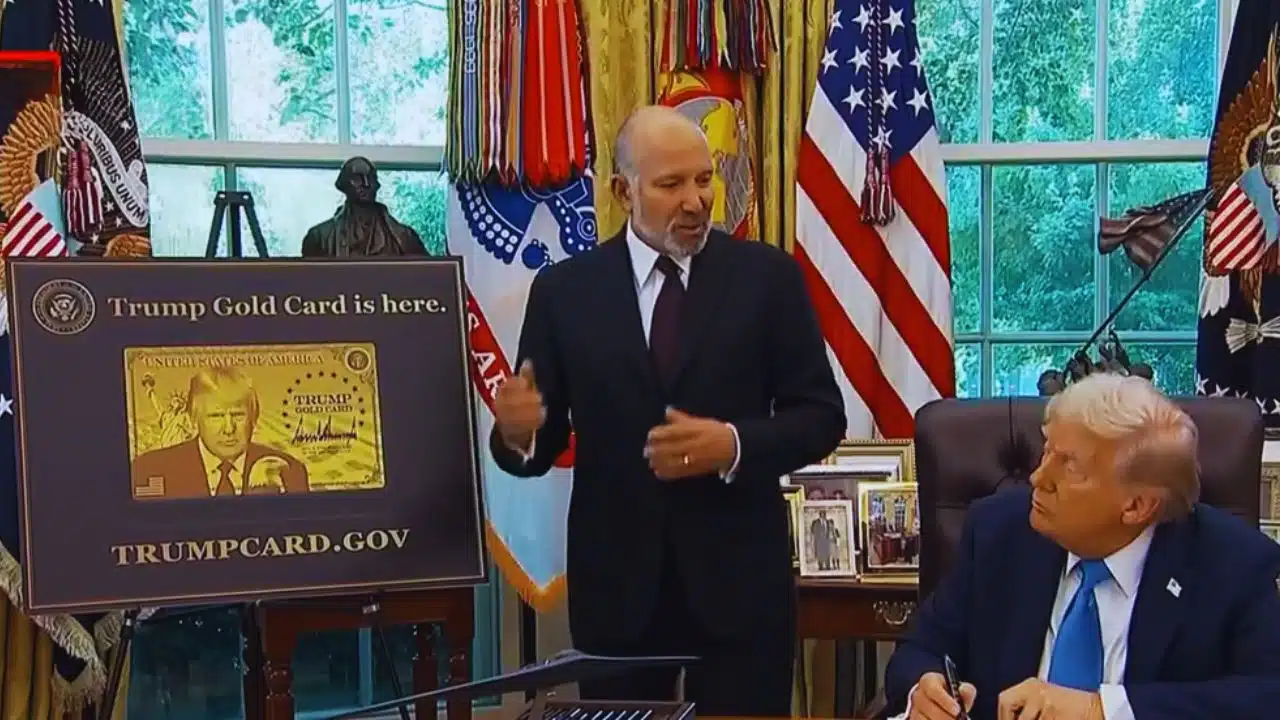
President Donald Trump has signed an executive order that creates a new immigration pathway called the “Gold Card Visa.” The program is designed to provide wealthy foreign nationals with a fast-track route to permanent residency in the United States if they are willing to contribute at least $1 million to the federal government.
The executive order, released on Friday, marks one of the most dramatic changes in U.S. immigration rules in decades. It ties immigration directly to financial contributions, shifting away from existing systems that emphasize exceptional talent, family ties, or job-creation through investment.
On an official website promoting the policy, the message is bold: “The Trump Gold Card is Here.” The mock-up image displayed online features a flashy gold card decorated with an American bald eagle, the Statue of Liberty, Trump’s photo, and his personal signature. The slogan reads: “Unlock life in America.”
How the Gold Card Works
Under the program:
- Individual applicants: Must provide a gift of at least $1 million to the U.S. Department of Commerce.
- Corporate sponsorships: Businesses can sponsor an applicant by contributing at least $2 million on their behalf.
- Government vetting: Every applicant will undergo background checks and vetting by the State Department and the Department of Homeland Security.
- Additional fee: A $15,000 vetting fee will be charged for processing each application.
Once approved, recipients will be granted lawful permanent residency — commonly known as a green card — making them eligible to live, work, and eventually apply for U.S. citizenship.
Commerce Secretary Howard Lutnick explained that 80,000 Gold Cards are expected to be made available. He also stated that this program is set to replace the EB-1 and EB-2 visa categories, which currently allow green cards for individuals with “extraordinary ability” or advanced professional qualifications.
According to Lutnick, the government’s definition of “exceptional ability” has now shifted: “You can prove exceptional value for the United States by contributing $1 million to the United States of America. That’s a pretty good expectation that they’re highly valuable.”
Comparison With Existing Visa Programs
The Gold Card shares similarities with the EB-5 Immigrant Investor Program, which has long provided green cards to foreigners who invest between $800,000 and $1.05 million in U.S. projects that create jobs. But there are important differences:
- EB-5 requires job creation, ensuring the money is invested into businesses that stimulate the economy.
- The Gold Card, by contrast, is a gift — no investment risk, no requirement to create jobs, and no conditions attached.
Critics argue this makes the new system closer to “selling green cards outright” rather than rewarding entrepreneurial contributions.
Platinum Card Proposal: Even Bigger Perks
The Trump administration is also considering an upgraded version of the Gold Card, called the “Platinum Card.”
- It would require a $5 million contribution.
- Holders would be allowed to spend up to 270 days per year in the U.S.
- They would not have to pay U.S. taxes on income earned abroad.
- However, the Platinum Card would not provide a pathway to citizenship.
- Unlike the Gold Card, the Platinum version will require congressional approval before being launched.
According to officials, an online waiting list has already been created for wealthy individuals interested in this future program.
New Restrictions on H-1B Visas

In the same announcement, President Trump signed a second executive order that directly impacts the H-1B visa program — one of the most widely used immigration routes for skilled workers, particularly in the technology sector.
- From now on, new H-1B visa applicants will face an additional $100,000 application fee.
- This fee applies only to future applicants, not those who already hold H-1B visas.
- The H-1B program currently allows foreign professionals to work in the U.S. for up to six years, filling roles in industries like technology, engineering, and healthcare.
Trump has repeatedly criticized the H-1B program in the past, claiming that some companies use it to hire cheaper foreign labor rather than employing American workers. By dramatically raising the cost of applying, the administration signals a major crackdown on the program.
When asked about the likely reaction from big tech companies such as Amazon, Microsoft, and Google, which sponsor thousands of H-1B visas each year, Trump suggested that firms would ultimately be satisfied: “These companies are going to pay a lot of money for that, and they’re very happy about it.”
Potential Consequences and Reactions
Immigration experts and analysts have raised several concerns:
- Equity & fairness – Critics argue that the Gold Card effectively creates a two-tier immigration system: one for the ultra-wealthy who can buy permanent residency, and another for skilled workers and families who face years of waiting.
- Impact on EB-1/EB-2 applicants – Professionals with advanced degrees or extraordinary talents may find their opportunities restricted as those programs are replaced by the Gold Card.
- Global comparisons – Other countries like Portugal, Canada, and Malta offer “golden visa” programs that grant residency to investors. However, those usually involve investment in housing or businesses, not direct gifts to the government.
- Legal challenges – Some immigration lawyers believe parts of the Gold Card order could face court challenges, as changing existing visa categories normally requires legislation by Congress.
At the same time, supporters argue the program will:
- Attract capital inflows into the U.S.
- Simplify the immigration system by reducing bureaucratic hurdles.
- Provide a fresh funding source for government projects.
The Trump Gold Card program represents a fundamental shift in U.S. immigration: it makes wealth the primary qualification for obtaining a green card.
- For $1 million, a foreign national can now fast-track U.S. permanent residency.
- For $2 million, corporations can sponsor candidates.
- A $5 million Platinum Card could offer extended stays and tax exemptions, pending congressional approval.
- Meanwhile, skilled worker visas like the H-1B will now come with a massive financial barrier, changing the landscape for both foreign professionals and American employers.
The program is still in its early implementation phase, and agencies have been given 90 days to finalize procedures. How it plays out in practice — and how the courts and Congress respond — will determine whether the Gold Card becomes a permanent fixture in U.S. immigration or a controversial experiment that triggers legal and political battles.
The Information is collected from CBS News and USA Today.































