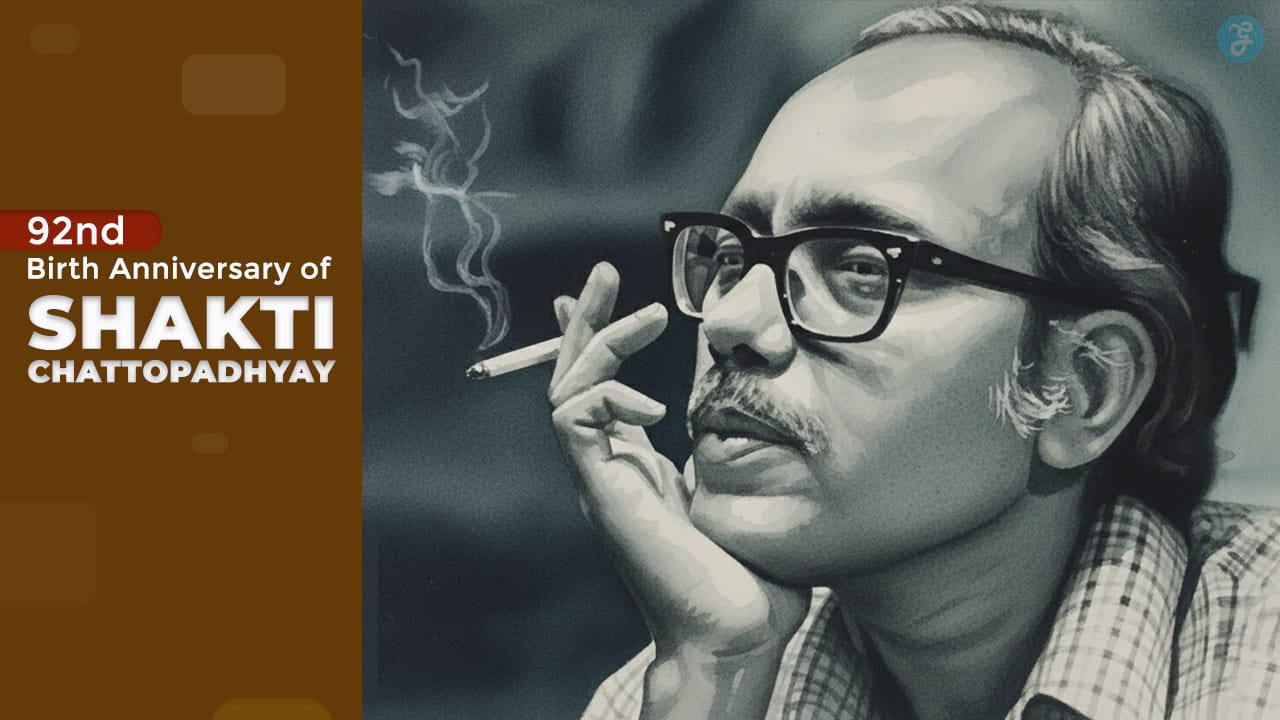
Have you ever picked up a book of Bengali poetry and felt like something was missing? Maybe the words felt too formal. Too distant.
That’s what made Shakti Chattopadhyay different. He wrote poems that felt like real conversations, poems that discussed heartbreak and rainy nights in words anyone could understand. His poetry connected with people because it was honest.
In this post, I’m going to walk you through his journey.
You’ll discover why his role in the Hungry Generation Movement shook up Bengali literature, what made his poems so memorable, and why readers today still turn to his work when they need something real.
Key Takeaways
- Shakti Chattopadhyay co-founded the Hungry Generation Movement in 1961, which challenged traditional Bengali poetry with raw, honest writing that spoke to post-partition disillusionment.
- He wrote approximately 2,500 poems across 45 books during his lifetime, earning the prestigious Sahitya Akademi Award in 1983 for his collection “Jete Pari Kintu Keno Jabo.”
- His iconic poem “Abani Bari Achho” became one of the most celebrated works in modern Bengali poetry for its simple yet profound exploration of longing and home.
- According to research, Shakti was paid just Rs 20 per poem early in his career, yet his work went on to influence generations of Bengali poets.
- His poetry continues to be studied in universities worldwide, with translators like Arunava Sinha bringing his work to English-speaking audiences through collections published as recently as 2024.
What Influenced Shakti Chattopadhyay’s Early Life?
Shakti was born on November 25, 1933, in Baharu village near Jaynagar Majilpur, a quiet town in what is now the South 24 Parganas district of West Bengal.
His childhood was marked by loss early on. He lost his father, Bamanath Chattopadhyay, when he was just four years old. His maternal grandfather stepped in to raise him.
The rural landscape around him left a deep mark. Open fields, winding rivers, and the constant presence of trees became images he would return to again and again in his poems. According to biographical accounts, his rural childhood shaped an initial worldview attuned to nature and everyday struggles, which later informed his literary sensibilities.
In 1948, Shakti moved to Bagbazar in Calcutta and enrolled in Maharaja Cossimbazar Polytechnic School. A teacher there introduced him to Marxism, which influenced his perceptions of class and society. By 1949, the young Shakti had already started Pragati Library and launched a handwritten magazine called Pragati, which later became a printed magazine renamed Bahnishikha.
He passed his Matriculation Examination in 1951. His maternal uncle, a businessman, wanted him to become an accountant and got him admitted to City College to study commerce.
But literature kept calling him back.
In 1953, Shakti passed the Intermediate Commerce Examination but immediately abandoned commerce. He got admitted to Presidency College (now Presidency University, Kolkata) to study Bengali literature with honors. Due to personal and financial constraints, he never appeared for the final examinations. He briefly enrolled in a comparative literature course at Jadavpur University in 1956 but didn’t complete it either.
College life in Kolkata connected him to other passionate writers. He met poets at the famous College Street Coffee House, where the Krittibas magazine circle gathered. Those adda sessions, intense conversations over endless cups of tea, became the breeding ground for new ideas. Friends like Samir Roy Choudhury and, later, Sunil Gangopadhyay, shared his hunger for a different kind of poetry.
His bohemian spirit took root during these years. Freedom mattered more to him than degrees or stable jobs.
Literary Career and Contributions
Shakti Chattopadhyay unexpectedly made a significant impact on Bengali literature.
What was Shakti Chattopadhyay’s role in the Hungry Generation Movement?
In November 1961, Shakti co-founded the Hungry Generation Movement alongside Malay Roy Choudhury, Samir Roychoudhury, and Debi Roy (also known as Haradhon Dhara). These four became known as the Hungryalist quartet.
The movement got its name from Geoffrey Chaucer’s medieval phrase “the sowre hungry tyme.” The founders believed that Bengali culture had reached its peak and was now feeding on outside influences, consuming whatever came its way.
According to Professor Howard McCord of Washington State University, who met the Hungryalists during the 1960s, the movement was “autochthonous” and stemmed from the profound dislocations of Indian life, not from Western beat poets as many believed.
The movement lasted from 1961 to 1965. During those intense years, the Hungryalists challenged everything the literary establishment held dear. They wrote with raw honesty, using street language and explicit imagery that made traditional critics uncomfortable.
Here’s what made their approach revolutionary:
- They rejected the polite, cultured language that dominated 1960s Bengali literature
- They distributed their manifestos on simple paper sheets collected from cafes and streets
- They addressed poverty, hunger, and displacement head-on in their work
- They challenged the Calcutta-centric, bourgeois sense of taste that controlled literary magazines
The establishment fought back hard. Leaders of the movement lost their jobs and faced jail time. Shakti himself later distanced himself from the group amid controversies, even testifying against other members. But by then, the movement had already changed Bengali poetry forever.
The Hungry Generation remains the only major literary movement in Bengal to have such a lasting impact. It provided a platform for subsequent poets, demonstrating the ability of poetry to communicate in the vernacular of the streets.
What are the main themes in Shakti Chattopadhyay’s poetry?
Love appears constantly in Shakti’s poems, but never in the romantic, idealized way you might expect.
His love poetry twists between joy and pain, often on the same page. According to translator Arunava Sinha, who has worked extensively with Shakti’s poems, a longing for the forest, rain, village, garden, trees, and youth is an oft-repeated refrain in his work.
Nature plays a central role. Trees, rivers, rain, and open fields aren’t just backdrops in his poems. They’re characters. The clouds roam like grazing cows. Green grass presses against doors. Rain falls for twelve months straight in his imagery.
His poetry had wanted to “demolish the city with the village, demolish death” according to critic Shankha Ghosh.
Existential despair runs through much of his writing. People search for meaning in a world that often feels empty or cold. Questions about life’s purpose appear in poems like “Jete Pari Kintu Keno Jabo” (I can go, but why should I?), where the speaker hesitates at the threshold of departure.
His poetry also carried a social conscience:
- He critiqued urban decay and the loss of traditional ways of life
- He wrote about poverty and displacement with intimate knowledge
- He raised environmental concerns, earning him recognition as a “green poet.”
- He challenged class hierarchies and the bourgeois literary establishment
What set his style apart was how he broke conventional forms. He used everyday diction, wrote in fragments, and mimicked the rhythm of spoken language. His images linger in your mind: rain-soaked roads, silent homes, and the sound of night knocking at a door.
Through all of it, human struggle stands at the center. Hope tangled with loss. Change is woven into every moment.
What are Shakti Chattopadhyay’s Most Notable Works and Achievements?
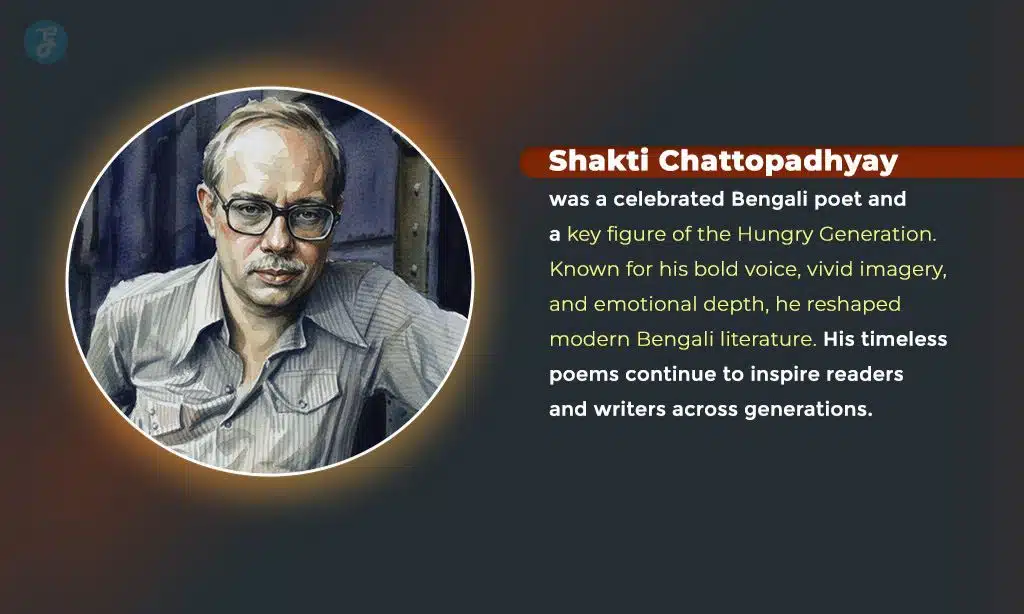
Shakti’s first poetry collection, “Hey Prem, Hey Naishyabda” (O Love, O Silence), was published in 1956. These early poems were written during his time at Chaibasa in the Singbhum district of Bihar (now Jharkhand), where he stayed as a guest of Samir Roychoudhury. There, he fell in love with Samir’s sister-in-law, an experience that transformed him from a novelist into what many call the best lyric poet after Rabindranath Tagore.
His iconic poem “Abani Bari Achho” (Abani, Are You Home?) appears in his 1965 collection “Dhormeo Achho Jirafeo Achho” (You Are in Religion, You Are in Giraffes). This poem is now considered one of the most iconic works in modern Bengali poetry.
Over his career, Shakti wrote approximately 2,500 poems published across 45 books. His prolific output is even more impressive when you know that early in his career, according to published accounts, he was paid a meager sum of Rs 20 per poem.
Here’s a look at some of his most celebrated works:
| Work | Year | Significance |
|---|---|---|
| Hey Prem, Hey Naishyabda | 1956 | The first poetry collection that established his voice is titled “Dhormeo Achho Jirafeo Achho.” |
| Dhormeo Achho Jirafeo Achho | 1965 | Contains “Abani Bari Achho,” his most famous poem |
| Jete Pari Kintu Keno Jabo | 1983 | Won the Sahitya Akademi Award |
In 1983, Shakti received the Sahitya Akademi Award, India’s highest literary honor for individual works, for his poetry collection “Jete Pari Kintu Keno Jabo” (I Can Go, But Why?). The Sahitya Akademi Award comes with an engraved copper plaque, a shawl, and a cash prize, which was Rs 10,000 in 1983.
He also received the prestigious Ananda Puraskar in 1975, recognizing his innovative poetic voice during his mid-career phase. Posthumously, in 1995, he was awarded the Rabindra Puraskar for his contributions to Bengali literature.
Beyond poetry, Shakti wrote novels to make a living. His first novel was “Kuyotala.” He also wrote essays, with his debut essay collection, “Rupkathar Kolkata” (Fairy Tale Kolkata), published in 1965 under the pseudonym Rupchand Pakshi.
From 1970 to 1994, he worked as a journalist with Ananda Bazar Patrika. He joined Visva Bharati University as a visiting professor after retiring.
His work has been translated into English by renowned translators. Arunava Sinha’s translation collection “Very Close to Pleasure, There is a Sick Cat” (published in 2024) comprises 123 poems handpicked from over thirty poetry collections, bringing Shakti’s voice to readers who don’t speak Bengali.
How Did Shakti Chattopadhyay Impact Bengali Literature and What is His Legacy?
Shakti Chattopadhyay changed how Bengali poetry sounded and what it could say.
Before him, much of Bengali poetry followed established patterns. After him, younger poets felt free to write in the language people actually spoke. According to literary scholars, his realistic portrayals of rural life and everyday struggles exerted significant influence on Bengali poets emerging after the 1970s, shifting the literary landscape toward more vivid, unrefined expressions of human experience.
Poet Subhash Mukhopadhyay placed Shakti in a direct line of descent from Jibanananda Das. While Jibanananda helped restore Bengali poetry to its mainstream after Rabindranath Tagore, Shakti carried on that tradition of pure poetry, pushing it in bolder, more experimental directions.
His approach opened new possibilities:
- He proved that poetry could use everyday words and still be powerful
- He showed that rural imagery and urban themes could coexist in the same poem
- He demonstrated that a poet could write about environmental crisis and personal heartbreak with equal intensity
- He made it acceptable to be honest about poverty, drinking, and the messy reality of life
The famous line from one of his collaborative poems, “Moddhorate Kolkata shashon kore charjon jubok” (In midnight, Kolkata is ruled by four young men), became iconic for an entire generation of poets. Along with Sunil Gangopadhyay, he formed what people called “Sunil-Shakti” due to their friendship and creative partnership.
His academic legacy continues to grow. Dr. Kuntal Chattopadhyay, Associate Professor in English at Narasinha Dutt College and Guest Faculty in the Department of Bengali at the University of Calcutta, completed his doctoral research on Shakti’s poetry. The thesis was published as a book titled “Mrityur Pareo Jeno Hete Jete Pari”: Shakti Chattopadhyayer Kavita (Bishay, Prasanga O Prakaran).
Today, universities across Bengal include his poems in their curricula. Literary magazines still debate his techniques and themes. The Paschimbanga Bangla Akademi recognizes him as a transformative figure who helped shape modern Bengali literature.
His influence spread beyond Bengal, too. The Hungry Generation Movement inspired similar experimental approaches in Hindi, Marathi, Assamese, and Urdu literature in the 1960s.
Contemporary poets continue to draw inspiration from his work. Young writers find courage in his example, knowing that he dared to write differently first. His poems appear in translation collections published by international presses, introducing new readers to his distinctive voice.
Takeaways
Shakti Chattopadhyay’s poetry still speaks to us because he never tried to sound like anyone else. He wrote about rain and rivers, about love that hurts, about villages left behind and cities that feel cold.
His legacy lives on in every poet who chooses honest words over fancy ones.
When students flip through collections like “Hey Prem” or “Abani Bari Achho,” they’re meeting a poet who understood that the best poetry comes from telling the truth. His verses carry bold ideas, deep feelings, and yes, sometimes a splash of humor that makes you smile even when your heart aches.
If you haven’t read Shakti yet, start with “Abani Bari Achho.” Let his words knock at your door like the night itself.
FAQs on the Legacy of Shakti Chattopadhyay
1. What made Shakti Chattopadhyay stand out as a Bengali poet?
Shakti revolutionized Bengali literature by blending profound urban alienation with lyrical romanticism, a style immortalized in his famous line “Abani, বাড়ি আছো.” His collection “He Prem, hey naishyabda” introduced a raw, confessional voice that shattered the formal boundaries of the time to speak directly to the reader’s heart.
2. Did Shakti Chattopadhyay write any novels?
Yes, beyond his poetry, he authored notable prose like the novel Kuyotola, bringing his signature intensity and lyrical flair to storytelling.
3. What was Shakti’s early life like before he became famous?
After passing his matriculation examination in 1949, he immersed himself in Calcutta’s literary world and helped launch the influential magazine এবং কৃত্তিবাস. Peers often recall that when they first met Shakti, he already exuded the restless, bohemian energy that would fuel his legendary career.
4. Why do readers still love Shakti’s work today?
His poetry cuts through the noise of modern life because he transformed his personal chaos into universal truths about love, loss, and loneliness. Readers connect with him not just as a poet but as a flawed, honest companion who articulates the feelings they often struggle to express.