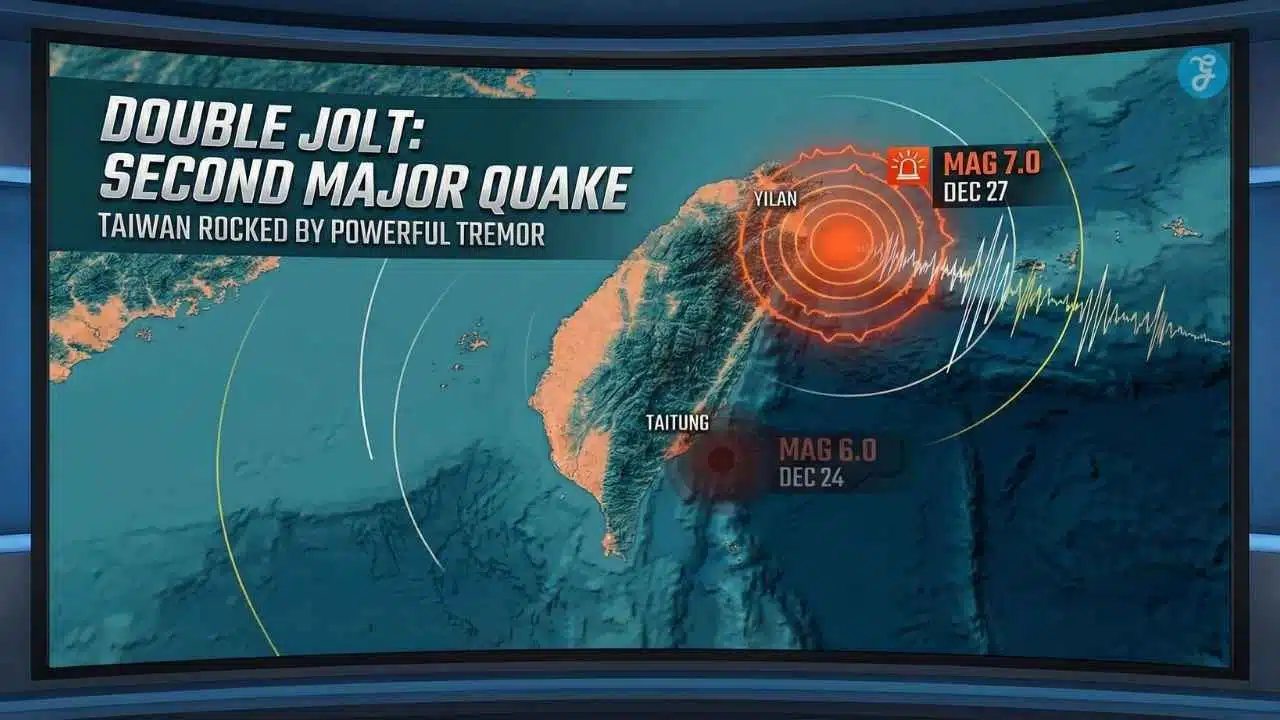
A powerful Taiwan Earthquake Magnitude 7.0 struck the northeastern coast late Saturday night, marking the second significant seismic disturbance to rock the island in less than a week. The tremor, which hit at 11:05 PM local time, sent residents across Taipei and the northern counties rushing into the streets, reviving memories of past disasters in this seismically active nation. While the magnitude was alarmingly high, the deep origin of the quake appears to have spared the island from catastrophic damage, though authorities remain on high alert for aftershocks.
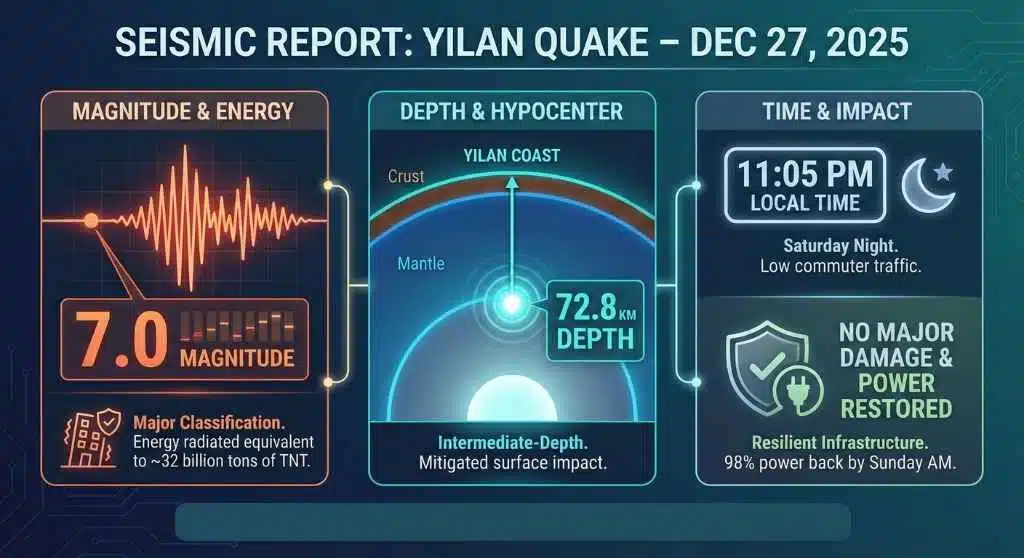
The epicenter was located approximately 32.3 kilometers east of Yilan County Hall, nestled in the Philippine Sea, with a focal depth of 72.8 kilometers. This “intermediate depth” is being credited by seismologists as the primary reason why a quake of such ferocity, capable of leveling cities if it were shallower, resulted in relatively minor structural damage.
However, coming just days after a shallow magnitude 6.0 quake in the south, the “double jolt” has reignited urgent conversations about disaster preparedness and the vulnerability of the global tech supply chain rooted on this island.
Key Takeaways
-
Event Summary: A magnitude 7.0 earthquake struck offshore Yilan on Dec 27, 2025, at a depth of 72.8 km.
-
Double Impact: This was the second major quake in one week, following a Mag 6.0 event in Taitung on Dec 24.
-
Economic Resilience: TSMC and Hsinchu Science Park operations remain stable; global chip supply is unaffected.
-
Safety Status: No major casualties reported. Power and transport networks are fully operational after brief inspections.
-
Forecast: Residents should remain alert for Mag 5.5+ aftershocks over the next 48-72 hours.
The “Double Jolt”: A Week of Seismic Anxiety
For the 23 million residents of Taiwan, this week has been a test of nerves. The psychological toll of two major earthquakes occurring within a 96-hour window cannot be overstated. While Taiwan is no stranger to the “Ring of Fire,” the distinct characteristics of these two events highlight the complex geological reality of the region.
The week began with a sharp shock on Wednesday, December 24, when a magnitude 6.0 earthquake struck Taitung County in the southeast. That event was a shallow crustal quake, occurring at a depth of just over 10 kilometers. Shallow quakes are typically more violent at the surface, feeling like a sudden, jarring punch. In contrast, Saturday’s magnitude 7.0 event in Yilan was a deep-subduction event. Residents in Taipei reported a rolling, nauseating motion that lasted for nearly a minute, a classic signature of deep seismic energy waves traveling through the lithosphere.
Comparative Analysis: The Two Quakes of December 2025
| Feature | Wednesday Event (Dec 24) | Saturday Event (Dec 27) |
| Magnitude | 6.0 (Revised) | 7.0 (CWA Estimate) |
| Location | Taitung (Southeast Coast) | Yilan (Northeast Coast) |
| Depth | ~11.9 km (Shallow) | 72.8 km (Intermediate/Deep) |
| Sensation | Sharp, violent jolts near the epicenter | Long, rolling sway felt island-wide |
| Primary Risk | Localized structural failure | High-rise swaying, dizziness, panic |
| Tectonic Cause | Crustal fault adjustment | Plate Subduction (Philippine Sea Plate) |
The juxtaposition of these two events serves as a grim reminder of Taiwan’s geographic destiny. The Central Weather Administration (CWA) has noted that while statistical clusters do happen, the energy release from two opposite ends of the island suggests a broader stress adjustment along the plate boundary. This “pincer movement” of seismic activity—south first, then north—has prompted the CWA to issue a specific advisory for seismic alerts covering the entire upcoming week.
Economic & Infrastructure Impact: The Global Pulse
Whenever the ground shakes in Taiwan, the tremors are felt financially in Silicon Valley, Tokyo, and Beijing. The island produces the vast majority of the world’s most advanced semiconductors, making its seismic stability a matter of global economic security.
Semiconductor Industry Status: TSMC Stands Firm
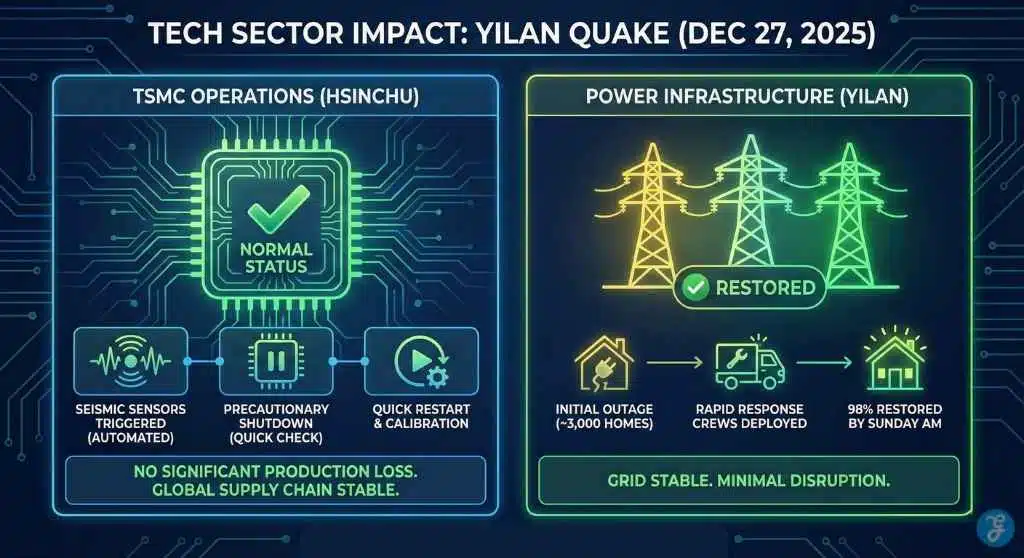
The Hsinchu Science Park, often dubbed the “Silicon Shield” of Taiwan, was rattled by the magnitude 7.0 quake. TSMC (Taiwan Semiconductor Manufacturing Company), the crown jewel of the industry, immediately activated its automated safety protocols.
According to official statements, several fabrication plants (fabs) detected seismic accelerations that exceeded the standard operational threshold. This triggered an automatic shutdown of sensitive lithography machines and a “Code Yellow” evacuation for non-essential staff.
-
Evacuation Status: Staff in cleanrooms were briefly evacuated to assembly points.
-
Damage Assessment: Initial inspections conducted between 12:00 AM and 4:00 AM Sunday confirmed that the infrastructure integrity of the fabs remained uncompromised.
-
Production Impact: While some “wafers in progress” may have been damaged due to the sudden halt, a common occurrence during quakes, TSMC has assured clients that total production loss is negligible. The calibration of extreme ultraviolet (EUV) lithography machines, which can be thrown off by mere nanometers, is currently being finalized.
This resilience is not accidental. Following the devastating 1999 Chi-Chi earthquake, Taiwan’s tech sector invested billions in dampers and base-isolation technologies. A magnitude 7.0 earthquake that might cripple industry elsewhere is, for TSMC, a managed operational hazard.
The “Golden 10 Seconds”: Anatomy of an Alert
One of the few bright spots in this week’s seismic anxiety has been the performance of Taiwan’s Public Warning System (PWS). For millions in the Taipei metropolitan area, the warning siren on their mobile phones screamed approximately 10 to 12 seconds before the primary shear waves (S-waves) arrived.
-
How it worked: The P-waves (faster, non-damaging) were detected by sensors in Yilan. Algorithms instantly calculated the epicenter and magnitude, beaming a “Presidential Alert” to cell towers in Taipei (approx. 40–60 km away) faster than the damaging S-waves could travel through the earth.
-
The Result: This brief window—known locally as the “Golden Seconds”—allowed the Taipei Metro to automatically brake trains and gave residents just enough time to Drop, Cover, and Hold On. It is a stark improvement from earlier systems and likely prevented injuries in the capital’s swaying high-rises.
Local Economy: The Chill After the Quake
While the semiconductor giants in Hsinchu remained unscathed, Yilan’s local economy faces a harder recovery. The county is Taiwan’s premier domestic tourism destination, famous for the Jiaoxi Hot Springs and the scenic Suhua Highway.
-
Tourism Dip: Hotel operators in Jiaoxi reported a wave of cancellations for the New Year holiday weekend immediately following the Saturday night quake.
-
Infrastructure Concerns: Although the Suhua Highway remains open, drivers are wary of rockfalls—a common post-quake hazard. Local officials are urging the central government to issue “safety vouchers” or subsidies to reassure tourists and prevent a long-term slump in the region’s hospitality sector, which relies heavily on weekend traffic from Taipei.
Public Utilities and Transport
The immediate aftermath in Yilan saw approximately 3,000 households plunged into darkness as safety breakers tripped at local substations. The Taiwan Power Company deployed emergency crews almost immediately. By 6:00 AM Sunday, power outage restoration was effectively 98% complete, with only isolated pockets in mountainous areas awaiting repair.
Transportation networks faced a chaotic Saturday night. The Taipei Metro (MRT) automatically suspended service as sensors detected the P-waves (primary waves) of the quake. Thousands of commuters were stuck in tunnels or on elevated platforms for roughly 45 minutes while engineers walked the tracks to check for misalignments. Similarly, the High-Speed Rail (THSR) halted all north-bound and south-bound trains. As of Sunday morning, all “Green Light” signals have been given, and services have resumed normal schedules.
Scientific Context: The Tectonic Battleground
To understand why this Taiwan Earthquake of Magnitude 7.0 occurred, one must look deep beneath the ocean floor. Taiwan is an orogenic island formed by the collision of the Philippine Sea Plate and the Eurasian Plate.
The Subduction Zone Mechanism
Saturday’s quake in Yilan is a textbook example of a subduction zone earthquake. In northeastern Taiwan, the Philippine Sea Plate is subducting (diving) under the Eurasian Plate. As the plate is forced deeper into the Earth’s mantle, immense friction builds up. When that friction is overcome, the plate slips, releasing energy in the form of seismic waves.
The depth of 72.8 km places this earthquake in the “Wadati-Benioff zone”—a dipping planar zone of earthquakes that defines the motion of the subducting plate.
Why Depth Matters
If this magnitude 7.0 earthquake had occurred at a depth of 10 km (like the 1999 Chi-Chi earthquake), the energy would have reached the surface with terrifying intensity, likely causing widespread building collapses in Yilan and Taipei. Because it originated nearly 73 km down, the rock layers above absorbed a significant portion of the high-frequency energy. What reached the surface were mostly low-frequency waves, which are responsible for the “swaying” motion that sickens people but rarely destroys well-built low-rise structures.
The Ring of Fire Connection
This event is part of a broader uptick in activity along the western edge of the Ring of Fire. Seismologists have observed that when major stress releases occur in one section of the plate boundary (like the Philippines or Japan), it often transfers stress to adjacent segments. The December 24 Taitung quake may have been a precursor, adjusting the stress field in a way that “unlocked” the deeper fault segment off Yilan three days later.
Beyond Borders: Regional Impact
The seismic energy released by Saturday’s magnitude 7.0 earthquake did not stop at Taiwan’s shores. The event triggered immediate alerts across the East China Sea, highlighting the interconnected geological fate of the region.
Japan: The View from Yonaguni
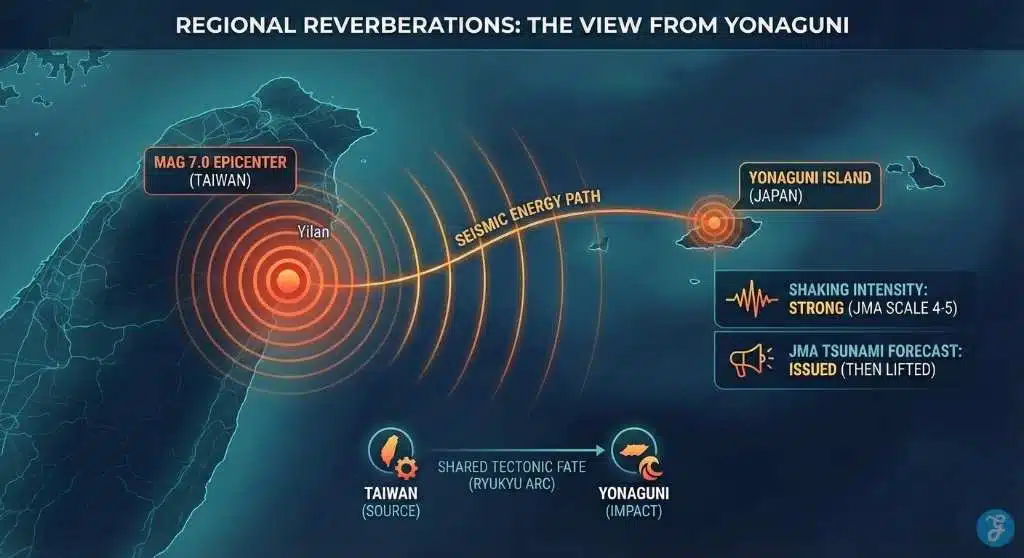
The tremor was not confined to Taiwan’s borders. Just 111 kilometers east of the epicenter lies Yonaguni Island, Japan’s westernmost point. The Japanese Meteorological Agency (JMA) immediately issued a tsunami forecast for the Okinawa region, though it was later lifted.
Residents on Yonaguni, who can see the mountains of Taiwan on a clear day, reported violent shaking comparable to that felt in Yilan. This shared tectonic fate highlights a critical but often overlooked reality: the Ryukyu Arc and Taiwan’s fault lines are inextricably linked. Disaster management officials in Okinawa and Yilan have increasingly coordinated on data sharing, knowing that a massive rupture in one jurisdiction instantly endangers the other.
China: Tremors in Fujian & Rail Delays
Across the Taiwan Strait, the shockwaves were felt distinctly in the Chinese coastal provinces of Fujian and Zhejiang.
-
Felt Reports: Social media platforms Weibo and WeChat were flooded with reports from residents in Fuzhou, Xiamen, and Quanzhou who felt their high-rise apartments swaying.
-
Rail Disruption: In line with standard safety protocols, China Railway Nanchang Group temporarily suspended several high-speed train services running along the Fujian coast to inspect tracks for deformation. Operations have since resumed, though speed restrictions remained in place on some segments throughout Sunday.
The Philippines: Northern Watch
While the epicenter was further north, the Philippine Institute of Volcanology and Seismology (PHIVOLCS) issued a brief advisory for the Batanes Group of Islands. No evacuation was ordered, but coastal communities were advised to monitor sea levels for unusual activity.
Safety Outlook: What Comes Next?
The Central Weather Administration (CWA) has been transparent but cautious in its forward-looking statements. The Director of the Seismological Center stated in a press briefing Sunday morning that aftershock warnings are in effect for the next three days.
Forecast:
-
Probability: There is a high probability of aftershocks ranging from Magnitude 5.5 to 6.0 within the next 48 hours.
-
Location: These are likely to be clustered near the epicenter off the Yilan coast.
-
Risk: While these aftershocks are unlikely to cause new structural damage, they could dislodge items in buildings already weakened by the main shock.
Building Codes: The Silent Savior
The limited damage from a Magnitude 7.0 event is a testament to Taiwan’s rigorous building codes, which were overhauled after 1999 and again after the 2016 Tainan earthquake. Modern buildings in Taipei are designed with “strong columns, weak beams” concepts, allowing the building to flex and crack without collapsing. The fact that the Taipei 101 skyscraper, once the world’s tallest, merely swayed gracefully (aided by its famous tuned mass damper) is proof of this engineering success.
Public Advisory
Residents are advised to check their homes for “X-cracks” on walls (a sign of shear damage) and to secure heavy furniture. The CWA also warns that heavy rainfall predicted for Yilan early next week could combine with the loosened soil from the quake to create a risk of landslides in the mountainous Su-Hua Highway region.
Beyond the Shaking: Living with the Fault Lines
The Taiwan Earthquake Magnitude 7.0 will likely be recorded in history as a “lucky miss.” It possessed the raw power to devastate, but its deep geological origin shielded the island from the worst-case scenario. However, coming on the heels of the Taitung quake, it serves as a wake-up call. The island’s seismic defenses, from the TSMC evacuation status protocols to the rapid power outage restoration by utility crews, performed admirably, but the geological pressure cooker beneath Taiwan remains active.
As the island returns to work on Monday, the focus shifts from rescue to resilience. With the Philippine Sea Plate continuing its inexorable march northwest, the question is not if the next big one will hit, but when, and whether the next one will be quite so mercifully deep.