We are witnessing the slow, quiet death of the romantic monopoly. For decades, we bought into a singular myth. We expected one person to be our lover, our co-parent, our financial advisor, and our only emotional anchor. It was a tall order. By 2026, that traditional marriage contract is suffocating under its own weight. It asks too much of two people and offers too little resilience when the spark inevitably dims. As a result, the search for a Platonic Life Partner has moved from the fringes of social experiment to the centre of our economic survival.
The mainstream narrative suggests we are living through a “loneliness epidemic” caused by a breakdown in traditional values. This is a surface-level misreading. The public sees a decline in marriage rates and assumes a decline in connection. They are missing the structural upgrade. We are not becoming more isolated; we are becoming more strategic. People are decoupling long-term security from their sex lives to build something far more durable. We are moving back to a model of kinship that looks like the pre-industrial extended family, but with one major difference: we are choosing our tribe based on character rather than blood or rings.
The old world gave us a binary choice. You were either “involved” or you were a stranger. This left a massive, empty space where our most stable bonds actually live. Today, that gap is being filled by the cross-gender best friend. This is the person who sits in the hospital waiting room while your latest dating app match is still ghosting your texts. The shift is about diversifying our emotional portfolio. When you stop asking a romantic partner to be your entire world, you actually start living in a bigger one. This is the year we admit that the person who shares your mortgage does not have to be the person who shares your bed.
The Market Resilience of the Platonic Life Partner
Consider Sarah, 34, and Anubhav, 35. They live in a sunlight-starved townhouse in the heart of a vertical city. Their lives are a complex weave of shared property taxes and a joint savings account earmarked for a leaking roof. They are each other’s healthcare proxies. They know the exact temperature the other likes their tea and the specific silence required after a bad day at the office. To a casual observer, they are a settled, domestic couple. To the bank, they are a high-functioning economic unit.
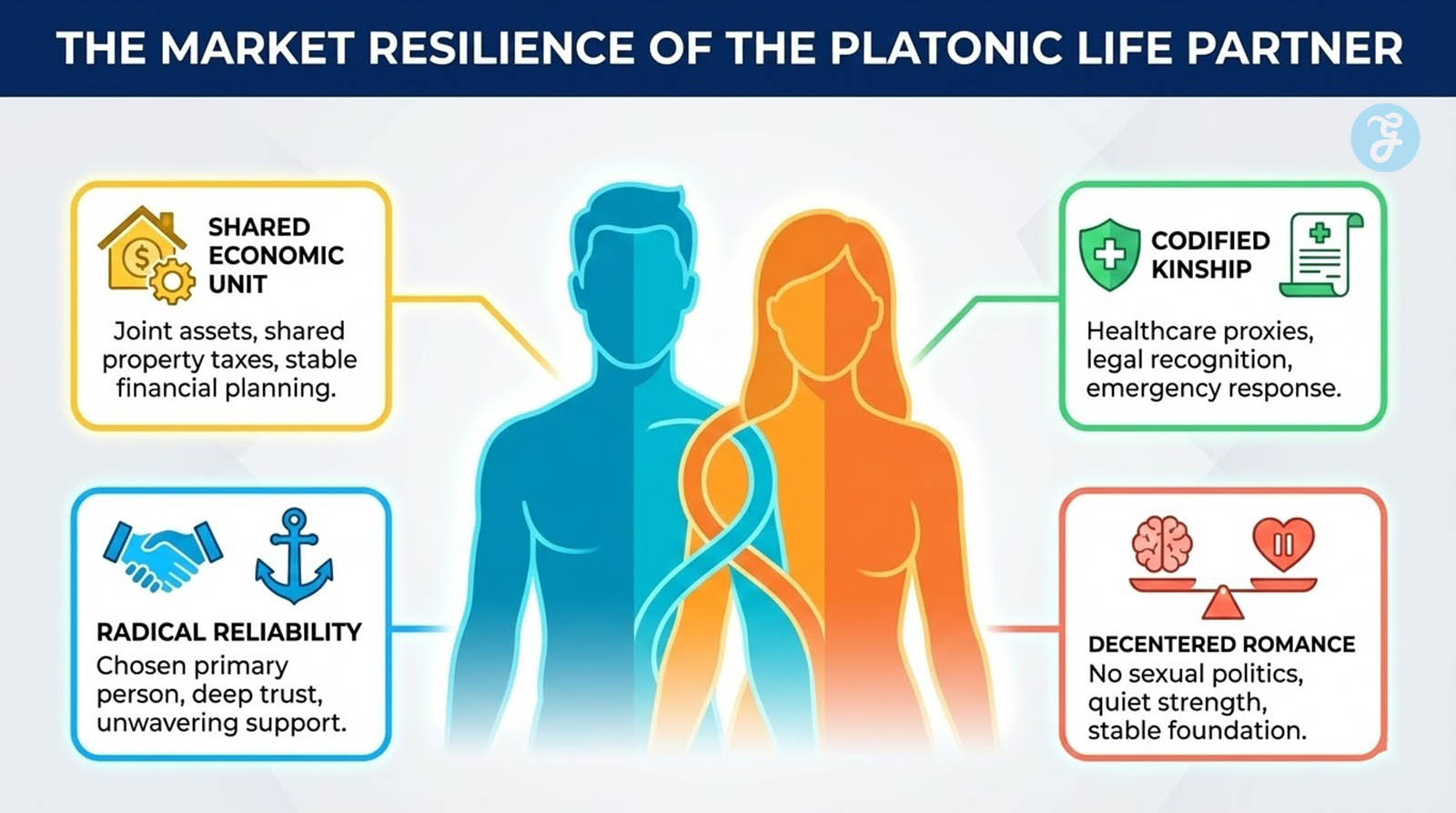 But there is no romantic spark to maintain. No anniversary to dread. No sexual politics to navigate. They have never been on a date, and they never will. Their intimacy is built on the radical reliability of the Platonic Life Partner. It is a commitment rooted in the “Primary Person” model. While the world outside chases the dopamine hits of swipe-right culture, Sarah and Anubhav have opted for the quiet strength of a grounded friendship. They are the new architects of the home, proving that you can build a life on a foundation of trust without the volatility of a bedroom.
The true weight of this bond was tested during a cold midnight in early 2026. When Sarah collapsed from a sudden medical complication, it was Anubhav who navigated the frantic bureaucracy of the ER. He did not just wait in the hallway. He knew her blood type, her allergies, and exactly which insurance clause would cover the private room. He managed the recovery and the grocery runs. He was the person who stayed when the adrenaline wore off. In that hospital room, the old social hierarchy dissolved. A romantic interest might have felt the pressure to perform or the fear of a long-term burden. A sibling might have lived three time zones away. But Anubhav was there because he is her chosen kin.
The Longevity of the Boring Bond
There is a strange irony in how we manage our lives. We plan our careers with cold precision. We hedge our investments. We buy insurance for our cars and our homes. Yet, for the most part, we leave our basic survival to the most volatile force in the human experience: romantic passion. We build our entire domestic infrastructure on the “spark.” When that spark inevitably flickers or fades, the whole house comes down. By 2026, we are seeing the cost of this fragility. Couples split, assets are liquidated, and emotional trauma is compounded by sudden housing instability. It is a high-risk gamble that fewer people are willing to take.
This is the central paradox of modern intimacy. We have been taught to trust our hearts more than our heads. We view romance as the only “serious” form of commitment. But romance is often seasonal. It is prone to the shifting winds of desire and ego. A Platonic Life Partner, by contrast, offers a kind of durability that passion simply cannot match. This bond is built on the quiet, steady rhythm of shared values and mutual reliance. It is the “boring” consistency that keeps a life together. While a marriage might buckle under the pressure of sexual boredom or a mid-life crisis, a platonic partnership thrives in the mundane.
In a traditional marriage, sexual fidelity is often the single point of failure. If that pillar collapses, the legal and financial walls usually follow. The platonic model removes that vulnerability. Because there is no expectation of sexual exclusivity, there is no threat of betrayal ending the domestic arrangement. It is a relationship that survives the lulls. It is an anchor that stays dropped even when the emotional weather turns cold. We are moving toward a period where people value a steady hand over a racing pulse.
The next five years will see a massive rebranding of the “best friend.” We will stop seeing these ties as secondary. Instead, they will become the primary hedge against an unpredictable economy. When you stop asking your partner to be your everything, you give them the space to be exactly what you need: a reliable co-pilot. This isn’t about a lack of love. It is about a more sophisticated kind of love. It is the realisation that the most stable relationships aren’t the ones that set the world on fire. They are the ones that keep the lights on.
The Biological Safety Net of the Best Friend
The numbers finally tell the story we have been feeling for years. We are living through a massive recalibration of the human household. Recent estimates from the U.S. Census Bureau show a historic milestone: only 47.1% of households in the United States are headed by married couples, meaning the traditional nuclear family is now a minority. This is not a sign of social decay. It is a sign of a society finding new ways to stay together. We are seeing a shift where the Platonic Life Partner is becoming the new anchor of the domestic world.
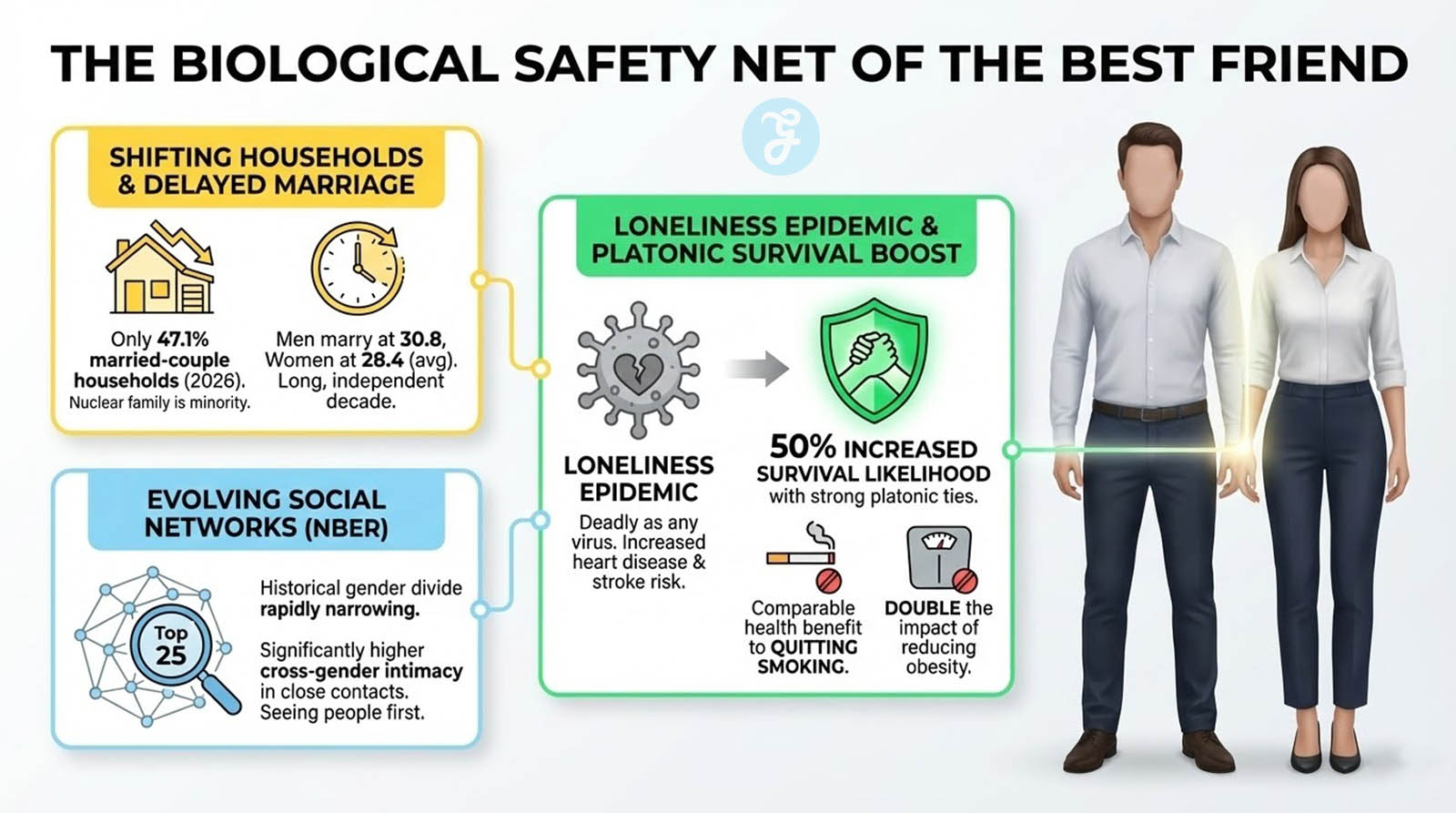
The clock has slowed down. Men are now waiting until an average age of 30.8 to marry. Women are waiting until 28.4. This creates a long, independent decade. During these years, we don’t just sit in a waiting room for a spouse. We build lives. We buy furniture. We navigate career pivots. Most importantly, we form deep, cross-gender friendships that serve as our primary support systems. By the time a romantic partner arrives, they aren’t filling an empty slot. They are walking into a pre-existing framework of care. They have to integrate into our friendships, rather than replace them.
A National Bureau of Economic Research working paper analysing 1.38 trillion social ties across global social networks highlights how our relationship patterns are shifting, revealing that the historical gender divide within our closest circles is steadily narrowing. While we aren’t entirely gender-blind yet, the Cross-Gender Friending Ratio shows a distinct evolution. Within our “Top 25” closest contacts, cross-gender intimacy is significantly higher than in our peripheral networks. We are increasingly stripping away the purely predatory or romantic lenses through which we historically viewed the opposite sex, choosing instead to see each other as people first. This structural shift in how we connect is the engine behind the new stability we see in platonic partnerships.
There is also a biological reality at play here. We are currently facing a global loneliness epidemic linked to increased risks of heart disease, stroke, and early mortality. Isolated people are more likely to suffer from heart disease and stroke. However, the data shows that strong platonic ties lead to a 50% increased likelihood of survival. That is a health benefit comparable to quitting smoking. It is double the impact of reducing obesity. Our bodies do not care if the person supporting us is someone we sleep with. They only care that someone is there.
The Structural Evolution of Commitment
| Metric | The 20th Century Model | The 2026 PLP Model |
| Primary Anchor | Romantic Marriage | Platonic Life Partnership |
| Stability Driver | Sexual Fidelity | Shared Values & Reliability |
| Household Focus | Nuclear Family | Chosen Kin & Dual-Primary Suites |
| Legal Status | Marriage Certificate | Bespoke Contracts & Trusts |
| Health Impact | Married “Health Premium” | 50% Survival Rate Increase |
| Economic Unit | Single-Earner / Joint Spousal | Multi-Stakeholder Kinship |
The New Kinship Economy
The market is finally waking up to the fact that two salaries are better than one, even without a marriage certificate. Some real-estate developers are beginning to design housing that moves beyond the traditional nuclear-family layout. We are seeing a surge in “Dual-Primary” suites. These are homes built with two equal master bedrooms, separated by neutral living spaces. They are designed for friends who want to build equity together without fighting over who gets the smaller wardrobe. This is the Kinship Economy in action. It is a pragmatic response to a housing market that has priced out the solo buyer.
The legal world is also playing catch-up. For a long time, the law was blind to any bond that did not involve blood or a ring. That is changing. In 2026, legal advocates globally are pushing to codify ‘Domestic Stability’ in non-romantic households. While statutory law still heavily favours marriage, citizens are increasingly bypassing these outdated systems. They are utilising corporate structures, co-ownership agreements, and bespoke trusts to secure the inheritance and property protections once exclusively reserved for spouses. This shift acknowledges that a Platonic Life Partner provides the same societal value as a traditional husband or wife. They offer stability. They pay taxes. They keep each other off the streets.
This shift is a response to a looming global care crisis. Birth rates are plummeting. The traditional safety net of “having children to look after you” is fraying. As we age, the question of who will hold the power of attorney becomes urgent. In this new landscape, the chosen family is the ultimate fallback. Friends are stepping into the roles that children or spouses once occupied. They are becoming the primary caregivers for an ageing population that refuses to spend their final years in isolation.
We are moving toward a world where the state and the market value the quality of the commitment over the nature of intimacy. It is a win for common sense. When we allow friends to share the same legal and economic benefits as married couples, we make the entire social structure more resilient. This is not about devaluing marriage. It is about valuing the bonds that actually hold our communities together.
The Deep Logic of the Gender-Fluid Bond
To understand why 2026 is the year of the cross-gender best friend, one must look at the obsolescence of old labour divisions. In the past, men and women were forced into romantic unions partly because they could not perform each other’s roles. The man provided the wage; the woman managed the home. That economic wall has crumbled. When both genders are equally capable of earning, cooking, and navigating the world, the “need” for a spouse becomes an “option”.
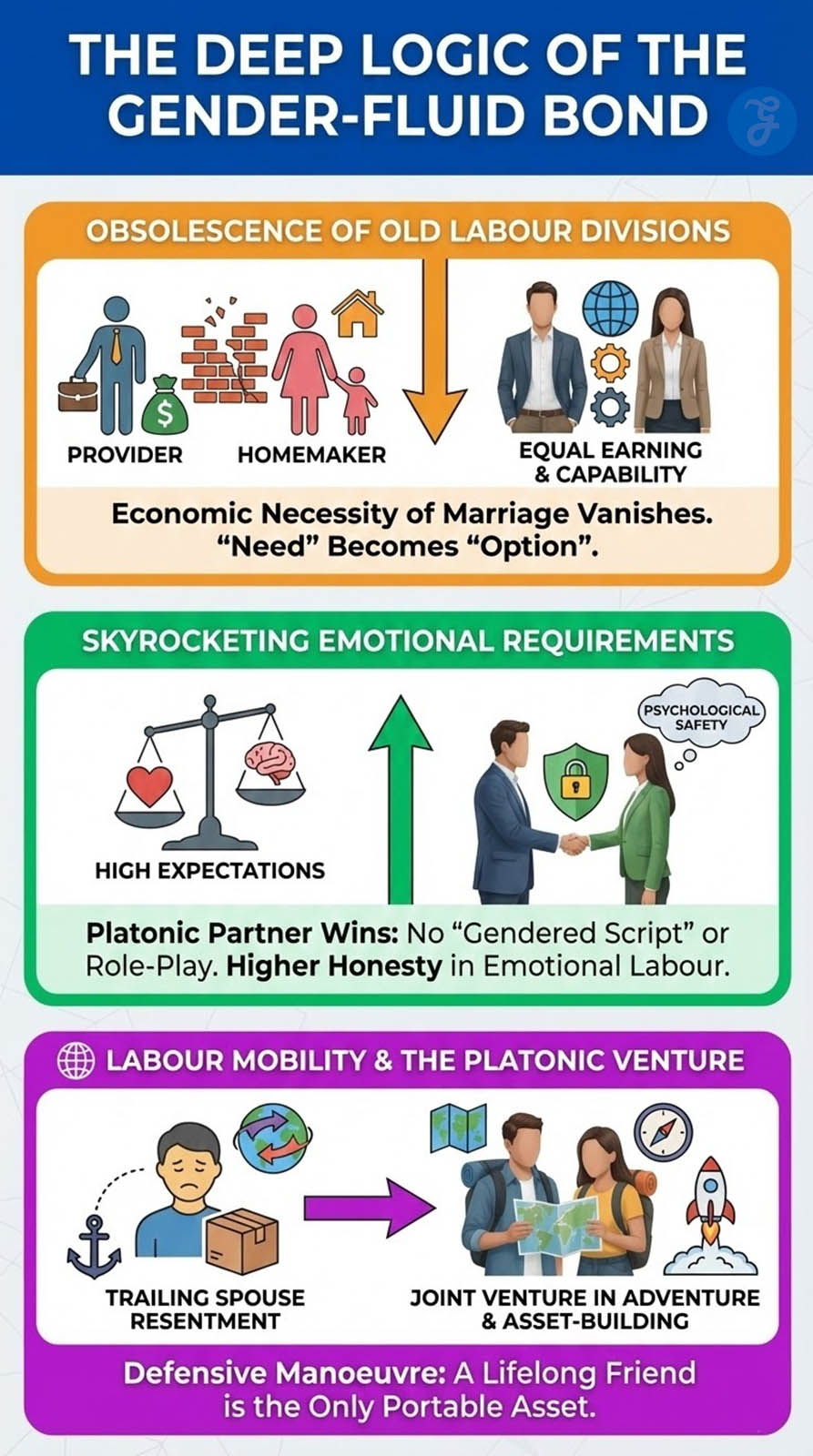 When the economic necessity of marriage vanishes, the emotional requirements skyrocket. This is where the Platonic Life Partner wins. A friend does not demand that you change your personality to fit a gendered script. There is no “man of the house” or “homemaker” performance required. This lack of role-play allows for a much higher level of psychological safety. We are seeing a generation of men and women who provide emotional labour for each other with more honesty than previous generations did within their marriages.
Closer scrutiny reveals that this isn’t just a social preference; it’s a defensive manoeuvre against the volatility of the modern world. Labour mobility requires us to move cities frequently. In a transient world, a lifelong friend is the only portable asset we have. If you move for a job, your spouse might resent the sacrifice. A platonic partner, often sharing similar career ambitions or working remotely, is more likely to view the move as a joint venture in adventure and asset-building.
The Shift to Intentional Kinship
We are stepping out of a long shadow. For centuries, we followed a script that told us exactly how to love and who to live with. We were taught that a marriage certificate was the only valid blueprint for a stable life. But in 2026, we are choosing to design our own structures. We are moving away from the rigid expectations of the past toward a model based on clarity and choice. The rise of the Platonic Life Partner is not a sign that we have given up on connection. It is a sign that we have finally become honest about what actually sustains us.
The traditional romantic monopoly is over. We have stopped pretending that one person can be our entire universe. Instead, we are finding peace in the reliability of a friend who stays because they want to, not because a biological or romantic drive demands it. We are discovering that the person who manages your mortgage or makes your medical decisions does not need to be the person you kiss goodnight.
The future of human stability is being built on these quiet, cross-gender alliances. These are the bonds that keep the lights on and the heart full. We are no longer waiting for a soulmate to start our lives. We are building them today with the people who have been there all along.
Foresight Assessment
Looking ahead, we are likely to see a surge in the adoption of “Kinship Contracts”, bespoke legal frameworks drafted by friends to formally govern shared property, pet custody, and long-term elder care. This shift will place mounting pressure on insurance providers to adapt, forcing a move toward “Designated Primary Kin” models that allow individuals to extend benefits to their chosen support systems, regardless of traditional marital status.
However, an unintended consequence will be the emergence of a new social hierarchy. Those with high “social capital”, people who can maintain deep, long-term friendships, will thrive economically. Those without these skills, or those who still rely on the crumbling marriage-only model, will find themselves increasingly vulnerable to market shocks. We are moving from a world where “who you marry” determines your status to one where “who you keep” determines your survival.
As the legal and economic walls around marriage continue to fall, we must ask ourselves: if we no longer need romance to survive, will we find it harder to justify its inherent messiness, or will we finally be free to enjoy it for what it is?
Disclaimer: Names and specific identifying details in the case studies have been changed to protect the privacy of the individuals involved.