The quiet but undeniable rise of minilateralism is actively rewriting the rules of global power, shifting the center of gravity away from bloated international institutions toward small, agile alliances. For decades, the international order relied on a grand, universal architecture to manage crises and enforce norms. However, as great power competition intensifies and global institutions face unprecedented gridlock, this traditional model is fracturing. Nations are no longer waiting for universal consensus to secure their borders, protect their supply chains, or advance their technological dominance.
Instead, a new diplomatic playbook has emerged, prioritizing speed, flexibility, and shared interests over universal, ideological alignment. By forming highly targeted coalitions of three to nine nations, countries are bypassing diplomatic bottlenecks to deliver tangible results. This shift represents a fundamental transformation in how global governance operates in the 21st century. It is an era defined less by sprawling global treaties and more by pragmatic, problem-solving networks.
To understand this transformation, one must first look at the systemic failures that made it necessary. The shift is not a sudden accident, but a calculated response to a paralyzed global system that struggles to meet the demands of a multipolar world.
The Paralysis of the Old Order: Why Multilateralism is Fracturing
The post-World War II international architecture was designed to prevent global conflict through broad, inclusive forums. Institutions like the United Nations Security Council (UNSC) and the World Trade Organization (WTO) were built on the premise that collective dialogue could resolve any dispute. For a time, this multilateral consensus worked.
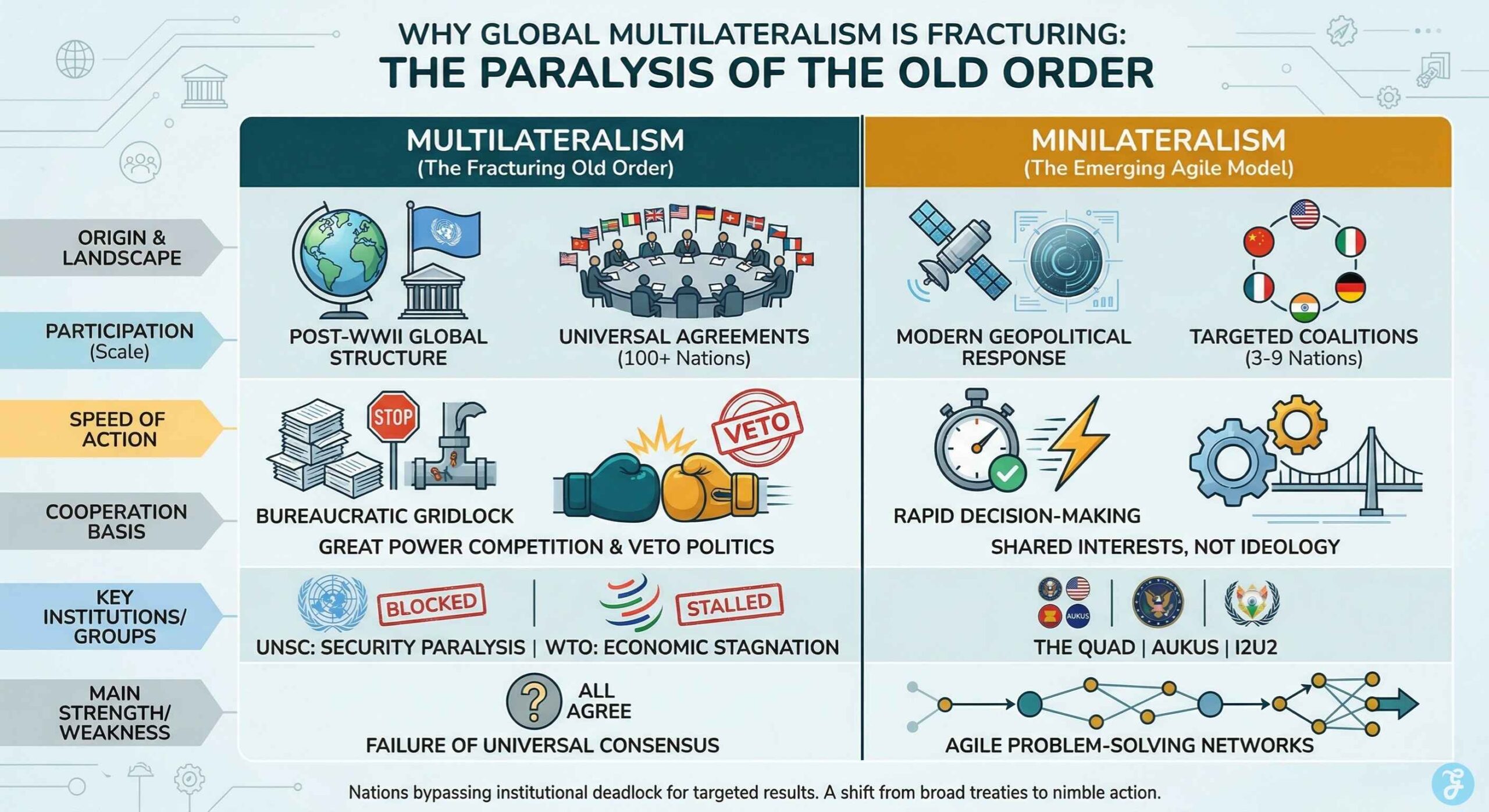
However, today’s geopolitical landscape is far too fractured for this model to remain the sole avenue of diplomacy. The UNSC is frequently paralyzed by veto politics, rendering it incapable of addressing major conflicts or territorial aggressions. Similarly, the WTO struggles with consensus-based decision-making, often failing to deliver timely responses to modern economic warfare or supply chain disruptions.
This institutional stagnation has eroded trust in the old order. Countries facing immediate threats, whether from aggressive neighbors, pandemic outbreaks, or cyber espionage, cannot afford to wait years for a global mandate. They are instead seeking out trusted partners to build localized, highly effective defense and economic shields. The shift is a pragmatic adaptation to an increasingly contested global environment.
This growing frustration with international gridlock leads directly to the deeper structural issues plaguing these global bodies.
The Thucydides Trap and Institutional Stagnation
The intensifying rivalry between the United States and China has fundamentally altered the utility of global forums. As these two superpowers navigate what scholars call the “Thucydides Trap”, the dangerous friction that occurs when a rising power threatens to displace an established one, multilateral bodies have become arenas for performative diplomacy. Rather than solving problems, universal platforms are frequently used to score political points or block rival initiatives.
In this polarized climate, achieving universal agreements on complex issues like artificial intelligence standards, semiconductor supply chains, or maritime domain awareness is nearly impossible. Global forums are too large, too diverse, and too easily obstructed by rival factions. Consequently, states are turning toward smaller, interest-based coalitions that can act decisively, completely changing the architectural makeup of international relations.
The Architecture of Agility: Defining the Minilateral Model
Unlike sprawling global treaties, minilateral alliances are designed as streamlined, purpose-built engines of statecraft. They are not burdened by the need to satisfy over a hundred differing national agendas. Instead, they bring together a select group of like-minded nations, usually those with the most at stake in a specific issue, to collaborate quickly and effectively.
These smaller groupings represent a stark departure from the bureaucratic heaviness of traditional diplomacy. They often lack formal secretariats, rigid charters, or binding treaty obligations, which allows them to adapt rapidly to changing circumstances. When a crisis emerges, a minilateral group can coordinate military exercises, share critical intelligence, or pool economic resources within days, rather than the months it might take a larger institution.
The differences between the old and new models of global cooperation are profound and structural. To fully grasp why nations are pivoting to this new framework, it is helpful to compare the two approaches side-by-side.
| Feature | Multilateralism | Minilateralism |
| Scale | Universal or near-universal (100+ nations) | Small, highly targeted (typically 3 to 9 nations) |
| Pacing | Slow, bound by consensus-building and veto politics | Rapid, agile, and immediately deployable |
| Focus | Broad, overarching global governance and universal norms | Issue-specific (tech, maritime security, supply chains) |
| Commitment | Binding treaties and rigid institutional frameworks | Flexible, voluntary, and highly adaptable |
| Membership | Open and inclusive | Exclusive, based on shared immediate interests |
The flexibility highlighted in this structural shift also represents a bigger philosophical change in how modern alliances are formed.
From Broad Values to Targeted Interests
Modern geopolitical cooperation is shifting away from broad ideological alignment toward highly targeted partnerships based on shared vulnerabilities. In the past, alliances were often forged around shared democratic values or broad security guarantees. Today, the driving force is functional necessity.
A nation does not need to align perfectly with another country’s domestic policies to cooperate on securing a critical maritime choke point. This pragmatic approach allows for highly specialized collaboration. It also lowers the barrier to entry, enabling nations to join multiple, overlapping minilateral groups depending on their specific needs at any given time. This issue-based diplomacy is proving far more effective at delivering concrete public goods and security outcomes.
The Middle Power Resurgence: Niche Diplomacy in Action
The proliferation of small alliances is actively empowering countries outside the traditional superpower binary to proactively shape the international order. For decades, global politics was heavily dictated by the actions of Washington, Moscow, or Beijing. However, the rise of minilateralism has provided a powerful new tool for middle powers like India, Japan, Australia, and the UAE.
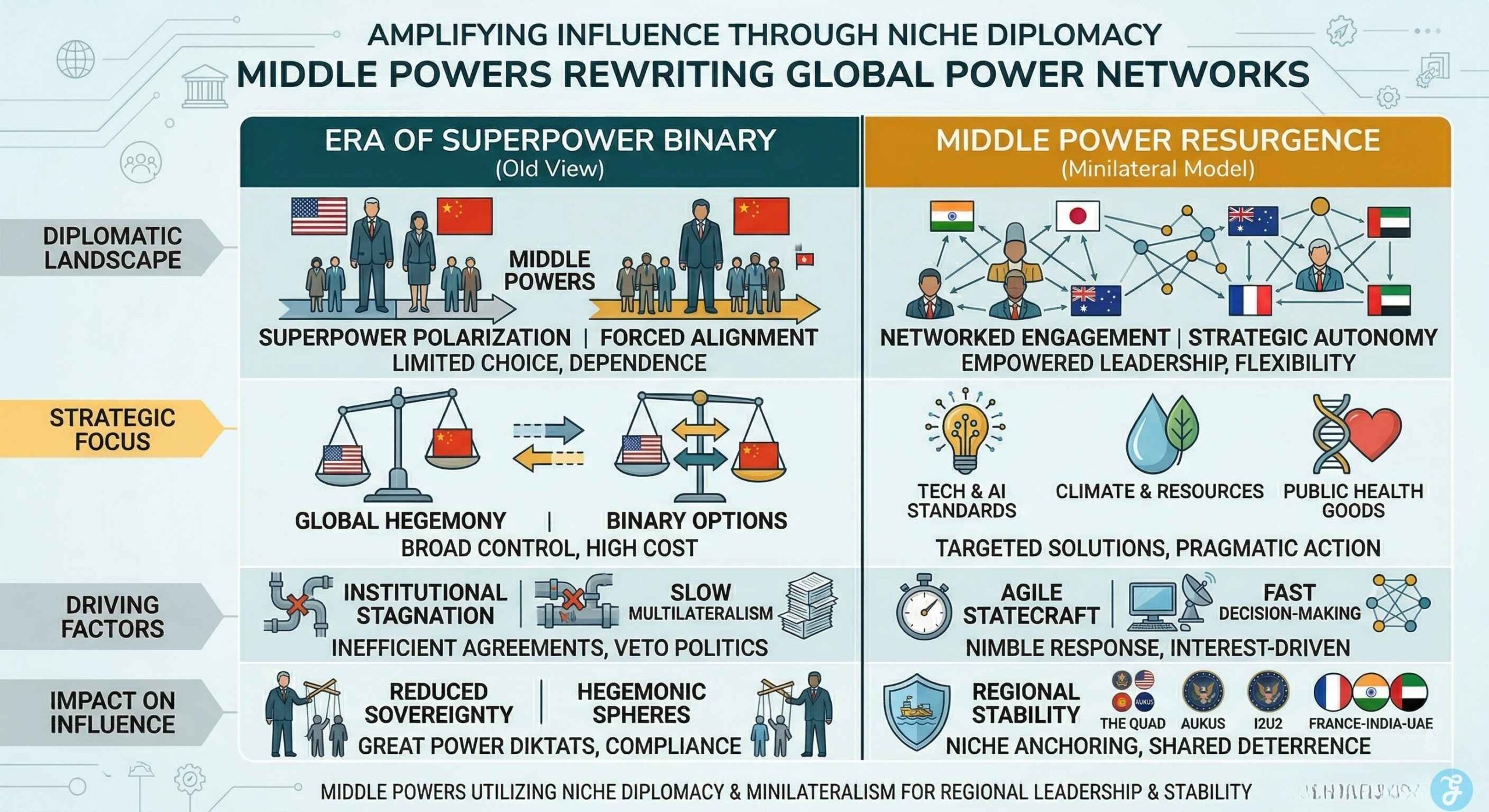
These nations are no longer simply reacting to the maneuvers of great powers. By forming their own specialized coalitions, they are amplifying their diplomatic influence and establishing themselves as regional anchors. They can pool their economic and military resources to create localized deterrence, manage supply chains, and set technological standards without relying entirely on a superpower patron.
This resurgence is characterized by “niche diplomacy.” A middle power might lack the resources to project global hegemony, but it can lead a highly focused initiative. For example, a country with advanced maritime capabilities might lead a minilateral group focused on ocean governance, while another with a robust technology sector might spearhead an alliance on artificial intelligence regulations.
This newfound agency requires a structural departure from older, more rigid alliance networks.
Strategic Autonomy and the “Lattice” Network
The rigid, Cold War-era “hub-and-spoke” alliance model, where a single superpower serves as the central security guarantor for multiple disconnected allies, is rapidly being replaced. In its place, a networked, overlapping web of trilateral and quadrilateral partnerships is forming. This new architecture is often described as a “lattice” framework, where multiple nodes connect directly with one another.
For countries heavily invested in their sovereign decision-making, this lattice structure is crucial for maintaining strategic autonomy. It allows nations to cooperate closely with Western powers on specific issues like maritime domain awareness, without entering into a formal mutual defense treaty that might compromise independent foreign policy.
Middle powers use these flexible arrangements to hedge their bets, diversifying their security and economic dependencies to avoid being trapped in a binary choice.
The Indo-Pacific Laboratory: The Quad, AUKUS, and the Squad
The Indo-Pacific has become the primary testing ground for agile statecraft, hosting the highest concentration of consequential new alliances. The region is the economic engine of the world, but it is also the epicenter of escalating territorial disputes and military build-ups. The sheer vastness of the maritime geography and the complex threat environment have made traditional security architectures inadequate.
Consequently, the region has witnessed the rapid deployment of powerful minilateral frameworks. These groupings are specifically tailored to address the unique challenges of the Indo-Pacific, ranging from securing critical sea lanes in the South China Sea to preventing the monopolization of advanced defense technologies. They operate parallel to existing regional bodies like ASEAN, often stepping in where a broader consensus is impossible.
The evolution of these alliances, from broad public goods focuses to highly specific deterrence mechanisms, demonstrates the sheer versatility of the minilateral model. Each grouping serves a distinct strategic purpose within the broader regional architecture.
To understand how these alliances operate practically on the world stage, we must examine their specific tactical applications.
Counterbalancing Without Provoking Direct Conflict
These localized groupings allow nations to build credible deterrence and pool military resources while maintaining the diplomatic maneuverability to avoid triggering an outright crisis.
The Quadrilateral Security Dialogue (the Quad), comprising the US, India, Japan, and Australia, is perhaps the most prominent example. During recent diplomatic cycles, the Quad has deliberately avoided overt militarization to prevent being labeled an “Asian NATO.” Instead, it focused heavily on delivering regional public goods, such as humanitarian assistance, health initiatives, and secure 5G telecom deployments.
This soft-balancing approach builds immense regional goodwill and solidifies “habits of cooperation” without aggressively provoking strategic rivals. Conversely, AUKUS (Australia, the UK, and the US) represents a harder edge of minilateralism. Focused strictly on advanced defense capabilities, including nuclear-powered submarines and hypersonic weapons sharing, AUKUS is a direct technological counterbalance to rapid military modernization in the region.
More recently, the emergence of the “Squad”, bringing together the US, Japan, Australia, and the Philippines, highlights the hyper-localized nature of minilateralism. Driven directly by rising maritime friction, the Squad focuses intensively on maritime security cooperation in a very specific sub-geography, proving that these alliances can be custom-built to address immediate, localized flashpoints.
The European Echo and Beyond: Minilateralism Goes Global
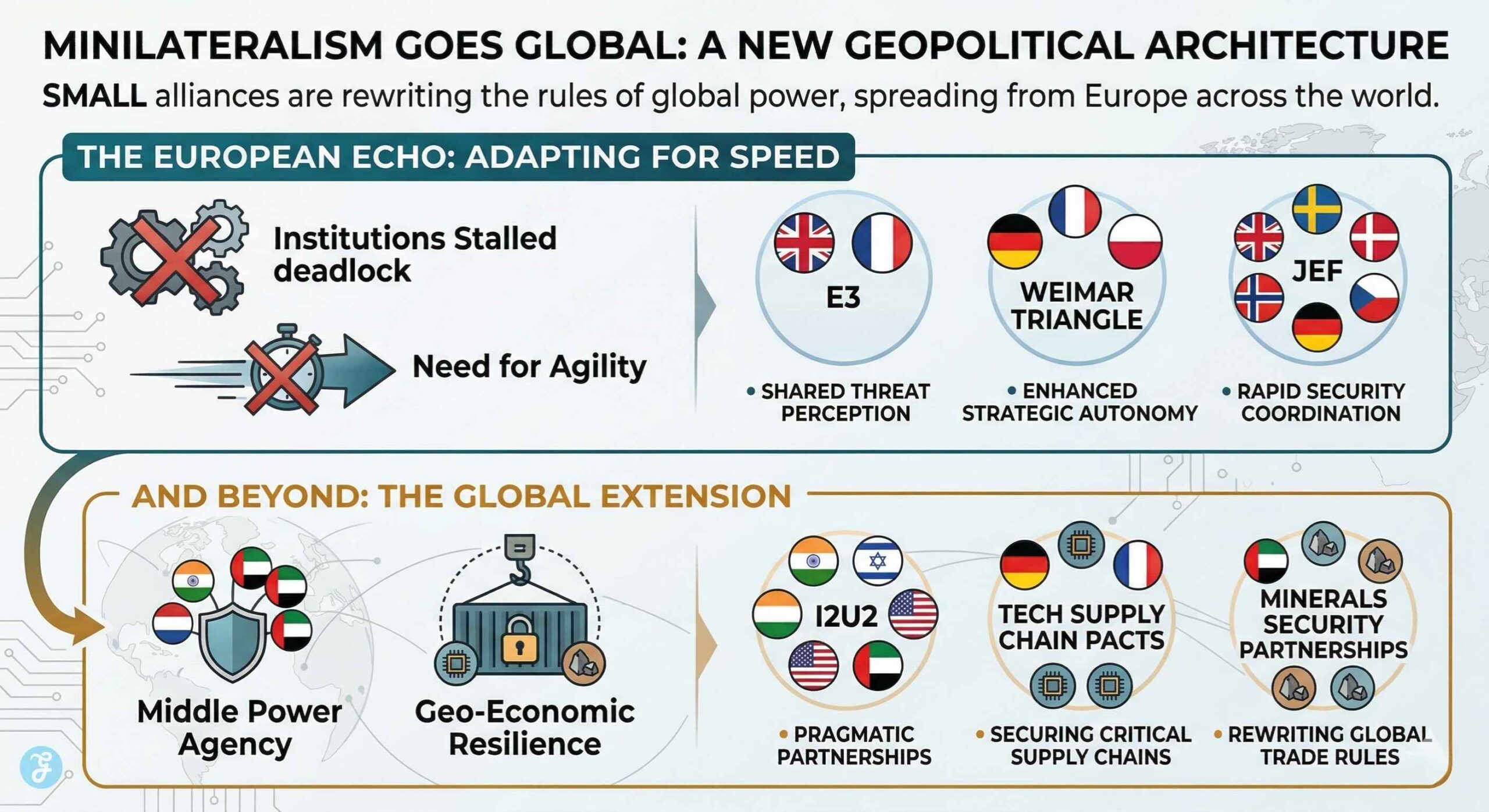
While highly visible in Asia, the shift toward flexible alliances is actively reshaping European defense and Middle Eastern geo-economics. The trend is not an isolated regional phenomenon; it is a systemic evolution of global statecraft. In Europe, anxieties over shifting foreign policy priorities and the enduring threat of conventional warfare have prompted nations to look beyond the massive, sometimes sluggish machinery of existing defense blocs.
Formats like the E3 (France, Germany, the UK) or the Weimar Triangle provide European powers with venues for rapid crisis consultation and coordinated defense posturing. These smaller groups can act as vanguards, testing policies and forging agreements that are later adopted by larger multilateral bodies.
In the Middle East and beyond, minilateralism is breaking historical barriers. The I2U2 group, linking India, Israel, the US, and the UAE, is a prime example of how these frameworks can transcend traditional geographic and political divides. By focusing entirely on geo-economic cooperation in areas like water, energy, transportation, and space, the I2U2 bypasses historical grievances to deliver immediate mutual benefits.
The expansion of these frameworks underscores that modern geopolitics is no longer solely about military might, but increasingly about economic leverage.
Economic Minilateralism: Technology, Trade, and Sovereignty
Small-group cooperation is expanding rapidly beyond military security to encompass critical geo-economic battlegrounds, including semiconductor supply chains, clean energy, and AI standards. The weaponization of trade and technology has forced nations to realize that economic security is synonymous with national security.
When a single global supply chain disruption can paralyze an entire domestic industry, relying on vast global organizations for redress is no longer viable. Minilateral tech alliances are attempting to secure the critical components of the future economy. These groupings aim to create trusted, resilient supply networks, often referred to as “friendshoring,” that are immune to coercion by hostile state actors.
This economic minilateralism is rewriting the rules of global trade, fragmenting the once-unified global market into distinct, trust-based technological ecosystems.
The Death of the Mega-Trade Deal: Friendshoring the Future
The era of the sweeping, inclusive “mega-trade deal” is largely over, replaced by the strategic weaponization of supply chains. Today, nations are forming exclusive economic clubs to lock down the critical resources that will define the next century. Look at the technology sector. The “Chip 4” alliance, uniting the United States, Japan, Taiwan, and South Korea, is a perfect example.
This highly targeted minilateral isn’t about promoting global free trade. It’s designed to tightly secure the microchip supply chain, maintain a technological edge, and bypass the slow-moving bureaucracy of the World Trade Organization.
The same playbook is unfolding with the newly launched Forum on Resource Geostrategic Engagement (FORGE), the 2026 successor to the Minerals Security Partnership. In this coalition, advanced economies have teamed up to control the rare earth elements essential for electric vehicle batteries and artificial intelligence data centers.
This aggressive turn is known as “friendshoring”, trading primarily within a trusted circle of strategic allies. While it helps wealthy nations quickly patch their economic vulnerabilities, it fundamentally fragments the world economy. More concerningly, it threatens to lock developing countries out of the upcoming green energy and AI revolutions, deepening global inequality under the banner of national security.
The Strategic Risks in the Rise of Minilateralism
The future of international relations will not be defined by a choice between global institutions and small alliances, but by how effectively they are forced to coexist. The rise of minilateralism is not a temporary trend; it is a permanent structural adjustment to a more complex, multipolar world. These agile frameworks have proven their worth by delivering public goods, securing vital supply chains, and providing necessary strategic deterrence in regions where traditional institutions have stalled.
However, this proliferation of small alliances is not without severe strategic risks. The greatest danger is the fragmentation of the global order. If the world continues to carve itself into exclusive, overlapping technological and security blocs, we risk an environment of “alliance fatigue.” Diplomatic bandwidth is finite, and the sheer volume of new minilateral summits, working groups, and joint initiatives is already stretching the capacities of many participating nations.
Furthermore, the exclusion of smaller, developing nations from these elite groupings could exacerbate global inequalities, leaving them vulnerable to economic and security shocks.
Minilaterals are incredibly effective at putting out immediate fires, but they lack the broad legitimacy required to establish universal international law or tackle planetary threats like climate change. A group of four nations cannot rewrite global maritime laws, nor can a trilateral tech alliance set worldwide carbon emission standards.
Ultimately, the global architecture is entering a hybrid horizon. Agile minilateral coalitions will increasingly serve as the first responders of geopolitics, managing regional flashpoints, securing critical technologies, and deterring immediate threats. Meanwhile, reformed multilateral institutions must be preserved to manage baseline global norms and ensure that the world does not splinter into entirely separate, hostile spheres.
The powers that master the delicate balance between these two frameworks will be the ones who successfully navigate and command the new era of global power.