You want a cozy home in the Northern USA. Frigid wind, thin walls, and old windows let heat escape through the building envelope. You watch energy bills rise every winter, and you feel the chill when drafts sneak in.
A Passive House can cut whole-house energy use by as much as forty percent in cold zones. It uses solar gain, airtight walls, and a Heat Recovery Ventilation system to lock in warmth.
This guide will show ten simple design tips, from south-facing windows to thermal mass and an air-source heat pump. Find out how.
Key Takeaways
- Passive House can cut whole-house energy use by up to 40% in Northern USA cold zones (Section 1).
- Orient the long side east-west with the facade facing true south. Use custom overhangs for summer shading and winter sun, guided by a compass and solar diagram (Section 2).
- Install large triple-pane windows with low-emissivity coatings (R-5 in the Durango case study) and advanced frames to hit HERS-54 in Aspen’s Burlingame Ranch Phase I. Seal every joint to meet 2012 IECC rules, as in Upstate NY (Section 4).
- Wrap the building in heavy insulation: R-23 foam on ICF basements in Spirit Lake, Iowa; R-100 in attics at the Omaha Anna Model; and 12-inch double walls at MassDevelopment Devens Green. Use spray foam, airtight tape, and gasket seals to stop drafts (Sections 5, 7).
- Fit a Heat Recovery Ventilation system or enthalpy exchanger to reclaim 70–90% of outgoing heat. Examples include the Shore Road Project in Old Greenwich and the Near Zero Maine II Home in Vassalboro (Section 9).
How can I optimize building orientation for cold climates?
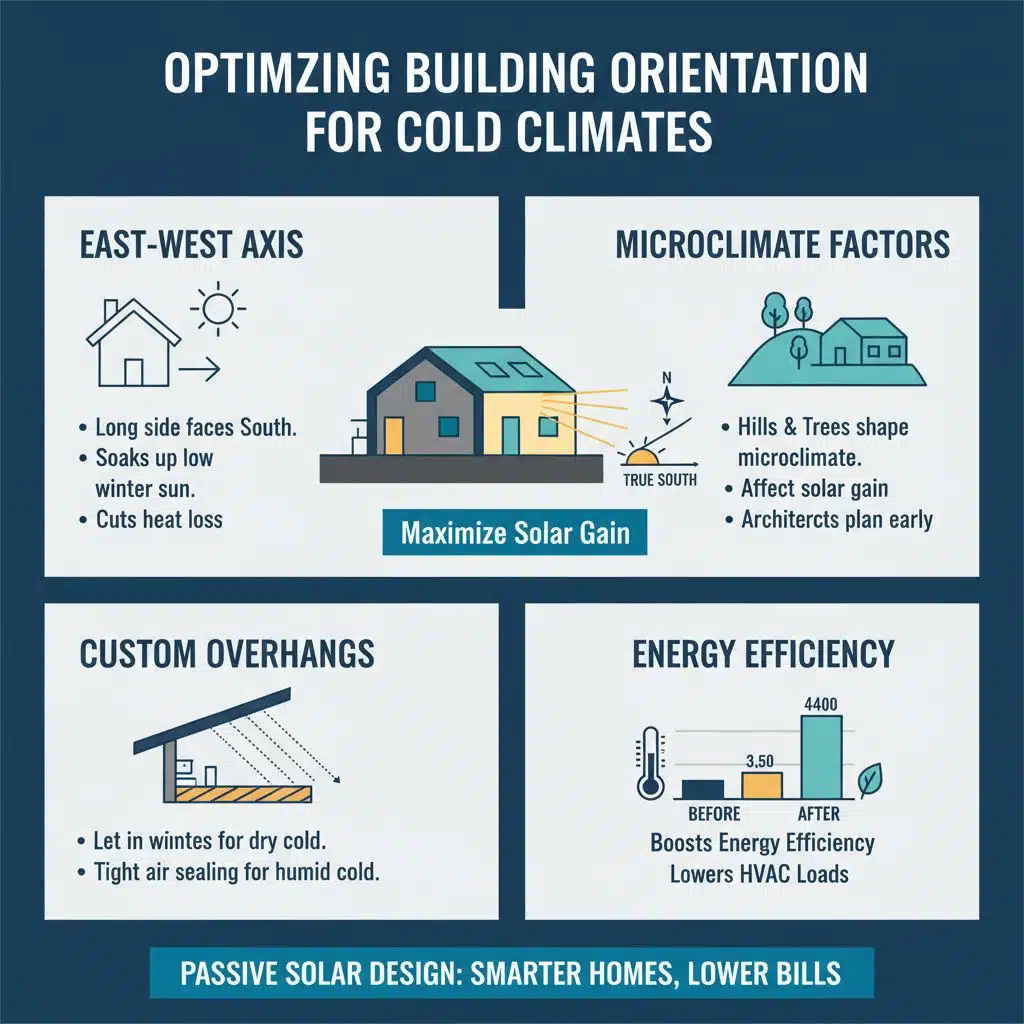
Point your Passive House along an east-west axis so the long side faces south. A south-facing facade soaks up low winter sun and cuts heat loss. Use a compass and solar diagram to find true south.
Small hills or trees shape your microclimate and affect solar gain. Architects plan orientation and shading early in design.
Custom overhangs block high summer sun but let low winter rays warm floors. Dry cold areas need deeper eaves to capture more light. Humid cold regions benefit from tight air sealing on south walls.
This passive solar design step boosts energy efficiency and lowers HVAC loads.
How do I maximize solar heat gain in a Passive House?
Large south-facing windows let winter sun flood interiors. This passive heating trick cuts the need for heat pumps and furnaces. Twin-pane glass with a low-emissivity coating stops heat loss.
Solid masonry walls in direct gain zones absorb sunlight. The walls release warmth after dark.
Heat-absorbing masonry walls store solar warmth and emit it later. A south-facing solarium or sunspace acts as an isolated gain system. You can seal it off at night to lock in heat.
Light-colored gravel around the foundation reflects rays into windows. This tactic boosts solar gain and shrinks your energy bill.
What are the best high-performance windows and doors for cold weather?
Double-glazed glass units, armed with low-emissivity coatings, lock heat inside a superinsulated shell. Triple-pane glass units raised the bar in a Durango case study at Shenandoah Circle.
R-5 panes cut energy consumption in Devens Green in MassDevelopment, MA. The HERS-54 townhouses in Aspen’s Burlingame Ranch Phase I proved how advanced frames and glazing lower energy demand.
Teams sealed every joint for 2012 IECC compliance in Upstate NY. These upgrades trimmed hvac system duty and boosted energy efficiency in cold climate homes.
Curbside entryways, fitted with thermal breaks, block thermal bridging like a knight’s shield. Well-sealed entryways keep humidity in check, and let cross ventilation kick in when spring doors crack open.
Green building teams match these doors with energy recovery ventilators to preserve indoor air quality. Such combos shave carbon footprint and deliver extra thermal comfort in passive houses, without cranking up heating and cooling.
What types of insulation work best for Passive Houses in cold areas?
Heavy parkas defend your house from cold winds, and premium insulation materials play the same role. Fiberglass and cellulose batts fill wall cavities with dense, thermal insulation.
Spray foam seals every crack, boosting indoor air quality and energy efficiency. Home builders in Spirit Lake, Iowa, wrapped ICF basement walls in R-23 foam. Engineers in Libertyville chose R-20 spray insulation at School Street Homes.
Anna Model in Omaha went next level with R-23 fiberglass. Candlewood Hills Rebuild in New Fairfield earned LEED Platinum and delivered $3,000 in annual energy savings through hard-working insulation.
Illinois First Challenge Home in Downers Grove blends blown fiber and polyiso board for robust thermal comfort. Hamilton Way in Farmington uses foam-sheathed walls and ICF footings to cut energy losses.
Adaptation Home in Geneva and the Omaha Anna Model stack R-100 in attics to stop heat from slipping out. MassDevelopment Devens Green in Massachusetts built 12-inch double walls for top-tier envelope performance.
How can thermal mass materials improve energy efficiency?
Concrete and brick walls store heat from the sun. They soak up solar gain through south-facing windows in a passive solar building. Those thermal mass materials send warmth back into rooms at night.
This trick cuts strain on hvac systems and slashes energy use.
A Trombe wall stands behind glass to catch sun rays in winter. It heats stone by day and pumps heat out when the air cools. Tile floors or masonry walls add more slow release heat.
Pair mass with strong insulation to lock in warmth and boost energy efficiency.
What are effective airtight construction techniques?
Cold leaks waste heating energy. Airtight homes improve indoor air quality.
- Use an air barrier membrane on wall sheathing, seal all seams with certified tape for tight sealing that boosts energy efficiency.
- Seal attic junctions with sealant foam at top plates like at McCormick Avenue in Brookfield to cut drafts and save energy.
- Install gasket seals behind lighting fixtures and outlet boxes to stop wind infiltration and guard indoor air quality.
- Spray R-20 foam alongside stud cavities like at School Street Homes in Libertyville to improve envelope tightness and reduce heat loss.
- Run an air leakage fan test for each house, track leaks with an airflow gauge, and match 2012 IECC compliance achieved by LECESSE Construction and the Challenge Homes program.
- Fit weather strips on all glass window and door edges to preserve thermal comfort and curb heating costs.
- Pair energy recovery ventilation systems with the sealed envelope to bring fresh air, preserve heat, and maintain thermal comfort.
How should roof overhangs be designed for seasonal efficiency?
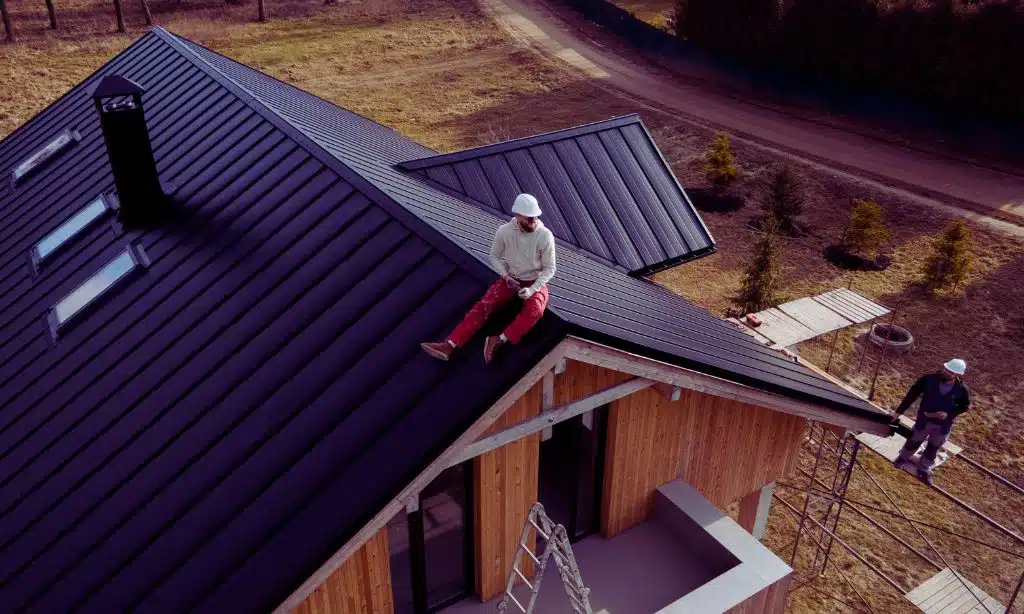
Roof overhangs let winter sun pour in through south-facing windows. They shade those windows on hot summer days to cut cooling loads. This passive solar feature trims heat loss and gains.
It ties into building orientation and boosts energy efficiency.
Design teams set overhang depth to match sun angles. A shorter overhang works best in cold climates because it still gives solar gain control and free heat when sun sits low. An awning sized right blocks high sun yet welcomes low winter rays.
This tweak boosts seasonal efficiency and cuts energy use.
What are the benefits of heat recovery ventilation (HRV) systems?
HRV systems trap outgoing warmth, then feed it to fresh air through a plate heat exchanger. This design cuts winter heat loss and boosts thermal comfort. Owners face a high initial investment.
They earn back that cost with energy savings over months. Installers attach inline fans deep in air-sealed walls. This setup drafts fresh air and maintains top indoor air quality in a sealed shell.
Shore Road Project in Old Greenwich and Near Zero Maine II Home in Vassalboro, ME use these tools. Installers pair HRVs or enthalpy exchangers with a geothermal heat pump or solar pv system.
The Building America program names them key to mechanical ventilation in Passive House design. This mix helps hit net-zero targets and slashes energy consumption in cold climates.
How do sunspaces or solariums contribute to Passive House design?
A solarium sits on the south side behind double-glazed windows. It soaks up solar gain and stores warmth. Thermal mass floors and walls act as heat buffers. This passive solar feature slashes heating bills and boosts thermal comfort.
Heat built up in the solarium flows into living areas in winter. Isolated gain systems let you seal off the room to control transfer. This move keeps cold drafts out and maintains indoor air quality.
It drives energy savings in passive housing.
Which reflective or insulated roofing materials are best for cold climates?
Reflective metal panels bounce sunlight off the roof, cut heat loss in winter. Dark asphalt shingles soak up solar gain, then radiate warmth inside. Preferred Builders in Old Greenwich tried cool-roof shingles and saw energy efficiency climb.
Proper insulation tops off that combo. The Brookfield house at McCormick Avenue sports R-60 in the attic. Geneva’s Adaptation Home and Omaha’s Anna Model hold R-100 for better thermal comfort.
They cut energy use and seal in heat.
How can strategic landscaping protect against wind?
Evergreen trees stand like a shield on the north side of a Passive House. Dense shrubs fill gaps, stopping cold gusts. They act as windbreakers and cut wind chill. These buffers reduce heat loss through walls and windows.
Light gravel around south-facing windows bounces sunlight into living spaces. That extra solar reflection adds passive solar gain and delivers energy savings.
Wooden fences and living hedges make sturdy barriers against wind. They protect vents and keep air sealing tight around openings. Snow drifts land away from the foundation, guarding the building envelope.
That setup improves thermal comfort and indoor air quality. It helps reduce energy consumption and promote sustainable living.
What are the best methods to seal air leaks and improve envelope tightness?
Sealing leaks stops chilly drafts. Proper envelope tightness cuts energy waste.
- Run a blower door test with a thermal imager to spot leaks around doors and windows, then mark cold spots for energy savings.
- Seal joints and utility openings at top plates and attic junctions with spray foam to boost air sealing like on McCormick Avenue in Brookfield.
- Fill rim joists and utility penetrations with closed cell foam to reinforce the air barrier and stop drafts.
- Apply caulk with a caulking gun at door and window perimeters and fit foam weatherstripping to block gaps in a cold climate.
- Tape seams along the building envelope edges with airtight construction tape to cut infiltration.
- Install polyiso board insulation on exterior walls, as in Downers Grove’s Illinois First Challenge Home, to boost seal strength.
- Choose insulated concrete form walls like those in River Forest’s first certified Passive House and The Preserve in New Paltz to lock out air leaks.
- Conduct a follow-up blower door test to verify 2012 IECC compliance, as LECESSE Construction and Housing Visions did in Upstate NY, and fine-tune energy-efficient building design after sealing work.
- Scan walls and ceilings for thermal bridging with a handheld thermal imager and seal any cracks with a quality sealant.
- Tighten the envelope to boost energy efficiency, improve indoor air quality, and maintain thermal comfort in a cold climate.
What is the ideal Passive House shape and layout for cold regions?
An elongated east-west form maximizes solar gain from south-facing windows. It trims north-facing wall area, cutting heat loss. Compact shapes boost energy efficiency. Shared walls in Town Homes at Perrin’s Row shrink envelope exposure and cut drafts.
Cluster rooms near the solar face, and stash bathrooms, closets, and garages on the north side. Continuous insulation and air sealing wrap the envelope tight. Heat recovery ventilation moves fresh air with minimal power on cold winter days.
How can renewable energy solutions be integrated into Passive House design?
South roofs serve as a solar stage in Passive House design. Garbett Homes in Herriman, UT built the first certified net zero energy home with rooftop solar panels and two tankless water heaters.
Town Homes at Perrin’s Row, Hickory Drive, Singer Village and EcoVillage all use PV modules to harness solar gains. Denver’s ArtiZEN Plan hit HERS -3 with rooftop photovoltaics, delivering net positive energy.
The Shore Road Project in Old Greenwich features 4.5 kW solar shingles on its roof.
Solar hot water arrays meet 80 percent of domestic hot water needs at Wisdom Way Solar Village. Designers often add ground source heat pumps to the ventilation unit. Air source heat pumps can do the same, cutting grid power use.
Small PV systems can offset the pump’s energy draw. Stack ventilation helps reduce cooling loads in summer.
How do efficient interior zoning and layout improve energy use?
A Passive House zones high-use areas, like the kitchen and living room, in sunny, well-insulated spots. This tactic cuts heating needs by up to 15%. A sunspace acts as a heat buffer.
It traps solar warmth and sends it to nearby rooms on cold nights. That boosts thermal comfort all day long.
Open-plan designs make air flow easy, and they spread passive heat gains well. Warm air drifts freely, thanks to natural ventilation paths. The nearby townhouses share walls, which cuts heat loss along shared barriers.
This layout lifts energy efficiency and indoor air quality, with fewer drafts and more fresh air.
What cost-effective and durable materials should I choose?
Concrete, brick, and stone act as thermal mass. They store heat and stand up to wear. ICF block walls or 12-inch double-stud cavities boost thermal comfort. MassDevelopment Devens Green used this setup.
Fiberglass, cellulose, spray foam, and polyisocyanurate cut heating bills in cold climates. Candlewood Hills Rebuild in New Fairfield earned LEED Platinum and saved $3,000 a year. LED bulbs and efficient appliances deliver energy savings.
Shenandoah Circle in Durango runs on 80 percent LED lighting and sees better indoor air quality.
How can I monitor and adjust for long-term energy efficiency?
Long-term energy checks keep costs low and comfort high. Ongoing audits and real-time data guide your tweaks.
- Use a smart meter and building energy management system to log power draw every hour and spot high loads.
- Pull benchmarks from the DOE’s Building America program to compare against B10 standards and aim for 40 percent energy savings.
- Run blower door tests twice each year to track air sealing and seal leaks around glass windows or double glazing.
- Collect run data from ground source heat pump controls and review winter curves from Efficiency Vermont’s 2013–2014 tests of air-source units in cold climates.
- Install carbon dioxide and humidity sensors in key zones to monitor indoor air quality and maintain steady thermal comfort with HRV.
- Log solar panel output and seasonal solar gain via south-facing windows while tracking thermal mass storage in passive solar buildings.
- Apply Optimized Climate Solutions Tool metrics to measure 30 percent energy savings over the B10 benchmark and tweak shading strategies plus building orientation.
- Assess radiant heating and hot water heater cycles monthly to sync them with occupancy and dampen peak loads for net zero-energy goals.
- Enroll in Novatr’s 8-month Masters in Computational Design program to master renewable energy technologies and improve return on investment.
Takeaways
Smart steps can turn a chilly shell into a cozy powerhouse. South-facing windows soak up winter sun and block icy drafts. Thick insulation, airtight seals, and a balanced ventilation system work as a tight team to save energy.
Photovoltaic panels or air-source heat pumps bring clean power to your home. A blower door test and the PHPP tool spot leaks fast to keep comfort on track. Simple windbreak plantings can shield walls from harsh gusts, adding heat and calm.
FAQs on Passive House Design Tips for Cold Climates
1. What is the passivhaus standard for cold climate homes?
It is a strict rule set, it drives energy efficiency. It uses air sealing and thermal mass to trap warmth, it cuts heat loss, it boosts indoor air quality.
2. How does building orientation boost solar gain?
You point your home to the sun, place south windows, catch more light. The sun warms the floor and walls, it saves you cash on heating.
3. How do I fix indoor air quality and keep thermal comfort?
Use heat recovery ventilation, wind towers, they swap stale air for fresh. Seal cracks and gaps, stop drafts. You get clean air, steady warmth.
4. Why add solar panels and a heat pump?
Panels on the roof make clean power, they shrink bills, they cut energy use, they boost energy savings. A heat pump pumps warmth from the ground, it cuts extra fuel needs.
5. How do energy retrofits improve indoor environments?
You start with insulation, then air sealing, next new windows, then add water-heating and water heating gear. You might drop in evaporative cooling or a chimney effect vent. Each tweak boosts thermal comfort, cuts energy use, and steers you toward leadership in energy and environmental design.