
What was once the stuff of science fiction is now becoming reality. A team of researchers at Cortical Labs, a cutting-edge biotech startup based in Australia, has officially launched the world’s first commercialized biocomputer—a machine powered by living human brain cells.
Unveiled at a recent tech conference in Barcelona, this revolutionary computer, named CL1, merges the biological complexity of human neurons with modern computational hardware. The goal? To create machines that learn, adapt, and solve problems more efficiently than current artificial intelligence (AI) systems.
According to ABC News Australia, this development marks a major milestone in what scientists are calling “synthetic biological intelligence.”
What Is CL1? Inside the Living Biocomputer
The CL1 device is no ordinary computer. It contains approximately 800,000 living neurons—a mix of human and mouse brain cells—that were grown in a lab using advanced cell culture techniques. These neurons are placed on a specially designed chip that facilitates two-way communication between biology and machine.
The neurons sit in a controlled dish, where they receive continuous nutrients and are shielded from microbial contamination. The chip sends electrical signals to the neurons, prompting them to respond. These responses are then captured by sensors, creating a real-time feedback loop that mimics the way a brain processes information.
In essence, CL1 functions like a miniature brain, learning from its inputs and adapting its outputs—just like living creatures do.
How Was CL1 Developed? A Six-Year Journey
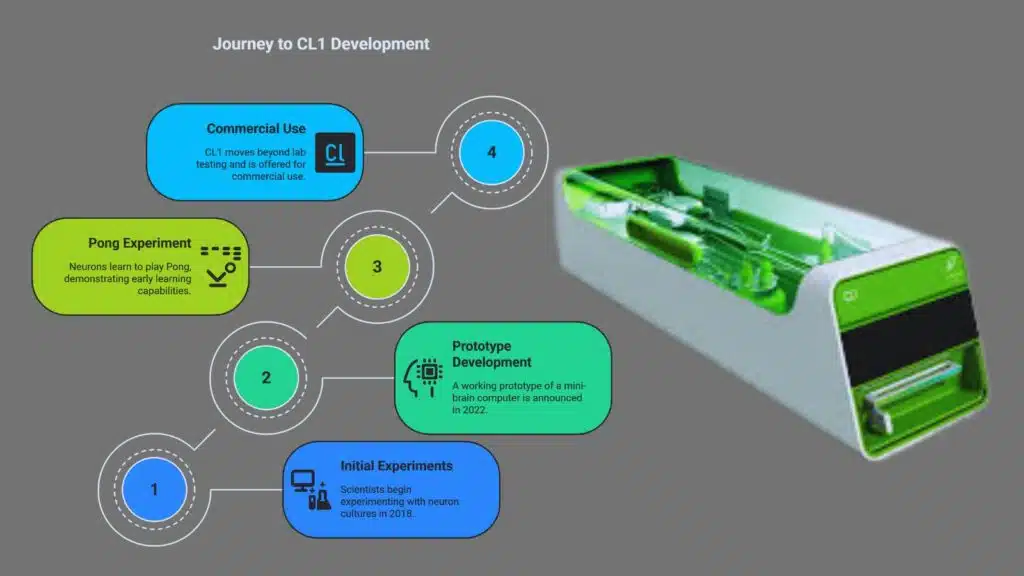
The biocomputer project took six years to reach this stage. Cortical Labs scientists began experimenting with neuron cultures as early as 2018. Their goal was to develop a system that not only mimicked biological learning but could also be integrated with modern computer systems.
In 2022, the team made headlines when they announced a working prototype of a “mini-brain computer” using neurons grown from reprogrammed blood cells. These neurons displayed early signs of learning by playing a simplified version of the video game Pong, adjusting their responses based on feedback.
This successful experiment laid the foundation for CL1, which has now moved beyond lab testing and is being offered for commercial use.
Biological AI vs Traditional AI: What’s the Difference?
Cortical Labs believes their invention introduces a new category of intelligence—one that is both biological and synthetic. Unlike traditional AI models like ChatGPT, which require vast datasets and powerful GPU clusters, CL1 can perform complex tasks using minimal data and very little energy.
The company describes CL1 as an “ultimate learning machine” that doesn’t rely on brute force computation but instead uses evolutionarily honed neural patterns to learn and adapt quickly. According to Cortical Labs’ chief scientist Dr. Brett Kagan, this allows the biocomputer to achieve levels of flexibility and abstraction unmatched by conventional machines.
Fast Learning and Low Energy Consumption
One of CL1’s most impressive features is its energy efficiency. While large language models like GPT-4 require hundreds of megawatts to train and deploy, CL1 can operate on as little as 20 watts of electricity—roughly equivalent to a household light bulb.
This ultra-low energy consumption makes biological computing a sustainable alternative to current AI systems, which are increasingly under scrutiny for their massive carbon footprints.
As reported by New Atlas, early tests show that CL1’s learning capacity is far more dynamic and efficient than silicon-based models, especially in tasks that involve pattern recognition and decision-making with limited data.
Making Complex Decisions Like Humans and Animals
One of the most exciting potentials of CL1 is its ability to mimic natural decision-making processes. According to Dr. Kagan, this means the system can solve problems in ways that mice, cats, birds, and humans can—but existing AIs cannot.
These tasks include spatial navigation, recognizing novelty, and adapting to unpredictability—areas where traditional machine learning systems still struggle. For instance, while a conventional AI might require thousands of images to identify a dog, CL1 could make the same connection after just a few exposures, thanks to its biologically based learning model.
Other Players in the Biocomputing Space
While Cortical Labs is leading the charge, they’re not alone. In 2024, FinalSpark, a Swiss biotech startup, introduced its own biological computer made of 16 organoid “mini-brains”—tiny 3D cell cultures that resemble early-stage human brain development.
Meanwhile, scientists at Johns Hopkins University are working on integrating brain organoids into machines to study neurological disorders and potentially create hybrid computing systems in the future.
These parallel efforts indicate a growing global interest in biohybrid computing, which merges neuroscience, bioengineering, and AI.
Skepticism and Challenges: Not Everyone Is Convinced
Despite the excitement, some experts urge caution. Claude Touzet, a French neuroscientist and artificial intelligence researcher, remains skeptical about whether current bio-computers can achieve true intelligence.
In a 2023 article for L’Express, Touzet pointed out that neurons in a dish do not organize themselves like those in a real brain. Without the complex structure of a human cortex, he argues, their learning capacity remains limited.
Touzet also highlighted the biological fragility of living neurons. These cells are highly sensitive to temperature changes, chemical exposure, and fatigue. Unlike silicon chips that run 24/7, human neurons require rest cycles and are prone to degradation over time.
Commercial Availability and Pricing
Despite technical limitations, Cortical Labs is confident enough in its technology to offer the CL1 for sale. Priced at $35,000, the biocomputer is now available for purchase by research institutions, universities, and potentially even high-end developers or corporations.
The company hopes that, like many emerging technologies, the cost will decrease over time as mass production scales up and additional use cases are discovered.
This move from prototype to product signals a major shift—from experimental biology to commercial computing innovation.
Computing Reinvented or Overhyped?
As Cortical Labs executives told Usbek & Rica, this development is more than just a new computer—it’s a reinvention of computing itself. The vision is clear: integrate the adaptive power of living cells with the processing speed and scalability of modern machines to build systems that learn like humans, but work like computers.
Still, the future of biological computing remains uncertain. Can it scale? Can it compete with quantum or neuromorphic computing? Can ethical and biological constraints be addressed?
Those are questions only time—and more research—can answer.
A Brave New Frontier in Computing
The creation of CL1 represents a paradigm shift in how we understand and build machines. For decades, AI has relied on silicon, statistics, and speed. Now, a biological layer is being added to the mix—one that could make machines think, feel, and adapt more like living beings.
With growing global concerns around AI safety, energy consumption, and data efficiency, the arrival of synthetic biological intelligence offers an intriguing new direction.
Whether this is the beginning of a new revolution or just a scientific curiosity remains to be seen. But one thing is clear: the future of computing is no longer purely artificial—it’s also alive.
The Information is Collected from Live Science and MSN.