

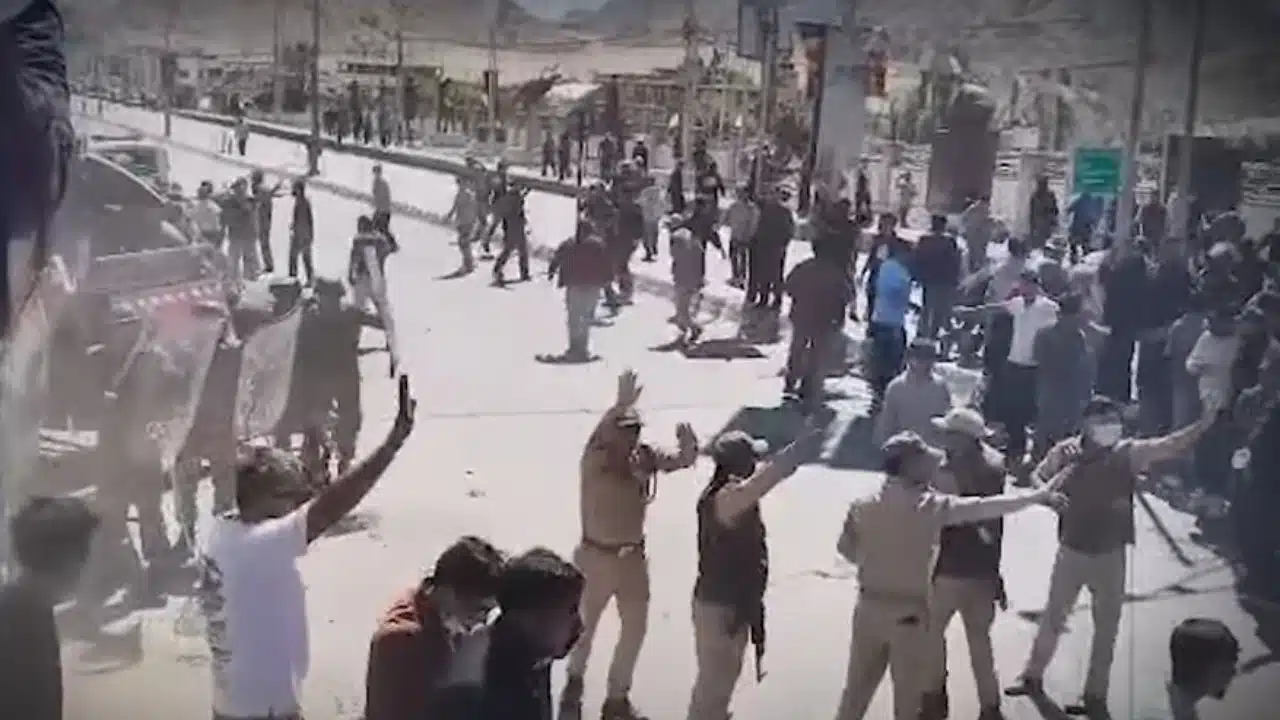
Violence broke out in Leh, Ladakh, on September 24, 2025, after weeks of peaceful protests demanding statehood and constitutional safeguards. The unrest has been described as a “Gen Z revolution”, with climate activist Sonam Wangchuk emerging as its symbolic leader. But the Union government and the activist have exchanged sharp words, each blaming the other for the chaos.
Below is a detailed explanation in 10 sections.
1. Why Are People in Ladakh Protesting?
Ladakh became a Union Territory (UT) in August 2019 after the abrogation of Article 370 and the bifurcation of Jammu & Kashmir. While Jammu and Kashmir retained a legislative assembly, Ladakh did not. This meant that Ladakhis were placed directly under the control of the Union government through an appointed Lieutenant Governor.
At first, many Ladakhis—including Wangchuk—welcomed UT status. But soon, they began to feel a political vacuum. Without elected representatives, local voices were excluded from decision-making. Over time, frustration built over issues like:
- Lack of employment opportunities for Ladakhi youth.
- Weakening land and job protections that existed earlier.
- Fear of losing Ladakh’s fragile ecosystem to large central projects.
This discontent gave rise to widespread protests, and for the first time, Buddhist-majority Leh and Muslim-majority Kargil joined forces through the Apex Body of Leh (LAB) and the Kargil Democratic Alliance (KDA).
2. The Flashpoint of September 24
For two weeks, protests in Leh remained peaceful, with hunger strikes as the main form of resistance. However, on September 24, the situation spiraled out of control.
- Protesters torched the BJP office in Leh.
- A CRPF van and other vehicles were set ablaze.
- The headquarters of the Hill Council was attacked.
- Clashes broke out with security forces, leading to gunfire and tear gas.
By the end of the day, at least four people had died, and over 70 were injured, including 22 police personnel. Authorities swiftly imposed a curfew across Leh, cutting off public assembly.
3. What Sparked the Violence?
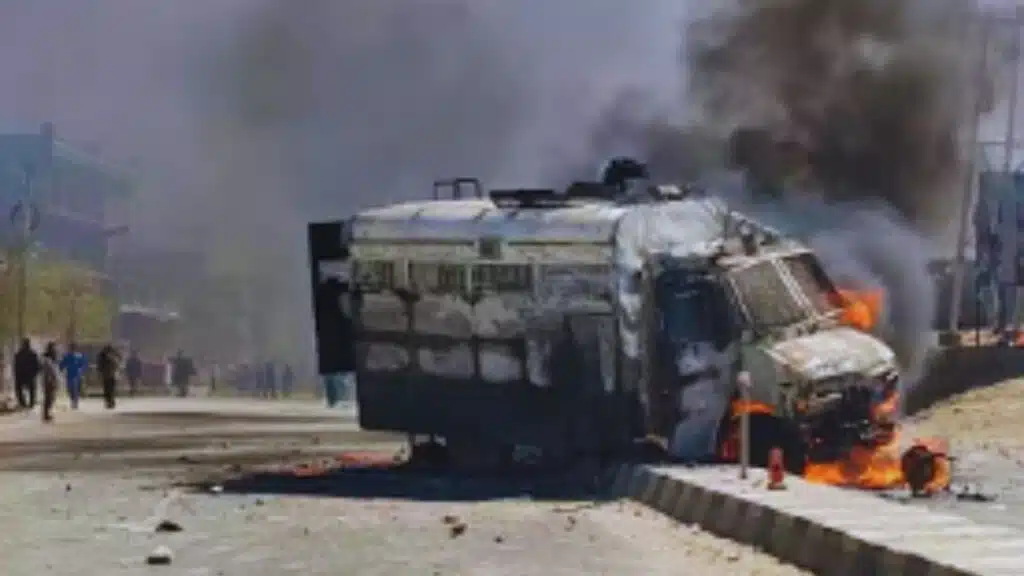
The immediate trigger came when 15 hunger strikers were rushed to hospital after their health deteriorated. Protesters accused the government of dragging its feet by scheduling the next negotiation only on October 6, despite the ongoing hunger strike.
The youth wing of LAB called for a shutdown in Leh. What began as anger over delays quickly escalated into arson and street violence. Protesters specifically targeted political offices and government property, symbols of Delhi’s control over the region.
4. Why the Demand for Statehood and Sixth Schedule?
Ladakh’s protesters argue that UT status without an assembly has left them voiceless. Their core demands include:
- Full Statehood – so Ladakh can elect its own government.
- Sixth Schedule Protections – constitutional safeguards meant for tribal and hill regions that provide local councils more control over land, jobs, and cultural preservation.
Without these protections, Ladakhis fear that:
- Outside corporations may take over local land for mega projects.
- Youth unemployment will rise due to lack of local recruitment policies.
- Fragile ecology will be damaged by mining, hydropower, and solar energy projects imposed without consultation.
The protesters see statehood as essential not just for governance but also for protecting their identity and environment.
5. Sonam Wangchuk’s Role in the Protests
Climate activist Sonam Wangchuk became the face of the agitation. Known globally for his environmental work and winner of the 2018 Ramon Magsaysay Award, Wangchuk began a hunger strike on September 10.
His protests drew wide attention because he has long warned about Ladakh’s ecological vulnerability. Wangchuk’s credibility, combined with his Gandhian method of peaceful resistance, inspired thousands of youth to rally.
The fact that Aamir Khan’s character “Phunsukh Wangdu” in 3 Idiots was modeled after him added to his visibility, especially among India’s younger generation.
When strikers’ health collapsed and some were carried away on stretchers, Wangchuk’s movement transformed into a full-blown youth-led protest wave.
6. The Government’s Stand
The Union government strongly blamed Wangchuk for the violence. According to the Ministry of Home Affairs (MHA):
- Wangchuk’s speeches invoked the Arab Spring and Nepal’s Gen Z protests, which they claimed misled Ladakhi youth.
- Protesters left his hunger strike site to attack government buildings, suggesting direct incitement.
- Wangchuk “broke his fast and left in an ambulance without calming the situation.”
The government maintains that unruly mobs forced police to open fire in self-defense and insists the incident was provoked rather than spontaneous.
7. Sonam Wangchuk’s Response
Wangchuk rejected the allegations, saying the violence was “one of the saddest days of my life.” He emphasized that:
- The violence was not pre-planned, but an organic outburst from frustrated youth.
- The real anger stemmed from five years of unmet promises, worsening unemployment, and BJP’s U-turns on earlier commitments.
- For years, he and others had followed peaceful, Gandhian methods—but the younger generation had lost patience.
He described how two elderly hunger strikers collapsing was the tipping point. For him, the tragedy showed Delhi’s failure to address Ladakh’s grievances in time.
8. BJP vs Congress: Political Blame Game
The violence quickly entered the national political battlefield.
- BJP leader Amit Malviya accused Congress councillor Phuntsog Stanzin Tsepag of actively instigating the mob.
- He posted images on X (formerly Twitter) claiming Tsepag was seen leading violent groups.
- Malviya even linked the protests to Rahul Gandhi, who had recently urged India’s Gen Z to rise against election manipulation.
Congress, however, dismissed the allegations as political deflection, arguing that the protests were homegrown anger, not opposition-manufactured unrest.
9. Voices from Ladakh, J&K, and the L-G
Political reactions reflected the wider regional crisis:
- Omar Abdullah, Chief Minister of Jammu & Kashmir, said Ladakhis now feel betrayed after celebrating UT status in 2019. He compared it to J&K’s unfulfilled statehood promise, noting that both regions had been let down by Delhi.
- Ladakh Lieutenant Governor Kavinder Gupta imposed curfew and declared the violence a “conspiracy.” He squarely blamed protesters for deaths and accused “instigators” of misleading youth.
- Local groups in Leh and Kargil repeated that the movement is not about partisanship, but about representation and survival.
10. What Lies Ahead for Ladakh?
For now, Leh remains under curfew, but the streets have calmed since late September 24. The next big test will be negotiations.
- The Centre has scheduled a High-Powered Committee meeting for October 6, 2025, with preparatory meetings on September 25–26.
- Officials confirmed that statehood and Sixth Schedule protections are on the agenda.
- Protest leaders remain skeptical, warning that patience is running thin among the youth.
The situation is a turning point for Ladakh. If the Centre fails to provide a roadmap for political representation and constitutional safeguards, the protests could return with greater intensity.
The unrest in Leh is not just about one day of violence—it is about five years of accumulated frustration. The “Gen Z revolution” shows that the younger generation in Ladakh feels deeply alienated, without jobs, opportunities, or a political voice.
While the government blames Sonam Wangchuk’s activism, his supporters argue that he simply gave voice to what Ladakh’s youth were already feeling.
The coming weeks, especially the October 6 talks, will determine whether Ladakh gets a seat at the table or remains governed from afar—risking more discontent in the future.































