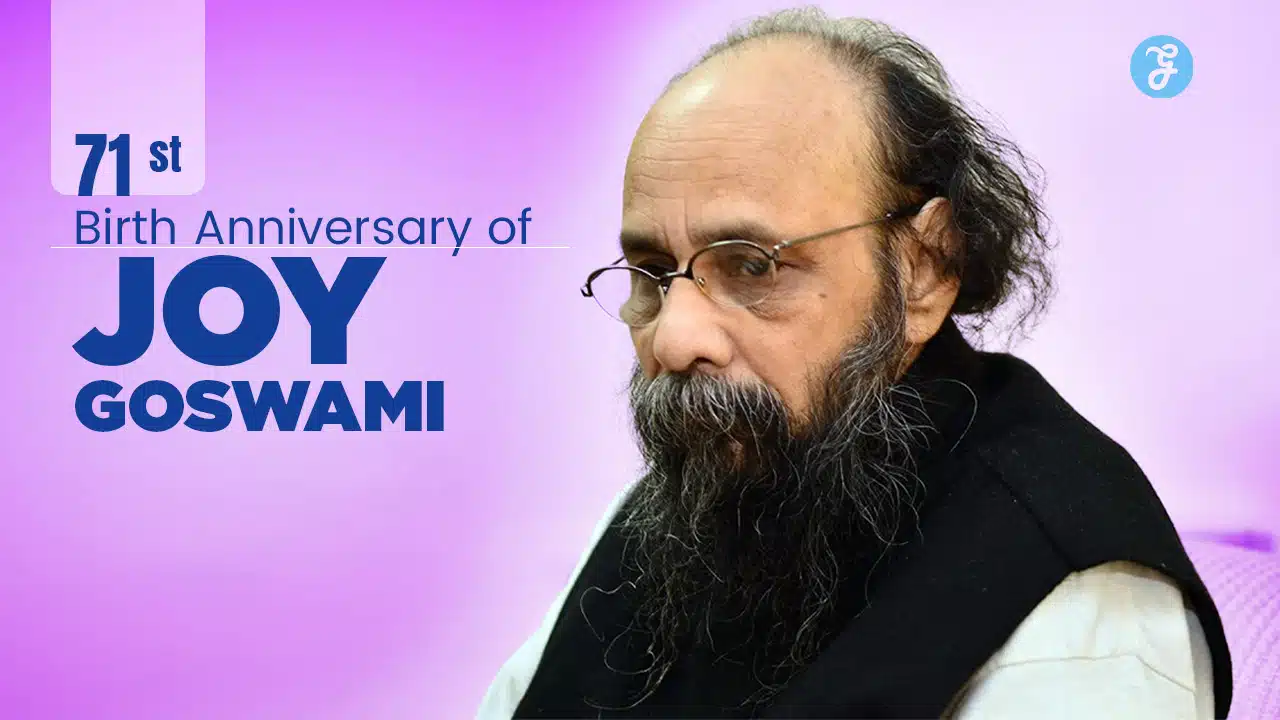
On November 10th, one of the most profound voices in contemporary Bengali literature, Joy Goswami, turns 71. For over five decades, his poetry has served as a mirror to the human soul, reflecting our deepest loneliness, our strangest dreams, and the stark realities of daily life in Bengal.
Known to many as Joy Goswami, the solitary bard of Bengal, he is not just a poet; he is a phenomenon. He successfully spanned the divide between elite literary circles and the average reader. Both university professors and lovelorn teenagers quote his lines. As he crosses this 71-year milestone, it is time to look back at the journey of a man who decided that poetry was not just an art form but a necessary act of survival against forgetting.
This article explores his life, his haunting themes, and the works that have cemented his legacy as a guardian against cultural oblivion.
From Ranaghat to Global Recognition: The Early Years
Joy Goswami was born on November 10, 1954, in Kolkata, but his heart and early formation belong to Ranaghat, a small town in the Nadia district of West Bengal. This geographical shift is crucial to understanding his poetry. The sights, sounds, and slower pace of Ranaghat seeped into his consciousness, later emerging as the surreal yet grounded imagery that defines his work.
Roots in Reality and Early Loss
His childhood was not without deep shadows. The Goswami family moved to Ranaghat when he was very young. Tragedy struck early when he lost his father at the tender age of six. This immense loss introduced him to the concepts of death, absence, and solitude long before he could articulate them in verse.
Growing up, he was surrounded by a landscape that was vastly different from the concrete jungle of Kolkata. The open fields, the local trains ferrying daily passengers, the monsoon rains turning unpaved roads into rivers—these became the primary colors on his poetic palette. His mother, a schoolteacher, became his anchor. She worked hard to raise him and his brother, instilling in him a resilience that often shines through his melancholic verses.
He was not initially a star student interested only in books. He was deeply connected to the musical traditions of Bengal. He even took formal training in Indian classical music, a discipline that undoubtedly contributed to the impeccable rhythm and cadence of his later poetry. He stopped his formal education after finishing his higher secondary exams, a decision that marked the beginning of his unique, self-taught journey into the world of letters.
Breaking onto the Literary Scene
Joy Goswami did not burst onto the scene with immediate applause. His early years were spent writing quietly, observing the world from the margins. His first poetry collection, Christmas o Sheeter Sonnet Gucccho (Christmas and Winter Sonnets), was published in 1976. It was a quiet entry, but it signaled a new voice—one that was unafraid of vulnerability.
It was widely noted by critics in the late 1970s and early 80s that here was a poet who didn’t sound like the strident political poets of the Naxalite era, nor did he sound entirely like the pure romanticists of the past. He was something new—a blend of stark reality and dreamlike subjectivity.
| Early Life Highlight | Details |
| Birth Date | November 10, 1954 |
| Hometown | Ranaghat, Nadia District, West Bengal |
| Key Childhood Event | Loss of his father at age six |
| Education | Completed Higher Secondary; Self-taught in literature |
| Other Interests | Indian Classical Music |
| Debut Collection | Christmas or Sheeter Sonnet Gucccho (1976) |
Defining Joy Goswami the Solitary Bard of Bengal: Key Themes
Why is he often called the “Solitary Bard”? It is not because he lives a hermit’s life—he is quite active in literary circles—but because his poetry speaks directly to the solitary self that exists within all of us. His solitude is a chosen vantage point, a quiet corner from where he observes the noisy procession of life with unflinching clarity. It is in this deep, internalized space that he embodies the persona of Joy Goswami, the solitary bard of Bengal, finding the universal language of pain and wonder.
The Theme of Solitude vs. Solidarity
One of the greatest paradoxes of Goswami’s work is how intensely personal it feels, yet how universally it resonates. When he writes about sitting alone in a room while the rain falls outside, thousands of readers feel he is describing their exact moment of loneliness.
He has mastered the art of “confessional poetry” without making it overwhelmingly self-centered. His “I” often becomes a collective “we.” In a busy city like Kolkata, or anywhere in the modern world, people often feel isolated in a crowd. Goswami gives a voice to that modern urban isolation. He shows that being alone does not mean being disconnected from humanity. In fact, his deep dive into his own solitude often leads to a greater empathy for others.
Surrealism and Magic Realism in Daily Life
Goswami’s poetry is famous for its dreamlike quality. He uses surrealism not to escape reality, but to describe it more accurately. In his poems, ordinary objects take on magical properties. A mundane evening commute on a local train might transform into a mystical journey.
For instance, he might describe the moon not just as a celestial body, but as a burnt ruti (bread) hanging in the sky of a hungry family. This blending of the magical and the painfully real is a hallmark of his style. It allows his readers to see their everyday, often difficult lives through a lens of wonder and strange beauty.
Joy Goswami Voice Against Oblivion in Bengal
The subtitle of this tribute refers to his “Voice Against Oblivion.” This is perhaps his most important contribution. In a fast-paced world that quickly forgets yesterday’s tragedies and everyday struggles, Goswami remembers.
His poetry acts as an archive of overlooked lives. He writes about the poor, the marginalized, the crazy lovers, and the quiet sufferers whom history often ignores. By turning their pain and small joys into lasting art, he fights against the “oblivion” (the state of being forgotten) that threatens them. As Joy Goswami voices against oblivion in Bengal, he critiques power structures not just with statistics, but by giving us the face of the victim, making it impossible for us to look away and forget.
| Core Poetic Theme | Description |
| Deep Solitude | Exploring the lonely self even within a crowd. |
| Surreal Imagery | Blending everyday reality with dreamlike, magical elements. |
| Empathy for the Marginalized | Giving a voice to those society often ignores or forgets. |
| Anti-Oblivion | Using poetry as a tool to remember forgotten people and histories. |
Essential Joy Goswami: Works You Must Know
Joy Goswami has been prolific, publishing dozens of collections of poetry, essays, and novels in verse. For a newcomer, the sheer volume can be overwhelming. Here are the essential works that define his career.
Jara Brishtite Bhijechhilo (Those Who Got Drenched in Rain)
This is arguably his magnum opus. Published in the late 1990s, Jara Brishtite Bhijechhilo is a novel written entirely in verse. It was a bold experiment that became a massive success.
The story follows ordinary people, their struggles, their illicit loves, and their desperate attempts to find meaning amidst poverty and social constraints. The “rain” in the title is metaphorical—it is the rain of hardship, of passion, and of cleansing. Readers were mesmerized by how a long narrative could be sustained with such high poetic intensity throughout, serving as a prime example of Joy Goswami voice against oblivion in Bengal by immortalizing these everyday struggles.
Pagali tomar sange (With you, O Crazy Girl)
If you ask an average Bengali reader to name a Joy Goswami book, this is likely the first one they will mention. This collection struck a nerve with readers of all ages.
It is an intense exploration of love, madness, and obsessive attachment. The “Pagali” (crazy girl) in the poems can be interpreted as a real lover, a muse, or even poetry itself. The raw emotion in these poems made it an instant classic. It is the collection that won him the Sahitya Akademi Award, cementing his place in the official canon of Indian literature.
Other Notable Mentions
- Bajrabidyut-bharti Khata (A Notebook Full of Lightning): A powerful collection known for its electric, shocking imagery and intense energy.
- Ghumiechho, Jhaupata? (Have you slept, Casuarina leaves?): A more meditative collection, showing his ability to be quiet and introspective, asking questions of nature itself.
- Goer Jogot (The World of Goe): His critically acclaimed works of prose/essay that offer deep insights into his creative process and views on literature.
| Book Title (Bengali) | English Translation/Meaning | Why It’s Essential |
| Jara Brishtite Bhijechhilo | Those Who Got Drenched in Rain | A masterclass in the verse-novel format. |
| Pagali tomar sange | With you, O Crazy Girl | His most popular collection of love and obsession. |
| Bajrabidyut-bharti Khata | A Notebook Full of Lightning | Known for high-energy, intense imagery. |
| Ghumiechho, Jhaupata? | Have you slept, Casuarina leaves? | Shows his meditative, nature-centric side. |
Awards and Accolades: Cementing a Legacy
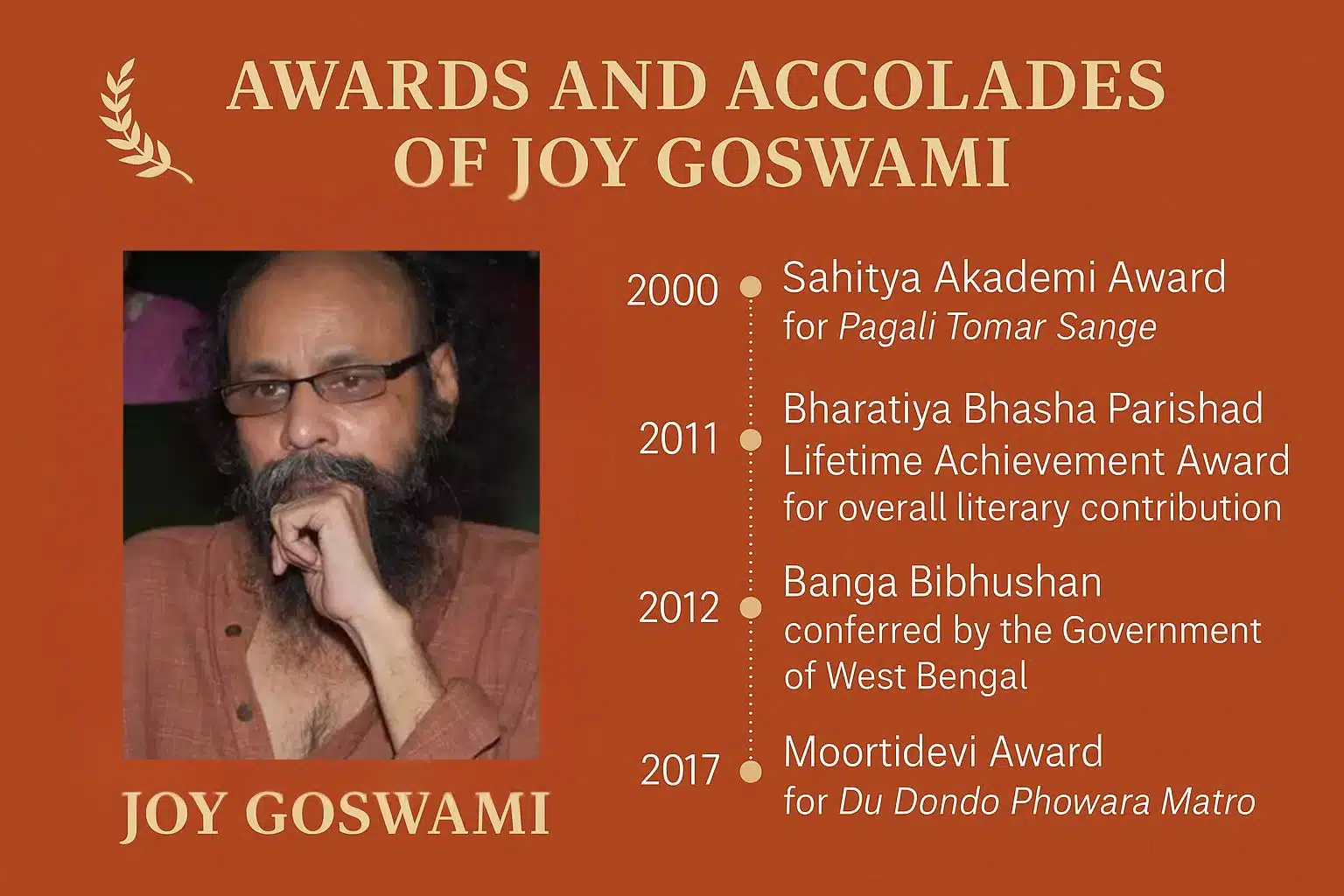
While poetry is not written for awards, recognition from major institutions helps bring a poet’s work to a wider audience. Joy Goswami has received almost every major literary award available to a Bengali writer.
The Sahitya Akademi Award (2000)
Receiving India’s National Academy of Letters award in 2000 for Pagali tomar sange was a watershed moment. It signaled that the literary establishment recognized his unique voice—one that broke many traditional rules of classical Bengali poetry—as a vital part of Indian literature.
Other Prestigious Honors
He is also a recipient of the Ananda Puraskar, one of the most coveted awards in Bengal, not just once, but multiple times, which is a rare feat. He has also received the Banga Bibhushan, the highest civilian award instituted by the West Bengal government, recognizing his lifetime contribution to the state’s culture.
These awards are not just shiny trophies. They represent a consensus among critics, fellow writers, and readers that Joy Goswami is an essential pillar of the language.
| Award Name | Year / Work (If applicable) | Significance |
| Sahitya Akademi Award | 2000 (for Pagali tomar sange) | National recognition as a major Indian poet. |
| Ananda Puraskar | Received multiple times (e.g., 1990, 1998) | Highest non-governmental literary honor in Bengal. |
| Banga Bibhushan | Lifetime Achievement | State-level recognition of his cultural impact. |
| Purnatithi Gallantry Award | Early career recognition | Helped establish him in his initial years. |
Why Joy Goswami Remains Relevant at 71
It is rare for a poet who began writing in the 1970s to remain a bestseller in the 2020s. Yet, Joy Goswami has managed this effortless bridge across generations.
Connection with Gen Z and Millennials
Walk into any Kolkata book fair, and you will see young college students buying his books. Search Instagram or Facebook, and you will find his lines used as captions for photos. Why?
Because the feelings of heartbreak, existential confusion, and the search for identity don’t change with technology. His ability to articulate deep, messy emotions in simple yet startling words resonates with young people today just as it did thirty years ago. It is why Joy Goswami, the solitary bard of Bengal, remains relevant; he doesn’t sound like an “old” poet preaching from a pedestal but like a friend whispering secrets in the dark.
The Unyielding Voice in Modern Times
At 71, he hasn’t stopped carrying the torch. He continues to write, attend literary meets, and encourage younger poets. In an era of immense noise and digital distraction, his dedication to the quiet, difficult craft of poetry serves as a reminder of the power of the written word. He remains a steady moral compass, his recent works still reflecting a deep empathy for the human condition in changing times.
Honoring Joy Goswami the Solitary Bard of Bengal
As Joy Goswami turns 71, we celebrate more than just a birthday. We celebrate a lifetime of looking at the world unflinchingly. He taught generations of Bengali readers that poetry isn’t just about pretty flowers or high ideals; it’s about the dirt under our fingernails, the strange dreams we have before waking, and the silent pain of those around us.
He is the bard who never let us feel truly alone. He is, ultimately, Joy Goswami voice against oblivion in Bengal, ensuring that the small, fragile moments of human life are preserved forever in ink. Happy 71st Birthday to the master.