Climate change can feel overwhelming. Rising temperatures, extreme weather, and biodiversity loss are no longer distant threats. They are happening now in every region of the world. But alongside the bad news, there is powerful progress.
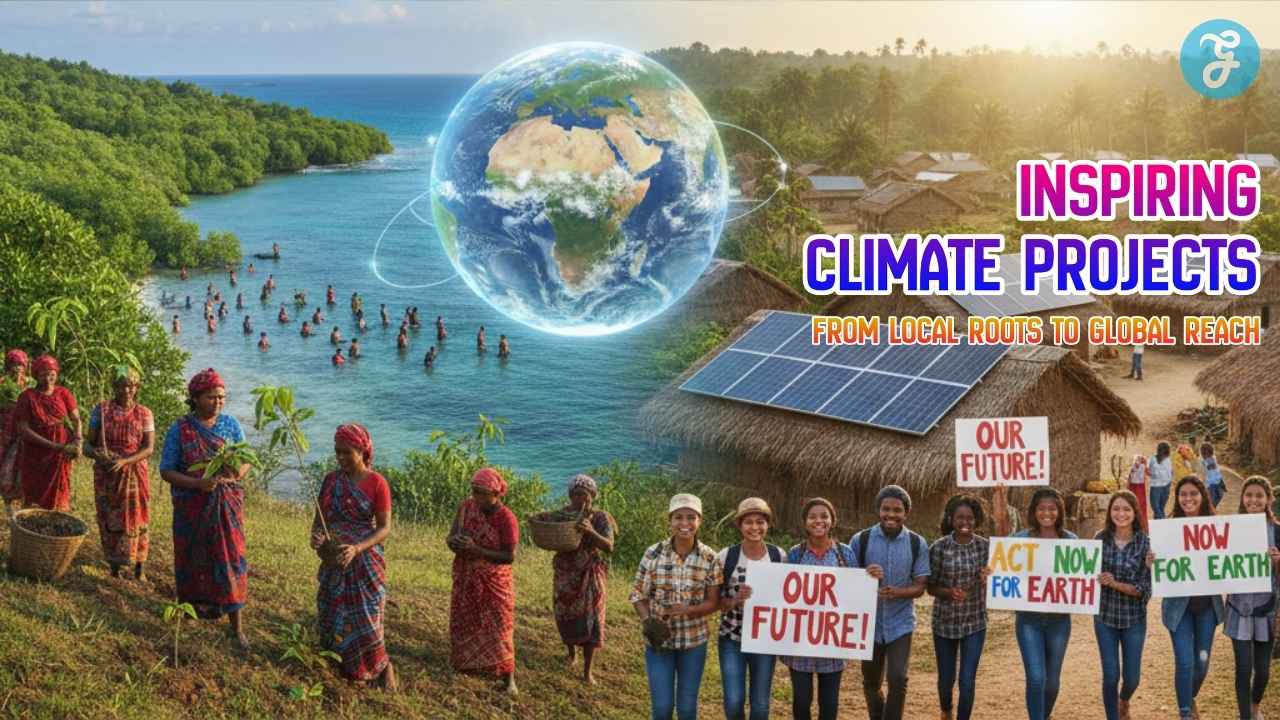
All over the globe, communities, cities, and organizations are running Inspiring Climate Projects that restore forests, protect coasts, power homes with clean energy, and give young people a voice. These are not abstract plans. They are real projects with measurable results.
In this guide, we highlight 18 Inspiring Climate Projects you should follow. Each one shows a different way to cut emissions, protect nature, or help people adapt to a changing climate. You’ll see how they work, why they matter, and how you can keep up with their progress or even support them.
Why Climate Projects Matter Now
Climate science is clear: we must cut emissions fast and build resilience at the same time. The good news is that many solutions are already working on the ground.
- Large-scale restoration efforts, such as the Great Green Wall in Africa, aim to restore up to 100 million hectares of degraded land in the Sahel by 2030.
- Global reforestation initiatives like 1t.org are mobilizing governments, companies, and NGOs to conserve, restore, and grow 1 trillion trees by 2030.
- The UN Environment Programme (UNEP) supports around 90 climate adaptation projects in over 50 countries, with plans to benefit 3.5 million people and restore hundreds of thousands of hectares of land.
These Inspiring Climate Projects turn targets and pledges into visible progress. They pilot new ideas, create jobs, support frontline communities, and show policymakers what is possible at scale.
When you follow these projects, you do more than just “keep up with the news.” You:
- See practical solutions that actually work.
- Learn models that can be copied in other places.
- Find concrete opportunities to donate, volunteer, or amplify.
Quick Overview of the 18 Projects
Here is a snapshot of the 18 climate projects covered in this list.
| # | Project / Initiative | Main Focus | Best For |
| 1 | Eden: People+Planet (Eden Reforestation Projects) | Global reforestation & jobs | Supporting nature-based solutions |
| 2 | Great Green Wall (Africa) | Land restoration in the Sahel | Following large-scale landscape repair |
| 3 | 1t.org Trillion Trees | Global tree conservation & restoration | Tracking corporate & government pledges |
| 4 | Green Belt Movement (Kenya) | Trees + women’s rights | Learning about grassroots leadership |
| 5 | UN Decade on Ecosystem Restoration Flagships | Large restoration “flagship” sites | Seeing global restoration at scale |
| 6 | Global Mangrove Alliance | Mangrove protection & blue carbon | Following coastal climate solutions |
| 7 | Solar Sister | Women-led clean energy businesses | Supporting gender + energy access |
| 8 | Barefoot College “Solar Mamas” | Training rural women as solar engineers | Inspiring skills-based empowerment |
| 9 | C40 Cities | Big-city climate action network | Tracking urban climate solutions |
| 10 | Global Covenant of Mayors | Local governments’ climate plans | Seeing thousands of cities in action |
| 11 | Race to Resilience (UNFCCC) | Climate resilience for vulnerable people | Following adaptation at global scale |
| 12 | RegionsAdapt | Regional governments adapting to climate risks | Learning about subnational action |
| 13 | UNEP Climate Adaptation Projects | Field adaptation projects worldwide | Exploring practical adaptation examples |
| 14 | Climate-Smart Villages (CGIAR) | Climate-smart agriculture | Understanding farmer-level adaptation |
| 15 | Global Mangrove Alliance (coastal focus) | Coastal restoration & fisheries | Seeing climate and livelihoods together |
| 16 | Green Climate Fund (GCF) Portfolio | Climate finance for developing countries | Following major funding flows |
| 17 | Fridays for Future | Youth climate strike movement | Tracking youth activism & pressure |
| 18 | YOUNGO & Youth Climate Action | Youth engagement at the UNFCCC | Understanding youth-led policy work |
Top 18 Inspiring Climate Projects You Should Follow
Discover inspiring climate projects that are actively restoring nature, powering communities with clean energy, and building global resilience.
1. Eden: People+Planet (Eden Reforestation Projects)
Eden: People+Planet works with local communities in countries such as Madagascar, Kenya, Nepal, and Brazil to restore forests and fight poverty at the same time. They hire villagers to plant and protect trees, creating income and long-term stewardship.
Since its founding, Eden has helped plant hundreds of millions of trees, aiming for 50 billion trees by 2030. Their model is simple and powerful: “employ to plant.” Jobs go to people in areas with high unemployment and severe deforestation, so the project improves both ecosystems and livelihoods.
For readers, Eden is easy to follow and support. You can sponsor trees, fund specific project sites, or just track progress through their detailed impact reports and interactive maps.
| Aspect | Key Detail | Quick Explanation |
| Main focus | Reforestation + jobs | Local people are paid to plant and protect trees. |
| Scale | Billions of trees planted | Massive impact on carbon storage and biodiversity. |
| Benefits | Climate, biodiversity, income | Forests recover while families gain stable work. |
| How to follow | Website, reports, social media | Track tree counts, locations, and community stories. |
2. Great Green Wall (Africa)
The Great Green Wall is one of the most iconic land restoration efforts on Earth. Launched by the African Union, it aims to restore 100 million hectares of degraded land across the Sahel, create 10 million jobs, and lift millions out of poverty by 2030.
By 2020, around 18 million hectares had already been restored, with hundreds of thousands of jobs created through agroforestry, sustainable farming, and land management. The project has shifted from a literal “wall of trees” to a mosaic of farms, forests, and grasslands that work for people and nature.
Following the Great Green Wall is a good way to see how climate action, food security, and rural development can fit together in one ambitious program.
| Aspect | Key Detail | Quick Explanation |
| Region | Sahel, across 11+ countries | Stretches ~8,000 km across Africa. |
| Goal | 100M ha restored by 2030 | Combines trees, crops, and grazing. |
| Benefits | Jobs, food, climate resilience | Helps communities stay on their land. |
| How to follow | UNCCD & AU updates | Watch country-level progress and stories. |
3. 1t.org Trillion Trees
1t.org is a global platform, co-founded by the World Economic Forum and partners, to mobilize action to conserve, restore, and grow one trillion trees by 2030.
It does not plant trees itself. Instead, it connects governments, companies, and NGOs, helps set science-based targets, and tracks commitments. For journalists, policy watchers, and activists, it is a key place to see which big players are backing forest-based climate solutions.
This is one of the Inspiring Climate Projects that can show whether large corporate and government pledges translate into real trees and healthier forests.
| Aspect | Key Detail | Quick Explanation |
| Main focus | 1 trillion trees by 2030 | Coordination and tracking, not direct planting. |
| Partners | WEF, NGOs, companies, governments | Brings major actors under one umbrella. |
| Benefits | Forest protection and restoration | Supports climate, water, and biodiversity. |
| How to follow | Online dashboards & reports | See pledges and progress country by country. |
4. Green Belt Movement (Kenya)
The Green Belt Movement, founded in 1977 by Nobel Peace Prize winner Wangari Maathai, links tree planting with women’s rights and democracy in Kenya.
Women are paid small stipends to grow and plant native trees, restoring degraded land while supporting families. Over the decades, the movement has planted millions of trees and empowered tens of thousands of women to organize, vote, and speak out about land rights and corruption.
This project is a classic example of how climate and social justice can go hand in hand.
| Aspect | Key Detail | Quick Explanation |
| Main focus | Trees + women’s empowerment | Climate action plus social transformation. |
| Location | Kenya (national network) | Rural communities and forests. |
| Legacy | Millions of trees planted | Long-term change started from simple nurseries. |
| How to follow | GBM website & stories | Deep background for environmental justice reporting. |
5. UN Decade on Ecosystem Restoration Flagships
Under the UN Decade on Ecosystem Restoration, UNEP and FAO have named “World Restoration Flagships” — large, long-term restoration programs that follow clear principles and robust monitoring.
These flagships include mountain ecosystems, peatlands, small islands, and major river basins. Together, they aim to restore tens of millions of hectares and create up to 15 million jobs by improving forests, farmlands, wetlands, and coasts.
Following these flagships gives you a curated view of some of the most ambitious nature-based climate solutions on the planet.
| Aspect | Key Detail | Quick Explanation |
| Scope | 10+ flagship initiatives | From mountains to islands and drylands. |
| Target | >60–68M ha restored | Very large-scale nature recovery. |
| Benefits | Jobs, climate, biodiversity | Restoration as a development strategy. |
| How to follow | UN Decade website & reports | Track progress across multiple regions. |
6. Global Mangrove Alliance
The Global Mangrove Alliance (GMA) is a partnership that works to halt mangrove loss and expand global mangrove coverage by 20% by 2030.
Mangroves are climate superheroes: they store huge amounts of carbon, protect coasts from storms, and support fisheries. Alliance members have already helped protect around 70,000 hectares and restore around 65,000 hectares of mangroves, with nearly 1 million hectares managed.
For coastal communities, these projects are about survival, not just carbon. Following GMA helps you understand blue carbon, climate resilience, and local livelihoods in one story.
| Aspect | Key Detail | Quick Explanation |
| Main focus | Mangrove conservation & restoration | Nature-based climate solution on coasts. |
| Targets | 20% global extent increase by 2030 | Ambitious, measurable goal. |
| Benefits | Carbon, storm protection, and fisheries | Protects people and marine life. |
| How to follow | Alliance reports & member projects | Rich case studies from many countries. |
7. Solar Sister
Solar Sister supports women in off-grid communities in Africa to start clean energy businesses. Entrepreneurs receive training, a “business in a bag” of solar lanterns and clean cookstoves, and ongoing support.
The model tackles three issues at once: lack of electricity, indoor air pollution, and women’s economic exclusion. Solar Sister is recognized by the UNFCCC as a “lighthouse” climate solution at the nexus of gender, energy, and climate.
As one of the most Inspiring Climate Projects in clean energy access, it is ideal to follow if you want to see how micro-entrepreneurship can scale climate solutions.
| Aspect | Key Detail | Quick Explanation |
| Main focus | Women-led clean energy sales | Local businesses distribute solar products. |
| Region | Sub-Saharan Africa | Uganda, Nigeria, and other countries. |
| Benefits | Clean power + income + health | Replaces kerosene and wood, boosts income. |
| How to follow | Impact stories, annual reports | Human-centered narratives and data. |
8. Barefoot College “Solar Mamas.”
Barefoot College International trains rural women with little or no formal education to become solar engineers. Over six months of hands-on training, they learn to assemble, install, and repair solar systems.
In places like Zanzibar, these women — often called “Solar Mamas” — have already connected over 1,800 homes in nearly 30 villages to clean power, with trainees also coming from other African countries. They return home as respected technicians and community leaders.
This is a vivid example of how climate technology, skills training, and gender equality can reinforce each other.
| Aspect | Key Detail | Quick Explanation |
| Main focus | Training women as solar engineers | Skills, confidence, and income. |
| Reach | Women from >90 countries | A global training network. |
| Benefits | Electricity, health, empowerment | Cuts kerosene use and creates local experts. |
| How to follow | Barefoot College stories & films | Highly visual and inspiring cases. |
9. C40 Cities
C40 Cities is a network of 90+ major cities representing around 920 million people and a quarter of the global economy.
Cities in C40 commit to halving emissions by 2030, building resilience, and advancing climate justice. They share policies on clean transport, zero-carbon buildings, waste, and more. Case studies range from bus electrification to low-emission zones and nature-based urban cooling.
For anyone tracking urban climate solutions, C40 is one of the most important hubs to watch.
| Aspect | Key Detail | Quick Explanation |
| Main focus | City-level climate action | Mayors collaborate on practical solutions. |
| Members | 97 cities worldwide | From Dhaka to London and São Paulo. |
| Benefits | Cleaner air, lower emissions, resilience | Cities move faster than many nations. |
| How to follow | C40 reports & knowledge hub | Detailed guides and case studies. |
10. Global Covenant of Mayors for Climate & Energy
The Global Covenant of Mayors (GCoM) is the world’s largest alliance of city and local government climate commitments, with over 13,500 signatories covering more than 1.2 billion people.
Cities in GCoM commit to measuring emissions, setting targets, and reporting progress. The platform offers tools and data to help small and medium cities that lack big technical teams.
Together with C40, GCoM shows how local action can add up to significant global emission cuts.
| Aspect | Key Detail | Quick Explanation |
| Main focus | Local climate commitments | Standardizes planning and reporting. |
| Membership | 13,500+ cities and regions | Across six continents. |
| Benefits | Data, guidance, visibility | Helps cities turn pledges into plans. |
| How to follow | Interactive maps & reports | See which cities are acting and how. |
11. Race to Resilience (UNFCCC)
Race to Resilience is a UNFCCC-backed campaign launched in 2020 to boost climate resilience for vulnerable communities. It brings together 34 partner initiatives with over 1,700 members working in 139 countries.
The goal is to protect people and nature from climate shocks — floods, heatwaves, storms, and droughts — by improving infrastructure, early-warning systems, ecosystems, and social protection.
If you want to follow adaptation, rather than only emissions reductions, this is one of the central Inspiring Climate Projects to watch.
| Aspect | Key Detail | Quick Explanation |
| Main focus | Climate resilience & adaptation | Focus on vulnerable cities, regions, and communities. |
| Reach | 139+ countries via partner initiatives | Massive global footprint. |
| Benefits | Reduced risk and losses | From better housing to restored ecosystems. |
| How to follow | UN Climate Champions updates | Campaign reports and partner stories. |
12. RegionsAdapt
RegionsAdapt supports regional governments (states, provinces, regions) to plan and implement climate adaptation, often linking directly with the Race to Resilience.
Regional governments often control land use, transport, and natural resource policies. RegionsAdapt helps them share best practices, publish progress reports, and coordinate with national governments and the private sector.
This initiative is useful to follow if you want to see how climate adaptation works between the city and national levels.
| Aspect | Key Detail | Quick Explanation |
| Main focus | Regional adaptation planning | Bridges local actions and national policies. |
| Members | Subnational governments worldwide | From Europe to Latin America and Africa. |
| Benefits | Shared knowledge & financing links | Makes adaptation more coordinated and efficient. |
| How to follow | Regions4 and RegionsAdapt reports | Policy briefs, progress reports, and case studies. |
13. UNEP Climate Adaptation Projects
The UN Environment Programme (UNEP) supports nearly 90 climate adaptation projects in over 50 countries. These projects plan to benefit about 3.5 million people, restore more than 240,000 hectares of land, and build thousands of water structures and weather stations.
Projects range from flood early-warning systems to climate-resilient agriculture and coastal protection. Together they form a living laboratory of what practical adaptation looks like across different geographies.
Following this portfolio gives a broad view of climate adaptation beyond a single project or country.
| Aspect | Key Detail | Quick Explanation |
| Scope | ~90 projects in 50+ countries | From Africa to Asia and Latin America. |
| People reached | ~3.5 million people targeted | Focus on vulnerable communities. |
| Benefits | Better water, land, and risk management | Hands-on adaptation in many sectors. |
| How to follow | UNEP adaptation map & project list | Browse by country, sector, or theme. |
14. Climate-Smart Villages (CGIAR)
The Climate-Smart Villages (CSV) concept, led by CGIAR’s climate program, tests adaptation and mitigation options directly with farmers in Africa, Asia, and Latin America.
Farmers experiment with drought-tolerant crops, new irrigation techniques, weather information services, and carbon-friendly farming practices. The goal is to improve food security while reducing emissions or increasing carbon storage in soils.
For anyone interested in rural development, this is one of the most practical and grounded Inspiring Climate Projects.
| Aspect | Key Detail | Quick Explanation |
| Main focus | Climate-smart agriculture | Helps smallholders adapt and mitigate. |
| Regions | West/East Africa, South & SE Asia, Latin America | Diverse climates and cultures. |
| Benefits | Stable yields, lower risk, climate gains | Protects food systems from climate shocks. |
| How to follow | CGIAR CSV case studies | Deep technical and human stories. |
15. Global Peatlands Initiative
The Global Peatlands Initiative (GPI) works to protect and restore peatlands — wetlands that store more carbon than all the world’s forests, despite covering only about 3% of land.
Peatlands are sometimes called a “carbon bomb.” When they are drained or burned, they release huge amounts of CO₂. GPI, led by UNEP and partners, helps countries like Indonesia, Peru, and the Congo Basin nations map peatlands, protect them, and change management practices.
If you care about nature-based climate solutions, following GPI is essential — peatlands are one of the fastest ways to avoid large emissions.
| Aspect | Key Detail | Quick Explanation |
| Main focus | Peatland conservation & restoration | Protects some of the densest carbon stores. |
| Regions | Global, with tropical focus | Indonesia, DRC, the Republic of Congo, Peru, etc. |
| Benefits | Huge emissions avoided, water & biodiversity | Supports climate targets at low cost. |
| How to follow | GPI assessments & Peatland Breakthrough | New maps, targets, and national commitments. |
16. Green Climate Fund (GCF) Project Portfolio
The Green Climate Fund is the largest dedicated climate fund for developing countries. It finances mitigation and adaptation projects, often in partnership with national institutions and development banks.
Recent board meetings have approved hundreds of projects worth around $17–21 billion in GCF funding and tens of billions more in co-finance. Projects range from resilient agriculture and coastal defenses to renewable energy and green bond initiatives.
Rather than one single project, the GCF portfolio is a window into how global climate finance is actually flowing — and which kinds of solutions are being scaled.
| Aspect | Key Detail | Quick Explanation |
| Main focus | Climate finance for developing countries | Grants, loans, and guarantees. |
| Portfolio | 300+ projects worldwide | Mitigation and adaptation split. |
| Benefits | Unlocks larger investments | Helps countries implement their climate plans. |
| How to follow | GCF project database & board news | Track approvals, regions, and themes. |
17. Fridays for Future
Fridays for Future (FFF) is a youth-led movement that began with Greta Thunberg’s school strike in 2018 and grew into global climate strikes involving millions of people.
Students and young adults skip or use part of their Fridays to protest inaction on climate change, call for fossil fuel phase-outs, and demand climate justice. The movement continues to organize global climate strikes, including plans for major actions around COP30 in Brazil.
While not a “project” in the traditional sense, FFF is a powerful engine that keeps public pressure high and amplifies many of the other projects on this list.
| Aspect | Key Detail | Quick Explanation |
| Main focus | Youth climate strikes & activism | Street protests, online campaigns, advocacy. |
| Reach | Actions in 100+ countries | Global, decentralized movement. |
| Benefits | Public pressure and visibility | Forces leaders to react and respond. |
| How to follow | Social media, local FFF groups | Great for real-time updates and stories. |
18. YOUNGO & Youth Climate Action
YOUNGO is the official children and youth constituency of the UNFCCC. It is a global network of youth organizations and activists up to age 35, working on policy, education, and local projects.
YOUNGO members organize the annual Conference of Youth (COY) before COPs, draft youth position papers, and coordinate working groups on topics like food, energy, and human rights. They also highlight grassroots youth projects, from agroecology to community organizing.
If you want to follow youth voices inside the official UN climate process, this is the place to look.
| Aspect | Key Detail | Quick Explanation |
| Main focus | Youth engagement in climate policy | Official channel into UNFCCC talks. |
| Activities | COY events, position papers, campaigns | Links local youth work with global debates. |
| Benefits | Fresh ideas, justice-focused lens | Keeps negotiations accountable to future generations. |
| How to follow | YOUNGO website & working group channels | Follow specific themes like food, energy, or education. |
How to Engage with These Inspiring Climate Projects
You do not need to be a scientist, politician, or billionaire to support Inspiring Climate Projects. Small, steady actions matter.
Here are a few practical ways to engage:
- Pick 2–3 projects to track closely: Follow Eden, Solar Sister, or the Great Green Wall on social media. Read their newsletters. Over time, you’ll understand strategies that work.
- Support financially if you can: Even small monthly donations help community projects plan ahead. Many have transparent reporting and clear impact metrics.
- Use their stories in your own work: If you are a teacher, journalist, or entrepreneur, these case studies can inform lessons, articles, or business models.
- Volunteer your skills: Many NGOs need help with design, translation, coding, or communications. Some even have remote volunteering options.
- Connect local and global: Look at what C40 or Climate-Smart Villages are doing and ask: “How could something similar work where I live?”
When you engage with these Inspiring Climate Projects, you also change your own story about the climate crisis — from fear and paralysis to agency and connection.
Final Thought: The Power of Inspiring Climate Projects
Climate change is a long-term emergency, but it is not a story of doom alone. The Inspiring Climate Projects in this list prove that people everywhere are already restoring forests, protecting coasts, transforming cities, and raising their voices.
Following these projects keeps you grounded in real solutions. Supporting them — with your attention, money, or skills — helps them grow. Most importantly, they show that climate action is not just for governments and big corporations. It is for farmers, teachers, mayors, students, and you.
If you choose even one project from this list to follow or support, you become part of a global network of people who are quietly, steadily, reshaping the future.