There is something undeniably intimidating about a blank page. You buy a beautiful notebook, crack open the spine, hold your pen above the paper, and then… nothing. If you have ever felt this specific type of “writer’s block,” you are not alone. The concept of journaling for beginners often feels complicated because social media has convinced us that our journals need to be art galleries filled with calligraphy and watercolor paintings.
The truth? Journaling is messy, raw, and one of the most powerful tools available for your mental health. It isn’t about performing for an audience; it is about thinking on paper. Whether you are looking to reduce anxiety, boost your productivity, or simply document your life, this guide will walk you through exactly how to start journaling for beginners, what to write, and how to turn a fleeting interest into a life-changing habit.
Why Journal? The Science Behind the Habit
Before we dive into how to do it, it is crucial to understand why you are doing it. When you understand the tangible benefits, you are far less likely to quit after three days. Journaling isn’t just a hobby for writers; it is a cognitive exercise backed by psychology.
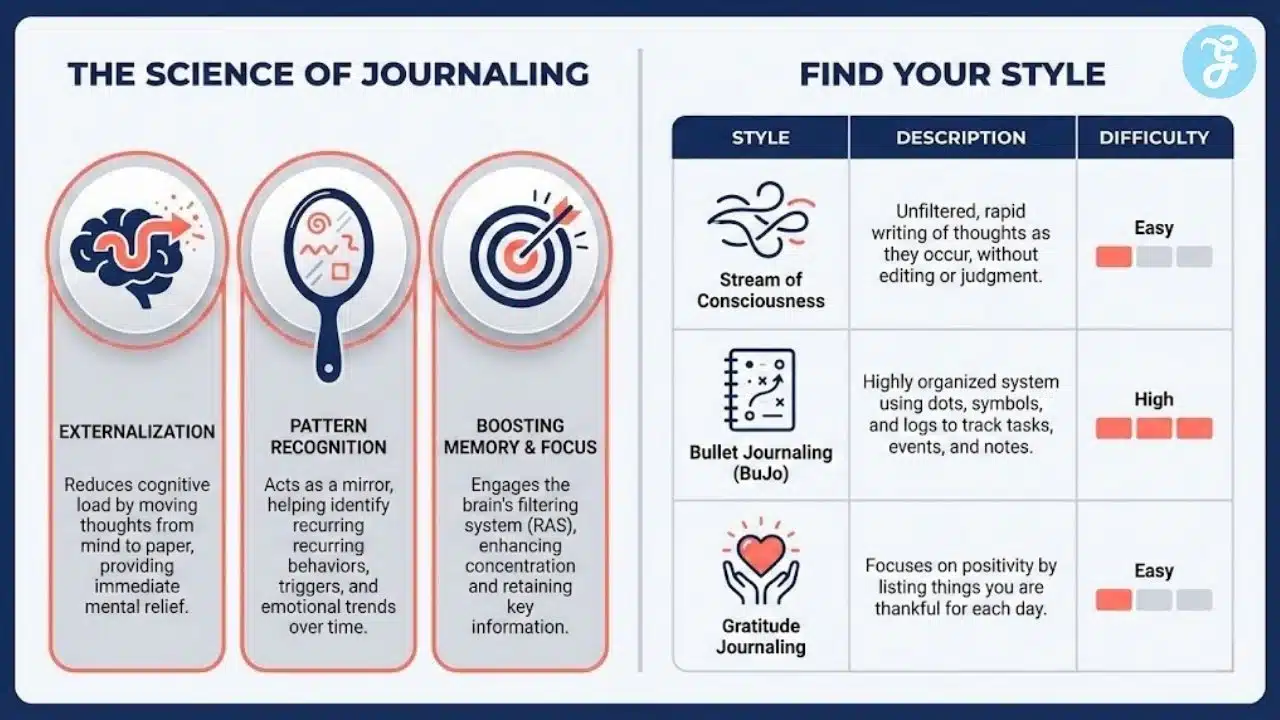
1. Externalizing Your Thoughts
Our brains are not designed to hold onto looping thoughts. When you keep worries, to-do lists, and vague anxieties trapped in your head, they bounce around and create “cognitive load.” This leads to stress and brain fog.
Writing these thoughts down is a process called “externalization.” By physically moving a thought from your mind to the paper, you signal to your brain that the information is safe and accounted for. This often provides an immediate sense of relief, commonly described as a “weight being lifted.”
2. Emotional Intelligence and Pattern Recognition
Have you ever felt sad but didn’t know why? A regular journaling practice acts as a mirror. Over time, you begin to see patterns. You might notice that you are always irritable on Tuesdays (perhaps due to a specific meeting) or that your mood dips whenever you skip breakfast. Identifying these triggers is the first step toward managing them.
3. Boosting Memory and Focus
In an age of digital distraction, we rarely focus on one thing for more than a few seconds. Journaling forces you to slow down (especially if you write by hand). Studies suggest that handwriting engages the brain’s Reticular Activating System (RAS), which helps filter information and brings focus to what is currently important.
Choosing Your Style: Different Types of Journaling
One of the biggest mistakes in journaling for beginners is trying to force a style that doesn’t fit your personality. If you hate drawing, don’t start an art journal. If you hate structure, don’t start a strict bullet journal.
Here is a breakdown of the most popular methods to help you decide which one fits you.
| Journaling Type | Best For… | Description | Difficulty Level |
| Stream of Consciousness | Anxiety relief & overthinkers | Writing whatever comes to mind without stopping, editing, or worrying about grammar. Often called “Morning Pages.” | Easy |
| Bullet Journaling (BuJo) | Planners & Type-A personalities | A system of dots, symbols, and logs to track tasks, habits, and future events. Highly organized. | High |
| Gratitude Journaling | Positivity seekers | Simply listing 3–5 things you are thankful for each day. Quick and effective for shifting mindset. | Easy |
| The “One Line a Day” | Busy professionals | Writing a single sentence summarizing your day. Low commitment, high reward for memory keeping. | Very Easy |
| Art / Junk Journaling | Creatives | Using collage, ticket stubs, photos, and sketches mixed with text. Focuses on visual expression. | Medium |
| Prompt-Based Journaling | Those with “Writer’s Block” | Answering a specific question each day (e.g., “What is your biggest fear?”). Removes the pressure of choosing a topic. | Easy |
Analog vs. Digital: Which Tool Should You Use?
There is an ongoing debate in the productivity world: Is it better to write by hand or use an app? Both have merits, and the “correct” choice is simply the one you will actually use.
The Case for Analog (Pen and Paper)
For most beginners, I recommend starting with a physical notebook.
-
No Distractions: A notebook does not have notifications, email pop-ups, or social media apps. It is a sacred, disconnected space.
-
Tactile Experience: The physical act of writing slows your racing thoughts down to the speed of your hand. This mismatch in speed is actually helpful—it forces you to process what you are thinking.
-
Freedom: You can draw an arrow, circle a word, scribble out a mistake, or tape in a receipt. You aren’t confined by software limitations.
The Case for Digital (Apps and Docs)
-
Searchability: You can instantly search for “Christmas 2019” or “Idea for startup” and find every entry you’ve ever written on that topic.
-
Security: If you live with roommates or family and are terrified of someone reading your private thoughts, a password-protected app (like Day One, Notion, or Apple Journal) offers peace of mind.
-
Speed: If you are a fast typist, you can log thoughts much quicker than you can handwrite them.
The Journaling Starter Kit (Recommendations)
You don’t need expensive gear, but having tools you enjoy using makes the habit stickier. Here are a few favorites from the community:
-
The “No-Pressure” Notebook: A simple Leuchtturm1917 or a Midori MD. These have high-quality paper that feels good to write on but aren’t so fancy that you’re afraid to ruin them.
-
The “Smooth” Pen: The Pilot G2 (0.7mm) or Muji Gel Ink pens are cult favorites. They glide across the page, making the physical act of writing satisfying.
-
The Digital Setup: Day One is the gold standard for dedicated journaling (it tracks weather and location automatically). For a free option, Google Keep or Apple Notes work perfectly for rapid-fire bullet journaling.
How to Start Journaling in 4 Simple Steps?
You have your “why,” you have picked a style, and you have your tool. Now, let’s get into the practical nitty-gritty of building the habit.
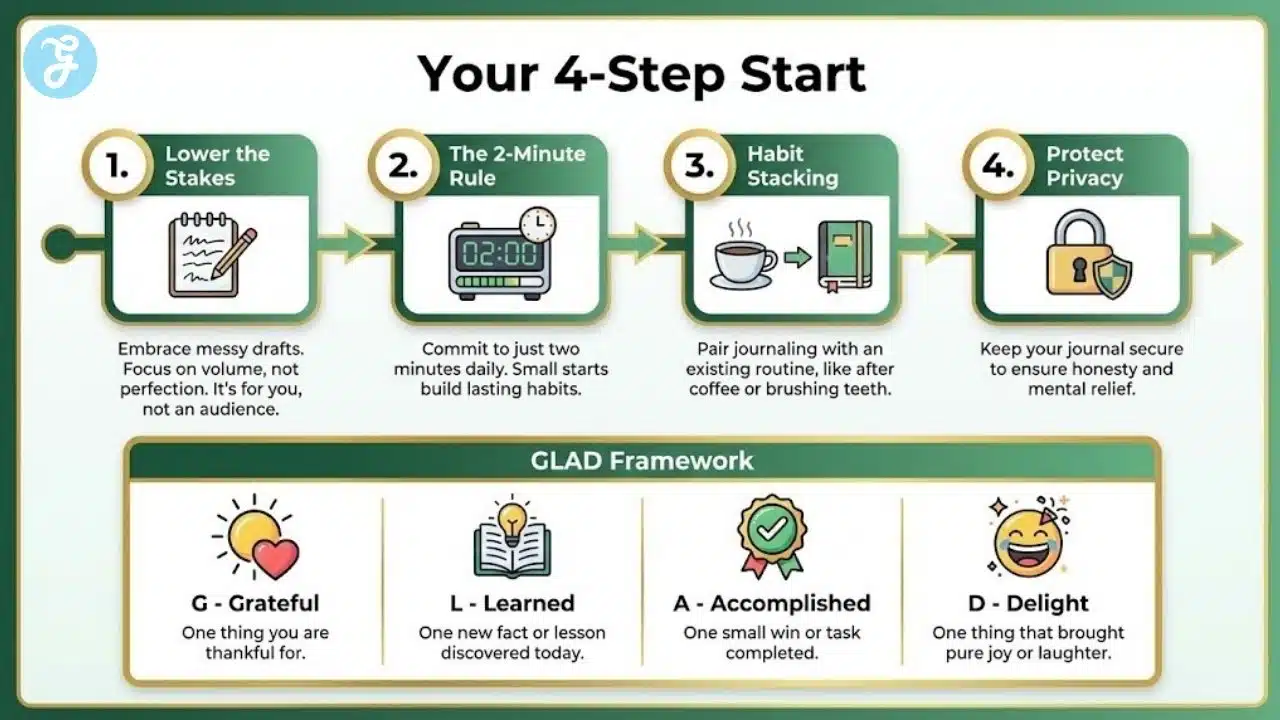
Step 1: Lower the Stakes
The biggest enemy of a new habit is perfectionism. If you buy a $40 leather-bound journal, you might feel like your writing needs to be “profound” to justify the cost.
Pro Tip: Start with a cheap composition notebook or a random stack of paper. Tell yourself, “This is my messy draft.” Give yourself permission to have bad handwriting, spelling errors, and boring entries. The goal is volume, not quality.
Step 2: The Two-Minute Rule
A common pitfall in journaling for beginners is overcommitting. You might say, “I will write three pages every morning at 5:00 AM.” You will likely do this for three days and then quit.
Instead, use the Two-Minute Rule. Commit to journaling for just two minutes. That’s it. Anyone can find two minutes. Usually, once you start, you will keep going for ten minutes. But if you truly only write for two minutes, that counts as a win.
Step 3: Habit Stacking
“Habit Stacking” is a technique popularized by James Clear. It involves pairing a new habit with an existing one.
-
Wrong: “I will journal sometime today.”
-
Right: “After I pour my morning coffee, I will open my journal.”
- Right: “After I brush my teeth at night, I will write one line about my day.”By anchoring the journaling to a trigger (coffee, toothbrush), you reduce the mental effort required to remember to do it.
Step 4: Protect Your Privacy
You cannot be honest in your journal if you are worried about judgment. If you are writing physically, keep your journal in a secure place. If you are truly paranoid, you can use a technique called “Write and Burn,” where you write out your most intense frustrations on loose paper and then destroy it immediately. The mental relief comes from the writing, not the keeping.
20 Journaling Prompts for Beginners
Still staring at that blank page? “What should I write about?” is the most common question beginners ask. Here is a curated list of prompts divided by category.
For Self-Discovery
-
What is a personality trait you have that you are proud of?
-
If you could talk to your teenage self, what advice would you give them?
-
What does your “perfect average day” look like? (Not a vacation, but a realistic ideal Tuesday).
-
What are three things that drain your energy? What are three things that give you energy?
-
What is a compliment you received recently that stuck with you?
For Anxiety and Stress Relief
-
The Brain Dump: List everything that is currently worrying you. Don’t use full sentences; just get it out of your head.
-
What is the worst-case scenario for your current problem? If that happened, how would you handle it?
-
Write a letter to someone you are angry with (but do not send it).
-
List 5 things you can see, 4 things you can feel, 3 things you can hear, 2 things you can smell, and 1 thing you can taste.
-
“Right now, I am feeling…” (Describe the emotion physically—is it a tightness in your chest? A headache?)
For Gratitude and Positivity
-
What made you smile today?
-
Who is a person in your life you are grateful for, and why?
-
What is a challenge you overcame in the past that you are proud of?
-
Look around the room you are in. Find one beautiful thing and describe it.
-
What is something you are looking forward to this week?
“Rapid Fire” (For Busy Days)
-
One good thing that happened today:
-
One thing I learned today:
-
Today’s dominant emotion was:
-
Tomorrow I want to focus on:
-
I am currently reading/watching/listening to
Level Up: The “CBT” Method for Anxiety
If you are journaling specifically to combat anxiety, “venting” isn’t always enough. Sometimes, we need to challenge our thoughts. This method borrows from Cognitive Behavioral Therapy (CBT):
-
The Trigger: What happened? (e.g., My boss sent me a vague email.)
-
The Automatic Thought: What did your brain immediately say? (e.g., “I’m getting fired.”)
-
The Evidence: Is this thought 100% true? (e.g., No. She sends short emails often. I hit all my targets last week.)
-
The Reframe: What is a more balanced thought? (e.g., “She is likely just busy. I will ask for clarification if I don’t hear back.”) Writing this sequence stops the spiral in its tracks.
Overcoming Common Journaling Hurdles
Even with the best intentions, you will face obstacles. Here is how to navigate the common roadblocks in journaling for beginners.
“I skipped a few days and now I feel guilty.”
This is the “breaking the chain” fallacy. We feel that if we break a streak, we have “failed” and might as well give up.
** The Fix:** Your journal doesn’t judge you. It doesn’t care if you skipped a week, a month, or a year. The next time you open it, just write: “It has been a while. Here is what has been happening…” Do not apologize to the notebook. Just pick up where you left off.
“My life is boring. I have nothing to say.”
You don’t need to be an explorer or a secret agent to have a worthwhile journal. Some of the most fascinating historical journals are simply accounts of weather, prices of food, and minor daily annoyances.
The Fix: Focus on observation rather than events. If you didn’t do anything today, what did you think about? What did you eat? How did the sky look? These small details ground you in the present moment.
“I hate my handwriting.”
Many adults haven’t written by hand since college, and their handwriting has deteriorated.
The Fix: Slow down. Treat your handwriting as a mindfulness practice. But ultimately, remember: legibility is for you, not for an art museum. If you can read it, it is perfect. If it really bothers you, switch to a digital journal.
How to Review Your Journal?
The magic of journaling often happens in the review. If you never look back at what you wrote, you are missing half the value.
Try to review your journal once a month. You will be shocked at what you find.
-
Perspective: You will read an entry from three weeks ago where you were panicked about a deadline. Now, from the future, you realize that the deadline passed and everything was fine. This teaches your brain that feelings are not facts and that anxiety is often temporary.
-
Progress: You might notice that you are complaining about the same relationship issue for six months straight. This objective data might be the push you need to finally make a change or have a difficult conversation.
The Sunday Reset: A Weekly Ritual
Reviewing a whole month can be daunting. Try a mini-review every Sunday evening. Draw a line across the page and answer these three questions to clear the slate for the week ahead:
-
What worked this week? (Celebrations/Wins)
-
What didn’t work? (Stressors/Distractions)
-
What is one thing I want to improve next week? (Actionable Goal)
Stuck? Try These 3 Structuring Frameworks
Sometimes, a specific prompt feels too restrictive, but a blank page feels too vast. This is where “Frameworks” come in. These are recurring structures you can use every single day to organize your thoughts without having to invent a new format each time.
1. The “GLAD” Technique
This is a fantastic, positive-psychology framework that covers all bases. It forces you to look for specific types of positives in your day.
-
G – Grateful: One thing you are thankful for.
-
L – Learned: One new fact or lesson you discovered today.
-
A – Accomplished: One small win (even if it was just “making the bed”).
-
D – Delight: One thing that brought you pure joy or made you laugh.
2. The “Sandwich” Method (For Bad Days)
If you are having a terrible day, spiraling into negativity can sometimes make it worse. The Sandwich Method ensures you vent your frustrations but wraps them in perspective.
-
Top Bun (Positive): Start with one good thing that is happening right now, no matter how small (e.g., “The coffee I am drinking is hot”).
-
The Meat (The Vent): Let it all out. Complain, whine, and describe exactly what is wrong. Get the “poison” out of your system.
-
Bottom Bun (The Hope): End with one actionable step you can take to make tomorrow 1% better.
3. The Morning Pilot
Instead of reacting to your day, use this framework to proactively “pilot” it. Do this first thing in the morning.
-
The “One Thing”: If I only get one thing done today, what should it be?
-
The “Let Go”: What is a worry I am carrying that I cannot control today? (Write it down, then mentally drop it.)
-
The “Vibe”: What one word do I want to describe my attitude today? (e.g., “Calm,” “Focused,” “Kind”).
Final Thoughts: Just Start
If you have read this far, you are ready. You have all the information you need. The only thing left to do is the action itself.
Remember that journaling for beginners is a journey, not a destination. You are not trying to write a memoir that will sell millions of copies; you are trying to build a relationship with yourself. Some days your entries will be deep and philosophical; other days they will just be a grocery list and a complaint about the weather. Both are valid.
Your mental health deserves those five minutes of attention. Your memories deserve to be captured. So, grab a pen, open a new page, and write the first word. You might be surprised by what follows.