Do you ever feel like you are running on a hamster wheel? You take on any client who can pay, compete purely on price, and feel completely stuck. I have been there. Your income stays flat even though you work harder each year. You deal with clients who drain your energy, miss deadlines, and argue about every invoice. Trying to be everything to everyone is costing you serious money.
Here is a secret that can change your business completely. Agencies that pick a specific niche charge up to three times more than generalists. They attract better clients, spend less time selling, and actually enjoy the work again.
I am going to walk you through how to niche down your agency, and I think you will be surprised at how easy it can be.
Why Niching Down Your Agency Matters
Niching down transforms your agency from a generic shop into a powerhouse. Clients actually want to hire specialists. You will attract better clients, charge more money, and spend less time chasing bad prospects.
Increased profitability
Specialization transforms your bottom line fast. A 2025 report by Promethean Research on the US market found that 84 percent of digital agencies now identify as specialists. More importantly, these focused firms grew two to three times faster than the industry average.
When you focus on a specific target market, you stop competing on price. Your service differentiation becomes crystal clear. You charge premium pricing because clients see the results you deliver.
For example, US data from agency growth expert Corey Quinn shows specialized agencies can retain law firm clients for an average of 30 months at $10,000 per month. Generalist competitors often lose similar clients after just 12 months at a $2,000 monthly rate. That is a massive difference in customer lifetime value.
Easier client acquisition
Niching down makes finding clients much simpler. Prospects in your target market already know you solve their specific problems.
“The riches are in the niches, so stop spreading yourself too thin.”
Your marketing strategy becomes laser-focused. You reach the right people at the right time. Your value proposition becomes obvious to decision-makers.
According to the 2025 B2B Buyer Experience Report by 6sense, 95 percent of the time, the winning vendor is already on the buyer’s Day One shortlist. Niching gets you on that shortlist because you are the recognized expert. Your revenue maximization accelerates because you close deals faster.
As your client acquisition machine starts humming along, magic happens behind the scenes. Your team stops chasing every lead and starts mastering one specific market.
You become the go-to expert. Clients recognize you as the authority in your space. This authority commands respect, attention, and premium pricing.
When you focus on one target market, you learn their specific language. You understand their problems better than generalists ever could. This expertise becomes your greatest competitive advantage.
Common Misconceptions About Niching
Many agency owners fear that picking a niche will shrink their business. They worry it closes doors to money-making opportunities. In reality, specialization opens better doors.
Fear of limiting opportunities

“Specialization does not limit your options; it clarifies your value.”
Many agency owners panic at the thought of narrowing their focus. They worry that picking a specific target market is business suicide. The truth is the exact opposite.
Clients pay premium pricing for specialists. Your strategic positioning becomes crystal clear when you focus on solving specific problems. You stop competing on price and start competing on value.
Abandoning the generalist approach transforms your agency. It becomes a revenue-generating machine that attracts clients willing to invest.
Concern about market size
Many worry that picking a niche shrinks their market too much. They fear they will lose money by serving fewer clients. A smaller, focused market actually generates more revenue.
A 2026 report by Artisan AI notes that there are over 100,000 marketing agencies in the US. You do not need all of them. Focusing on just 5,000 local dental practices can easily generate a $75 million total addressable market.
Your target market may look tiny on paper, but it holds serious buying power. Business growth accelerates because you attract better-fit clients. The real concern is whether you are reaching the right people with the right message.
Steps to Niche Down Your Agency
Finding your sweet spot requires a systematic approach. You will move through a clear process to transform your broad service offerings.
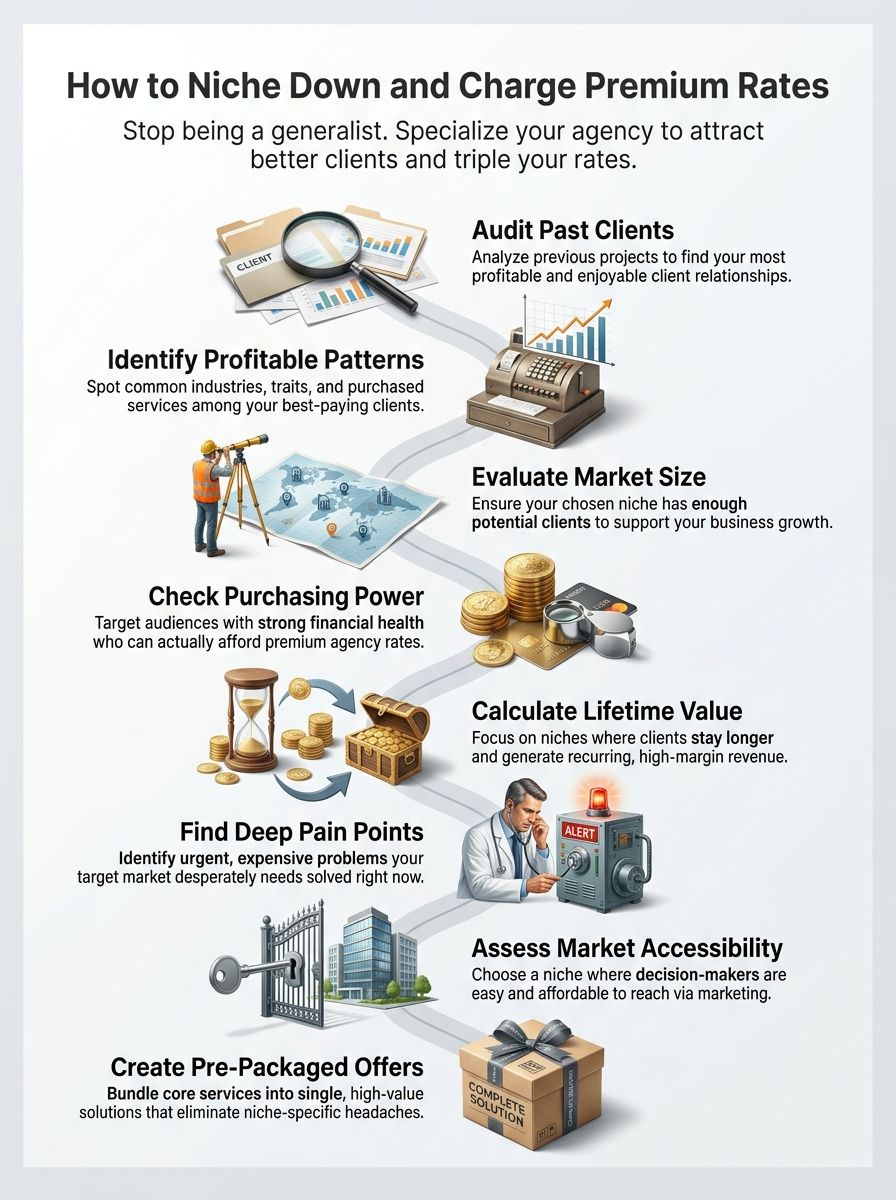
Step 1: Audit your current and past client list
Your client list holds gold. Dig through your records and pull every client you have worked with. Look at which clients brought in the most revenue.
I recommend using a modern CRM to pull this data quickly. For a digital agency, popular US tools in 2026 include:
- HubSpot CRM: Great for pulling detailed revenue reports.
- Pipedrive: Excellent for tracking historical deal velocity.
- NetHunt CRM: Perfect for viewing past email communication history.
Your best clients already exist in your files. Group them by industry, company size, and budget range. The clients you enjoyed most show you exactly where your specialization should go.
Step 2: Identify patterns and client preferences
Now that you have reviewed your client list, patterns start to emerge. Notice which projects made you money and which ones drained your resources.
The clients who fit this profile share common traits or challenges. These are your goldmines. Track which problems you solved best for them.
A great insider tip is to look for the clients with the highest lifetime value and the lowest number of support tickets. Clients in the same industry often share similar pain points and budget cycles. This data reveals where clients see premium pricing as money well spent.
Step 3: Evaluate potential niches based on key factors
Figuring out which niche makes sense separates smart moves from costly mistakes. Your target market must have real money to spend.
Agency growth expert Corey Quinn suggests running potential niches through three strict filters:
- Harvest existing wisdom: Choose a niche where you already have case studies.
- Check purchasing power: Ensure the industry is growing, not shrinking.
- Evaluate access: Make sure you can easily find and contact the decision-makers.
Market segmentation works best when you pick a niche where you genuinely want to work. This evaluation saves you from picking a niche that fails in reality.
Step 4: Total addressable market
It is time to measure the actual market size. Your total addressable market, or TAM, tells you how much money exists in your chosen niche. A small market cannot support premium rates. To calculate TAM accurately, you should use the Bottom-Up formula.
TAM = Number of potential customers x Annual Contract Value. If you target 5,000 dental practices in the Midwest and charge an annual contract value of $15,000, your TAM is $75 million. That is a solid market size that supports strong business growth.
Step 5: Purchasing power of your target audience
Knowing the size of your market means nothing if your audience cannot afford you. Your target audience’s purchasing power shapes your pricing strategy.
A smart pro-tip is to verify a company’s revenue before pitching. You can do this by checking:
- Public financial filings.
- Company size data on LinkedIn.
- Revenue brackets using tools like ZoomInfo.
Small startups operate with tight budgets and may balk at premium pricing. Mid-market companies have deeper pockets and value professional expertise.
Step 6: Lifetime value of potential clients
Dig deeper into how much clients will spend with you over time. Lifetime value measures the total revenue a client generates.
Calculate lifetime value by multiplying the average monthly revenue per client by how long they stay. A client who pays $5,000 monthly and stays for three years generates $180,000 in lifetime value.
High-value niches let you charge premium pricing without needing constant new clients. Promethean Research notes that specialist agencies often see 40 percent to 60 percent higher profit margins purely because of this increased retention.
Step 7: Strong need and pain points
Your target audience must have pressing problems that keep them awake at night. These pain points drive clients to spend money on solutions.
A 2025 survey by BlueWhale Research found that over 60 percent of US tech buyers start researching new solutions specifically to fix inefficiencies or improve ROI. You need to speak directly to those two triggers.
Ask people in your chosen niche what frustrates them most. Listen for the problems they mention repeatedly. When you solve problems that matter deeply, clients see real value.
Step 8: Ease of reaching your niche
A niche with massive demand means nothing if you cannot find your target audience affordably. Think about where your potential clients spend their time.
“If you cannot reach your target market easily, you do not have a business; you have a hypothesis.”
Measure the accessibility of reaching your target market before you commit. For US B2B audiences, LinkedIn Sales Navigator is an excellent tool to see exactly how many reachable decision-makers exist. Pick a niche where your message reaches the right people without burning through your budget.
How to Select the Right Niche
Picking your niche comes down to matching what you do best with what your clients actually need. You can slice your market in several different ways.
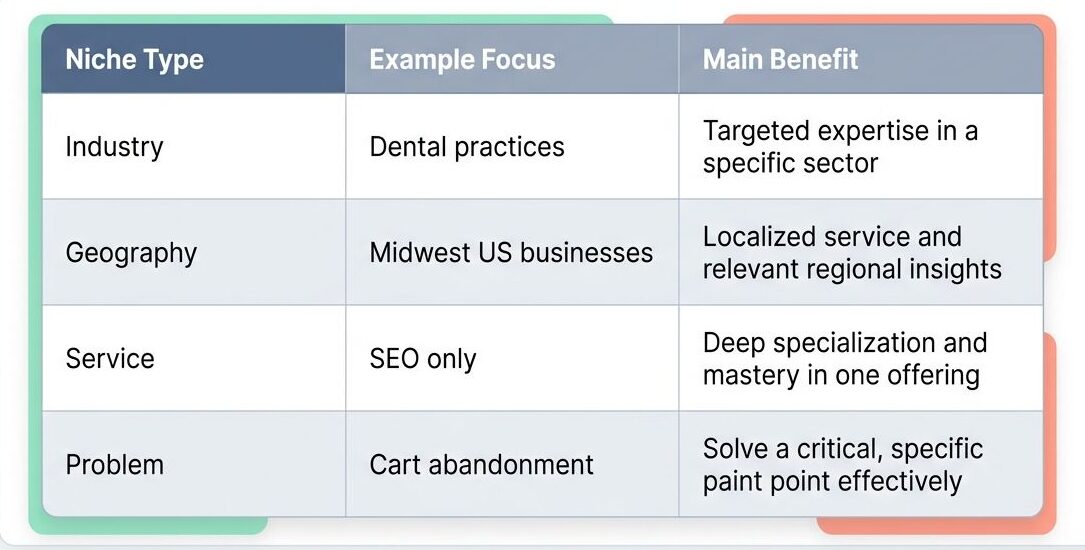
| Niche Type | Example Focus | Main Benefit |
|---|---|---|
| Industry | Dental practices | Deep knowledge of specific regulations and billing. |
| Geography | Midwest US businesses | Strong local networking and community trust. |
| Service | SEO only | Highly efficient internal processes and high margins. |
| Problem | Cart abandonment | Direct tie to the client’s immediate revenue growth. |
Niching by industry or vertical
Targeting a specific industry gives your agency a massive competitive edge. You become the go-to expert for real estate, dental practices, or law firms.
Clients in that vertical trust specialists more than generalists. For example, a specialized US FinTech PR agency understands strict SEC marketing rules like Rule 206(4)-1. A generalist agency will get stuck in legal review, costing the client time and money.
Your service differentiation becomes crystal clear. You speak their language, understand their regulations, and anticipate their seasonal needs.
Niching by geography
You can narrow your focus by serving specific geographic areas. Local agencies often charge premium pricing because they understand regional business challenges.
You establish credibility faster when you focus on one city or state. Geographic specialization creates real advantages for client relationships. Great ways to reach local clients include:
- Attending regional trade shows.
- Sponsoring community business events.
- Partnering with the local Chamber of Commerce.
This concentrated effort produces higher conversion rates because you speak directly to local pain points.
Niching by deliverables or services
Specialization through specific services creates a powerful positioning strategy. Instead of offering everything, you master specific solutions.
A great example is the US agency Pixel Cut Labs. They decided to offer search engine optimization exclusively. By focusing purely on SEO deliverables, they quickly scaled their revenue from $180,000 to over $800,000.
Clients pay premium pricing for specialists. Your sales process speeds up, and your team works much more efficiently. Profitability jumps because you eliminate wasted effort outside your wheelhouse.
Niching by solving specific problems
You can carve out your market position by solving concrete problems. This shifts your focus from what you do to the actual pain points you eliminate.
Instead of saying you manage social media, you can say you help e-commerce brands reduce cart abandonment by 30 percent. This problem-solving positioning attracts clients who desperately need solutions.
They pay premium pricing gladly because you address their exact struggles. Your value proposition becomes irresistible when potential clients see themselves in your messaging.
Creating a Pre-Packaged Offer for Your Niche
You must bundle your services into a clear package. Your clients get exactly what they need, and you charge premium rates because you have solved their problem before.
Define your core services
Your core services form the backbone of your service differentiation strategy. List every service your agency currently offers, then strip away anything that does not solve a massive pain point.
When pricing these core services, you can leverage a powerful psychological tool called the Decoy Effect. A 2025 study from Duke University found that adding a deliberately inferior middle option increases sales of the premium tier by 35 percent to 50 percent.
If you offer a $2,000 basic package and a $7,500 premium package, add a $6,500 middle package that lacks key features. Suddenly, the $7,500 premium tier looks like the smartest choice. This strategic positioning transforms how prospects perceive your pricing.
Bundle solutions to address niche-specific pain points
Bundling means you combine multiple services into one package. Instead of selling individual tasks, you create a pre-packaged offer.
“Clients pay for the completed puzzle, not the individual pieces.”
For example, a full-service digital marketing retainer of $7,500 per month is much easier to sell than itemizing SEO, content creation, and social media separately. Clients see the complete picture of what you deliver.
This strategy reduces client acquisition friction. Prospects feel like you created the package just for them. Market segmentation becomes easier because you know exactly who needs this specific bundle.
Testing Your New Niche
You need real feedback from actual prospects, not just a gut feeling. Talking to potential clients reveals the truth about your market.
Approach 3-5 potential clients in your chosen niche
Test your niche with real prospects before you go all in. Reach out to three to five potential clients and pitch your service differentiation approach.
If you use cold email for this outreach, temper your expectations. A 2026 B2B benchmark report by Prospeo shows the average cold email reply rate is now only 3.4 percent to 5.8 percent.
When reaching out to test your offer, follow these rules:
- Keep your test list under 50 people.
- Ask for their opinion, not their business.
- Focus entirely on their biggest daily headache.
This testing phase separates agencies that succeed from those that fail.
Collect feedback and refine your approach
Ask these prospects tough questions about their pain points. Listen more than you talk. Their answers reveal what keeps them awake at night.
According to 2026 data from Sopro, using advanced personalization in your outreach can double your response rates. Do not just send a generic pitch; reference a specific challenge their company is facing.
You will spot gaps between what you offer and what they truly want. This feedback shapes your service differentiation. Your premium pricing strategy takes shape when you nail the problems that matter most.
Benefits of Charging Premium Rates
When you charge premium rates, clients perceive your services as more valuable. Higher prices attract serious clients who respect your expertise.
Higher value perception
Clients perceive specialized agencies as premium service providers. Your strategic positioning creates a halo effect where prospects assume you deliver superior results.
This is heavily tied to the psychology of first pricing. In the SaaS and agency world, a higher initial price signals premium quality and powerful features. If your price is too low, prospects might assume your work is inferior.
Your focused expertise justifies higher rates. When you specialize, you eliminate the discount conversation completely.
Attracting higher-quality clients
Premium pricing attracts a different breed of client. These clients invest in solutions because they understand cheap often means compromised quality.
A 2025 Gartner US survey found an amazing statistic. Exactly 61 percent of B2B buyers now prefer a completely rep-free buying experience. They do not want to be sold to.
However, they actively seek an expert’s input for complex tasks like:
- Diagnosing a specific business problem.
- Comparing high-level technical solutions.
- Evaluating long-term strategic fit.
When you are a premium specialist, you become that trusted expert. Higher-quality clients stick around longer and rarely haggle over invoices.
Reducing workload while increasing income
Higher-quality clients bring steady, predictable revenue streams. Your workload shrinks because you work with fewer clients who pay more.
You stop chasing every lead and start attracting clients who value your positioning. The result is that you earn more money while working fewer hours.
Your revenue maximization happens naturally because premium pricing attracts serious buyers. You reduce stress and build a profitable agency that runs on your terms.
Success Stories of Niching Down
Real agencies have crushed it by picking a specific niche. These success stories show you exactly what is possible when you dominate your corner of the market.
Real-world examples of profitable niches
A brilliant example is Josh Nelson from Seven Figure Agency in the US. He started his local internet marketing agency with zero clients and zero revenue.
Instead of targeting everyone, he niched down specifically into the plumbing and HVAC home builder markets. Today, his agency bills over $4.5 million per year.
His service differentiation came from understanding their workflows and seasonal patterns. This positioning allowed his team to charge premium pricing that clients gladly paid.
Lessons learned from successful agencies
Successful agencies share one powerful lesson. They stopped trying to be everything to everyone. Their success comes down to three choices:
- Picking a single, specific market segment.
- Building services around exact, proven pain points.
- Charging premium rates for verified solutions.
The winners invested time in understanding their niche deeply. They refined their value proposition based on real feedback. Strategic positioning became their ultimate competitive advantage.
Final Thoughts
You have learned how to audit your client list, spot patterns, and pick a niche that matches your strengths. Bundling services lets you charge premium rates without feeling guilty.
Testing your niche with a handful of potential clients gives you real feedback before you go all in. Premium pricing attracts serious clients who value your work.
Your next move is simple. Pick one niche this week, reach out to three potential clients, and gather their thoughts. Taking action today separates you from the pack.
Frequently Asked Questions
1. How do I pick the right niche for my agency?
Start by reviewing your past US client data to see where you have actually helped businesses succeed, especially since 2026 projections show sectors like telehealth are booming. If you constantly get great results in one specific field, talk to your team and make that your official specialty.
Specialists command higher fees because they solve specific problems faster, and recent industry data shows specialist agencies convert leads at a massive 67 percent compared to just 20 percent for generalists. When US clients know you are the absolute expert in their exact industry, trust grows instantly, and they gladly pay a premium for your proven solutions.
3. What mistakes should I avoid when narrowing my focus?
Avoid chasing fleeting trends and instead focus your agency on stable US markets with proven staying power, like the massive wellness industry, so you do not end up lost in the crowd with low fees.
4. How can I show clients my higher prices are worth it after choosing a niche?
Prove your value by sharing specific US case studies that highlight hard metrics like improved customer acquisition costs or an optimal three-to-one return on investment ratio. Clients will gladly pay your higher rates when they can read relatable success stories and clearly see the exact financial results you delivered for similar businesses in their field.