The “Golden Age of Television” has evolved. It is no longer just a playground for Hollywood executives and A-list actors. In 2026, the economy surrounding our favorite shows, from Stranger Things to obscure 90s sitcoms, has exploded into a multi-billion-dollar ecosystem. For savvy creators, writers, and marketers, the question is no longer just “what should I watch?” but how to make money with TV series.
Gone are the days when you could simply upload a clip to YouTube and collect ad revenue; advanced copyright ID technology and stricter “repetitive content” policies have closed those loopholes. However, as one door closes, a dozen digital windows open. Whether you are a writer selling the next big pilot, a fashionista capitalizing on on-screen trends, or a reactor building a community, there is a revenue stream for you.
This guide explores seven data-backed strategies to monetize TV content, ranging from high-level industry deals to accessible side hustles you can start today.
The Blueprint: Monetization Models for Every Skill Level
Before diving into specific tactics, it is important to understand that there is no “one size fits all” approach. The modern entertainment economy is divided into three distinct tiers: Ownership (licensing content you own), Commentary (adding value to content others own), and Curation (guiding others to content).
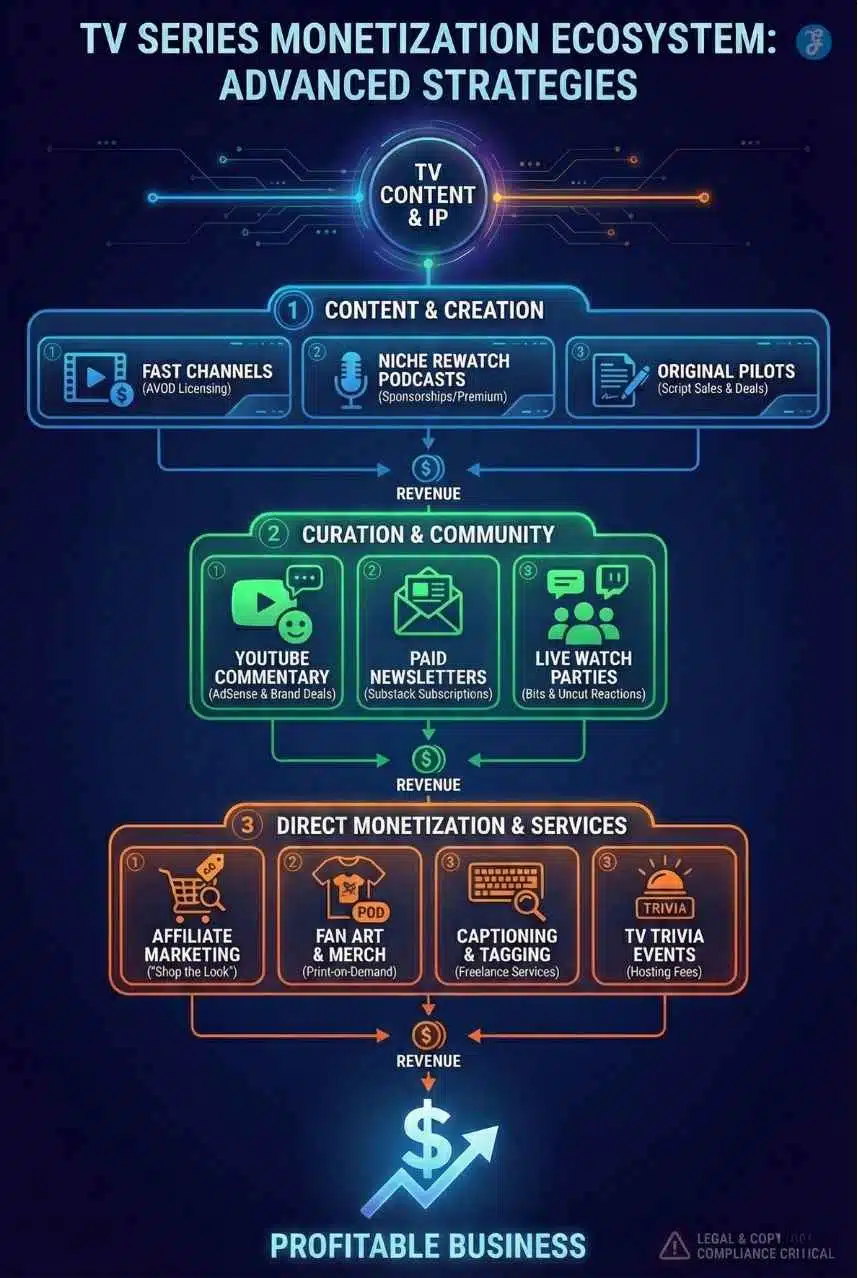
The following 10 strategies are categorized by “Role.” Whether you are a filmmaker with a hard drive full of footage, a writer with a sharp wit, or a community builder with zero technical skills, one of these paths will align with your strengths.
1. The Distributor Route: Launch a FAST Channel
Barrier to Entry: High
Revenue Potential: High
If you are a filmmaker with a catalog of web series, short films, or documentaries collecting digital dust, the biggest opportunity in 2026 isn’t Netflix—it’s FAST (Free Ad-Supported Streaming TV).
Platforms like Pluto TV, Tubi, and Samsung TV Plus are growing faster than subscription services. They operate like traditional cable—24/7 linear channels that play content on a loop, but they are free for the viewer and monetized by ads.
How It Works: The AVOD Model
FAST channels operate on an AVOD (Advertising Video On Demand) revenue model. Every time an ad plays during your content, you get paid.
-
The Split: Standard industry deals typically offer a 60/40 revenue share (60% to the content owner, 40% to the platform).
-
The “Linear” Hook: Unlike YouTube, where a user has to click every video, a FAST channel plays continuously. If a viewer tunes in and leaves the TV on for two hours, you generate ad revenue that entire time.
How to Get Started
You generally cannot pitch directly to Samsung or Pluto TV unless you are a major studio. Instead, you work with FAST Aggregators or “delivery partners” like Wurl, Amagi, or Whip Media. These companies take your video files, format them for broadcast, and distribute them to dozens of platforms simultaneously.
Pro Tip: You don’t need to produce all the content yourself. Many entrepreneurs now license rights to older, forgotten indie films or public domain series, package them into a genre-specific channel (e.g., “The 80s Horror Channel”), and monetize the ad inventory.
2. The Reactor Route: High-Value YouTube Commentary
Barrier to Entry: Low
Revenue Potential: Medium ($2k – $10k/mo)
Running a reaction channel is the most popular way to monetize TV fandom, but it is also the riskiest due to copyright strikes. To succeed in 2026, you must navigate YouTube’s “Inauthentic Content” policy carefully.
The “Safe Zone” for Reactors
YouTube’s algorithm and legal teams are cracking down on “lazy” reactions—videos where a creator silently watches a show with the clip playing in full screen. To monetize, your content must be transformative.
-
Face-Cam is Mandatory: “Faceless” channels using AI voiceovers to recap movies are being demonetized en masse. You must show your face and personality.
-
The Pause Rule: You must pause the footage frequently (every 30–60 seconds) to offer critique, analysis, or humor. This breaks up the audio/visual fingerprint and strengthens your Fair Use defense.
Monetization Data
-
AdSense: The average CPM (Cost Per 1,000 views) for entertainment channels is roughly $3 to $7.
-
Sponsorships: This is where the real money is. Because TV fans are a highly engaged demographic, sponsors like VPNs (NordVPN, ExpressVPN) and mobile games pay premiums to reach them. A channel with 50,000 views per video can charge $500–$1,500 per integrated ad read.
The “First Time Watching” Strategy
The highest-performing niche currently is cultural bridging.
Examples include:
-
“British person watches American Football shows (e.g., Friday Night Lights).”
-
“Filmmaker analyzes the lighting in Euphoria.”
- “Lawyer reviews the courtroom accuracy in Suits.”Adding an expert or cultural angle differentiates you from the thousands of generic fans just saying “Wow” at the screen.
3. The Stylist Route: “Shop the Look” Affiliate Marketing
Barrier to Entry: Low
Revenue Potential: Medium (Scalable)
Have you ever watched a show like Emily in Paris or Succession and immediately Googled, “Where did she get that coat?” Millions of people do this every day. This phenomenon, known as the “Second Screen” shopping habit, is a goldmine for affiliate marketers.
How to Execute This Strategy
You do not need to own the products. You simply act as the bridge between the viewer and the retailer.
-
Identify the Item: Use tools like Google Lens or sites like WornOnTV to identify the exact clothing, furniture, or tech gadgets used in popular scenes.
-
Create the Content: Launch a niche blog (e.g., “Decor Like Draper” for Mad Men style interiors) or a Pinterest board.
-
Use Affiliate Links: Sign up for programs like Amazon Associates, LTK (LikeToKnow.it), or Skimlinks.
Why This Works for High-Ticket Sales
While fashion is popular, furniture and home decor offer higher commissions. If a character in a popular show sits on a specific designer sofa that sells for $2,000, and you link to that retailer (like Wayfair or West Elm) with a 7% commission, a single sale nets you $140.
Semantic Keyword Strategy: To rank for this, target keywords like “TV fashion finder,” “Shop the look [Show Name],” and “Costume design breakdown.”
4. The Analyst Route: Niche Rewatch Podcasts
Barrier to Entry: Low-Medium
Revenue Potential: Medium
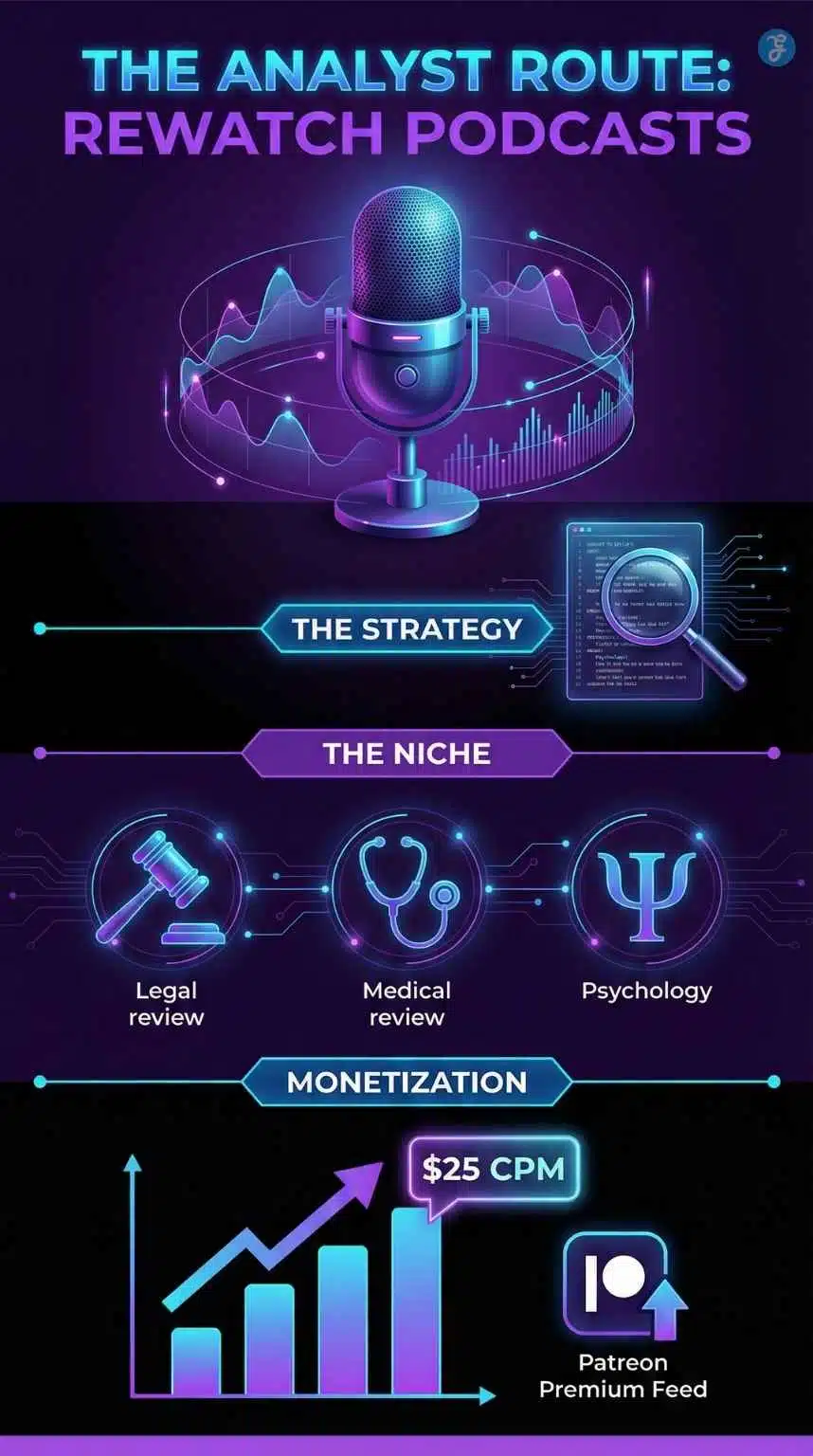
If you are worried about video copyright strikes, audio is your safe haven. Rewatch podcasts—where hosts analyze a TV series episode-by-episode—are commanding high ad rates.
The Economics of Podcasting
Advertisers love podcasts because listeners are “captive”—they don’t skip ads as often as YouTube viewers do.
-
CPM Rates: Entertainment podcasts generally command a $20–$25 CPM. If you have 10,000 listeners per episode, that is $200–$250 per ad slot.
-
Niche Down: The general “Recap Show” market is saturated. Success lies in hyper-niche angles.
-
Bad: “We talk about The Office.”
-
Good: “The Psychology of Management in the Office” (Targeting business owners).
-
Good: “The Historical Accuracy of The Crown” (Targeting history buffs).
-
The Patreon Upsell
Podcasters successfully monetize TV series by offering “Premium Feeds” on Patreon. For $5/month, superfans get:
-
Ad-free episodes.
-
Bonus episodes reviewing different shows.
-
Access to a Discord community to discuss the show live.
5. The Creator Route: Selling Original Pilots (Scriptwriting)
Barrier to Entry: Very High
Revenue Potential: Massive (6-7 Figures)
For those who want to create the show rather than talk about it, the landscape has shifted post-2023 WGA strikes. The streaming “spending spree” is over, and studios are now risk-averse, looking for specific types of content.
What Studios Are Buying in 2026
Data shows a move away from dark, ten-hour movies cut into episodes. Streamers now want “Blue Sky Procedurals”—shows with self-contained episodes that resolve a plotline in 45 minutes (think Reacher, The Night Agent, or classic network TV vibes). These shows have higher re-watch value and better retention rates.
The “One-Step Deal”
If you manage to sell a script or get hired to write a pilot, the pay is regulated by the WGA (Writers Guild of America).
-
Network Prime Time Pilot: The minimum for a 60-minute pilot script can range from $40,000 to $80,000+ for a “One-Step Deal” (draft and a polish).
-
The Package: You rarely sell a naked script anymore. To make money, you need a “package”: A polished script + a Showrunner attachment + a visual Pitch Deck.
6. The Insider Route: Captioning & Metadata Tagging
Barrier to Entry: Low-Medium
Revenue Potential: Low (Side Hustle)
You have likely seen viral TikToks claiming you can get paid to “watch Netflix all day” as a “Tagger.” While these jobs exist, they are rare corporate roles requiring years of archival experience. However, there is a very real, accessible alternative: Closed Captioning and Subtitling.
The Real Job: Freelance Captioning
Streaming services are legally required to provide accurate captions for the hearing-impaired. They outsource this volume to agencies.
-
Where to find work: Platforms like Rev, Vanan Services, and GoTranscript.
-
Pay Rates: Beginners typically earn $0.45 to $0.75 per audio minute, while experienced captioners (especially those who can translate languages) can earn $1.10 to $1.50 per minute.
-
The Workflow: You watch raw footage of TV shows (sometimes before they air) and type out the dialogue, tagging sound effects like [eerie music plays] or [door slams].
This is volume-based work. It won’t make you a millionaire, but it is a legitimate way to monetize your time spent watching screens.
7. The Community Route: Live Watch Parties
Barrier to Entry: Low
Revenue Potential: Scalable
This method utilizes the “Second Screen” experience to bypass copyright issues completely while building a highly monetizable community.
How Sync-Watching Works
You stream yourself live on Twitch or YouTube. You show your face and a timer on screen, but you do not show the TV show’s video or audio.
-
You tell your viewers: “Okay, hit play on Netflix in 3, 2, 1, GO.”
-
Your viewers watch the show on their own TV while listening to your commentary on their phone or laptop.
Monetization Channels
-
Twitch Bits & Subs: Fans pay to feel like they are “hanging out” with a friend.
-
Patreon “Uncut” Reactions: You can record your full-length reaction (watching the whole episode) and sell the video file on Patreon. Fans download it and sync it themselves. This is completely legal because your video contains only your face and voice, which you own the rights to.
Comparative Analysis: Effort vs. Reward
To help you decide which path fits your skills, here is a breakdown of the risk and reward for each method.
| Method | Barrier to Entry | Risk Level | Revenue Potential | Primary Skill Needed |
| FAST Channel Licensing | High (Need Content) | Medium | High (Passive) | Distribution/Sales |
| YouTube Reaction | Low | High (Copyright) | Medium | Personality/Editing |
| Affiliate Marketing | Low | Low | Medium | SEO/Trend Spotting |
| Niche Podcasts | Medium | Low | Medium | Audio Production |
| Scriptwriting | Very High | High (Rejection) | Massive | Creative Writing |
| Captioning/Tagging | Low | Low | Low (Hourly) | Typing Speed/Accuracy |
| Live Watch Parties | Low | Low | High (Community) | Community Management |
Frequently Asked Questions (FAQ)
Can I monetize clips of TV shows on TikTok?
It is very difficult. While some accounts gain millions of views posting clips, TikTok’s “Creativity Program” disqualifies “unoriginal content” from earning money. You might get views, but you likely won’t get paid directly by TikTok unless you add significant editing, commentary, or transformative value.
What is the “Fair Use” defense for reactors?
Fair Use is a legal doctrine that allows the use of copyrighted material for commentary or criticism. However, it is a defense you use in court, not a magic shield that prevents copyright strikes. To be safe, use short clips (under 10 seconds), avoid using the original audio when you aren’t speaking, and ensure your commentary is the primary focus of the video.
How do I pitch a TV show idea to Netflix?
Netflix does not accept unsolicited submissions. They return unopened envelopes to avoid legal liability. To pitch a show, you must have a licensed literary agent or entertainment lawyer submit the material on your behalf. Focus on getting representation first.
Will I get sued if I accidentally break copyright rules?
It is extremely rare for individual creators to be sued directly by a studio for a YouTube video or blog post. Instead, platforms operate on a “Strike System.”
Content ID Claim: The studio simply takes the ad revenue from your video, but the video stays up. This is the most common outcome.
Copyright Strike: The video is removed. If you receive 3 strikes within 90 days, your entire channel and Google account can be terminated.
Takeaway: You likely won’t go to court, but you risk losing your digital business overnight. Always err on the side of caution.
Can I use AI tools to help me make content?
Yes, but use them as an assistant, not a replacement.
Good AI Use: Using tools like Opus Clip to find viral moments for TikTok, Descript to edit your podcast text, or ChatGPT to brainstorm video titles and blog outlines.
Bad AI Use: Using AI-generated voices to narrate scripts or asking AI to write an entire article. Platforms like YouTube and Google search are actively downranking this “low-effort” content in 2026. Use AI to speed up your workflow, not to fake your personality.
Bottom Line: Make Money with TV Series
The landscape of how to make money with TV series has shifted from passive consumption to active creation. The most successful entrepreneurs in this space don’t just watch TV; they add value to the experience.
Whether you are identifying the wardrobe for The White Lotus to earn affiliate commissions, building a safe haven for fans to discuss theories on a podcast, or licensing your own indie films to a FAST channel, the opportunities are vast.
Your Next Step: Choose one method that aligns with your current skills. If you are camera-shy, start a “Shop the Look” blog. If you love to talk, record a pilot episode for a niche podcast. The content is already there; your job is to build the bridge that connects the fans to the value.