You scroll through sites and see slow pages, spam ads, and fake goods. You hear people talk about non-fungible tokens and blockchain technology. You wonder if NFTs can stop fraud and speed up the web.
Many folks feel lost on how smart contracts or a digital wallet fit in.
A recent report shows the user base for NFT digital assets on the Ethereum blockchain climbed from about 100,000 in 2020 to over 1 million by April 2024. This post will show 7 ways NFTs reshape web infrastructure with real tips on ownership, security, and fast transactions.
You will learn how smart contracts and digital wallets work in this new space. Read on.
Key Takeaways
- The Ethereum blockchain logged NFT users from about 100,000 in 2020 to over 1 million by April 2024. Smart contracts and blockchain domains let collectors own art, domain names, and virtual land without middlemen.
- Blockchain networks store every NFT transfer on a public immutable ledger. Arianee tags Breitling watches, Demand.io spots fraud, and CIEM with IPFS secures digital assets.
- Smart contracts on Ethereum pay creators and log royalties. For example, Beeple’s Everydays fetched $69.3 million and Mike Shinoda’s drop earned 200 WETH. RTFKT gear sold for $3.1 million, and a Top Shot LeBron dunk hit $208 000.
- Companies use NFTs in supply chains, gaming, and social media to boost transparency. Arianee mints badges for luxury goods and pharma tags vaccines. CryptoKitties, World of Warcraft items, and virtual real estate sell as tokens. Demand.io builds a user-owned social network with blockchain domains and badges.
Decentralized Ownership of Digital Assets
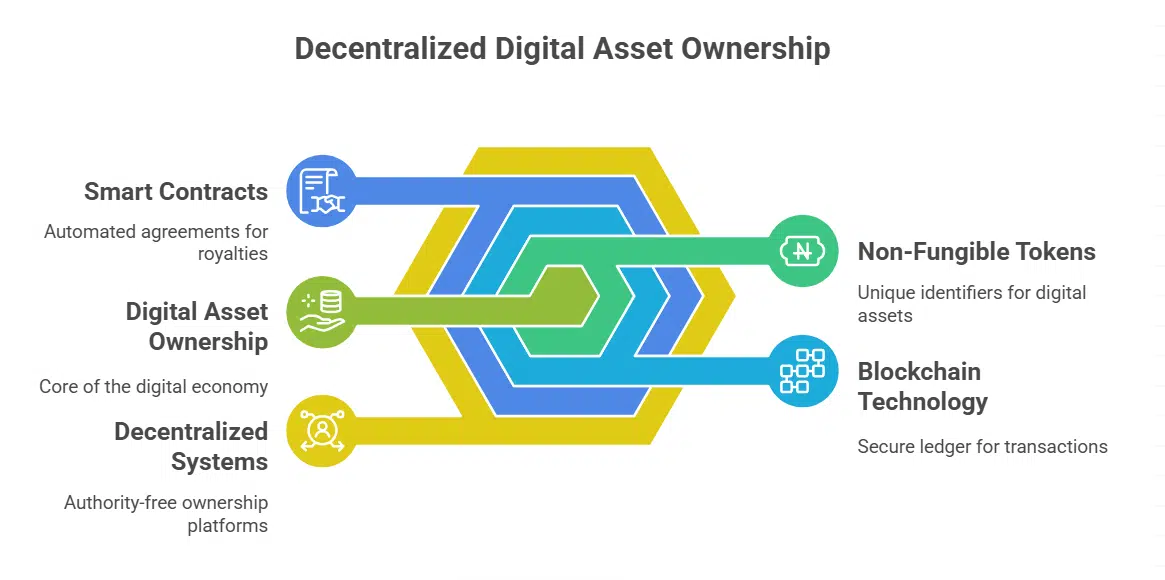
Collectors hold digital art and other digital assets with non-fungible tokens. The Ethereum blockchain uses blockchain technology to record each sale on an immutable public ledger, so owners get proof for every digital token, even domain names.
Growth proved trust in this system; users leapt from 100,000 in 2020 to over 1 million by April 2024, and it fuels a new digital economy. Blockchain domains let owners claim property, without a central authority like ICANN stepping in, and they block middlemen from taking a cut.
Museums use non-fungible tokens to lock cultural heritage on a tamper proof record, they turn artifacts and historical papers into digital collectibles. Smart contracts let artists code royalty payments on secondary sales, and they even allow fractional ownership in virtual real estate.
This design stops double sales or counterfeiting, and adds real market value through programmed scarcity. It feels like owning a rare stamp, but you hold it in a digital wallet, with no one else able to alter the record.
Enhanced Security and Authenticity
NFTs store each token on a public Ethereum network, it logs every transfer on an immutable blockchain. Arianee tags real watches with digital proofs, it fights copycats at the roots.
Cloud infrastructure entitlement management, called CIEM, shields digital collectibles from unwanted access. You hold a digital token only if you hold the secret code. Smart contracts lock terms, they seal deals without a middleman.
These parts of blockchain technology defend against identity theft and fraud. This design lifts security in the digital economy.
Sites like Demand.io scan sales on NFT marketplaces, they spot wrong moves in seconds. Digital art trades carry clear transfer records, they beat counterfeiting prevention at each step.
Virtual real estate owners trade land parcels on blockchains, they show proof without paper. Fractional ownership rings in small buyers, it spreads access in markets. NFTs cut out mass shipping, they lower carbon by ditching trucks and ships.
These gains tag into sustainable development goals, they back greener web 3.0.
Reshaping Digital Identity and Certification
Arianee tags every Breitling watch on the Ethereum blockchain using blockchain technology, so buyers see a clear record of origin and repair history. Blockchain domains remove ICANN from web handles, and users claim and control their own addresses.
It feels like a high-tech stamp of approval. Artists issue nfts as digital badges. They build them with smart contracts that certify art and track secondary sales. Collectors see each move on a public ledger.
Marginalized groups upload art or memoirs as digital tokens. They tap into a wider market without gatekeepers. Each token carries a cryptographic seal, and users open wallets with private keys, not bank accounts.
This method cuts middlemen fees, speeds up transactions, and links each certificate to a clear audit trail.
Revolutionizing Content Monetization
Creators strike gold, as non-fungible tokens shake up content money streams. NFT marketplace and smart contracts cut out middlemen, so artists keep more cash. Beeple’s Everydays fetched $69.3 million.
Mike Shinoda sold One Hundredth Stream for 200 WETH, about $30,000. RTFKT virtual jacket and sneakers flew off for $3.1 million in seven minutes. LeBron James dunk token on NBA Top Shot peaked at $208,000.
Smart contracts handle royalty splits. Transactions post to an immutable blockchain network on Ethereum, a pillar of modern blockchain technology, so everyone sees the full history.
Fans invest in digital art and digital collectibles, and creators earn from primary drops and secondary sales. This fresh approach fuels the digital economy. Artists grab power, and buyers grab prized digital assets.
Streamlining Supply Chain Transparency
Companies assign a non-fungible token (NFT) to each batch on the Ethereum blockchain. That digital certificate logs every handoff in the chain, like a diary you can’t alter. Stakeholders sign smart contracts when they ship, so no step goes dark.
Managers link data with wallets like MetaMask, MagicLink or Tweed. Shippers watch tokens move from farm to store.
Arianee mints badges for luxury items, so buyers read full histories. Pharma firms tag vaccines to block fake shots. The system runs on the ERC721 token standard, so every record sits on an immutable blockchain.
You spot a product’s origin, trace each mile, and sidestep counterfeits. This approach trims audits, saves time, and seals transparency gaps.
Transforming Virtual Real Estate and Gaming Platforms
Players swap digital assets like CryptoKitties or a World of Warcraft sword. They treat each asset as a digital token in an NFT marketplace. Smart contracts use blockchain technology on Ethereum to run trades securely.
They stop counterfeiting and set clear valuations in secondary sales. A player bragged that owning a rare kitten felt like striking gold.
Virtual real estate sites let users buy land in a digital city. They mint property deeds as non-fungible tokens on Ethereum blockchain. Fractional ownership splits a parcel into small shares for many investors.
Jeff Koons drops AR art installations like a pop-up carnival, and Nike’s CRYPTOKICKS march down a virtual runway. A collector uses the Drest app to parade AR fashion as if they walked a real mall.
Enabling Decentralized Social Networks
Networks built on blockchain let you own your posts and data. They use non-fungible tokens and smart contracts to mint badges, domain names, and profile art. They cut out big tech so users hold the keys in their crypto wallets.
They run as decentralized autonomous organizations on Ethereum chains. They feel like a town square you truly control.
Demand.io pushes this idea. It locks in data privacy and fuels community engagement. It pays crypto-art creators in digital tokens on an NFT marketplace. It promotes fair compensation and frees digital artists from gatekeepers.
It gives marginalized groups new income streams in the digital economy. It shows blockchain technology can drop reliance on central agencies.
Benefits of NFT Integration in Web Infrastructure

NFTs let sites use smart contracts on Ethereum to speed deals and tag each token with a clear ledger record. They plug into P2P networks like IPFS and let nodes share asset info fast, cutting trust gaps in web systems.
Improved Transparency
Non-fungible tokens log scarce digital assets on the Ethereum blockchain. Buyers can view each transfer and verify art or collectibles. Smart contracts record royalties, timestamps, and ownership details.
They halt hidden fees and shady deals.
Blockchain technology drives open ledgers. Blockchain domains give each website a unique address. Owners hold them without a central registrar. Arianee tracks luxury goods like watches.
A quick scan of a token shows full product history.
Greater Efficiency in Transactions
Smart contracts on ethereum blockchain speed trades. They slice out banks and brokers. A digital token moves within seconds. NFT marketplaces handle bids and settlement at once.
RTFKT gear sold for $3.1 million in 7 minutes on a marketplace. NBA Top Shot listed a LeBron dunk for $208,000 and paid out in moments. Beeple’s Everydays netted $69.3 million through a smart contract that auto-executes.
Artists like Mike Shinoda collect funds in 200 WETH, near $30,000, without delay.
Challenges in Adopting NFTs for Web Infrastructure
High gas fees on the Ethereum mainnet act like a toll booth, slowing down smart contracts and frustrating hot wallet users. Power-hungry proof-of-work rigs guzzle electricity, and IPFS nodes add more leaky buckets to an already strained network.
Scalability Issues
Many new users join Ethereum to buy non-fungible tokens. The user base grew from 100,000 in 2020 to over 1 million by April 2024. That surge pumps digital assets through blockchain networks.
Validators struggle to keep pace as smart contract calls clog pipelines. Network bandwidth needs improvement across http and internet technology.
Wireless tech like multi-user MIMO can ease some signal jams. Web servers still hit a ceiling in data flow. TCP/IP stacks slow down and http calls stall under heavy loads. Developers test layer 2 solutions and tweak load balancers to split traffic lanes.
The mainnet feels the stretch like an overfilled balloon.
Environmental Concerns
Non-fungible tokens demand huge electricity on the Ethereum network. Proof-of-work validation eats vast amounts of energy. That drives up carbon emissions. Arianee taps renewable energy to cut its footprint.
It funds carbon offsetting projects around the world. Digital art and other digital collectibles drop shipping and physical goods.
This change slashes fuel use and material waste. Blockchain technology still draws heavy energy loads though. Smart contracts on the ethereum blockchain burn power. NFT marketplaces spike transaction counts daily.
Critics cite the impact on climate and energy sources. They point to sustainable development goals and call for green upgrades.
Takeaways
Web infrastructure evolves fast thanks to NFTs. They give artists real control over digital art. Smart contracts lock terms on a public ledger. A marketplace script lets sellers list tokens in seconds.
A digital wallet holds each digital token with ease. Domain names tie an address to each asset. Virtual real estate in games grows in value. We can ride this wave of change with a smile.
FAQs on How NFTs Are Reshaping Web Infrastructure
1. What are NFTs and how do they use blockchain technology?
NFTs are non-fungible tokens (nfts). They live on the ethereum blockchain. They run on an unchangeable ledger, so no one can alter past records. They power the digital economy. They aid identity management too. I get it, it sounds like sci-fi.
2. How do NFTs change digital art and digital collectibles?
NFTs let artists sell digital art and digital collectibles in an nft marketplace. Fans can flip them in secondary sales. The smart contract pays the creator each time. It is like an online auction that never stops. Trust me, fans love it.
3. What role do smart contracts play in NFT sales?
Smart contracts set the rules for each digital token sale. They work on blockchain technology. They cut out middlemen, so trades are fast. They also pay fees on every secondary sale.
4. How do NFTs impact virtual real estate and domain names?
NFTs let you own virtual real estate in metaverse worlds. You can also hold domain names as digital tokens. It is like owning a lot on a new web street. No hard hat or shovel needed.
5. Can NFTs help with counterfeiting prevention and digital rights management?
NFTs assign one token per asset and help with counterfeiting prevention. They work with drm (digital rights management) to track rights. They back up intellectual property rights and help with compliance. This brings more trust online. It is like a club bouncer for art.
You can use an NFT as a loan pledge on defi platforms. You can split a token into shared ownership. Many people can invest in one asset at once. This opens new paths in decentralized finance.