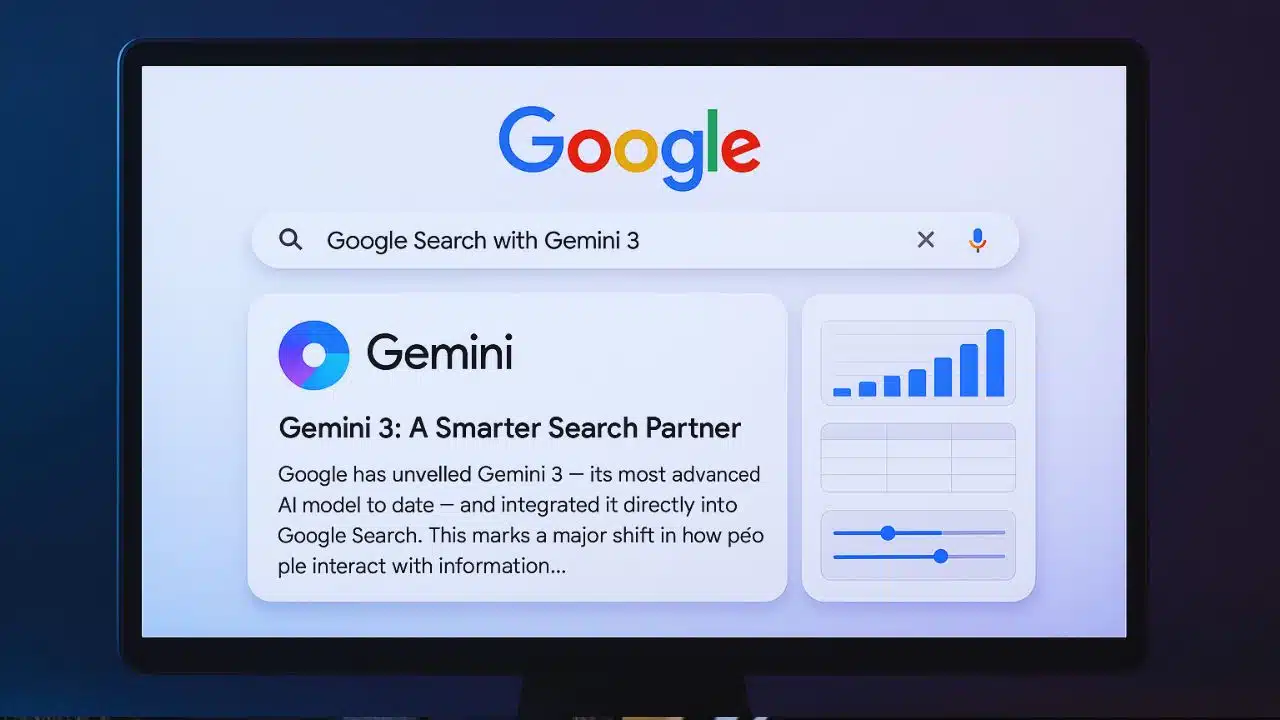
Google has unveiled Gemini 3 — its most advanced AI model to date — and integrated it directly into Google Search. This marks a major shift in how people will interact with information online. Instead of simply retrieving links, Search can now understand deeper meaning, generate dynamic visual responses, and even build interactive tools tailored to each question. Gemini 3 is designed to make Search feel more like a knowledgeable assistant that reasons, analyzes, and guides you through complex topics.
Gemini 3 has been introduced first to Google AI Pro and Ultra subscribers in the U.S. through AI Mode, where users can select “Thinking” from the model menu to access Gemini 3 Pro. This is the first time Google has launched a new Gemini model directly inside Search on day one. According to Google, the vision behind this release is to help users explore challenging questions more clearly, learn more interactively, and understand topics in deeper and more meaningful ways. Soon, the model will be available to all users in the U.S., with higher usage limits for paid subscribers.
One of the most important upgrades is the improvement in Google’s query fan-out system. Traditionally, Search interprets a question and then performs many smaller searches to gather relevant information from across the web. With Gemini 3’s advanced reasoning abilities, Search can now run even more extensive fan-out searches, interpret the intent behind complicated questions, and discover information that older models might have skipped. This leads to results that are not only richer but also more precise and aligned with what the user truly wants to know. Google says this will help people uncover more credible and highly relevant content from quality sources across the internet.
In the coming weeks, Google will also use Gemini 3 to power its automatic model-selection system inside Search. This means that when a question requires deeper analytical reasoning, complex decision-making, or multi-step interpretation, Search will automatically route it to Gemini 3. For simpler queries that do not require intensive reasoning, faster lightweight models will still handle the task to keep responses quick and efficient. This smarter routing system will initially roll out to Google AI Pro and Ultra subscribers, with wider access planned later.
Another major advancement is the arrival of generative UI — a new interface approach powered entirely by Gemini 3’s multimodal understanding and agentic coding abilities. Instead of delivering plain text paragraphs, the model can now build custom visual layouts for each query. This includes images, comparison tables, charts, grids, and even small functional tools that appear directly within the search results. Every layout is created dynamically based on what the model determines is most helpful for the user. The goal is to make complex information more intuitive, clearer to explore, and easier to act on.
Gemini 3 also introduces a new level of interactivity in Search results. When the model identifies that a simulation or interactive tool will help you understand a topic better, it can write and generate that tool in real time. For example, someone learning about astrophysics and the three-body problem will not just get textual explanations—they will also see an interactive simulation where they can adjust variables and observe gravitational interactions. In personal finance, users researching mortgage options may receive a fully functional loan calculator coded on the spot, allowing instant comparison between different loan structures. This moves Search far beyond static answers and transforms it into a dynamic problem-solving environment.
Despite the highly generative nature of these new interfaces, Google emphasizes that Search will continue to surface and link to high-quality web sources prominently. These links help users verify facts, explore deeper context, and maintain a healthy information ecosystem where publishers continue to be credited for their work. Google says this balance between AI-generated insight and traditional search discovery is essential for maintaining trust, transparency, and access to authoritative information.
The company notes that this new approach reflects years of foundational research into generative user interfaces. The result is a system that can understand the type of visual structure or interactive experience that best supports the user’s intent, and then build it on demand. Google plans to refine this technology further based on user feedback and ongoing evaluations of safety, accuracy, and usability.
By placing Gemini 3 directly inside Search, Google aims to make it easier for people to ask anything—whether simple, complex, or highly technical—and receive deeper, clearer, and more actionable insights instantly. Gemini 3 does not just change how search results look; it reshapes how people learn, explore, and make decisions online. The latest update marks one of the most significant leaps in Search’s history, opening the door to an increasingly capable and interactive search experience powered by generative AI.