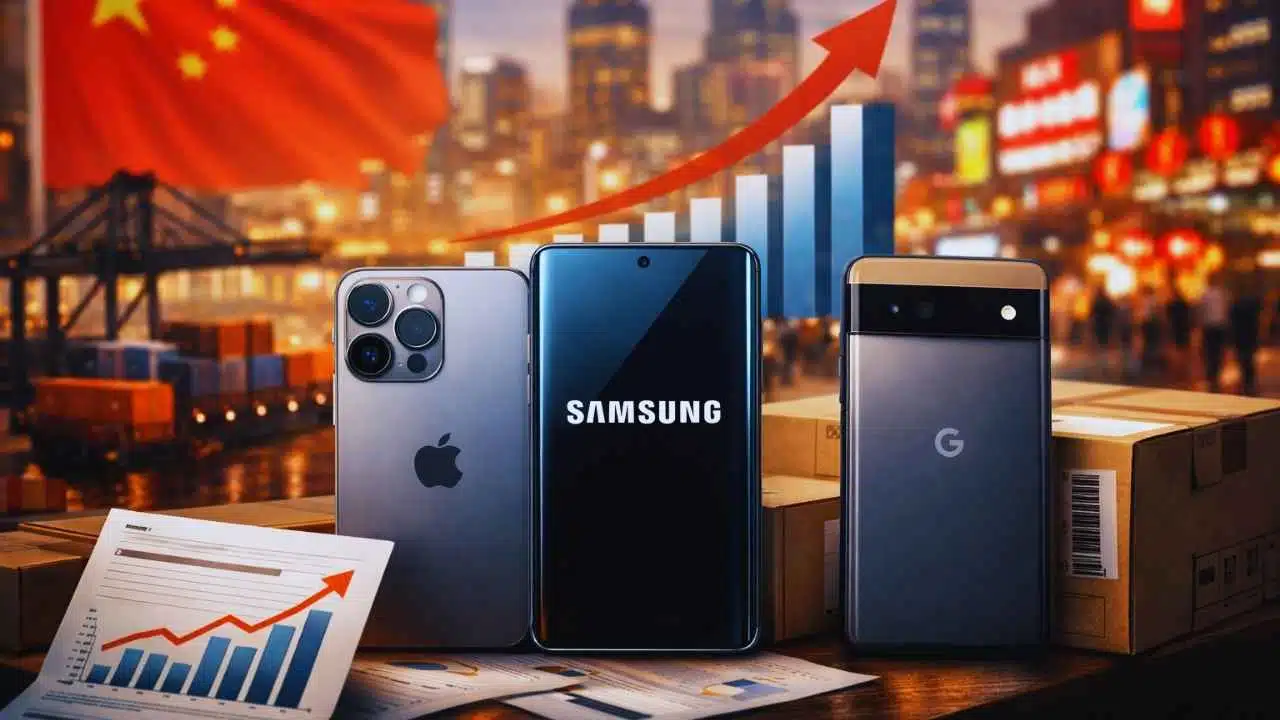
Foreign smartphone shipments in China hit about 6.93 million units in November 2025, more than doubling year over year, even as overall phone shipments rose slightly to roughly 30.16 million, according to CAICT-tracked market data.
November 2025 numbers: a surge in foreign brands despite modest overall growth
China’s phone market did not “boom” in November. The headline is the split inside the market.
Data attributed to the China Academy of Information and Communications Technology (CAICT), a government-affiliated research body, indicates overall mobile phone shipments in China rose 1.9% year over year in November 2025 to about 30.16 million units. Over the same period, foreign-branded phone shipments reached about 6.93 million units, a 128.4% year-over-year increase.
That combination matters. It suggests the market’s month-to-month lift was not driven evenly by all brands. Instead, the foreign-brand segment expanded rapidly, while the rest of the market absorbed most of the volatility.
It is also important to understand what shipment data typically represents. “Shipments” track devices sent into distribution channels (for example, to wholesalers, retailers, and carriers) rather than confirmed consumer purchases. In many markets, shipment spikes can reflect both real demand and inventory decisions—especially around major promotions.
Still, even allowing for channel effects, a doubling of foreign-brand shipments is hard to ignore. It implies that foreign brands regained meaningful shelf space and sell-in momentum during one of the most commercially important parts of the year.
Key figures from the November release (units)
| Indicator (Nov 2025) | Value |
| Total mobile phone shipments (China) | ~30.16 million |
| Foreign-branded phone shipments | ~6.93 million |
| Foreign-brand YoY change | +128.4% |
| Total shipments YoY change | +1.9% |
Using the two headline numbers alone, the implied non-foreign portion of the market (total minus foreign) is about 23.23 million units for November 2025. This remainder is not a perfect substitute for “domestic brand shipments” in every dataset definition, but it provides a practical view of market composition when only two figures are highlighted publicly.
A second point: while foreign brands include multiple companies, industry watchers often treat this figure as heavily influenced by Apple’s iPhone performance in China because Apple is a major foreign brand with a large premium footprint. If iPhone momentum rises or falls sharply, it can meaningfully move the foreign-brand line.
How the brand mix shifted: from a low base in 2024 to a stronger 2025 finish?
To see how unusual November 2025 looks, it helps to compare it with a year earlier.
CAICT’s November 2024 report stated that total mobile phone shipments were 29.606 million units. It also stated domestic-brand shipments were 26.571 million units, equal to 89.7% of the market for that month. The implied foreign-brand remainder (total minus domestic) was about 3.035 million units, or about 10.3% share.
Put side by side, the picture becomes clear: the foreign-brand slice appears to have moved from roughly 3.0 million units in November 2024 to roughly 6.9 million units in November 2025—more than doubling on a year-over-year basis.
November year-over-year comparison (derived from CAICT-reported totals)
| Metric | Nov 2024 | Nov 2025 |
| Total shipments | 29.606 million | ~30.16 million |
| Domestic-brand shipments (reported) | 26.571 million | (not always shown in summaries) |
| Implied foreign-brand shipments (derived) | ~3.035 million | ~6.93 million |
| Implied foreign-brand share (derived) | ~10.3% | ~22.9% |
This change in implied share is one of the most meaningful parts of the story. Even if the exact share shifts slightly depending on rounding and how each summary defines the domestic/foreign split, the direction is consistent: foreign brands captured a much larger portion of the month’s shipments than they did a year earlier.
The late-2025 timing also matters because the market is typically shaped by:
- New flagship launches and early adopters in the premium category.
- Large-scale promotions (especially in the run-up to year-end).
- Retailer inventory decisions heading into holiday and post-holiday sales cycles.
When those forces align, the effect can be amplified for brands that rely on premium price tiers and high-visibility retail placement.
To round out the context, CAICT’s October 2025 report showed total shipments of 32.267 million units, with 5G phones accounting for 90.9% of shipments. Even though the November 2025 summary headlines focused on the foreign-brand spike, the broader pattern across recent months suggests China remains a strongly 5G-led smartphone market, with the newest premium releases typically positioned as 5G-first devices.
Why foreign smartphone shipments in China spiked: promotions, premium demand, and policy support?
A shipment jump this large usually does not come from one single cause. More often, it reflects several forces hitting at once—pricing, product cycles, retail activity, and broader consumer sentiment.
1) Promotion cycles can disproportionately lift foreign brands
China’s late-year retail season is intensely competitive. Promotions often compress the gap between premium and mid-tier models, bringing high-end devices closer to psychologically important price points.
Foreign brands—especially those concentrated in premium pricing—tend to benefit more from discounting than brands that already compete primarily on value. A 5%–10% promotion on a premium phone can change the buying decision for fence-sitters, while it also helps retailers move high-priced inventory quickly.
Promotions also influence channel behavior. Retailers and e-commerce platforms prepare inventory ahead of major campaign windows. If platforms expect strong demand for a flagship, they may place larger orders, which show up as shipment strength in the month’s sell-in data.
2) Flagship momentum can move the foreign-brand line quickly
In November 2025 coverage of the China market, Counterpoint Research reported Apple’s China momentum strengthened around the time of its latest iPhone cycle, including a month where iPhones represented about one-quarter of smartphone sales in China and Apple’s monthly unit sales rose year over year.
While “shipments” and “sales” are not identical measures, strong sales performance during the flagship window often supports higher shipments as brands replenish channels and retailers keep popular configurations in stock.
This dynamic matters because foreign-brand shipments in China are heavily affected by the iPhone cycle. When Apple is gaining traction, foreign shipments can rise faster than the overall market. When Apple weakens, the reverse can happen.
3) Government-backed consumption support can reinforce replacement demand
Policy is another layer of support—particularly when consumers are cautious.
China’s official communications around its consumer goods replacement efforts have described subsidy measures that include smartphones and other digital products, covering both domestic and foreign brands. The plan described a 15% subsidy for eligible products priced below 6,000 yuan, with a cap (maximum subsidy per item) and limits on how many items each consumer can subsidize in each category.
Even when policies are not perfectly timed to a single month’s shipment print, they can shape buying expectations. Consumers may delay purchases until a subsidy window is open, or pull purchases forward if they believe the subsidy will be limited. Retailers and brands respond by adjusting inventory.
For foreign brands, subsidy eligibility can be significant because it reduces the effective price of devices that are near the program threshold. That can place certain premium models into a more accessible range for a larger group of buyers, especially during promotion season.
4) A “premiumization” effect can make foreign gains look larger
China’s smartphone market has increasingly split into distinct tiers: entry-level affordability at one end and premium flagship competition at the other.
Foreign brands are often more concentrated in the premium segment. If premium demand rises—even slightly—it can translate into a larger visible jump for foreign shipments because the baseline is smaller than domestic shipments.
In other words, a modest absolute increase in premium demand can create a dramatic percentage increase for foreign shipments if the comparison month was weak.
5) Channel strategy and inventory discipline can magnify the swing
One more reason shipment figures can move quickly is inventory management.
Brands that keep tighter control over channel inventory may show sharper month-to-month shipment changes. If a company intentionally reduced channel inventory earlier, it can later “refill” channels during a strong sales window—creating a large shipment increase that reflects both demand and restocking.
For retailers, stocking a high-demand flagship is also about foot traffic and ecosystem sales. Selling a premium phone often leads to additional purchases—cases, chargers, service plans, warranties, and wearables—so retailers have incentives to prioritize devices that drive broader revenue per customer.
What tends to lift shipments vs what tends to suppress them?
| Factor | Usually lifts shipments when… | Usually suppresses shipments when… |
| Promotions | Discounting stimulates upgrades and improves affordability | Consumers wait for deeper discounts or skip upgrades |
| Flagship cycle | New model demand is strong and supply is steady | New models are delayed or demand is soft |
| Subsidies/policy | Eligibility is clear and consumers can redeem easily | Rules are unclear, redemption is complex, or coverage is limited |
| Channel inventory | Retailers increase orders ahead of peak season | Retailers reduce orders to clear old stock |
| Consumer confidence | Households feel stable enough to upgrade | Buyers delay big purchases due to uncertainty |
None of these points requires guessing. Together, they provide a grounded explanation of why foreign smartphone shipments in China can jump sharply in a single month—even if total market growth looks small.
What it means for domestic brands, retailers, and 2026 competition?
The November 2025 foreign-brand surge does not mean domestic brands lost control of China’s phone market overnight. Domestic vendors still ship the majority of units in most months, and their strength is deep across price bands, city tiers, and retail channels.
But the November shift does signal a more competitive environment in several ways.
Domestic brands may face higher pressure in the premium tier
When foreign brands gain share, the immediate battleground is often the premium segment, where profit pools are larger. Domestic brands that have been pushing premium devices may need sharper differentiation—camera systems, AI features, chip performance, design materials, and ecosystem integration—to hold ground without heavy discounting.
If the market tilts toward premium devices around big retail periods, brands that compete in that tier must balance two goals at once:
- Protect brand value (avoiding endless discounts)
- Keep volume healthy (avoiding lost shelf space to competitors)
That balancing act becomes more difficult when a foreign brand’s flagship becomes a “default” premium choice for many buyers.
Retailers and platforms could adjust shelf space and promotion priorities
Retailers tend to follow demand. If foreign-brand devices are moving faster, platforms may allocate more promotional slots, ad inventory, and front-page placement to those products, reinforcing momentum.
The effect can become self-reinforcing: visibility drives sales, sales drive replenishment, replenishment shows up as shipments, and shipments encourage retailers to give even more visibility.
Component suppliers and assemblers may see mix changes
A higher share of foreign-brand shipments can change the component mix demanded by the market. Premium phones often have more advanced components, which can support demand for:
- Higher-end memory configurations.
- More complex camera modules.
- Premium display stacks.
- Higher-performance application processors and connectivity solutions.
Even if total unit volume is roughly flat, the bill of materials (and therefore revenue opportunities across the supply chain) can shift meaningfully.
Watchpoints for early 2026: what to monitor next?
The next few CAICT releases will matter because they will help answer a key question: was November a seasonal spike, or the start of a sustained trend?
Here are practical indicators to watch:
| Indicator to watch | Why it matters | What would confirm a sustained shift |
| Foreign-brand shipments in Jan–Mar 2026 | Tests momentum outside peak season | Foreign share stays elevated after promotions end |
| Domestic-brand shipment recovery | Shows whether domestic vendors regain lost ground | Domestic shipments rebound without heavy discounting |
| 5G share trend | Tracks technology maturity and upgrade cycle | 5G remains dominant while premium devices grow |
| Retail pricing behavior | Shows intensity of competition | Fewer extreme discounts but steady demand |
| Policy/subsidy execution | Influences timing and affordability | High participation and smooth redemption |
The biggest takeaway: the competitive picture is no longer just about “how big the market is.” It is about who captures the market’s most valuable upgrades during the months when consumers are most likely to buy.
Foreign smartphone shipments in China more than doubled in November 2025, reaching about 6.93 million units while the overall market rose only slightly. That gap points to a meaningful late-year brand mix shift, likely shaped by promotions, flagship momentum, and policy-linked support for device upgrades.
The next phase of the story will be whether foreign brands can keep these gains when the calendar flips and promotional intensity fades. If foreign shipments remain elevated into early 2026, domestic brands may have to respond with sharper premium strategies, tighter channel execution, and faster feature cycles—without sacrificing profitability.