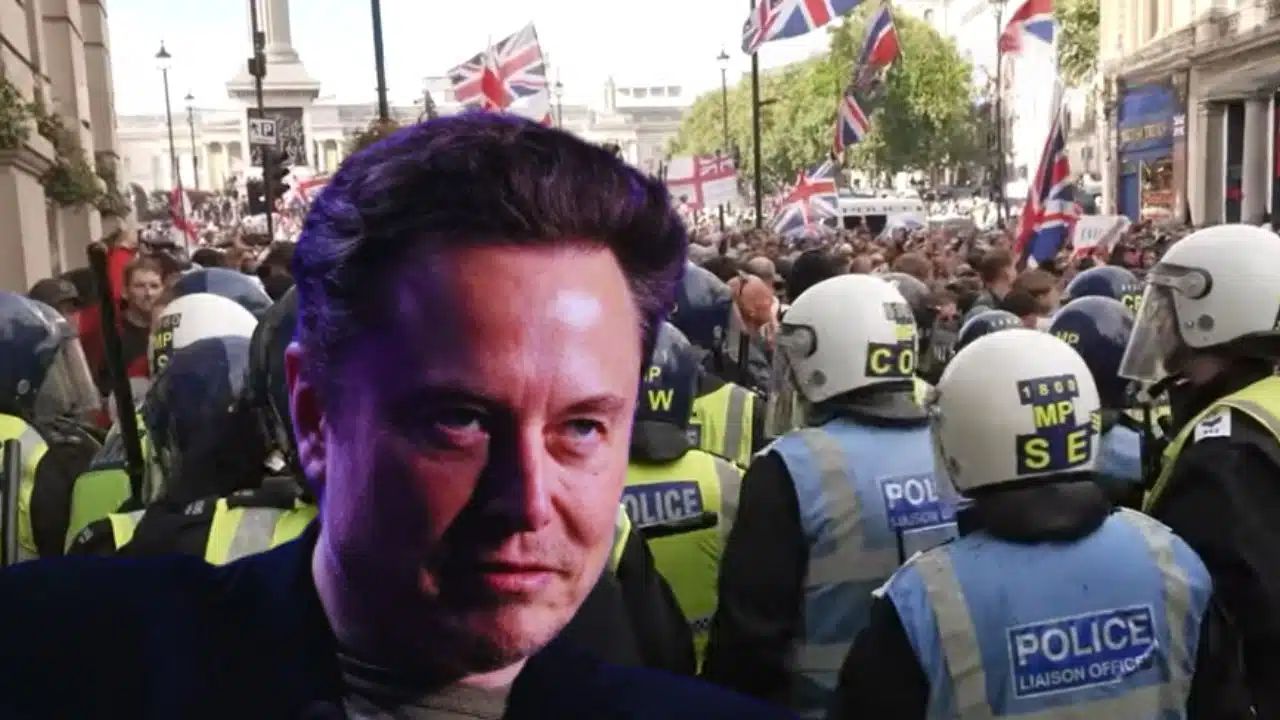
On Saturday, 13 September 2025, central London became the stage for one of the largest far-right rallies in Britain’s modern history, with crowd estimates ranging from 110,000 to 150,000 participants. The demonstration, titled “Unite the Kingdom”, was organised by far-right activist Tommy Robinson (real name Stephen Yaxley-Lennon). Supporters carrying Union Jack and St. George’s flags flooded the streets, converging on Westminster Bridge and marching toward Downing Street, where speeches were delivered by far-right leaders from across Europe and North America.
The Metropolitan Police confirmed that the turnout “significantly exceeded” organisers’ own predictions, describing the rally as a massive security operation that required around 1,000 officers to keep protesters and counter-protesters apart.
Elon Musk’s Video Address and “Fight or Die” Message
The event took a global dimension when Elon Musk, billionaire owner of X (formerly Twitter) and influential tech mogul, appeared via video link. His intervention shocked many observers due to its provocative and inflammatory tone. Musk told the crowd:
- “You’re in a fundamental situation here.”
- “Whether you choose violence or not, violence is coming to you. You either fight back or you die.”
— Elon Musk (@elonmusk) September 13, 2025
Musk further claimed that “the left is the party of murder and celebrating murder”, framing the political climate as a life-or-death struggle. He also alleged that Britain was in “rapid decline” due to “massive uncontrolled migration”, calling for the dissolution of Parliament and rejecting the idea of waiting for the next scheduled election.
His comments were swiftly criticised by mainstream politicians, who accused him of encouraging extremism and undermining Britain’s democratic process. The fact that a foreign billionaire with vast social media influence injected himself into the UK’s already heated immigration debate raised concerns about outside interference in domestic politics.
Other Far-Right Speakers: From Europe to North America
Robinson’s rally featured an international line-up of far-right political figures:
- Éric Zemmour, French politician and far-right commentator, reiterated the discredited “Great Replacement” conspiracy theory, which falsely claims that non-white immigrants are being deliberately brought in to replace native European populations.
- Petr Bystron, member of Germany’s Alternative für Deutschland (AfD), addressed the crowd with an anti-immigration message.
- References were also made to American far-right figures, particularly Charlie Kirk, a US activist and Trump ally. Robinson dedicated the event to Kirk, with many attendees holding placards bearing his image.
This cross-border presence demonstrated how far-right networks are increasingly coordinated internationally, sharing narratives on immigration, national identity, and resistance against liberal institutions.
Violence and Clashes with Police
Although the demonstration began with speeches and chants, tensions soon boiled over into violence.
- Clashes erupted when groups of protesters attempted to breach “sterile areas” that police had established to separate them from counter-protesters.
- Projectiles, including bottles, cans, and flares, were thrown at officers.
- In chaotic scenes, running battles unfolded on side streets near Westminster and Trafalgar Square.
The Metropolitan Police reported 26 officers injured, with four suffering serious injuries such as broken teeth, concussion, a suspected broken nose, and even a prolapsed spinal disc.
At least 25 arrests were made for violent disorder, assaulting police, and other offences. Video footage circulating online showed officers being pushed to the ground, while others struggled against crowds attempting to smash through barriers.
Counter-Protests: Standing Against Racism
While Robinson’s supporters dominated the streets in sheer numbers, a smaller counter-demonstration of around 5,000 people organised by Stand Up to Racism took place about a mile away.
- Protesters marched under banners proclaiming solidarity with refugees and asylum seekers.
- Long-time Labour politician Diane Abbott addressed the crowd, calling Robinson’s rhetoric “dangerous nonsense” and warning that scapegoating migrants fuels social division.
- Demonstrators emphasised that the UK should remain a place of diversity, tolerance, and inclusion.
The counter-rally underscored that opposition to far-right movements remains strong, though its numbers were dwarfed by the unprecedented turnout at Robinson’s event.
Political and Official Reactions
The violent scenes and Musk’s intervention sparked strong reactions across the political spectrum:
- Shabana Mahmood, the UK’s Home Secretary, condemned the assaults on police:
“Those who attacked and injured police officers will face the full force of the law. Violence against officers keeping our streets safe is unacceptable.” - Ed Davey, leader of the Liberal Democrats, accused Musk of recklessness:
“Our democracy is too precious to be manipulated by foreign tech barons who use their platforms to amplify hate.” - Civil society organisations like Hope Not Hate described the rally as the largest far-right mobilisation in Britain in over a decade, warning that mainstreaming extremist voices could embolden more violent activity.
A Broader Context: Immigration, Politics, and Rising Extremism
The rally did not occur in isolation. It came against a backdrop of rising anti-immigration sentiment in the UK:
- Hotels housing asylum seekers have been frequent targets of protests.
- Riots in 2024, sparked by anti-immigration rhetoric and online disinformation, left towns and cities across Britain scarred by violence. Robinson himself was accused of inciting unrest through social media posts at that time.
- Polls currently show Nigel Farage’s Reform UK party gaining momentum, often capitalising on dissatisfaction with migration policy and the ruling Labour government led by Prime Minister Keir Starmer.
Experts from King’s College London noted that Saturday’s rally marked a rare convergence of multiple far-right factions, suggesting a broader realignment within Britain’s radical right. For them, the turnout demonstrated how economic pressures, cultural anxieties, and online radicalisation are fuelling an emboldened movement.
Voices from the Crowd
Interviews with participants highlighted their motivations:
- Emily Rose, who travelled from Glasgow wearing a Union Jack dress, said: “I knew I needed to be here. We need to be heard.”
- Ritchie, 28, described immigration as an “invasion” of asylum seekers crossing the Channel in small boats.
Signs carried by marchers bore slogans like “Stop the Boats”, echoing a phrase popularised by right-wing leaders, while others attacked Prime Minister Starmer directly.
A Warning Sign for Britain
The “Unite the Kingdom” rally marked a turning point for the far-right in Britain. With record-breaking numbers, international speakers, and the unprecedented participation of Elon Musk, it demonstrated the global reach of far-right populism and its ability to dominate the streets.
Yet the violence, police injuries, and divisive rhetoric have also alarmed politicians, academics, and civil society. For many, the weekend’s events are a warning sign: Britain is grappling with deeper tensions around identity, migration, and democracy.
The coming months — especially with potential elections on the horizon — may reveal whether this moment was an outlier or the start of a more organised and dangerous far-right surge.
The Information is Collected from India Today and NDTV.