As the planet heats up, so does the need for smart solutions. Climate change crisis in 2025 is no longer a distant worry—it’s a global emergency. But amid the crisis, a new hope is emerging from the digital world. Clean code is helping to clean up the planet.
Technologies like Artificial Intelligence (AI), Blockchain, and the Internet of Things (IoT) are reshaping how we tackle the climate crisis. These innovations are not just futuristic—they’re already making a difference today.
Let’s explore how these digital tools are solving one of humanity’s greatest challenges.
Understanding the Climate Change Crisis in 2025
The world in 2025 is experiencing more frequent and intense climate events. From rising sea levels to scorching heatwaves, the impact is visible and devastating.
According to the Intergovernmental Panel on Climate Change (IPCC), we must reduce carbon emissions by nearly 50% by 2030 to limit global warming to 1.5°C.
Traditional methods like tree planting, recycling, or switching to clean energy are valuable—but they’re not enough. We need smarter, scalable solutions. That’s where AI, Blockchain, and IoT come in.
How Artificial Intelligence Is Combating Climate Change

AI isn’t just powering your smartphone or recommending your next movie. It’s joining the fight against the climate crisis—and it’s already making an impact. From predicting wildfires to saving energy in buildings, AI is becoming one of our strongest allies in building a greener planet.
AI in Climate Modeling and Prediction
AI algorithms can process massive climate data to forecast future risks. For example, IBM’s Green Horizon Project uses AI to model air pollution and help cities improve their environmental policies.
“AI can accelerate climate science and improve forecasting accuracy,” says Dr. Andrew Jones, a climate scientist at the MIT Environmental Solutions Initiative.
AI in Energy Efficiency and Consumption
Tech giants like Google are using AI to save energy. Google’s DeepMind reduced energy used for cooling data centers by 40%, simply by letting AI manage power distribution more efficiently.
Homes and offices are also benefiting from AI-powered smart thermostats that learn usage patterns and cut waste.
AI in Environmental Monitoring
AI tools are being used with drones and satellites to detect illegal deforestation, pollution, and methane leaks. These smart monitors help governments and organizations respond faster and smarter.
How Blockchain Technology Supports Climate Solutions
Blockchain isn’t just for crypto anymore—it’s stepping up as a game-changer in the fight against climate change. From making supply chains transparent to transforming carbon credits into trackable digital assets, this technology is bringing trust and accountability to sustainability.
Supply Chain Transparency and Sustainability
Blockchain creates tamper-proof records that help trace the source of goods. This transparency ensures companies use sustainable materials and follow ethical practices.
Example: IBM Food Trust verifies if your food is ethically sourced and carbon-friendly.
Green Financing and Carbon Credit Systems
Toucan Protocol and KlimaDAO are turning carbon credits into digital tokens. This makes it easier for businesses and individuals to invest in carbon-offsetting projects securely and transparently.
“Blockchain brings trust and visibility to green financing,” says a report from the World Economic Forum (2024).
Encouraging Sustainable Behavior
Blockchain can also reward eco-actions. For example, Plastic Bank uses blockchain to reward people in developing countries with digital tokens for collecting plastic waste.
How the Internet of Things (IoT) Is Driving Eco-Friendly Innovation
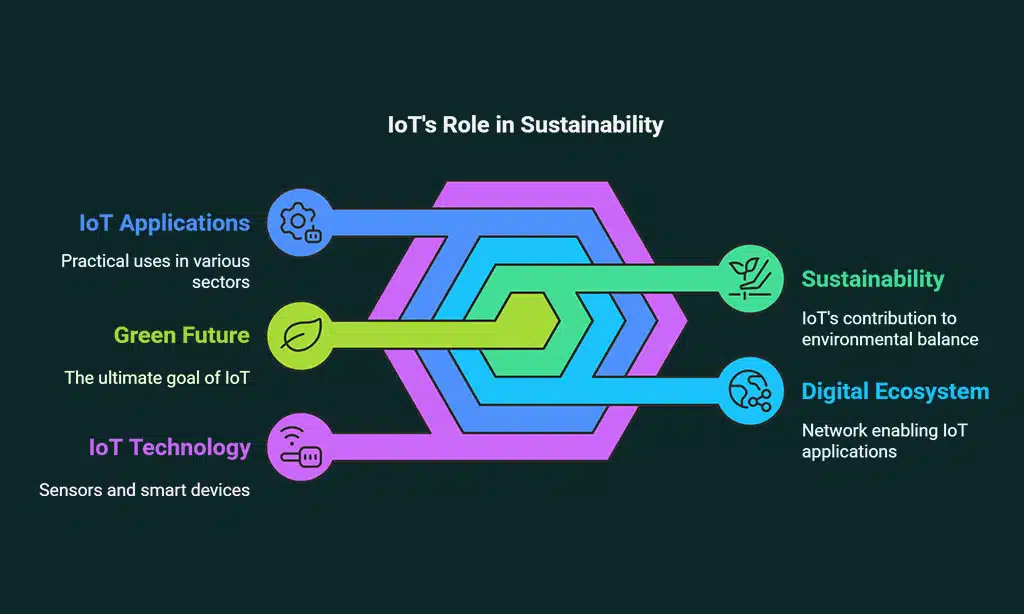
The Internet of Things isn’t just about connecting gadgets—it’s about connecting us to a greener future. With sensors and smart devices, IoT is helping farmers save water, cities cut emissions, and factories run cleaner. It’s a digital ecosystem that makes our planet smarter and more sustainable.
Smart Agriculture and Water Use
IoT sensors in farms monitor weather, crop health, and soil moisture. Farmers can water only when necessary, saving water and improving yields.
Example: John Deere’s precision farming tools.
Smart Cities and Energy Management
Cities like Amsterdam use IoT for smart streetlights, waste bins that signal when they’re full, and buses that adjust routes based on real-time traffic and demand. These reduce emissions and increase efficiency.
Industrial and Home Applications
Smart appliances, thermostats, and motion sensors reduce energy use in homes. Industries use IoT sensors to detect leaks, manage machinery, and optimize factory processes to reduce waste.
Traditional vs Tech-Driven Climate Solutions
| Area | Traditional Approach | Tech-Driven Solution |
|---|---|---|
| Climate Forecasting | Manual data collection | AI-powered real-time models |
| Carbon Tracking | Paper-based reports | Blockchain carbon credits and ledgers |
| Energy Saving | Manual regulation | AI-optimized power usage in buildings and data centers |
| Waste Management | Static collection schedules | IoT-enabled smart bins and route-optimized waste pickup |
| Agriculture | General irrigation and fertilizing | IoT precision sensors and real-time soil analysis |
The Power of Combining AI, Blockchain, and IoT
When these three technologies work together, the impact is far greater.
Imagine this: IoT sensors track pollution in a river, AI analyzes the data to identify the source, and blockchain records the information so it can’t be tampered with. Together, they offer transparency, action, and accountability.
Projects like ClimateChain are already integrating these tools to build global networks for climate data and action.
Top 5 Green Tech Startups to Watch
- Carbon Clean (UK): Developing low-cost carbon capture systems for industries
- Ampd Energy (Hong Kong): Battery-powered energy systems replacing diesel generators on construction sites
- ClimateAi (USA): Using AI to help farmers and food producers adapt to climate risks
- VergeSense (USA): IoT-based energy monitoring for smart buildings
- Greenly (France): Helping businesses track and reduce their carbon footprint using AI
Real-World Case Studies
- Microsoft’s AI for Earth: A $50 million program supporting AI projects that protect ecosystems and species
- AgriDigital: An Australian platform using blockchain and IoT to track grain supply from farms to buyers
- Grid Singularity: Blockchain-based decentralized energy management system helping microgrids
Challenges and Ethical Concerns
While these technologies offer hope, they come with challenges.
- Energy Consumption: Some AI and blockchain platforms use significant energy. Sustainable coding and green energy are needed to power them.
- Privacy & Data Security: IoT devices collect personal data, which can be misused if not protected.
- Access Gap: Not all regions have the digital infrastructure to use these tools. Tech must be inclusive to be truly global.
What’s Next? The Future of Tech in the Climate Battle
By 2030, we may see:
- AI creating dynamic carbon budgets for cities
- Blockchain-based climate action networks tracking every major emitter
- IoT sensors on every farm, forest, and coastline
The United Nations calls for “bold digital transformation” in its Digital for Climate Action Pathways framework.
“Technology is not a silver bullet, but it is a powerful accelerator,” says Inger Andersen, Executive Director of the UN Environment Programme.
Takeaways
A cleaner planet starts with cleaner code. AI, blockchain, and IoT are not just buzzwords—they are real tools helping to reverse the damage we’ve done to Earth.
While challenges remain, the potential is undeniable. When tech is used with purpose, the results can be revolutionary.
It’s time to code for a cause.