When the skies opened over Asia this year, they did not simply bring rain. They brought walls of water, collapsing hillsides, burst rivers, and a chain of disasters stretching from Sumatra to Sri Lanka and the Philippines.
“Across the region, a rare storm in the Malacca Strait, record monsoon downpours, cyclones in the Bay of Bengal, and back-to-back typhoons in the western Pacific have combined into one brutal story: Several credible news sources have confirmed, more than 1,100 people are dead, hundreds are still missing, and many millions are struggling to rebuild their lives.”
The numbers tell only part of the human tragedy. Families dig through mud for their relatives. Cities that never expected such floods are now grappling with overwhelmed morgues and ruined streets. Governments are rushing to show that they are in control, even as climate-fueled extremes expose old weaknesses in planning and infrastructure.
A Region Under Water
From Indonesia and Thailand to Vietnam, Sri Lanka, and the Philippines, this has been a season of relentless storms.
- A rare tropical storm in the Malacca Strait triggered catastrophic floods and landslides in Indonesia, Thailand, and Malaysia.
- Central and south-central Vietnam endured some of its worst flooding in years.
- Cyclone Ditwah ripped through Sri Lanka, causing deadly floods and landslides.
- In the Philippines, a string of strong typhoons flooded entire provinces and displaced millions.
- Along India’s southeast coast, states like Tamil Nadu and Andhra Pradesh have stayed on high alert as Ditwah moved north after battering Sri Lanka.
Taken together, these disasters form a single story of a region pushed to its limits by extreme weather — and in many cases left exposed by fragile infrastructure and unplanned development.
Indonesia: Villages Buried in Mud
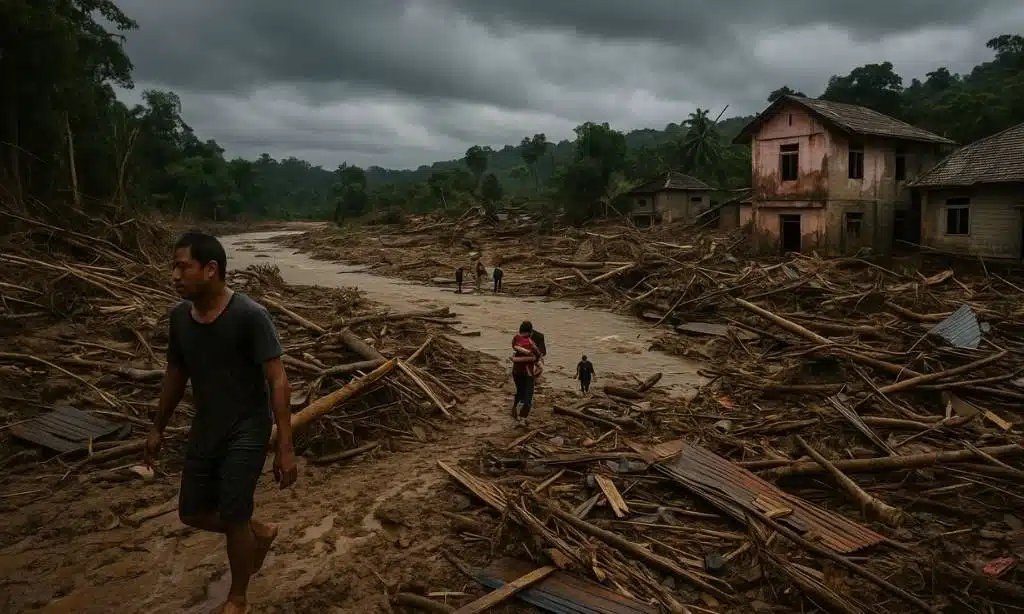
The most shocking images of this Asian storm season have come from Indonesia’s Sumatra region, where days of torrential rain were intensified by the unusual storm swirling in the Malacca Strait.
Rivers burst their banks, mountain slopes gave way, and towns and villages were suddenly swept downstream in torrents of brown water and debris.
- Death toll: At least 435 people have been confirmed dead.
- Missing: Authorities list around 406 people as still missing.
- Displaced: Around 213,000 people have been forced from their homes.
- Total affected: Roughly 1.1 million people have been impacted across western Indonesia.
Entire communities in districts such as Palembayan, Padang, Sibolga, and Central Tapanuli were buried under mud and rocks. In some places, rescuers arrived to find only roofs poking out of thick landslide debris, and no signs of life.
Roads and bridges collapsed or vanished under floodwaters, leaving villages completely cut off. Helicopters became the only way to bring in food, water, and basic supplies. In more isolated areas, delays in relief triggered desperate scenes of looting, with people breaking into shuttered shops not for luxury goods but for rice, cooking oil, and fuel.
For local authorities, the scale of the tragedy has raised painful questions. Hillsides stripped of trees, homes built right along riverbanks, and weak early warning systems have all come into focus. For many families, however, the questions are simpler and more immediate: where to live, what to eat, and how to find relatives still missing in the mud.
Thailand: Record Rainfall and Overwhelmed Morgues
Across the Strait, Thailand has faced one of the worst flood crises in its recent history, especially in the southern province of Songkhla.
The same storm system that drenched Sumatra dumped extraordinary amounts of rain over southern Thailand. The city of Hat Yai recorded around 335 millimetres of rain in just one day — its highest daily total in centuries.
- Death toll: Around 170 people have been confirmed dead in Thailand’s latest floods.
- Injuries: More than 100 people have been reported injured.
- Affected: Nearly 3 million people in southern Thailand alone have been touched by the disaster, with hundreds of thousands experiencing flooded homes, damaged roads or broken livelihoods.
The human impact has been grim. In some areas, morgues filled up so quickly that authorities had to bring in refrigerated trucks to store bodies. Local hospitals and clinics struggled to handle flood-related injuries and the rising risk of disease in crowded shelters.
Earlier in the month, separate flood events in other regions of Thailand had already affected around half a million people. The new, larger disaster in the south, therefore, hit communities that were already stretched and anxious.
Thailand’s prime minister has publicly acknowledged shortcomings in flood management and emergency coordination, promising compensation packages for families of the dead and more investment in prevention. But many residents, especially in poorer areas, remain unconvinced that the country is prepared for the kind of storms that are now appearing with alarming regularity.
Malaysia: Fewer Deaths, Heavy Displacement
Next door in Malaysia, the same tropical storm and monsoon surge brought fierce winds and heavy rain, especially across northern states.
In pure casualty terms, Malaysia has been spared the worst compared to its neighbours. But the damage has still been significant.
- Death toll: At least 3 deaths have been linked to the latest floods and storm conditions.
- Displaced: About 18,700 people are staying in evacuation centres.
- Earlier impact: Over 12,500 people had already been displaced in nine states before the latest wave of rain arrived.
Schools, community halls, and sports complexes have been turned into temporary shelters. Families sleep on mats and thin mattresses under fluorescent lights, waiting for floodwaters to recede so they can return to their homes — or what remains of them.
Malaysia’s meteorological service has since lifted the immediate warnings for the rare tropical storm and continuous heavy rain. But the floodwaters, damaged infrastructure, and lost income continue to shape daily life in affected areas. Many farmers fear losing entire planting seasons, while small businesses — from roadside stalls to workshops — are left counting their losses.
Vietnam: An 800-Kilometre Disaster Zone
Further east, Vietnam has faced its own nightmare, with central and south-central regions battered by weeks of heavy rain and repeated storm systems.
From Quang Tri to Lam Dong, a stretch of roughly 800 kilometres, floods and landslides have ripped through both coastal and highland provinces.
- Death toll: At least 91 people have died.
- Missing: Around 11 people remain unaccounted for.
- Economic damage: Authorities estimate losses at about 13 trillion Vietnamese dong, roughly US$490 million, in damaged homes, crops, and infrastructure.
The province of Dak Lak has been among the worst hit, with more than 60 deaths, many of them due to drowning as floodwaters rose faster than residents could escape. Coffee growers and other farmers in the Central Highlands have watched fields vanish under water or mud, threatening income for entire communities.
Bridges have collapsed, roads have been washed away, and power and communication lines have been disrupted across multiple provinces. In some areas, helicopters have been used to drop food packages to stranded villages or to airlift vulnerable people to safety.
For Vietnam, a country that has long experienced typhoons and heavy monsoon rains, this year’s floods are not a completely new story. But the scale and intensity of the damage, spread across such a long stretch of territory, have reignited debates about deforestation, dam management, and the rapid expansion of construction in flood-prone zones.
Sri Lanka: Cyclone Ditwah’s Trail of Destruction
Few countries in this storm season have suffered a shock as sudden and severe as Sri Lanka.
Cyclone Ditwah, which formed over the south-west Bay of Bengal, passed near the island and unleashed days of torrential rain, violent winds, and deadly landslides.
- Death toll: At least 212 people have been confirmed dead.
- Missing: Around 228 people remain missing.
- Displaced: About 148,000 people have been forced into nearly 800 relief centres, many of them schools and public buildings.
- Total affected: More than half a million people across Sri Lanka have been impacted by floods, landslides and infrastructure damage.
Low-lying areas around Colombo, including towns such as Malwana, experienced the worst flooding in about a decade. Entire neighbourhoods sat under murky water. Power cuts left thousands in darkness just as water levels rose around them.
One of the most heartbreaking incidents occurred at a care home for the elderly, where 11 residents drowned after rising waters cut off exits in the middle of the night. In the central hill country, home to many of the island’s tea estates, landslides wiped out houses and buried tea bushes, hitting thousands of small farmers and workers.
Sri Lanka’s government has rushed to deliver food, drinking water, and medicine to affected communities, but the scale of the displacement means that many people still lack basic supplies. For a country already under economic pressure, the cost of recovery and reconstruction from Ditwah’s damage will be very high.
India: On High Alert as Ditwah Moves North
After battering Sri Lanka, Cyclone Ditwah continued its journey into the Bay of Bengal, prompting serious concern in neighbouring India.
States along the east coast — especially Tamil Nadu, Andhra Pradesh, and Puducherry — have been placed on red and orange alert as authorities track the storm’s intensity and path.
- Death: At least 03 persons have been killed in rain-related deaths so far, the State government confirmed.
- Emergency teams from the National Disaster Response Force (NDRF) and state disaster forces have been deployed.
- Coastal communities in vulnerable districts have been encouraged or ordered to move to safer ground.
- Relief camps have been opened in some areas, and fishermen have been warned not to go out to sea.
Heavy rain has already lashed districts like Nagapattinam, triggering localised flooding and power outages. However, India has not yet reported a large, confirmed nationwide death toll linked directly to Ditwah, thanks in part to early warnings and pre-emptive evacuations.
For Indian meteorologists and planners, Ditwah is another reminder that cyclones in the Bay of Bengal are becoming more intense and less predictable, demanding constant improvements in forecasting, coastal defences, and public awareness.
The Philippines: A Month of Typhoons
While current headlines focus on floods in Southeast Asia and Sri Lanka, the Philippines has been battling its own series of devastating storms since early November.
Back-to-back typhoons — including Typhoon Kalmaegi (locally known as Tino), Super Typhoon Uwan, and Typhoon Fung-wong — have pounded the archipelago.
Typhoon Kalmaegi (Tino): Deadliest Storm in a Year
Kalmaegi brought widespread flooding and damage, particularly across the Visayas region.
- Deaths: At least 116 people have been confirmed dead, making Kalmaegi the deadliest storm in the Philippines in about a year.
- Some assessments suggest that more than 250 people died when Kalmaegi’s effects are combined with related floods and landslides, with over 100 people still listed as missing.
- Hard-hit areas include Cebu, Southern Leyte, and other Visayas provinces, where homes and vital bridges were destroyed.
In response to the scale of damage, the World Bank has released around US$500 million to support recovery and reconstruction in the worst-affected regions — a signal of just how serious the humanitarian and economic impact has been.
Super Typhoon Uwan and Typhoon Fung-wong: Millions Affected
Kalmaegi was not the end. Soon afterwards, Super Typhoon Uwan and Typhoon Fung-wong continued the assault.
- Uwan affected more than 4.4 million people across 16 regions of the country, with widespread flooding, strong winds, and destroyed infrastructure.
- Fung-wong killed at least 2 people and displaced around 1.4 million people on Luzon, the Philippines’ most populous island.
These storms came one after another, hitting communities again before they could recover from the previous disaster. Local governments struggled to keep emergency shelters running, while residents faced repeated evacuations, lost homes, and destroyed crops.
For many Filipinos, this season has highlighted a painful reality: they live at the crossroads of warmer oceans and shifting storm tracks, and even small improvements in preparation and infrastructure can mean the difference between life and death.
The Human and Economic Toll Across Asia
When we look across the region, the combined toll of these storms is sobering.
Lives Lost and People Missing
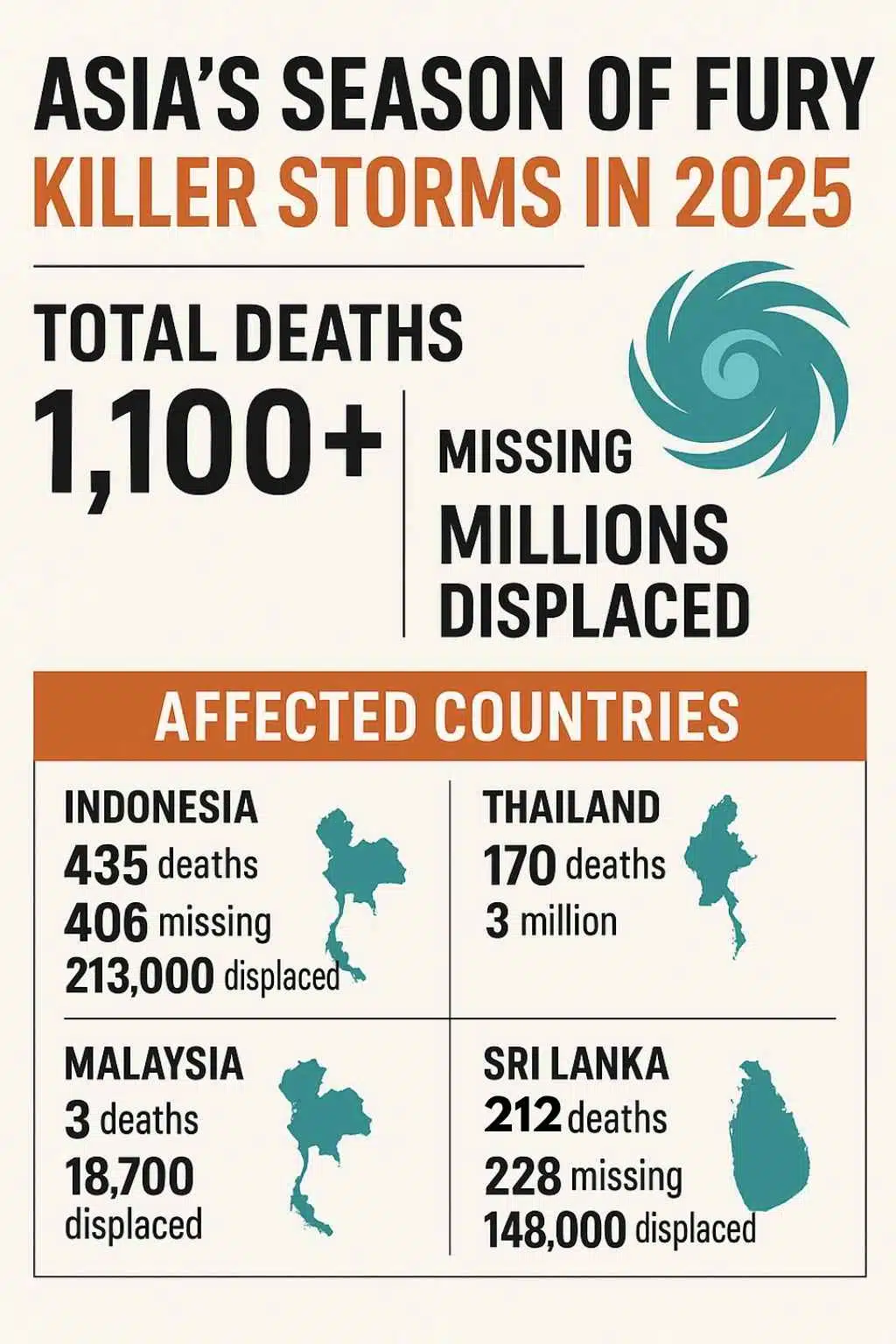
Based on official figures from governments and humanitarian agencies, this wet-season storm cluster has led to:
- Indonesia: 435 dead, 406 missing
- Thailand: 170 dead
- Malaysia: 3 dead
- Vietnam: 91 dead, 11 missing
- Sri Lanka: at least 212 dead, 228 missing
- India: At least 03 dead
- Philippines: more than 250 dead and over 100 missing when Kalmaegi and related floods are considered, plus additional casualties from Uwan and Fung-wong
Taken together, more than 1,100 people have lost their lives, and well over 700 people remain missing. Many of those missing may never be found, especially in areas where landslides have buried entire settlements.
Displacement and Damage
The number of people forced to leave their homes — at least temporarily — runs into the many hundreds of thousands:
- Over 213,000 displaced in Indonesia
- Around 148,000 displaced in Sri Lanka
- Tens of thousands in evacuation centres in Thailand, Malaysia, and Vietnam
- 1.4 million displaced by Fung-wong and millions more affected by other storms in the Philippines
Economic losses already stretch into the billions of dollars:
- Vietnam alone estimates around US$490 million in damage from its central and south-central floods.
- The Philippines has secured US$500 million in World Bank financing for recovery after Kalmaegi and related disasters.
- Sri Lanka, Indonesia, and Thailand will also spend heavily on rebuilding roads, bridges, schools, homes, and farms, even as many of them struggle with existing economic pressures.
Behind each figure is a life, a family, or a small business suddenly pushed into crisis. Floods have swept away schoolbooks, wedding photos, livestock, harvests, and the tools of countless trades.
Why Are These Storms So Intense?
Asia has always had monsoons, cyclones, and typhoons. But scientists say several factors are now combining to make storms more intense, more destructive, and sometimes more clustered in time.
- Warmer oceans
Tropical storms draw their energy from warm sea surfaces. As ocean temperatures rise, storms can grow stronger and hold more moisture, leading to heavier downpours. - A warmer atmosphere
Warmer air holds more water vapour. That means when it rains, it can rain much harder, increasing the risk of flash floods and sudden landslides. - Urbanisation and land use
Cities have expanded into wetlands, floodplains, and hillsides. Concrete and asphalt surfaces shed water quickly, overwhelming drains. Deforestation on slopes makes landslides more likely. - Aging or weak infrastructure
Drainage systems, dams, embankments, and roads in many parts of Asia were not designed for today’s extremes. When record-breaking rainfall hits, they fail.
These factors do not cause a specific storm. But they help explain why a storm like the one in the Malacca Strait can cause such extraordinary damage across countries, why Cyclone Ditwah produced such devastating floods in Sri Lanka, and why typhoons in the Philippines are now displacing millions at a time.
Lessons in Preparedness and Governance
Beyond the immediate humanitarian response, this year’s storms are raising hard questions for governments across Asia.
Early Warnings vs. Reality on the Ground
In several countries, weather agencies issue warnings days in advance.
But early warnings only work if:
- People trust them.
- They know what to do.
- They have somewhere safe to go.
In rural Sumatra, central Vietnam, or the Philippine islands, many people still live in homes that cannot withstand floods or landslides, and evacuation centres may be too far or too crowded. For Sri Lanka’s elderly residents in care homes, even a warning did not translate into a safe evacuation plan.
Planning and Land Use
The storms have highlighted a familiar pattern:
- Homes built right on riverbanks or in dry channels that quickly fill with water.
- Illegal or poorly regulated hillside construction that weakens slopes.
- Drainage systems are clogged by rapid urban growth.
In Thailand, public frustration has focused on why Hat Yai and other cities remain so exposed despite past flood disasters. In Indonesia and Vietnam, environmental groups are calling for stricter rules on land clearing and hillside building.
Social Protection and Recovery
Beyond the immediate emergency aid, there is the longer, slower work of recovery. How quickly can families rebuild? Who receives compensation? How are the poorest protected?
Promised payments to families of victims in Thailand, reconstruction loans in Vietnam, and international financing for the Philippines are all part of the answer. But in many places, disaster risk reduction still relies heavily on local communities, informal networks, and charities.
A Region on the Front Line
What makes this season’s story of “a brutal storm cycle rewriting Asia’s disaster map” so striking is not just the number of disasters, but how they overlapped.
A rare storm in the Malacca Strait was still flooding southern Thailand and northern Malaysia, while Sumatra was digging out from landslides. Vietnam’s central belt was counting its dead as Sri Lanka faced its worst flooding in years. The Philippines was being hit again and again by typhoons. India watched Ditwah closely, praying for a weaker landfall.
For millions of people, this was not a string of separate news events. It was a single, grinding reality: rain, sirens, evacuation orders, and the sound of water rising outside the door.
Final Words: After the Waters Recede
As waters slowly recede across many of these countries, the cameras will move on. But for the families living in tents or crowded school halls, the crisis is far from over.
Children have lost months of schooling. Farmers have lost harvests and seeds for the next season. Small shop owners have lost stock and equipment. Many survivors carry invisible scars — the trauma of losing loved ones, homes, and livelihoods in a matter of hours.
This storm season has underlined what experts have been warning for years: Asia, home to more than half of the world’s population, is also home to some of its most vulnerable coastlines, river deltas, and mountain slopes. As the planet warms, the question is no longer whether extreme storms will come, but how prepared societies will be when they arrive.
For now, the numbers remain stark: more than 1,100 dead, hundreds missing, millions affected. Behind them stand stories of grief, courage, and solidarity — and a clear message that rebuilding cannot simply mean returning to the way things were.
If this was Asia’s season of fury, what comes next will depend on whether governments, communities, and the international community are ready to treat these storms not as isolated tragedies, but as urgent warnings of a future that is already here.