Finding scholarships is not the hard part. Finding ones you can actually win is. Many students sign up for five sites, get flooded with emails, and apply to the same $1,000 prize drawings as thousands of others. The right scholarship search apps for college students fix this by matching you to awards that fit your profile and by keeping your deadlines in one place.
Bold.org is the best app for scholarships it awards itself. Fastweb has the biggest database. Sallie, the app that took over Scholly, is a solid free pick with one form for many awards. For trusted, no-strings searches, use BigFuture and CareerOneStop.
What Most Scholarship Lists Do Not Tell You
Most guides praise every site the same way. Before you pick from the scholarship search apps for college students below, know these four facts.
1. Some lists are out of date: Sallie Mae bought Scholly in 2023, and its search now lives inside the Sallie app and website. A 2026 report also says Going Merry stopped taking new applications in March 2026. Check that a tool still works before you build your profile there.
2. Your profile has value: Free sites earn money somehow. Appily, for example, says on its own scholarship page that it is a data broker. Look for a “Do Not Sell My Information” link and use it.
3. Many “no essay” awards are drawings: Niche offers a $40,000 no essay scholarship, but one student wins it by random draw. These are fine to enter, but your odds are low. Essay awards with fewer applicants often pay off better.
4. Scams copy real sites: The FTC says real scholarships never guarantee a win and you should never pay to apply. Walk away from any “processing fee.”
Quick Comparison Table
All ten scholarship search apps for college students below are free to use. Details were checked in October 2026.
| Tool | Size | Phone app | Best for |
|---|---|---|---|
| Bold.org | Thousands of exclusive awards | iPhone and Android | Awards you apply for in one place |
| Fastweb | 1.5 million+ opportunities | iPhone | Biggest search |
| Scholarships.com | 3.7 million+ awards, about $19 billion | iPhone and Android | Browsing without an account |
| Sallie (Scholly) | Thousands | Yes | One form for many awards |
| Scholarships360 | Vetted list | Web only | Clean, checked listings |
| CareerOneStop | 9,500+ awards | Web only | Government-run, no ads |
| BigFuture | 24,000+ programs, $1.5 billion a year | Web only | Trusted College Board search |
| ScholarshipOwl | 10,000+ awards | Web only | Repeat awards |
| Unigo | Millions searchable | Web only | Short essay contests |
| Niche | Directory plus own awards | iPhone and Android | Big drawings |
Only five of these have a true phone app. The rest work fine in a phone browser.
Our Top 10 Picks
Each pick was judged on how many real awards it lists, how easy it is to use, and how it handles your data. Use two or three of these scholarship search apps for college students, not all ten.
1. Bold.org
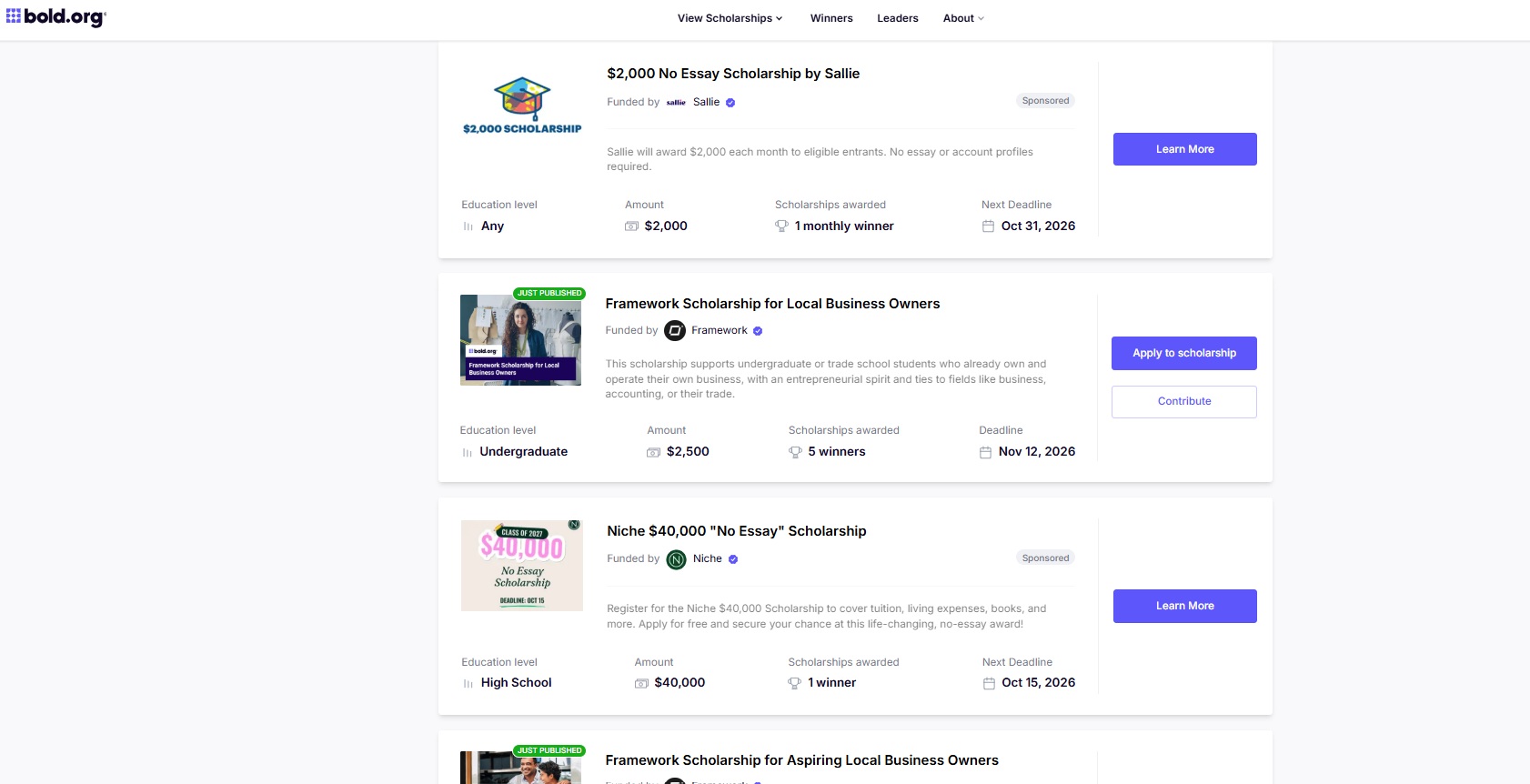
Bold.org is different from most sites. Donors fund scholarships right on the platform, so you apply inside Bold.org instead of being sent elsewhere. Its live counter shows almost $17.9 million awarded to members. Among scholarship search apps for college students, it is the best for awards you can track from start to finish.
Pros
- Free, with apps for iPhone and Android
- Many awards are only on Bold.org
- New scholarships are added daily
Cons
- Some awards draw huge numbers of applicants
- Smaller database than Fastweb
2. Fastweb
Fastweb has been around since 1995 and lists more than 1.5 million scholarship opportunities. Over 2 million members use it. You fill out one profile, and it matches you to awards. For sheer size, it leads all scholarship search apps for college students.
Pros: huge database, free, iPhone app.
Cons: most links send you to outside sites, and you expect a lot of email.
3. Scholarships.com
Scholarships.com lists over 3.7 million scholarships and grants worth about $19 billion. You can browse its directory without an account, which is rare among scholarship search apps for college students. Make an account only if you want personal matches. It has apps for iPhone and Android.
Pros: browse without signing up.
Cons: many listings are small or local, so results take sorting.
4. Sallie (formerly Scholly)
Sallie Mae bought Scholly in 2023, and the search now lives in Sallie. It is free and lets you sort thousands of awards by major, state, and background. Its Easy Apply tool lets you enter up to $18,000 in scholarships each month with one form. That makes it one of the fastest scholarship search apps for college students to use.
Pros: one form, many entries.
Cons: Easy Apply awards are mostly drawings, and Sallie is also a student loan lender.
5. Scholarships360
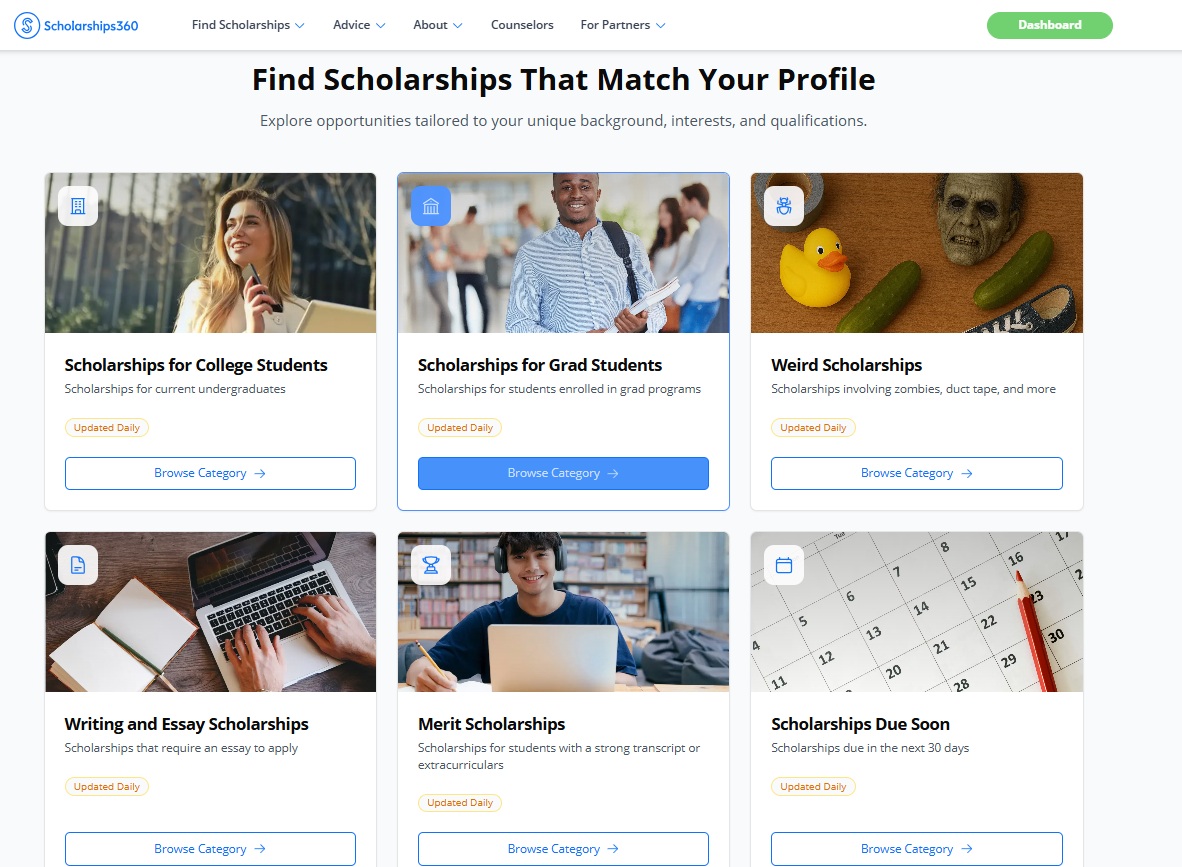
Scholarships360 is free and focuses on vetted listings. It also runs its own awards, such as a $10,000 no essay scholarship with an October 31, 2026 deadline. Among scholarship search apps for college students, it is the cleanest to scan.
Pros: checked listings, own awards.
Cons: no phone app, smaller list.
6. CareerOneStop Scholarship Finder
This free tool is sponsored by the U.S. Department of Labor. It lists more than 9,500 scholarships, fellowships, and grants. You can filter by location and level of study and sort by deadline. It is the most trusted of the scholarship search apps for college students because no company is selling anything.
Pros: government run, no sign-up needed.
Cons: plain design, no matching.
7. BigFuture by College Board
BigFuture matches you with over 24,000 programs worth more than $1.5 billion a year. It works best for high school seniors and new college students. If you already used College Board for the SAT, this is one of the easiest scholarship search apps for college students to start with.
Pros: trusted source, large list.
Cons: web only, and its own BigFuture drawings are for high schoolers.
8. ScholarshipOwl
ScholarshipOwl checks your profile against 10,000+ scholarships. It can also reapply you to awards that pick winners all year. The site states that its paid plan does not raise your chance of winning. Use the free version of these scholarship search apps for college students first.
Pros: automatic reapplying.
Cons: pushes premium upgrades.
9. Unigo
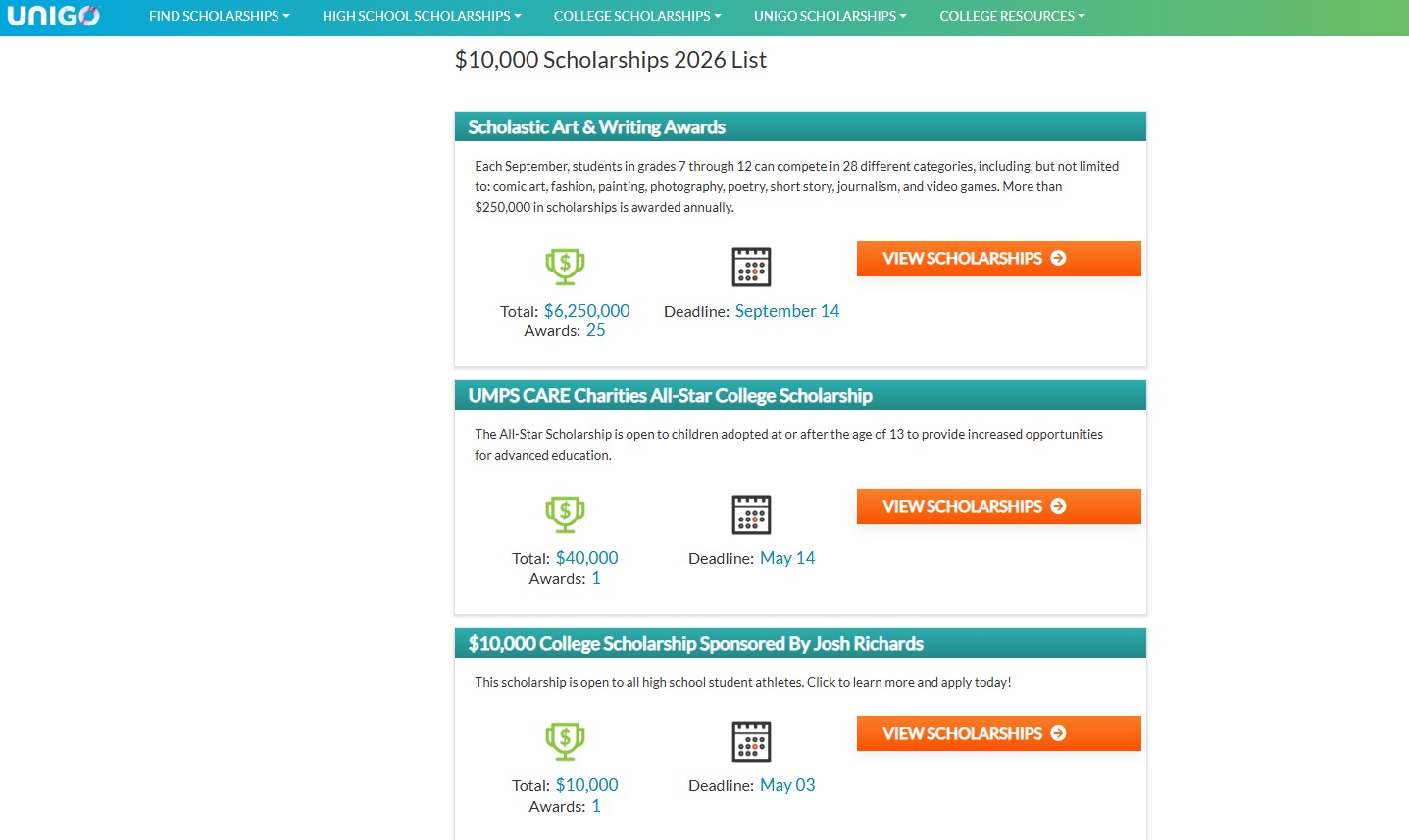
Unigo runs its own small awards with essays of 250 words or less, and one winner each month. One application covers all of them. Unigo says it has given over $600,000 since 2007. It is a good fit among scholarship search apps for college students who write well and fast.
Pros: short essays, one application.
Cons: small prizes, high competition.
10. Niche
Niche is known for college rankings, but it also lists scholarships and runs its own. Its $40,000 no-essay award goes to one student by random draw, with an October 15, 2026, deadline. Treat it as a bonus entry, not a plan. Among scholarship search apps for college students, it suits those already using Niche to compare schools.
Pros: phone app, big prizes.
Cons: prizes are drawings with long odds.
How to Use These Apps Without Wasting Time
Most students lose hours on awards they will never win. These steps help you get more from scholarship search apps for college students:
- Make a new email address just for scholarships. It keeps the flood of marketing mail out of your main inbox.
- Fill out your profile fully. Matches depend on your major, state, GPA, and background.
- Pick two big sites and one trusted free tool, like Fastweb, Bold.org, and CareerOneStop.
- Check your college’s financial aid office for local awards. Fewer people apply, so your odds are better.
- File the FAFSA. It opens each October 1, and many schools use it for their own aid.
- Keep a deadline sheet with the name, amount, and due date of each award.
For more ways to stand out, read our tips to increase your chances of securing a scholarship. Planning to study in another country? Our full scholarship to study abroad guide covers awards these apps often miss.
Frequently Asked Questions (FAQs)
Are scholarship apps free?
Yes. Every tool on this list is free to search. Real scholarship search apps for college students never charge you to apply. If one asks for money to apply or “hold” an award, it is a scam.
Are no essay scholarships worth it?
They take little time, so they are fine to enter. But most are random drawings with thousands of entries. Spend most of your effort on essay awards and local ones.
Can college students already in school use these apps?
Yes. Fastweb, Bold.org, Scholarships.com, and CareerOne Stop all list awards for current undergrads and graduate students. Update your profile each year so matches stay current.
Final Thoughts
You do not need ten accounts. Start with Bold.org and Fastweb for reach, add CareerOneStop for a safe, ad-free search, and use Sallie if you want one form for many entries. Set up a separate email, turn on “Do Not Sell” where you can, and focus on awards you have a real shot at. Used this way, scholarship search apps for college students can turn a few hours a week into real money for school.